
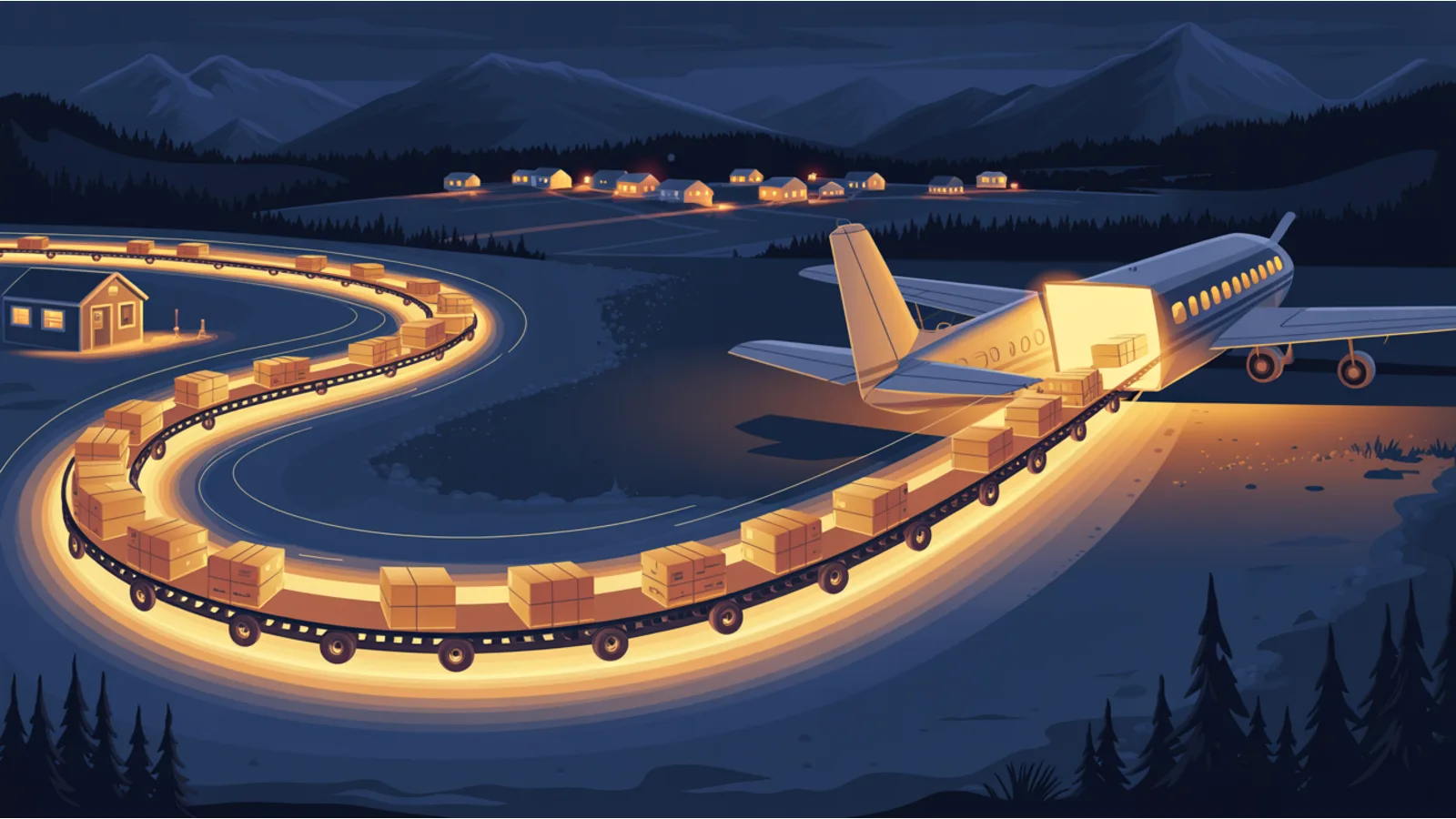
A shipper in Anchorage shrink-wraps a pallet of groceries, drives it to the airport, and hands it to an airline. The airline flies it to a hub, transfers it to a bush carrier, and the bush carrier lands it in a village and delivers it to the store's door. Postage was paid on the way in. Somewhere in that chain the United States Postal Service is supposed to appear. It never does. It does not accept the pallet, does not sort it, does not deliver it. Its role, in the words of its own Inspector General, "is to pay the bills, with little control over any other aspect of the program," as the 2011 audit put it.
That is Alaska Bypass: a freight program wearing a postage stamp, in one state only. Nearly every write-up reaches the same verdict, that USPS has bled on it forever. The regulator's own table says something stranger. On the books that actually govern the program, Alaska Bypass made money for decades and only stopped in 2024, largely because the rest of the Postal Service got more expensive.
What actually moves
The definition is the whole trick. USPS Handbook PO-508 defines bypass mail as "Parcel Post mail that is prepared so as not to require handling by Postal Service personnel or in a Postal Service facility," a line quoted in Alaska's state aviation white paper from October 2025. Mail that by design no postal worker ever handles.
Everything follows. There are two acceptance points in the state, Anchorage and Fairbanks. Approved shippers enter orders through an internal system that controls dispatch and calculates what the airlines get paid. Each order must weigh at least 1,000 pounds, palletized and shrink-wrapped. Hazardous and construction materials are excluded, and frozen goods move at the shipper's risk. Service reaches about 20 regional hubs and 120 to 130 bush destinations. Bypass cannot go to a P.O. box, because the whole point is that the airline carries it to a door, which is more than ordinary mail gets in remote Alaska: that stops at the post office. The program that skips the Postal Service entirely provides a better last mile than the Postal Service does.
One precision point trips up almost everyone: the 1,000-pound minimum is not in the statute. Search the full text of 39 U.S.C. 5402 and the phrase does not appear. It is an administrative rule from PO-508, a handbook USPS has not updated since 2012 and still treats as governing. The only weight threshold Congress wrote is 7,500 pounds, the line separating a bush carrier from a mainline carrier.
USPS does not set the price it pays
Here is the structural fact the argument turns on. USPS controls the postage coming in. It does not control the payments going out.
As the Civil Aeronautics Board was sunsetting in 1984, Congress passed Public Law 98-443, barring the Postal Service from contracting directly for air service in Alaska and handing rate-setting to the Department of Transportation. That authority was meant to revert to USPS in 1989 so rates could be set by negotiation and competitive bidding. A 1988 law extended it, and the extension became permanent. The OIG calls the result what it is: an arrangement that "effectively served to maintain the structure of airline regulation exclusively in Alaska," decades after deregulation everywhere else.
DOT's own witness described the mechanism cleanly at a 2014 House Oversight hearing. Dennis Devany of DOT's Office of Aviation Analysis testified that "the rates we set have nothing to do with the price of stamps. The rates we set are what the Postal Service pays to the airlines to carry a ton of mail a mile." They are indexed to cost per available ton mile, explicitly not to inflation, per the hearing transcript. So one agency sets the cost, another collects the revenue, and the revenue is capped ground-rate postage. USPS has told the Postal Regulatory Commission exactly this: its costs "are largely outside its control because air carrier rates are set by the Department of Transportation, and it is precluded from directly contracting for air service in Alaska."
The allocation rules came later. The Rural Service Improvement Act of 2002, championed by the late Senator Ted Stevens, arrived as a section of that year's supplemental appropriations act. Its problem was specific: after 1984, carriers "began eliminating passenger service in favor of carrying only profitable Bypass program pallets paid for by the Postal Service." The fix tied freight to passengers. The statutory split sends 75 percent of nonpriority bypass mail to carriers providing scheduled bush passenger service and 25 percent to carriers hauling a quarter or more of the route's nonmail freight, with a residual category legislated to zero. It is a passenger-versus-freight split, not a mainline-versus-bush one. The act also built a moat: a carrier seeking tender on an existing mainline route must first match 75 percent of the largest incumbent's passenger seats, for six months, before carrying any bypass freight.
Two ledgers, one program, opposite verdicts
A USPS spokesman told reporters in 2025 that Alaska Bypass generated 38.2 million dollars in revenue while USPS spent 118.9 million. The Nome Nugget carried a USPS statement naming the year, that "this product's revenue did not cover its attributed costs in FY2024"; the Anchorage Daily News reported the same figures from a named spokesman without naming a year. Both trace to USPS. Neither number appears in any PRC or USPS document I could find, so treat them as reported, not primary. The 80.7 million dollar gap everyone quotes is arithmetic on that pair, not a figure anyone published. And the 118.9 million is best read as what USPS pays out, not its full accrued cost, which is how the OIG defined the analogous 2010 figure: airline payments, explicitly excluding administrative costs.
Set that beside the Commission's own table and the same product in the same year looks entirely different. Table III-6 of the FY2025 Annual Compliance Determination, on page 44, gives cost coverage across five years: 129.75 percent in FY2021, 135.99 in FY2022, 120.06 in FY2023, 99.32 in FY2024, 78.43 in FY2025. Unit contribution ran positive at 5.99, 7.61 and 5.21 dollars before turning to negative 22 cents in FY2024 and negative 9.62 in FY2025. Further back, coverage was 193.4 percent in FY2017.
Both ledgers are honest. They measure different things. On the payments-and-postage basis, USPS has lost money on Alaska Bypass every year since it began, and Deputy Inspector General Tammy Whitcomb testified to exactly that in 2014. On the Commission's regulatory attributable-cost basis, the one that decides whether the product is legally compliant and whether prices must rise, it was comfortably profitable until two years ago. State one without naming the basis and the other contradicts you.
The accounting engine, and why it broke
The reconciler is the Alaska Adjustment Factor. Attributable costs are computed by multiplying accrued costs by the AAF, and the AAF is a ratio: inter-SCF cost per pound divided by Alaska Bypass cost per pound. Inter-SCF means between Sectional Center Facilities, the wider USPS inter-facility network. So roughly a third of what USPS spends is attributed to the product, and the rest becomes institutional cost spread across every mailer in the country.
The method has an ancestor. Before 1997, Alaska Bypass costs sat in the Parcel Post cost pool, and when the losses started pushing Parcel Post's rates up, domestic parcel mailers pushed the regulator to change it. The approved method, in the OIG's description, "imagines a road network throughout Alaska and allocates all extra costs in Alaska above this to the Postal Service's institutional costs to be borne by all mailers." The study behind it put notional surface costs at about 7 percent of actual air costs, cutting attributed cost from 116 million dollars to about 8 million. Ninety-three percent of the cost simply became everyone's. The ratio is recomputed annually, and the arc from that 7 percent to today's 29.94 percent is the real story of this program's accounting.
Which brings the tell. In FY2024, USPS explained to the Commission, and the FY2024 determination reports, that the AAF rose because cost per inter-SCF pound increased 26.8 percent while cost per Alaska Bypass pound increased 4.3 percent. Read that twice. Alaska Bypass's own cost per pound rose four percent. The wider network's rose twenty-seven. Because attributable cost is pegged to that ratio, Alaska Bypass's attributable cost jumped and the product fell out of compliance. It went non-compensatory substantially because the rest of the Postal Service got more expensive. In FY2025 the AAF rose again, to 29.94 percent, driven by an 8.6 percent increase in inter-SCF costs and a 16.9 percent decrease in inter-SCF pounds. The network did not just get pricier. It shrank.
The Commission noticed what that implies. USPS told it the network changes under the Delivering for America plan had no impact on Alaska Bypass, then in the same response attributed the inter-SCF pound decline to service standard changes and shifts in the mixture of volume using the network. The Commission's verdict: "Both service standard changes and the mixture of volume using the network are key tenets of the DFA Plan. These responses appear contradictory." It also rejected the fatalism, writing that it "does not accept the Postal Service's premise that price adjustments are its only available tool." USPS submitted no narrative at all about Alaska Bypass in its FY2025 filing.
The price, and where it is going
Under 39 C.F.R. 3030.221, USPS must now raise Alaska Bypass prices by at least two percentage points above the class average in every Market Dominant adjustment affecting Package Services through the FY2026 determination.
The rate ladder is public. USPS Notice 123 prices Alaska Bypass Service at 41.58 dollars per 70 pounds effective July 12, 2026. Prior editions list 35.570 dollars from July 2024 and 38.910 from July 2025. That middle step is the widely reported 9.4 percent increase, far above the two-point floor, because Bypass was the only Package Services product not covering its attributable costs in FY2024. The 2026 step adds another 6.9 percent. A 1,000-pound minimum order now costs roughly 594 dollars; at the 2014 hearing it cost 365. The odd 70-pound unit is itself an artifact of a 2009 rate case, after which USPS began slicing several-hundred-pound pallets into 70-pound increments for pricing, "even though Bypass rates were already well below costs." One price applies per increment, regardless of how far the pallet flies.
Ratio-adjusted
Change the measure. The reported FY2024 gap of about 80.7 million dollars sits against USPS operating expenses near 89.5 billion, per the FY2025 results release. That is about 0.09 percent, roughly one dollar in every 1,100 the Postal Service spends. Against a net loss of 9.5 billion that year, the whole program is under one percent. Divided across Alaska's population of 738,737, it is about 109 dollars per resident per year, tracking the OIG's own 2010 framing of roughly 100 dollars per resident.
Here is the distinction separating this from every other rural subsidy argument, including Essential Air Service: Alaska Bypass is not federal spending. No appropriation funds it. The 1970 Postal Reorganization Act directed USPS to be self-supporting, and it receives no appropriations for regular operating expenses. The money comes from postal ratepayers, absorbed as institutional cost across every class of mail. You can express the gap as roughly a thousandth of a percent of federal outlays, but only as a scale comparison, never as a budget share. The OIG's stakeholder table is blunter than any ratio: continental U.S. ratepayers receive "almost none" of the benefits and "fund 70 percent of the program."
The case against
The Inspector General's 2011 report is still the canonical critique, and it matters who wrote it. There is no standalone GAO report on Alaska Bypass. GAO's only recent substantive mention is one background line in a December 2025 report noting the program cost USPS 133 million dollars in 2022, offered as an example of uncompensated mandates, with no recommendation attached. The efficiency case belongs to the OIG.
Its findings: Alaska Bypass "is not mail. It is a freight service that includes items seemingly considered nonmailable anywhere else in the United States." It exceeds Priority Mail service within Alaska while charging rates based on Parcel Post. DOT's rate method is "an artifact of a bygone era of price regulation" that removes any incentive for a carrier to cut costs. And the Rural Service Improvement Act "created overcapacity in passenger service": national seat utilization runs over 80 percent, but only 40 to 50 percent of seats are filled to bypass destinations.
The sharpest evidence is a bag of chips. In October 2010, OIG field researchers found a 14-ounce bag of Ruffles selling for 4.29 dollars in Anchorage and 9.99 at both grocery stores in Bethel, the exact same price at each. Shipping that bag by Bypass, inside a 1,000-pound order, cost about 35 cents. The subsidy did not show up at the register. The OIG's read was that the stores "could possibly still offer the identical price of 9.99 per bag profitably even if it were delivered via the private freight market, whose rates could be five times higher." Its stakeholder table lands the point: rural Alaska residents get a passenger service subsidy "but minimal commodity cost savings."
The case for
Alaska has 663,267 square miles and one mile of road per 40 square miles of land, against one mile per square mile in the continental U.S. The state's transportation department puts the share of communities not connected by road at 82 percent, though that fact sheet is dated April 2012 and I found no current unambiguous primary source for the figure, so read it as more than 80 percent. The state's 2025 white paper offers a cleaner number anyway: Bypass lets air carriers handle processing and delivery, "eliminating the need for USPS to build facilities or staff operations in more than 200 remote communities." The carriers build and staff the storage facilities USPS would otherwise be obligated to provide.
The passenger interlock is statutory, not rhetorical. The Rural Service Improvement Act makes a minimum of passenger service a prerequisite for receiving bypass freight. Senator Mark Begich testified in 2014 about the combi aircraft this produces, "half freight, half people," and Representative Don Young put the economics in one line: "If you can't have passengers, you will not have efficiency." Strip the freight revenue out and you are not just removing groceries from a plane, you are removing the reason the plane flies.
The stakes at the register are not abstract. KNOM reported in August 2025 that a 10-pound bag of sugar costs 29.65 dollars at the store in Elim, more than triple the Anchorage price, and that in Stebbins only 28 percent of working-age residents work year-round, with average earnings under 10,000 dollars a year.
What the record will not tell you
The honest limit of this piece is the limit of the record. The gross gap is documented. The net cost is not. Begich testified that avoiding parcel post saves USPS about 45 million dollars a year, and Young put the counterfactual at 200 million. Neither offered a methodology, and no OIG, GAO, PRC or USPS document I could find quantifies what USPS would spend if this volume moved through postal facilities. Anyone citing the loss without that offset is citing half a subtraction. Anyone citing the offset is citing an advocacy number. Nobody publishes how many Alaskans live in bypass-served communities either, so the 109-dollar figure divides by the whole state and understates the per-beneficiary cost.
The live reform vector is thinner than headlines suggest. An internal USPS draft titled "Accelerating Progress," dated January 2026 and posted by Federal News Network, lists Alaska Bypass at 200 to 400 million dollars among categories that "could be subject to review." USPS's on-record response was that it is "an old document that lays out a broad set of options," and the Postmaster General has confirmed nothing has been submitted to Congress. It is a menu, not a proposal.
The ledger reading
Alaska Bypass is a program whose price is set by one agency, whose bill is paid by another, whose service is performed by neither, and whose cost is borne by someone in Ohio buying stamps. Every actor is behaving rationally inside rules Congress wrote in 1984 and 2002, and no actor can fix it alone, which is exactly why it has survived forty years of reports saying it should not.
The part worth carrying away is the accounting. This product did not fall out of compliance because Alaska got expensive. Alaska's cost per pound rose 4.3 percent. It fell out because the network it is measured against rose 26.8 percent and then shrank, and because a ratio invented in the 1990s to hide the cost from parcel mailers now runs in reverse and surfaces it. The Commission has already said raising the price is unlikely to fix it, and it is right, because the number driving the failure is not in Alaska at all. When a program's compliance depends on a denominator two thousand miles away, you are not measuring the program anymore. You are measuring the yardstick.
Related reading
- Essential Air Service: What It Costs to Keep Small-Town America Flying: the sibling program that buys the passenger half of the same airplanes, with appropriated money instead of postage.
- The Tatitlek Corporation: When a Native Village Owns the Contractor: another Alaskan structure built by a specific act of Congress, read the same way.
- America's Hidden Sovereign Wealth: the Alaska Permanent Fund, and the argument about what a state can pay for itself.
- Who Actually Borrows From Social Security: another program where the money moves in ways the headline number hides.
- The W2 Trap and the Toll Economy: who pays into a system and who collects, the question underneath this whole post.
Fact-check notes and sources
- The definition, mechanics, tender minimum, exclusions, hub and destination counts, and PO-508's 2012 vintage: the Alaska Department of Transportation and Public Facilities Bypass Mail white paper (October 2025), quoting USPS Handbook PO-508. This is a state government source and an interested one. The handbook could not be retrieved directly; every PO-508 detail here is quoted through the state paper or the OIG. The same paper lists four current mainline carriers (Alaska Airlines, Everts Air Cargo, Lynden Air Cargo, Northern Air Cargo); the Nome Nugget put total participating carriers at fourteen in July 2025.
- USPS's role as bill-payer, the 1984 and 1988 statutory history, the door-delivery contrast, the findings, the overcapacity figures, the Bethel price comparison, the stakeholder table, and the pre-1997 cost-pool history: USPS Office of Inspector General, RARC-WP-12-005, "Alaska Bypass: Beyond Its Original Purpose" (November 28, 2011). This report is fifteen years old; its five-carrier list and its Alaska Permanent Fund figures are stale and are not used here as current.
- That the 1,000-pound minimum is administrative rather than statutory, the 7,500-pound mainline and bush definitions, and the 75 / 25 / 0 allocation: 39 U.S.C. 5402, prelim edition, read directly. The split is between bush passenger carriers and nonmail freight carriers, not between mainline and bush carriers, which is a separate axis.
- DOT's rate-setting mechanics, the "nothing to do with the price of stamps" quote, the 2014 testimony from Begich, Young and Whitcomb, and the 365-dollar minimum order of that era: the House Oversight subcommittee hearing transcript, March 4, 2014. The hearing's title was chosen by the majority and is not neutral description. Witnesses gave differing figures for the same year; each figure here is attributed to its speaker.
- The 38.2 million dollar revenue and 118.9 million dollar spend, and the FY2024 label: the Nome Nugget (July 3, 2025), which carries a USPS statement naming FY2024, and the Anchorage Daily News (June 11, 2025), which quotes a named USPS spokesman but does not name the year. Both trace to a single USPS source. Neither figure appears in any PRC or USPS document I could locate, and the 80.7 million dollar gap is arithmetic on the pair, not a published number. It should not be multiplied by the Alaska Adjustment Factor; it is not the Commission's accrued-cost figure.
- Cost coverage of 129.75, 135.99, 120.06, 99.32 and 78.43 percent for FY2021 through FY2025, the unit contribution series, the Alaska Adjustment Factor and its drivers, the DFA contradiction, the Commission's pushback on pricing as the only tool, the 39 C.F.R. 3030.221 mandate, and the 193.4 percent FY2017 figure: PRC FY2025 Annual Compliance Determination, Docket No. ACR2025 (March 27, 2026), Table III-6 at page 44. The 26.8 percent inter-SCF versus 4.3 percent Alaska Bypass cost-per-pound comparison: PRC FY2024 Annual Compliance Determination (March 28, 2025), where it appears as the Commission reporting USPS's explanation rather than as its own finding. "Inter-SCF" means between Sectional Center Facilities and includes Alaska's own facilities; it is not a synonym for the lower 48.
- The price ladder of 35.570, 38.910 and 41.58 dollars per 70 pounds, effective July 2024, July 2025 and July 2026: USPS Notice 123 and its prior editions. The current 41.58 dollar price and the 44.59 dollar FY2025 unit attributable cost are not contemporaneous and should not be compared directly. The 70-pound pricing increment traces to the backlash over PRC Docket No. R2009-2.
- USPS operating expenses near 89.5 billion dollars in FY2024, with a net loss of 9.5 billion: USPS FY2025 results (November 14, 2025). Federal outlays of about 7.01 trillion dollars in FY2025, used only as a scale comparison: the Final Monthly Treasury Statement. Alaska Bypass receives no appropriation and is not a federal outlay. Alaska's population of 738,737 as of July 1, 2025: Alaska Department of Labor and Workforce Development. The per-resident figure divides by the whole state, not by the served communities, whose population is not published.
- The 133 million dollar 2022 cost, and the fact that GAO makes no recommendation on the program: GAO-26-107336 (December 16, 2025). GAO does not state whether "2022" is fiscal or calendar, or what the figure covers, so it is not comparable to the 118.9 million figure and no trend should be drawn between them.
- The 82 percent off-road figure, road density, and state geography: Alaska DOT&PF aviation fact sheet, dated April 2012. This is a state advocacy document and it is fourteen years old. The USPS OIG's 2022 restatement of "82 percent" is grammatically ambiguous about whether it means 82 percent of all communities or 82 percent of the road-inaccessible ones, so it is not relied on here.
- Rural price and employment conditions in Elim and Stebbins: KNOM Radio Mission (August 20, 2025). The 200 to 400 million dollar line item: the internal USPS draft "Accelerating Progress", which USPS publicly characterized as an old options document that has not been submitted to Congress. It is not a proposal.
- The 45 million dollar and 200 million dollar avoided-cost claims are unverified advocacy estimates made in 2014 testimony without methodology. No government document quantifies the program's net cost. That gap is the honest limit of any accounting of this program, including this one.
This post is informational and journalistic, describing a public program and public records. It is not legal, financial, or policy advice, and it has no affiliation with any agency, carrier, or organization named. Figures are drawn from government reports, statute, and published price lists, with reported and derived figures labeled as such. Details are current as of mid-2026 and change.
