
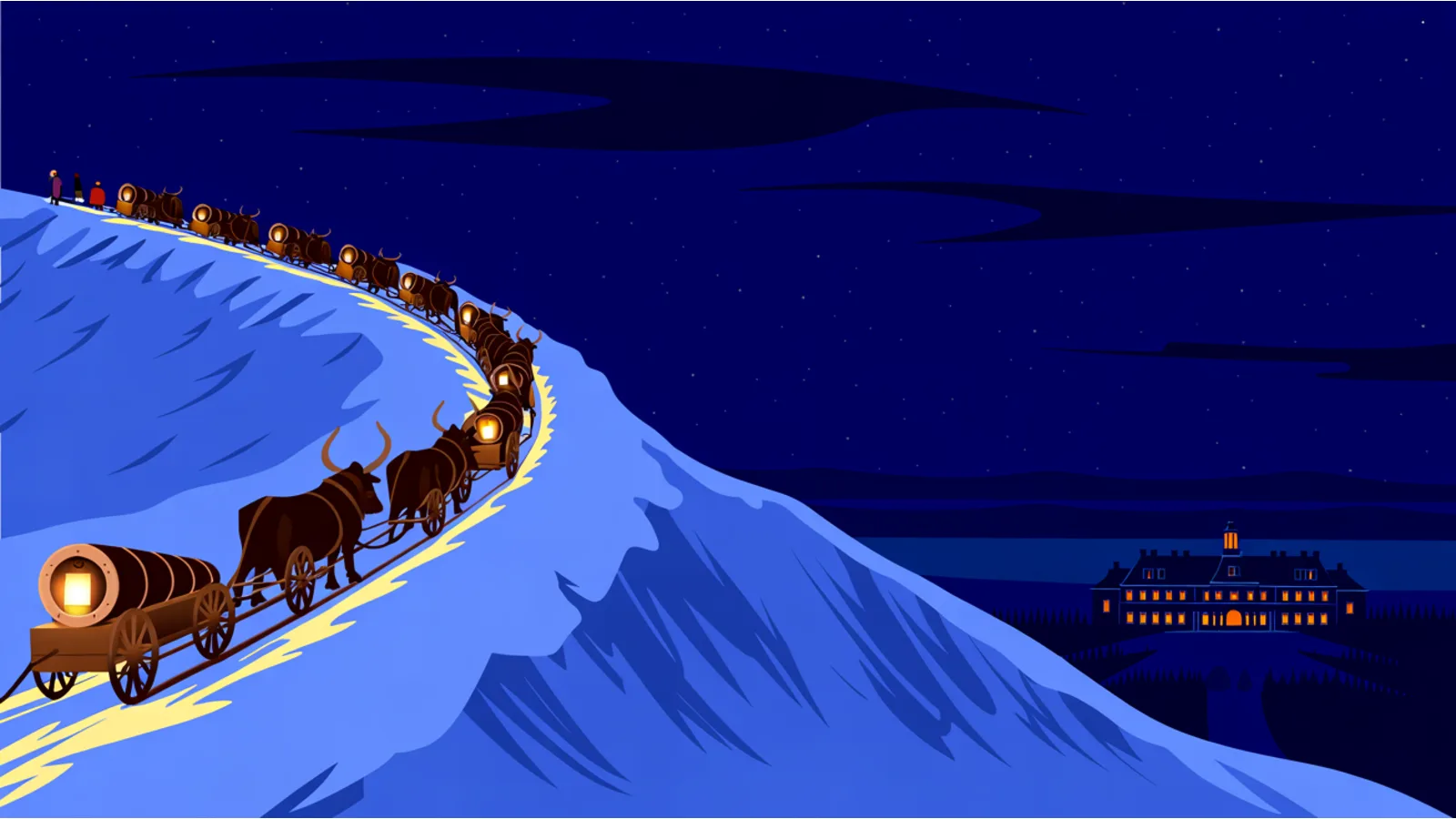
The most famous logistics operation in American history was run by a 25-year-old bookseller with no military experience. In the winter of 1775-76, Henry Knox took sixty tons of captured British guns, mortars, and cannon, a 120,000-pound train, from Fort Ticonderoga on Lake Champlain and moved them over 300 miles of snow, iced rivers, and mountains, by boat down Lake George and then on ox-drawn sleds, to Washington's siege lines outside Boston. He didn't lose a single cannon. When the guns appeared on Dorchester Heights on March 17, 1776, the British evacuated Boston without a battle.
Knox is the least forgotten man in this series; every account of the Revolution tells the "noble train" story. What the accounts skip is the second half of his life, which belongs squarely in this series about founders and money: the general who could move sixty tons of iron across the Berkshires without losing a pound could not move a 576,000-acre estate across a decade without losing all of it. His widow inherited what a Maine historian's summary calls a mountain of debt, and the dream mansion he built was eventually demolished to make room for a railroad.
The bookseller who read his way into the artillery
Knox was born in Boston on July 25, 1750, seventh of ten children of a shipmaster. Mount Vernon's researchers record that his father abandoned the family for the West Indies in 1759, and at nine years old Henry left school for a bookbindery to support his mother and younger brother. The bookstore became his university: he taught himself fortification, entrenchment, and gunnery from the shelves, poring over Sharpe's Military Guide and Caesar's Commentaries, and eventually opened his own shop, the London Book Store, described as one of the most fashionable places in Boston. One of its browsing customers was John Adams, who in 1775 recommended the well-read young militiaman to Washington's new army.
In June 1774 Knox had married Lucy Flucker, and the match mattered enormously to everything that followed. Lucy's family were wealthy, powerful Loyalists; her father, Thomas Flucker, was the royal secretary of the Province of Massachusetts, and her brother put on a British uniform. She married the patriot bookseller anyway, over her father's objections, and when the Revolution came her entire family fled to England while Lucy stayed, the only Flucker on American soil and the only one on the American side. Hold that thought; her inheritance becomes the second act.
Washington's indispensable man
The résumé between 1775 and 1794 is one long ascent. Chief of artillery after the Ticonderoga feat. The man who ran the boat logistics for the Delaware crossing that made Trenton and Princeton possible, and a brigadier general because of it. Builder of the army's artillery corps and its wartime gunnery schools, the institutional seed that, per Mount Vernon, set the precedent for American military academies for more than a century and a half. At Yorktown his guns outmatched the British so thoroughly that Washington told Congress Knox's "genius supplied the deficit of means," and in March 1782 he became the army's youngest major general. In November 1783 he rode at the head of the forces reoccupying New York City, and at the Fraunces Tavern farewell he was the first officer to come up and embrace Washington.
The friendship was the real thing, on both sides and for life. Washington wrote near the end of his own: "there is no man in the United States with whom I have been in habits of greater intimacy; no one whom I have loved more sincerely, nor any for whom I have had a greater friendship."
The offices followed the affection. Knox became the Confederation's Secretary of War on March 8, 1785, kept the post through the constitutional transition, and served as the first Secretary of War of the United States from 1789 to 1794 in Washington's cabinet: militia plans, frontier diplomacy, the response to Shays's Rebellion. Add it up and this series has now covered the proto-cabinet in full: Morris at Finance, the Committee of Correspondence's heirs at State, Knox at War, and Hillegas holding the purse underneath them all.
The second act: the general bets the estate
Now the turn, and Mount Vernon's encyclopedia dates it precisely: Knox retired at the end of 1794 after taking several weeks of absence to manage personal financial concerns. The debts were already showing while he still held the office.
The retirement plan was Lucy's ghost inheritance. Her grandfather, Brigadier General Samuel Waldo, had held the Waldo Patent, a 576,000-acre tract of midcoast Maine. The Flucker family's American holdings were forfeited in the Revolution, except what Lucy stood to inherit, and per the Maine Memory Network's account Knox acquired most of the patent through purchase and by asserting Lucy's rights. In 1794, the year before he left office, he began building Montpelier, a grand mansion at Thomaston, and moved his family north to live like the lord of a half-million-acre domain.
Then he tried to make the domain pay for the life. The ventures came in volley: land sales to settlers, shipbuilding, lime works, brick works, a wharf and store, with speculation partners that started with William Duer and later included William Bingham, whose separate million-acre Maine contract Knox had originally signed and handed over when the War Department consumed his time. His account books show the machine running right to the end; the Maine Memory Network cites a September 24, 1805 sale of 15,000 acres to a single buyer.
But the domain fought back. Revolutionary War veterans and other settlers had moved onto the Waldo Patent during his long absence as Secretary of War, cleared it, improved it, and regarded it as their earned pay for the war. Knox asserting a Loyalist family's old patent over them went exactly as well as you'd guess. An anonymous 1796 pamphlet, The Unmasked Nabob of Hancock County, attacked his right to the land and closed with a mock version of his will: "I will to my oldest son, sixty-seven thousand pounds to spend at gaming and carousing." It took years of commissions and negotiations (his own 1798 newspaper notice summoning settlers to Reeds Tavern survives) to quiet the claims.
And the arithmetic never closed. The businesses, in the summary of the sources below, failed; holdings were sold to cover debts even before the end. On October 25, 1806, at fifty-six, Knox swallowed a chicken bone at Montpelier; the resulting infection killed him within days. He was buried on the estate with full military honors, the funeral as grand as the house. Lucy and the surviving children inherited the mountain of debt. Over the following decades the lands went piecemeal to creditors and buyers, and the estate left the family entirely in 1871, when Montpelier itself was demolished to make room for a local railroad line. The mansion tourists visit in Thomaston today is a 1929 re-creation. The original didn't survive its own economics by even one lifetime.
The lesson the general missed
Knox's genius was throughput under constraint: get the guns over the mountains with the oxen you have before the snow melts. The Maine project inverted every condition that made him great. No deadline, no defined objective, unbounded scope, and a fixed grand lifestyle billing against speculative income. The man who never lost a cannon lost the estate because an estate isn't a convoy; it's a payroll that never stops, and he'd built the payroll first and the revenue never.
He is, in other words, the third data point in this series' custom-build file, alongside Robert Morris's unfinished Folly and in instructive contrast to Bingham, who carried the same Maine wilderness on cash and died rich. I've written up the Montpelier story as a construction-and-carrying-cost case study on the Resale Trap blog, because its failure mode, a dream house funded by ventures that all have to work, walks into builder's offices every week.
None of which touches the first act. The guns got to Dorchester Heights. The republic got a War Department built by a self-taught bookseller its first president loved like family. Some men are geniuses of the campaign and casualties of the peace; Knox was the American original of the type.
Related reading
- William Bingham Was the Richest Man in Early America. You've Never Heard of Him.: his Maine partner, and the version of the land bet that worked.
- Robert Morris: The Founding Father in the Capitol Dome Nobody Can Name: the other founder whose dream house outran his money.
- James Wilson Drafted the Constitution and Died Hiding From His Creditors: carrying costs as destiny, the judicial edition.
- Michael Hillegas Was America's First Treasurer. His Reward Came 103 Years Late.: the man keeping the books under the war Knox's guns won.
Fact-check notes and sources
- War biography (born July 25, 1750, father's abandonment in 1759 and the bookbindery at nine, self-education from Sharpe's Military Guide and Caesar's Commentaries, the London Book Store "one of the most fashionable places in Boston," the Adams connection, the Ticonderoga mission arriving December 5, 1775, the 120,000-pound lot moved by boat down Lake George and then sleds and oxen, chief of artillery, Dorchester Heights March 17, 1776, Washington's "genius supplied the deficit of means" report, secretary of war under the Confederation and in Washington's cabinet, military academy precedent, Shays's Rebellion, the end-of-1794 retirement after weeks of absence "to manage personal financial concerns," the move to Maine on land tied to Lucy's family, death in 1806, and Washington's "no man in the United States..." letter): Mount Vernon Digital Encyclopedia, "Henry Knox", citing Founders Online.
- Corroboration and additional detail (sixty tons of cannon over 300 miles by ox-drawn sled without losing one, the Delaware crossing logistics and brigadier promotion, youngest major general March 1782, riding into New York November 1783 and being first to embrace Washington at Fraunces Tavern, Secretary of War appointment March 8, 1785 succeeding Benjamin Lincoln, marriage to Lucy Flucker in June 1774 against her father's wishes while her brother joined the British army, death October 25, 1806 from an infection caused by a lodged chicken bone, burial at Thomaston with full military honors): American Battlefield Trust, "Henry Knox".
- The Waldo Patent and Maine ventures (the 576,000-acre patent of Lucy's grandfather Samuel Waldo, her father Thomas Flucker as royal secretary of the Province of Massachusetts, the family's flight and forfeiture except Lucy's inheritance, acquisition through purchase and asserted inheritance rights, speculation partnerships with William Duer and later William Bingham, the September 24, 1805 sale of 15,000 acres, settler and veteran conflicts, the 1796 Unmasked Nabob of Hancock County pamphlet and its quoted mock will, the 1798 Reeds Tavern notice): Maine Memory Network / Thomaston Historical narrative, "Henry Knox: Land Dealings", a Maine Historical Society project.
- Montpelier's fate (built the year before his 1795 retirement, on land Lucy inherited, family until 1871, demolished for a local railroad line, the 1929 re-creation open today): American Battlefield Trust heritage-site page, "Montpelier". The "mountain of debt" characterization and the failed-business summary follow the Maine sources aggregated in the search record, consistent with Mount Vernon's note that financial concerns forced his 1794 absences.
- Where sources differ on his father (abandonment per Mount Vernon; early death per the Battlefield Trust), the fuller Mount Vernon account is used. The claim that Fort Knox is named for him is omitted as outside the consulted sources.
This post is informational, not financial advice. Historical institutions are mentioned as nominative fair use; no affiliation is implied.
