
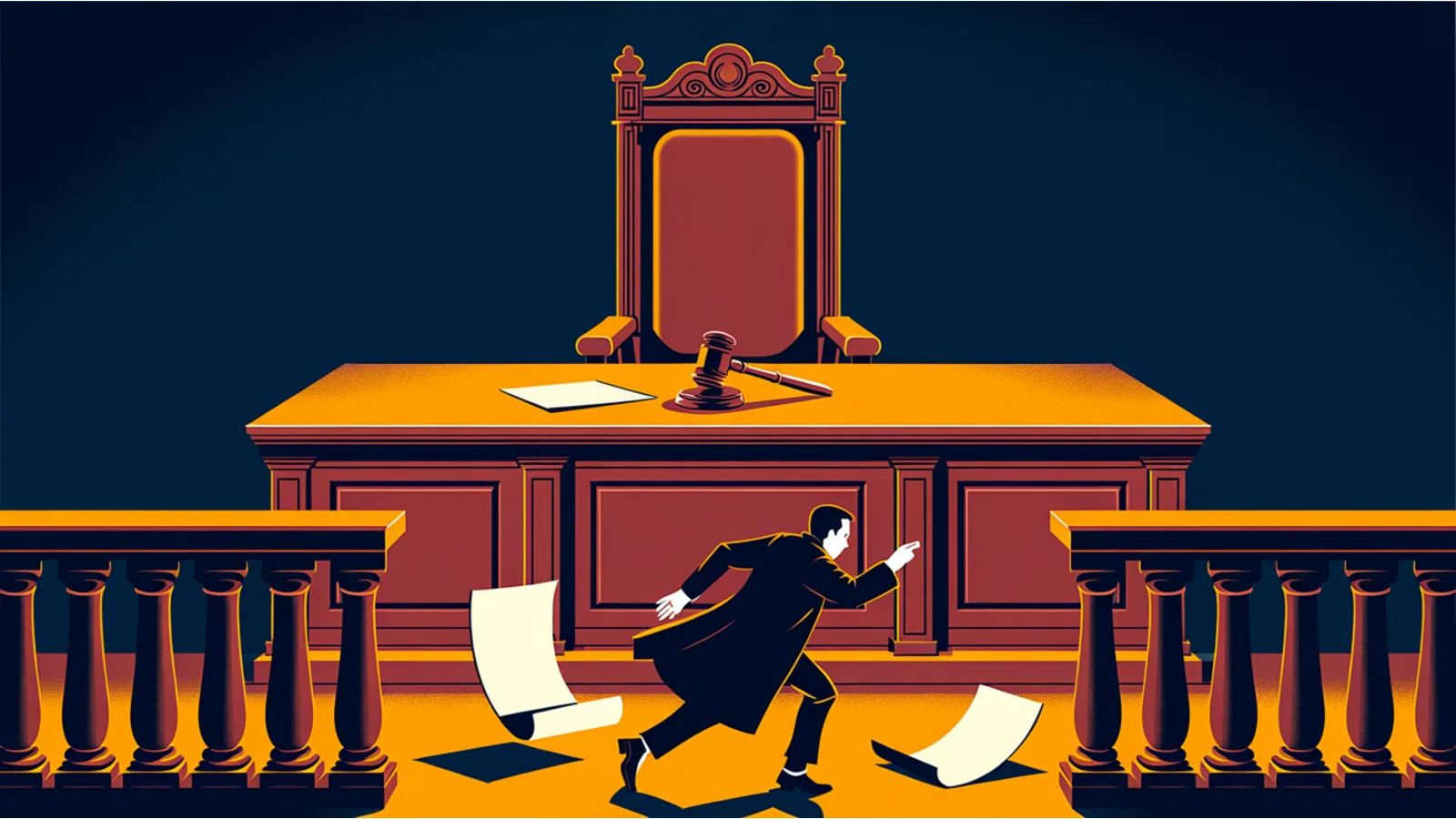
In 1906, on President Theodore Roosevelt's direction, workers in Edenton, North Carolina disinterred a casket that had been in the ground at Hayes Plantation for 108 years and put it on a route to Philadelphia. There was a formal procession to Christ Church. The Chief Justice of the United States, Melville Fuller, attended, along with Justices White, Day, and Oliver Wendell Holmes, the governor of Pennsylvania, and Andrew Carnegie. The casket was buried next to Benjamin Franklin.
The man being honored had died in 1798, aged 55, in a state his own contemporaries described as acute mental distress, hiding from his creditors in a fellow judge's home. He was a sitting justice of the United States Supreme Court at the time. He had been jailed for debt twice while holding that office.
His name was James Wilson, and there's a respectable argument, made by people who study these things, that he did more to design the American government than anyone except Madison. A Yale Journal of Law & the Humanities article about him is titled, accurately, "The Lost Founder."
The farm boy who out-read everyone
Wilson was born on September 14, 1742 at Carskerdo, a farm near St. Andrews in Scotland. At fifteen he won a scholarship to the University of St. Andrews, then studied at Edinburgh and Glasgow while the Scottish Enlightenment was at full temperature: Hume, Adam Smith, Francis Hutcheson. In 1765 he sailed for America, taught Latin at the College of Philadelphia (the school that became the University of Pennsylvania), and then read law under John Dickinson, the most respected lawyer in the province. He was at the Pennsylvania bar by 1767.
In 1768, still in his twenties, he sat down to work out the legal relationship between Parliament and the colonies. He started from the assumption that Parliament had at least some binding authority over America and, per the DSDI account, was amazed to find he could establish none at all. He published the result in 1774 as Considerations on the Legislative Authority of the British Parliament and distributed it to the First Continental Congress. One paragraph reads:
"All men are, by nature, equal and free: no one has a right to any authority over another without his consent: all lawful government is founded on the consent of those who are subject to it."
That's 1774. The Declaration is two years away, and its logic is already on paper in Wilson's hand.
The vote that carried Pennsylvania
Wilson joined the Continental Congress in May 1775. Like Robert Morris, he thought the break with Britain needed slowing, and he helped engineer the three-week delay of the independence vote in June 1776. But when the roll was called on July 2, Pennsylvania's delegation split 3 to 2 for independence, and Wilson was in the three, with Franklin and John Morton. He signed the Declaration of Independence that August.
Then his career did something the marble-statue narratives can't use: it got complicated. He opposed Pennsylvania's radical new state constitution and got dropped from Congress for it. He defended loyalists in court. By October 1779 a Philadelphia mob was marching on his house at Third and Walnut; Wilson and his friends barricaded it, shots were exchanged, and people died on both sides at what history remembers as the attack on "Fort Wilson." In 1780 he was legal adviser to Robert Morris in founding the Bank of North America, the first true bank in the country, and defended its charter in print when the state came for it.
The convention's quiet engine
Madison's notes, unsealed after his death, are the reason we know how much of the Constitution runs through Wilson. At Philadelphia in 1787 he was, by reputation, the best-read lawyer in the room, and he argued three positions that define the government you live under.
First, popular sovereignty as architecture, not slogan. Wilson wanted the House elected directly by the people, not because it polled well but because, in Madison's paraphrase, he was "for raising the federal pyramid to a considerable altitude, and for that reason wished to give it as broad a basis as possible." He wanted senators directly elected too. He lost that one for 126 years, until the Seventeenth Amendment proved him right in 1913.
Second, the single president. Three weeks into the convention, Wilson proposed a one-person executive. Edmund Randolph called a single executive "the fetus of monarchy" and wanted a three-person council. Wilson answered that the colonists' grievances had been against Parliament, not the king alone, and that a plural executive meant permanent quarrel. The single presidency passed, seven states to three.
Third, the Electoral College. Wilson first proposed electors chosen by district on June 2, 1787. The convention rejected it, defaulted to letting Congress pick the president, deadlocked over the details, and finally, that September, a committee revived Wilson's elector scheme as the compromise. Every presidential election since is his fallback plan running in production.
And when the convention needed its debates turned into an actual text, the Committee of Detail handed the drafting to Wilson. Gouverneur Morris polished the final version, but per DSDI it closely followed the form and content of Wilson's draft. The famous opening words came through that pipeline. The DSDI biography flatly calls him the Architect of the Constitution; Mount Vernon's digital encyclopedia notes he is the only person who signed the Declaration and the Constitution and then served on the Supreme Court.
Honesty requires the next paragraph too. It was Wilson who offered the Three-Fifths Compromise, the formula that counted enslaved people as three-fifths of a person for representation, and Wilson who drafted the deliberately vague language of the Fugitive Slave Clause he personally opposed including. And though he claimed to oppose slavery for most of his life, Mount Vernon's researchers record that he enslaved a man named Thomas Purcell for 26 years, freeing him in 1794 at his second wife's request. The man who wrote "all men are, by nature, equal and free" in 1774 took twenty years to apply it in his own house. Both facts are his.
At Pennsylvania's ratifying convention he made the case with a lawyer's candor, admitting the document wasn't the one he'd have written alone: "I am bold to assert that it is the best form of government which has ever been offered to the world."
First offices, first lectures, first collapse
Wilson did something no other founder quite dared: he wrote to Washington and asked to be made Chief Justice of the United States. Washington gave the center chair to John Jay but made Wilson one of the original associate justices; per the Supreme Court Historical Society he was nominated on September 24, 1789 and confirmed two days later. That winter he added another first: the College of Philadelphia made him the country's first professor of law, and his opening lecture on December 15, 1789 drew Washington, John Adams, Thomas Jefferson, and Alexander Hamilton to the room. The government's entire senior management attended a class on what the Constitution meant, taught by the man who'd drafted it.
On the bench, his big moment was Chisholm v. Georgia in 1793, holding that a citizen could sue a state in federal court: "the people of the United States intended to form themselves into a nation for national purposes... the state of Georgia is amenable to the jurisdiction of the court." The states hated it so much they passed the Eleventh Amendment in 1795 to overrule it. Getting reversed by constitutional amendment is, in its way, a measure of how seriously they took him.
While all this was happening, Wilson was buying land. Not investing in land; buying it the way a man drinks. Twenty years of a top-tier law practice had given him capital, and he poured it into speculative warrants that required regular maintenance payments to keep alive. Mount Vernon's account is unsparing: he owed hundreds of thousands of dollars in land debt and continued to purchase more land despite his insolvency. When the credit cycle turned in 1796 and 1797, the same collapse that took Robert Morris took Wilson, except Wilson was on the Supreme Court while it happened. He was arrested and briefly imprisoned for debt twice, freed only when his son raised the money. He spent his final year largely absent from the Court, riding circuit in the South mostly to stay ahead of process servers.
In early 1798 he landed at Edenton, North Carolina, in the home of his colleague Justice James Iredell, exhausted and unwell. Mount Vernon records the cause as malaria. He died there on August 21, 1798, the first Supreme Court justice to die in office, and was buried at Hayes Plantation, far from Pennsylvania. Washington's nephew Bushrod, one of Wilson's own law students, took his seat.
The lost founder
Why did the man who designed the presidency vanish from the pantheon? The ingredients are familiar from Morris's story: he ended broke, discredited, and inconveniently complicated. No death-bed serenity, no farewell address. His legacy was administered by embarrassed silence for a century until Roosevelt's 1906 reburial started the repair. A law professor at the ceremony's era, L.H. Alexander, predicted that history would eventually settle on two towering figures of the founding: "Wilson, whose brain conceived and created the nation; the other, Washington who wielded the forces that made it." That's partisan, and Madison would like a word. But the fact that it's arguable at all, about a man most people can't place, is the point.
Wilson's ruin also has the cleanest modern translation of any founder's: he bought illiquid assets with obligations attached, on borrowed money, and kept buying as his position sank. The instrument was an 18th-century land warrant with maintenance payments; today it's any property whose carrying costs you don't control. I map that failure pattern for modern buyers in The Condo Trap, where the maintenance payment is called a special assessment, and the outcome, for the over-extended, is the same.
Related reading
- Robert Morris: The Founding Father in the Capitol Dome Nobody Can Name: Wilson's Bank of North America client and fellow casualty of the Panic of 1797.
- Haym Salomon: The Immigrant Broker Who Kept the Revolution Solvent: the third forgotten financial founder in this series.
- The Quant Quake Stopped Being an Accident: crowded positions unwinding at once, the 2007 edition.
- One Night at a Five-Star Hotel Now Costs More Than a Week of Average W-2 Pay: asset prices versus income, the current chapter.
Fact-check notes and sources
- Biography and convention detail (birth at Carskerdo September 14 1742, St. Andrews scholarship, 1765 emigration, Latin teaching, law under John Dickinson, 1767 bar admission, the 1774 Considerations and its quoted paragraph, May 1775 entry to Congress, the July 2 1776 Pennsylvania 3-2 vote with Franklin and Morton, removal from Congress in 1777, Fort Wilson riot and $10,000 bond, Bank of North America advising role in 1780, "best-read lawyer," Madison's "federal pyramid" paraphrase, Committee of Detail drafting and Gouverneur Morris's final text following Wilson's draft, the ratification-convention quote, first law professorship, the Chisholm v. Georgia quote, land warrants requiring maintenance payments, two imprisonments for debt while a sitting justice, death at James Iredell's home in Edenton August 21 1798, burial at Hayes Plantation, the 1906 Roosevelt-directed reburial next to Franklin with Chief Justice Fuller and Justices White, Holmes, and Day attending, the Alexander quote): DSDI, James Wilson.
- Corroboration and additional detail (only person to sign the Declaration and Constitution and serve on the Supreme Court, the June 1 1787 single-executive proposal against Randolph's "fetus of monarchy" three-person plan and the 7-3 vote, the June 2 Electoral College proposal and its September revival by the committee of eleven, Sherman's "essence of tyranny" objection to direct election, the Three-Fifths Compromise offer, the Fugitive Slave Clause drafting, the December 15 1789 first law lecture attended by Washington, Adams, Jefferson, and Hamilton, Chisholm negated by the Eleventh Amendment in 1795, "owed hundreds of thousands of dollars in land debt but continued to purchase more land despite his insolvency," the final year absent from the Court fleeing creditors, death from malaria at 55, first justice to die in office, succession by Bushrod Washington, and the enslavement and 1794 manumission of Thomas Purcell): Mount Vernon Digital Encyclopedia, "James Wilson", which cites Madison's convention notes via Farrand's Records. The "Lost Founder" title referenced is Nicholas Pederson, Yale Journal of Law & the Humanities (2010), listed in that article's bibliography.
- Supreme Court appointment dates (nominated September 24, 1789, confirmed September 26, 1789, eight years of service): Supreme Court Historical Society, "James Wilson, 1789-1798". Note: the DSDI page gives 1791 for the appointment; this article follows the Court historical society's 1789 dates.
- Where sources conflict or a claim appears in a single source, it is attributed inline.
This post is informational, not financial or legal advice. Historical institutions and publications are mentioned as nominative fair use; no affiliation is implied.
