
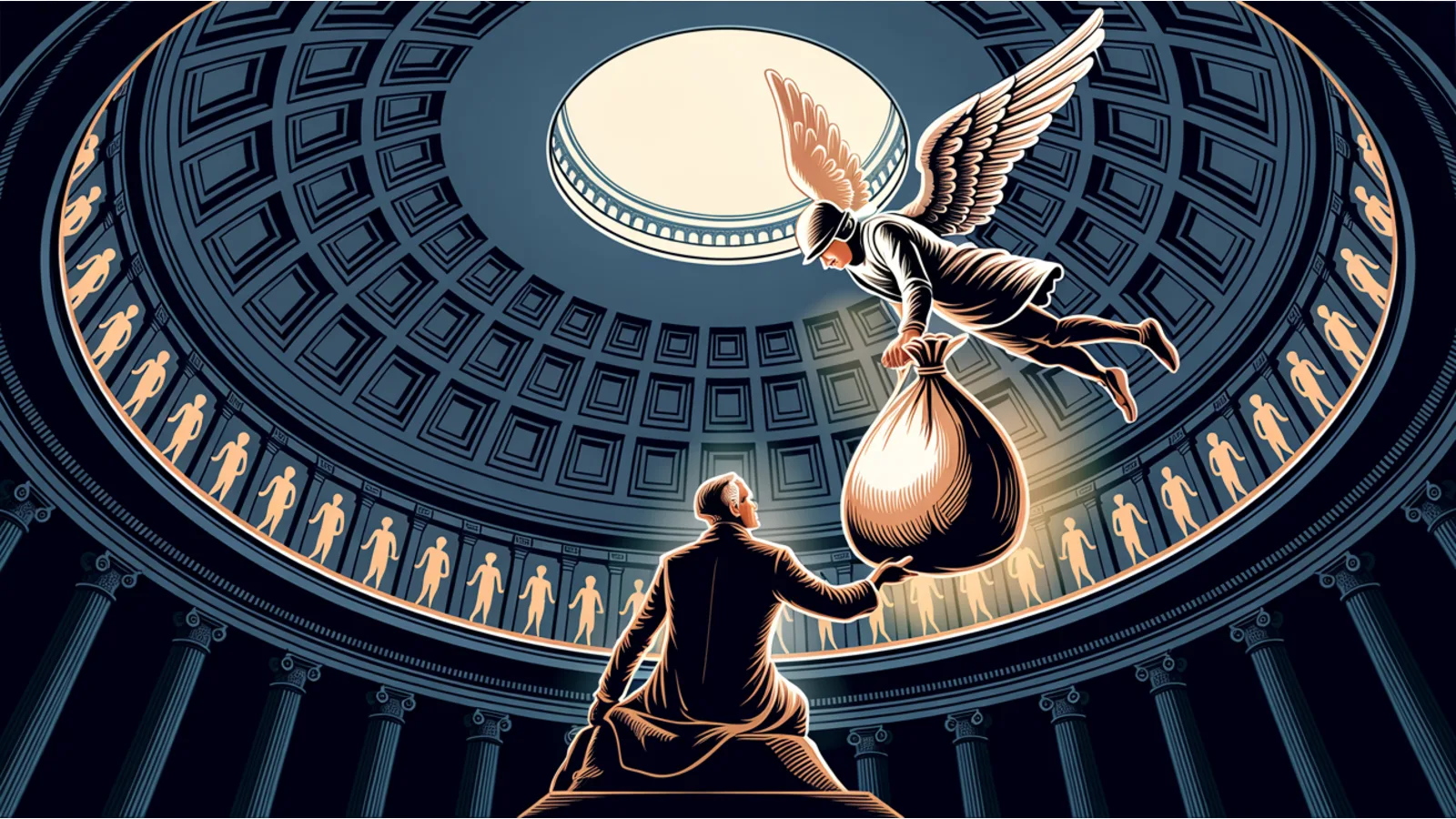
Stand in the center of the U.S. Capitol Rotunda and look straight up. There's a fresco 180 feet above the floor, covering 4,664 square feet of curved plaster. Constantino Brumidi painted it in 1865, in eleven months, for $40,000, right as the Civil War ended. It's called The Apotheosis of Washington, and six scenes ring its rim: War, Science, Marine, Commerce, Mechanics, and Agriculture.
In the Commerce scene, the Roman god Mercury leans down and hands a bag of money to a seated man in colonial dress. The Architect of the Capitol's official description identifies him in nine words: "Mercury handing a bag of money to Robert Morris, financier of the American Revolution."
Count the real, named Americans in that official description of the ceiling and you get five. George Washington at the center. Benjamin Franklin, Robert Fulton, and Samuel Morse in the Science group. And Robert Morris.
Four of those names you know. The fifth ran the money side of the entire Revolution, signed all three founding documents, held the first executive office in the national government, wrote the letter telling Washington he'd been elected president, and turned down the job of first Treasury Secretary. Then he went to debtors' prison, and we mostly stopped telling his story.
That's worth fixing.
An orphan with one year of school
Morris was born in Liverpool, England on January 31, 1734. His mother died when he was two, and his grandmother raised him until, at fourteen, he crossed the Atlantic to join his father, a tobacco agent in Oxford, Maryland. He got roughly one year of formal education before being sent to Philadelphia to clerk for the merchant Charles Willing.
Then came 1750. His father attended a dinner party aboard one of his company's ships, and as he rowed away, the crew fired a ceremonial cannon salute in his honor. Wadding from the shot tore through the small boat and injured him; he died of blood poisoning days later. Robert Morris was sixteen, alone on a new continent, with an inheritance the American Battlefield Trust puts at about twenty-five hundred pounds sterling.
He went to work. He partnered with Thomas Willing to form Willing, Morris & Company, a shipping and banking house that lasted him nearly forty years. He captained a trading run to Jamaica during the Seven Years War, got captured by French privateers, escaped to Cuba, and worked his way home. In his twenties he helped found the London Coffee House, an institution the Philadelphia Stock Exchange claims as its origin. At his peak, per the ranking DSDI cites from the Encyclopedia of American Wealth, he and Charles Carroll were the two richest of the 56 men who signed the Declaration of Independence.
One uncomfortable line belongs in any honest telling: for a period, the firm also ran slave-trading voyages. The DSDI biography records that Willing, Morris & Co. lost money at it and dropped the trade, and that in 1769 Morris helped organize the non-importation agreement that ended the slave trade in the Philadelphia region. The second fact doesn't erase the first. Both are part of the record.
The man who voted no
Morris didn't start as a revolutionary. He started as a street organizer. When the Stamp Act passed in 1765, he led a Philadelphia protest and personally convinced the tax collector to give up his post; the man later wrote that if he hadn't, his house would have come down "brick by brick." Ten years later, as warden of the port, Morris talked the captain of the tea ship Polly into turning around and sailing back to England, which is why Philadelphia never needed its own Tea Party.
And yet when independence itself came to a vote, Morris was against it. Not from loyalty to the Crown. He thought the colonies weren't ready for self-rule, feared anarchy, and doubted they could beat the superpower of the day. So on July 2, 1776, he did something almost extinct in politics: he left the room, so the vote could pass without his no.
A month later, on August 2, he signed the Declaration anyway, saying it was "the duty of every individual to act his part in whatever station his country may call him to in hours of difficulty, danger and distress."
He went on to sign the Articles of Confederation at York, Pennsylvania (one of only 16 Declaration signers who signed both), and then the Constitution. Exactly two men signed all three founding documents. Roger Sherman of Connecticut is one. Robert Morris is the other.
One clarification, because a four-document version of this fact circulates online: the First Continental Congress also produced the Continental Association, the 1774 trade boycott, and some retellings add it to Morris's list. The record doesn't support that. Morris wasn't in Congress yet in 1774; his national service began with Pennsylvania's Committee of Safety in 1775 and the Second Continental Congress after it. Sherman, who was there in 1774, did sign the Association, which is why Connecticut Humanities calls him the only person to sign all four of the era's major documents. Three for Morris, four for Sherman, and no one else came close to either.
The war ran through his ledger
In Congress, Morris sat on the Secret Committee and quietly converted his merchant network into a supply and intelligence web. So many war supplies moved across his wharf that Congress posted guards there at night. Before the victory at Trenton, he sent Washington's army money, weapons, and blankets at the moment they were needed most.
He sold the Continental Navy his best ships. One became the Alfred, another the Columbus, and a third, the Reprisal, carried Benjamin Franklin to France. Captains who had sailed for Morris's merchant fleet became the young Navy's officer corps, among them John Barry and Samuel Nicholas, the first Commandant of the Marine Corps. The war cost Morris over 150 ships by his own count. He told an old friend he came out "about even," mostly thanks to privateering.
The first offices
By 1781 the government's finances had collapsed. Congress created a new position, Superintendent of Finance, and gave it to Morris. The DSDI biography calls it "the first executive office in American history." The American Battlefield Trust calls it the precursor to the Treasury Secretary. Both descriptions fit: before there was a cabinet, there was Morris.
What he did with the office reads like a founding document for the executive branch. He submitted On Public Credit, the first national funding proposal, which DSDI notes became the basis for Hamilton's famous plan a decade later. He established the Bank of North America with two fellow signers, James Wilson and George Clymer. He cut government and military spending, tightened the books, and pleaded with the states to contribute funds, a process he compared to "preaching to the dead." When nothing else worked, he issued more than a million dollars in personal promissory notes, "Morris notes," so the army could eat and get paid. For three years, per the Battlefield Trust, Robert Morris personally financed the American Revolution on his own credit.
He also became Agent of Marine, taking operational control of the tiny three-ship Continental Navy, and he'd earlier served on the Committee of Correspondence, the body DSDI traces forward to today's State Department. Treasury, Navy, State: squint and you can see the first cabinet drawn in one man's handwriting.
The proof came at Yorktown. In 1781 Morris moved the money and supplies that got Washington's army to Virginia and coordinated with the French to bring their fleet into the Chesapeake, closing the trap on Cornwallis. DSDI puts his personal stake in the campaign at 1.4 million dollars of his own money.
Washington's banker, Hamilton's sponsor
The Morris and Washington families weren't just allies; they were close. A contemporary account quoted by DSDI says that at Martha Washington's dinners, Mrs. Morris always sat at her right hand, and Robert Morris at Mrs. Washington's right. In 1787 Washington stayed with Morris while both attended the Constitutional Convention, and it was Morris who nominated Washington to preside over it.
After ratification, Pennsylvania elected Morris one of its first senators. He served from 1788 to 1795, sat on 41 committees, and helped broker the Compromise of 1790 that placed the capital on the Potomac while the federal government assumed state war debts. It fell to Morris to write to Mount Vernon informing Washington that he had been elected President of the United States. Washington answered by offering him the first Treasury secretaryship.
Morris said no, and then made what DSDI calls one of the great casting recommendations in American history: he suggested his friend Alexander Hamilton instead, then spent his Senate years pushing Hamilton's program through, a program built on his own decade-old proposal. Even the executive mansion was his. The Battlefield Trust notes that Morris's Market Street house in Philadelphia served as the presidential residence in the 1790s.
In between, he kept building. DSDI's inventory of his ventures includes the first American trading ship to China in 1784, a steam engine company, a glass factory, the first iron rolling mill in America, coal and canal companies, and a hot air balloon launched from his own backyard. John Adams said of him: "I think he has a masterly understanding, an open temper, and an honest heart."
The fall
It unraveled with brutal speed. After Morris left the Senate in 1795, political enemies reopened long-settled Secret Committee accounts from the 1770s and billed his firm over $94,000; paying it cost him his shipping interests, his best remaining asset. He pushed what was left into land, and not modestly. At one point he owned the western half of New York State, which he sold to the Holland Land Company. With partners he held options on more than 6 million acres, plus building lots in the brand-new capital city of Washington.
Every support failed at once. A loan from Holland that the whole structure depended on never materialized once the French Revolution and Napoleon consumed Europe. Talleyrand bought 100,000 acres from him and never paid. Aaron Burr, acting as New York's attorney general, pressed a lawsuit that stripped Morris of hundreds of square miles, land that later became part of Adirondack State Park. Then the Panic of 1797 hit, creditors called everything, and the American Battlefield Trust puts the wreckage at nearly three million dollars owed.
In February 1798, the man who had financed the Revolution was locked in Prune Street debtors' prison in Philadelphia. He stayed three and a half years. A new federal bankruptcy law, which DSDI credits his friend Senator John Marshall with helping pass, freed him in 1801. Gouverneur Morris arranged an annuity so Robert and Mary could live quietly. He died of asthma on May 8, 1806, and is buried behind Christ Church in Philadelphia.
The grand marble townhouse he'd begun in 1794, designed by Pierre Charles L'Enfant, the planner of Washington D.C., was never finished. Philadelphians called it "Morris's Folly." It sold at auction in 1799 while he sat in prison.
Why he vanished, and where to find him
Morris is a hard fit for the hero shelf. He voted against independence before signing it. He got very rich, then went very broke. His firm's early slave-trade chapter is real. He died discredited, not martyred. And finance is the least romantic kind of war story: no musket, just a ledger that decided whether the men with muskets ate.
But he never actually left the room where American memory lives. In the Rotunda, John Trumbull's Declaration of Independence shows him seated in a yellow coat near John Adams. In the National Archives, Barry Faulkner's mural puts him in the front row, far left. There's a statue of him in Philadelphia near the Second National Bank, and universities in Pittsburgh and Illinois carry his name.
And 180 feet up, there's the fresco. The American Essence essay linked below walks the whole ceiling's symbolism, including Mercury's winged hat and caduceus, the ancient shorthand for trade and negotiation. Brumidi painted gods teaching and arming Americans all around that canopy, but the Commerce scene is the only one where the god hands an American the money. The American in the picture is a man who died broke, having spent the fortune of a lifetime proving the country was a good credit risk.
The mechanics that ruined him still ruin people: assets you can't sell fast, debts that come due faster, financing you counted on before it closed, and money that quietly changes value underneath you. I wrote about the modern version of that machine in The W-2 Trap, and the panic-driven unwind pattern shows up in everything from 1797 land to the 2007 quant desks. The century changes. The ledger doesn't.
Related reading
- Haym Salomon: The Immigrant Broker Who Kept the Revolution Solvent: the man who stands on Washington's other side in Chicago's Heald Square Monument.
- James Wilson Drafted the Constitution and Died Hiding From His Creditors: Morris's Bank of North America co-founder, ruined by the same Panic of 1797.
- The Quant Quake Stopped Being an Accident: another story about crowded positions and forced selling, 210 years after Morris.
- Why W-2 Workers Stay Broke (Even Making Six Figures): the structural version of income that never becomes wealth.
- One Night at a Five-Star Hotel Now Costs More Than a Week of Average W-2 Pay: what asset prices do while wages sit still.
- 13 Personal Finance Books Worth Reading in 2026: the reading list, if this post put you in the mood for money history.
Fact-check notes and sources
- Fresco details (artist, 1865, 180 feet, 4,664 sq ft, $40,000, eleven months, six scenes, and the Commerce description "Mercury handing a bag of money to Robert Morris, financier of the American Revolution"): Architect of the Capitol, Apotheosis of Washington. This is the official description; it names Washington, Franklin, Fulton, Morse, and Morris as the real Americans depicted.
- Fresco symbolism (Mercury's winged petasus and caduceus representing trade and negotiation): American Essence, "The Apotheosis of Washington: Deciphering the Symbols of Our Nation". Note: this essay covers the ceiling's symbolism but does not itself name Morris; the identification of the figure receiving the money comes from the Architect of the Capitol page above.
- Biography (birth, father's death, Willing Morris & Co., privateer capture, London Coffee House, wealth ranking, slave-trade chapter and 1769 non-importation agreement, Stamp Act and Polly episodes, July 2 abstention, August 2 signing and quote, Secret Committee, ships and captains, Superintendent of Finance, Bank of North America, Morris notes, "preaching to the dead," $1.4 million at Yorktown, Annapolis and Constitutional Conventions, Senate service, Hamilton recommendation, $94,000 charge, New York and D.C. land ventures, Talleyrand default, Burr lawsuit, Prune Street, 1801 release, annuity, death May 8, 1806, Trumbull and Faulkner depictions, Morris's Folly): DSDI, Robert Morris.
- Corroboration and additional figures (twenty-five hundred pound inheritance, "personally financed the American Revolution" for three years, precursor-to-Treasury framing, Compromise of 1790, presidential residence on Market Street, nearly $3 million owed, prison 1798 to 1801, bankruptcy act): American Battlefield Trust, "Robert Morris: Financier of the American Revolution".
- Roger Sherman as the only signer of all four founding-era documents (Continental Association, Declaration, Articles, Constitution): Connecticut Humanities, "Roger Sherman, Revolutionary and Dedicated Public Servant". Morris signed three; both DSDI and the American Battlefield Trust confirm his trio, and both date the start of his congressional service after the October 1774 Association.
- Where a figure appears in only one source (the $1.4 million Yorktown stake, the "first executive office" characterization), it is attributed to that source in the text.
This post is informational, not financial advice. Historical claims are cited above; institutions and publications are mentioned as nominative fair use with no affiliation implied.
