
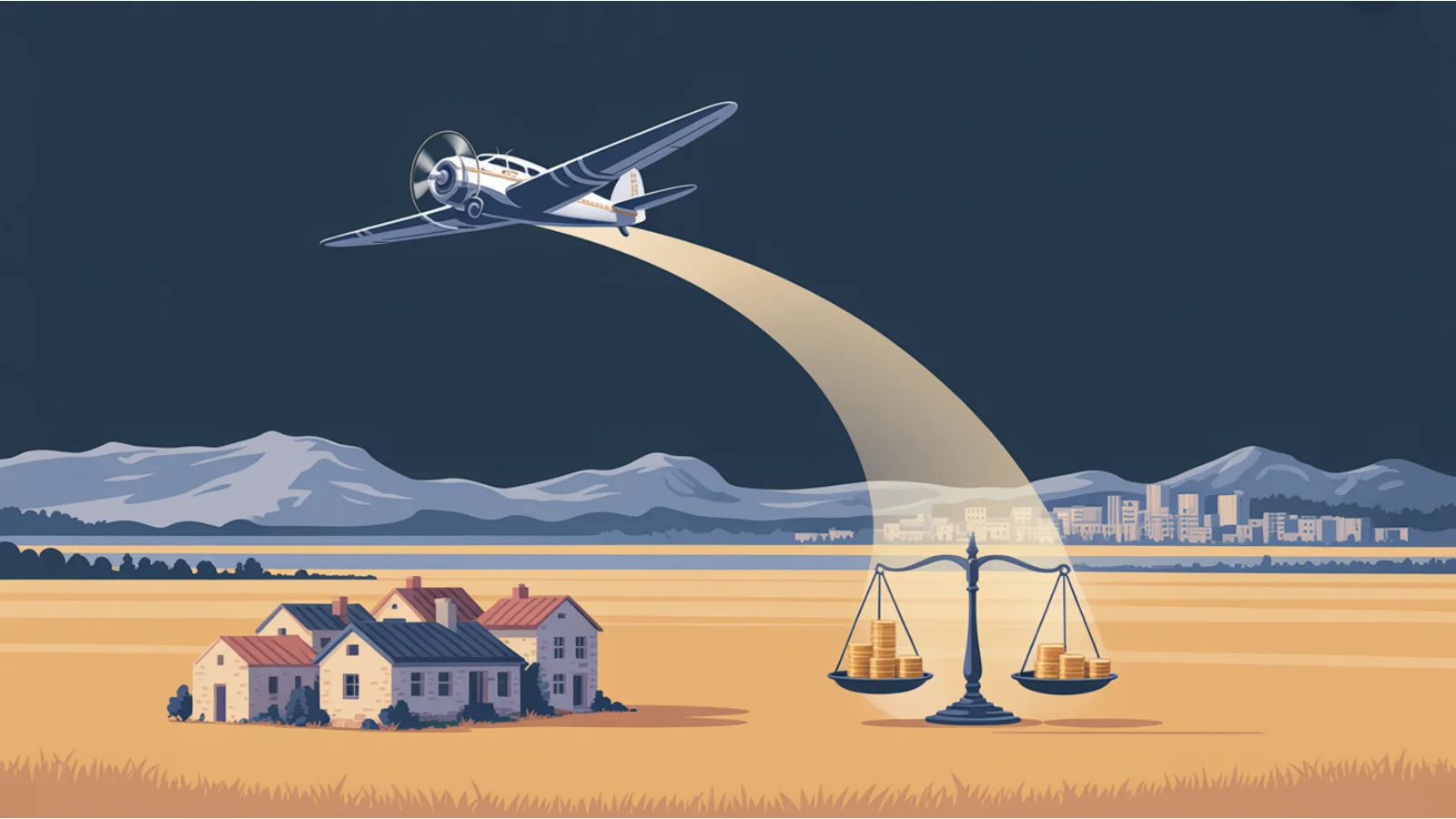
There is a federal program that pays airlines to fly nearly empty planes to towns most Americans have never heard of, and it has done so, without interruption, for almost fifty years. Some of those flights cost the government more than 1,900 dollars for every passenger aboard. Stated that way, it sounds like a textbook of waste. Stated another way, it is the only reason a few hundred isolated communities, most of them in roadless Alaska, can reach a hospital, a courthouse, or the rest of the country at all. The program is Essential Air Service, and whether you think it is a boondoggle or a bargain turns almost entirely on which number you decide to look at.
What it is, and who actually runs it
Essential Air Service was created by the Airline Deregulation Act of 1978, the same law that freed airlines to fly wherever the market took them. Congress understood that a deregulated market would abandon small communities that could never fill a jet, so it wrote in a guarantee: the government would subsidize a minimum level of scheduled service to the towns that had it before deregulation. The guarantee was meant to last ten years. In 1996 Congress made it permanent, according to the Congressional Research Service.
It is worth clearing up a common shorthand. People often call this the FAA's program, but the Federal Aviation Administration does not run it. Essential Air Service is administered by the Department of Transportation, specifically its Office of Aviation Analysis, as the Government Accountability Office states plainly. The FAA is connected to the money rather than the management. Part of the program is seeded by overflight fees, the charges the FAA collects from foreign aircraft that cross United States airspace without landing, and by law the first 50 million dollars of those fees each year, plus any surplus, flows to Essential Air Service. The program is also reauthorized inside the FAA's own funding bills, which is probably how the shorthand took hold. The rest of the cost comes from a regular appropriation tied to the Airport and Airway Trust Fund.
Where the money goes
The bill has grown. For the 2026 fiscal year Congress appropriated about 514 million dollars for the core subsidy account, up from 450 million the year before and about 349 million in 2024. Counting the overflight fees that also feed it, the total runs higher, around 591 million dollars in the Transportation Department's late-2024 accounting. The Government Accountability Office, measuring only the continental United States, found the subsidy rose about 31 percent between 2018 and 2023, driven by higher fuel and labor costs and a shift toward regional jets.
That money buys scheduled service to 183 communities as of late 2025, by the Government Accountability Office's count: 108 in the contiguous 48 states, 70 in Alaska, four in Hawaii, and one in Puerto Rico. The mechanism is a bid. The Transportation Department asks airlines to propose service to a given community, and carriers bid the schedule, the aircraft, the connecting hub, and the subsidy they need. The department sets payment to cover the carrier's projected loss plus a profit margin of roughly 5 percent, and it pays monthly, per completed flight. Critically, and this is where much of the criticism starts, it pays per flight rather than per passenger, so a carrier is made whole whether the plane is full or nearly empty. The largest recipients are regional carriers most travelers have never flown, led by SkyWest at about 85 million dollars a year.
Why it looks like a loss
Line the program up against ordinary efficiency and it fails badly. The subsidy per passenger runs from under 10 dollars to more than 1,900, depending on the route, and the worst cases have been genuinely striking. In 2017, the route to Lewistown, Montana cost about 1,905 dollars a passenger, by the advocacy group Taxpayers for Common Sense's accounting. A decade ago the airport at Devils Lake, North Dakota drew a nine-seat plane subsidized at 1.4 million dollars a year that, as CBS News reported, frequently carried a single passenger. Those examples are dated, and the very worst offenders have since been cut, but they capture the problem.
The planes are often close to empty. Two decades ago the Government Accountability Office found the median Essential Air Service flight carried about three passengers, and it reported that most flights operated largely empty. It also found that more than half of the continental communities in the program sat within 125 miles of a larger airport, meaning the subsidy was buying a short flight to people who could have driven. Congress has tried to police this. For years the law capped the subsidy at 200 dollars a passenger for any community within 210 miles of a hub. In 2024 it repealed that rule and replaced it with a tiered cap of 650 dollars a passenger for communities within 175 miles of a large or medium hub and 1,000 dollars beyond that, set to fall to 850, with Alaska and Hawaii exempt entirely. Oversight has its own gaps. The Transportation Department's inspector general found in 2021 that the department had done limited monitoring of some communities and had skipped legally required periodic reviews.
Ratio-adjusted for the communities
Now change the measure, and the picture inverts. Whatever you make of the per-passenger arithmetic, the whole program is a rounding error in the federal budget. At roughly half a billion dollars against federal outlays near seven trillion, Essential Air Service is on the order of 0.005 to 0.009 percent of what the government spends, a figure derived from the appropriation set against total outlays. It is the kind of line item that could be zeroed out entirely without a taxpayer noticing a cent, and whose elimination would still not close any meaningful part of a deficit.
Against that trivial cost sits a genuine lifeline, concentrated where the alternative is nothing. Roughly 91 percent of Alaska's Essential Air Service communities have no connection to the road system at all, according to a state aviation fact sheet, which means the subsidized flight is not a convenience competing with a three-hour drive, it is the only scheduled way in or out. And Alaska is served cheaply relative to its need. The state holds about 37 percent of all the program's communities but drew only about 7 percent of the dollars, which works out to roughly 641,000 dollars per community against about 4.3 million in the lower 48. The most expensive per-passenger routes, in other words, are mostly the lower-48 ones near a highway, not the Alaskan ones with no highway at all.
The benefits the communities cite are real if hard to price. The Government Accountability Office, interviewing officials in Essential Air Service towns, found every one of them called the service critical to emergency medical access, tourism, and keeping local employers from leaving, and its review of the academic literature found small but statistically real links between air service and local income and jobs. There is even an insurance value. When the pandemic hit in 2020, departures from Essential Air Service communities fell only about 5 percent, while comparable towns without the subsidy lost about 30 percent of their service, because the contracts mandate a floor. The honest skeptic's number belongs here too: one 2023 study estimated that the travelers who actually use the flights value them at only about 16 million dollars a year against a cost then near 290 million. The same Government Accountability Office report that cites it cautions that the study captured leisure travel only and left out the business-retention and community-wide benefits that are the program's whole rationale.
The ledger reading
Essential Air Service is one of those programs that is honestly described as wasteful and honestly described as worth it, because the two verdicts are answers to two different questions. Measured per passenger, on a route to a Montana town an hour from a real airport, it is hard to defend, and Congress has been right to prune the worst of those. Measured per community, on a fjord village in Alaska with no road, it is close to unanswerable, because the thing it buys, a connection to the rest of the country, has no substitute at any price the market would ever provide.
What makes it durable is that the second case protects the first. The program costs so little in the aggregate that the strong examples, the roadless villages and the medical flights, keep the weak ones aloft, and every attempt to kill it runs into a congressional map where a lot of small, rural, politically potent districts each have one airport they do not want to lose. A 2026 proposal to cut the program by more than half was reversed by Congress into a 64 million dollar increase. The lesson underneath it is the one that shows up whenever public money meets a thin, dispersed public good. Efficiency and access are not the same yardstick, a program can fail one and pass the other, and which number you lead with is usually a decision you have already made before you ever look at the spreadsheet.
Related reading
- Who Borrows From the Social Security Trust Fund: another federal program whose money moves in ways most people never see, read the same structural way.
- The W-2 Trap and the Toll Economy: who pays into the system and who gets routed around it, the flip side of who gets subsidized out of it.
- Fiat Lux: The University of California's Captive Insurer: a very different piece of public-money plumbing, followed through its own paperwork.
- Luck, Ladders, and Tolls: the series on the structures that decide who pays and who collects.
Fact-check notes and sources
- Created by the Airline Deregulation Act of 1978 and made permanent in 1996; administered by the Department of Transportation's Office of Aviation Analysis, not the FAA: the Congressional Research Service on the program's history and the Government Accountability Office. Seeded partly by FAA-collected overflight fees, with the first 50 million dollars and any surplus directed to the program: 49 U.S.C. 41742.
- About 514 million dollars appropriated for the core account in fiscal 2026 (up from 450 million and 349 million in the two prior years), with a larger total near 591 million dollars counting overflight fees, and roughly 31 percent subsidy growth from 2018 to 2023 in the continental United States: the enacted 2026 appropriation and the Government Accountability Office cost analysis. Reported dollar totals differ depending on whether they count only the appropriation, or also the overflight fees and contract obligations; the figures here name the stream.
- 183 communities as of late 2025 (108 contiguous, 70 Alaska, 4 Hawaii, 1 Puerto Rico), paid to carriers by competitive bid, per completed flight, at cost plus about a 5 percent margin, with SkyWest the largest recipient near 85 million dollars: Government Accountability Office and the Congressional Research Service.
- Per-passenger subsidies ranging from under 10 dollars to more than 1,900; the dated examples of Lewistown, Montana (about 1,905 dollars a passenger in 2017) and Devils Lake, North Dakota (a nine-seat plane subsidized at 1.4 million dollars a year often carrying one passenger): the Government Accountability Office for the current range, Taxpayers for Common Sense (an advocacy group) for Lewistown, and CBS News for Devils Lake. These named routes are historical illustrations, not current figures.
- A median of about three passengers per flight and more than half of continental communities within 125 miles of a larger airport: Government Accountability Office, 2002. The 2024 repeal of the 200-dollar, 210-mile cap and its replacement with a tiered 650 and 1,000 dollar cap keyed to 175 miles, with Alaska and Hawaii exempt: 49 U.S.C. 41731. The 2021 inspector-general finding of limited oversight: Department of Transportation Office of Inspector General.
- The program as roughly 0.005 to 0.009 percent of federal outlays (a figure derived from the appropriation against total federal spending); Alaska's communities about 91 percent roadless yet drawing only about 7 percent of the dollars; the "critical" designation by community officials, the small but real income and employment links, the COVID-era resilience (about 5 percent service loss versus about 30 percent for non-subsidized towns), and the 2023 study valuing rider benefits near 16 million dollars against a far larger cost with the GAO's caveat that it omits business and community benefits: the Government Accountability Office and a state of Alaska aviation fact sheet (a state and advocacy source). A 2026 proposal to cut the program by more than half, reversed into a 64 million dollar increase: the Senate Appropriations Committee summary.
This post is informational and journalistic, describing a public program and public records. It is not legal, financial, or policy advice. Figures are drawn from government reports and public law, with derived calculations noted as such; where advocacy or state sources are cited, they are labeled.
