
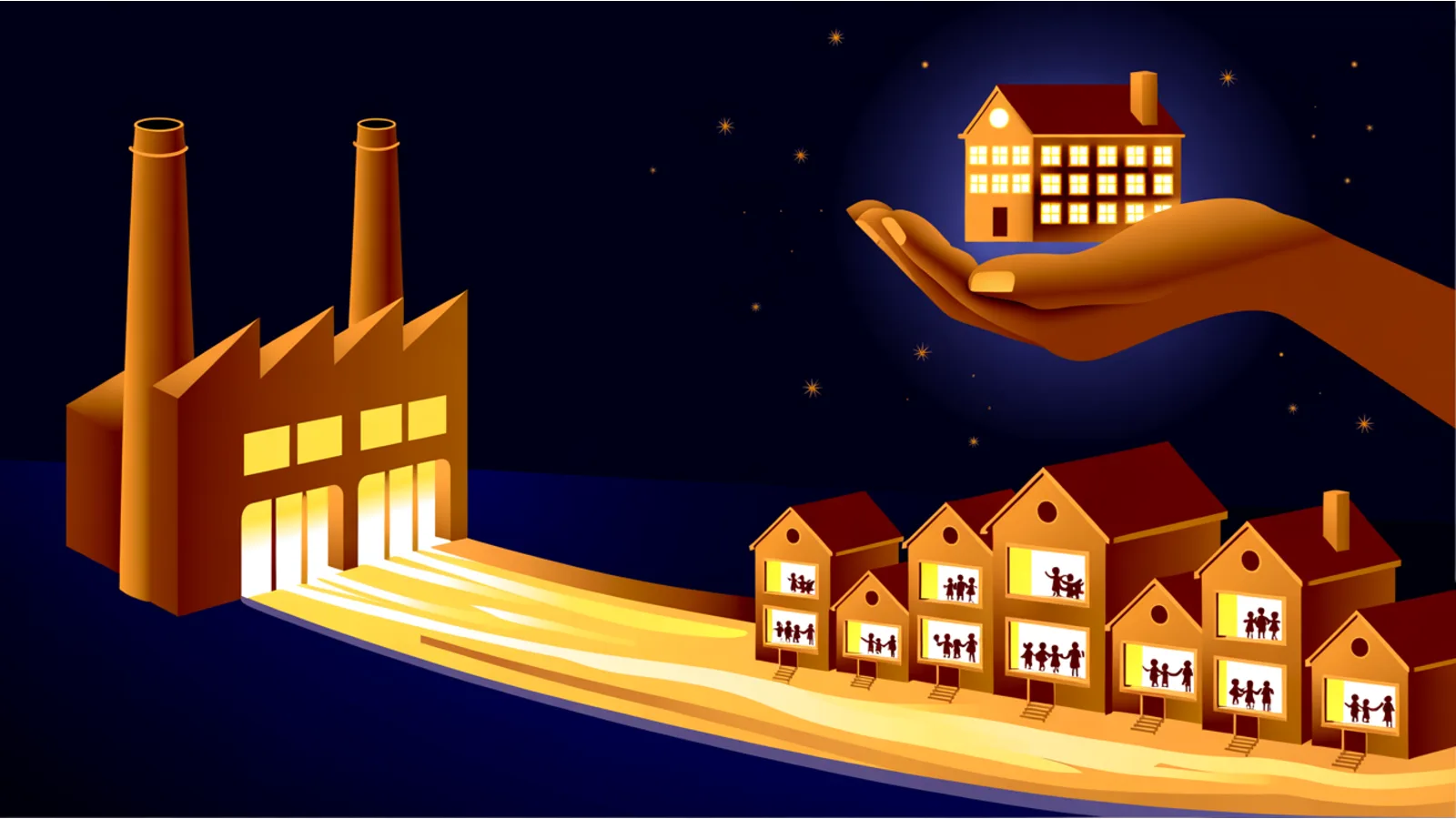
The Tax Reform Act of 1969 forced America's private foundations to sell down any controlling stake they held in a business, so that a charity could not double as a way to keep a company in the family. There is one enormous exception hiding in plain sight, and it is one of the most admirable institutions in the country. A candy fortune, left in trust for orphaned and poor children, still controls the Hershey Company outright, casting roughly four-fifths of the vote at a public corporation while owning barely a quarter of its economics, and the law that forced every foundation to let go cannot touch it. This is the story of that trust: a genuinely good American story built on a quiet structural advantage. Everything below is from the filings and the record.
The man with no heirs
Milton Snavely Hershey was born on a Pennsylvania farm in 1857, left school around the fourth grade, and failed at candy-making twice before he succeeded, going bankrupt in Philadelphia in 1882 and failing again in New York within a few years (Hershey Community Archives; Wikipedia, "Milton S. Hershey"). What finally worked was caramel made with fresh milk, and then, after he saw German chocolate machinery at the 1893 world's fair in Chicago, milk chocolate at a price ordinary people could afford. He founded the Hershey Chocolate Company in 1894, sold the caramel business for $1 million in 1900, and built a model company town in the Derry Township farm fields, with worker housing, a park, and schools (Hershey Community Archives, milk chocolate; HersheyPA).
He married Catherine Sweeney in 1898, and the couple had no children of their own; she died in 1915 (Hershey Community Archives, Catherine). That absence set the direction of the entire fortune. As Hershey put it, "I have no heirs, that is, no children. So I decided to make the orphan boys of the United States my heirs" (Hershey Community Archives, the gift).
The gift, made quietly
He acted on it twice. In 1909, Milton and Catherine signed a deed of trust founding the Hershey Industrial School, now the Milton Hershey School, for orphaned boys, naming the Hershey Trust Company as trustee (Hershey Community Archives, trust company). Then, on November 13, 1918, three years after Catherine's death, he did the thing that made the school one of the richest in the world: he transferred essentially his entire fortune, his controlling stock in the Hershey Chocolate Company, into the trust for the school (Milton Hershey School, the gift). He did it so quietly that the public did not learn of it for about five years; it was first reported in 1923 under the headline "$60,000,000 Gift Confirmed," the value the press assigned to it at the time (Milton Hershey School history). A man gave away his whole fortune to educate poor children and told almost no one.
The machine, and the advantage
A century of compounding turned that gift into a giant. The Milton Hershey School and School Trust reported total assets of $23.4 billion on its most recent Form 990, for the year ending July 2024, down slightly from a peak of $24.2 billion the year before, and it has been tax-exempt since 1937 (ProPublica, EIN 23-1353340). It is one of the largest charitable endowments in the United States, and it exists to run a single school.
Here is the structural fact that makes it remarkable. Through the Hershey Trust Company as trustee, the school's trust holds essentially all of the Hershey Company's special Class B stock, which carries ten votes per share to the common stock's one. As of the end of 2024 that gave the trust roughly 79 percent of the total shareholder vote while holding only about 28 percent of the company's economic value, and the Class B block elects most of the board (Hershey Company Form 10-K). A charity, in other words, controls a $40 billion public company outright.
The 1969 law was written precisely to stop this. Its excess-business-holdings rule generally caps a private foundation and its insiders at 20 percent of a company's voting stock, so that a foundation cannot be a control vehicle, and it was enacted to end exactly the arrangement Hershey has (IRS on Section 4943). But the rule reaches only private foundations. Because the Milton Hershey School is a public charity, a school, it files an ordinary Form 990 rather than the private-foundation return, and Section 4943 does not apply to it (ProPublica classification; IRS on public charities). The same public-charity status that makes the story admirable is what lets the trust keep the corporate control an equivalent private foundation would be forced to sell. That is the quiet advantage at the center of it.
What the money does
And what the advantage funds is genuinely good. The Milton Hershey School enrolls more than 2,100 children from lower-income families, from pre-kindergarten through twelfth grade, and it is entirely free to them: housing, meals, clothing, school supplies, medical and dental care, counseling, and tutoring, all covered (Milton Hershey School fast facts; Milton Hershey School FAQs). The children live on a 7,000-acre campus in more than 180 student homes of roughly eight to twelve kids each, cared for by married couples who live with them (Milton Hershey School fast facts). Reporting in 2021 put the all-in cost at roughly $139,000 per child a year (ProPublica). Eligibility is need-based, and the school that began for white male orphans now admits children of any race and sex, having enrolled girls since 1977 (Milton Hershey School admissions; Wikipedia, "Milton Hershey School").
The tension the control creates
The same control that funds the school is also the thing that keeps getting the trust into trouble, because a charity that owns a company faces a conflict the rest of us never think about: what is best for the children and what is best for keeping control are not always the same. In 2002 the trustees decided the trust was dangerously concentrated in one stock and moved to sell control of the Hershey Company to diversify; the Wrigley company offered about $12.5 billion (Forbes; Wikipedia, "The Hershey Company"). The town of Hershey revolted, and the Pennsylvania attorney general went to court to stop the sale, winning an injunction that a state appeals court upheld; the board abandoned the deal about 55 days after announcing it (Commonwealth Court injunction; CBS News). The episode produced a Pennsylvania law requiring a charitable trust that controls a public company to give the attorney general 60 days' notice before surrendering control (Pennsylvania statute). Governance fights over real-estate deals and board pay have recurred since, culminating in a 2016 settlement that imposed term limits and compensation caps (National Law Review). And a persistent critique argues the endowment has grown far faster than the school, roughly quadrupling from 1999 to more than $17 billion by 2019 while enrollment only doubled, in part because the founding deed limits the board to spending income rather than principal (Spotlight PA).
That is the whole shape of it. A near-illiterate, twice-bankrupt candy maker with no children gave his entire company to poor children, and a century of tax-exempt compounding turned it into a $23 billion trust that raises and educates two thousand of them, cost-free, forever. It works because the trust is allowed to keep the corporate control that the foundation rules would otherwise forbid, and that same control is the recurring source of its fights. The good story and the structural advantage are not two facts about the Hershey trust. They are the same fact, seen from two sides.
Related reading
- The Rules Beneath the Endowment: the 1969 excess-business-holdings rule the Hershey trust sits outside.
- The Orphan's Dividend: Stephen Girard's earlier bequest to educate orphans, and how that dividend is measured.
- The New Fortunes: the private foundations that the same rules do reach.
- The Working Ledgers: the market underneath every endowment that holds money.
Fact-check notes and sources
- Milton Hershey and the gift (his 1857 birth, minimal schooling, two bankruptcies, the 1894 founding of the Hershey Chocolate Company and the model town; his marriage to Catherine, who died in 1915, and their lack of children; the "make the orphan boys of the United States my heirs" quotation; the 1909 founding of the school; and the November 13, 1918 transfer of essentially his entire fortune into the trust, made public in 1923 as a "$60,000,000 Gift"): Hershey Community Archives, Hershey Community Archives on the gift, Milton Hershey School on the gift, and Milton Hershey School history. The $60 million is the value reported by the press in 1923, not an audited 1918 figure.
- The trust and the control (total assets of $23.4 billion for the year ending July 2024, down from a $24.2 billion peak, tax-exempt since 1937; the Hershey Trust Company holding the Class B supervoting stock for roughly 79 percent of the vote on about 28 percent of the economics, controlling most of the board; and the public-charity status that exempts the school, a Form 990 filer, from the Section 4943 excess-business-holdings rule that caps private foundations at 20 percent): ProPublica, EIN 23-1353340, the Hershey Company Form 10-K, IRS on Section 4943, and IRS on public charities. The 28 percent economic figure is derived from the share counts in the 10-K.
- The school today (more than 2,100 students from lower-income families, pre-K through 12, entirely free including housing, meals, and care; the 7,000-acre campus and 180-plus student homes; the roughly $139,000 per-child all-in cost reported in 2021; and the need-based, coeducational admissions since 1977): Milton Hershey School fast facts, FAQs, admissions criteria, and ProPublica.
- The 2002 sale and the controversies (the trustees' 2002 move to sell control, the roughly $12.5 billion Wrigley offer, the Pennsylvania Attorney General's injunction upheld on appeal, the abandonment after about 55 days, the resulting 60-day-notice law, the 2016 governance settlement, and the endowment-growth critique): Forbes, Wikipedia, "The Hershey Company", Commonwealth Court, CBS News, Pennsylvania statute, National Law Review, and Spotlight PA.
This post is informational and historical, not financial or legal advice. All figures are reproduced from the cited filings and public record. Institutions and individuals are discussed as nominative fair use from the public record, with no affiliation implied.
