
Most of the foundations in this series give money away. The J. Paul Getty Trust does something rarer: it spends its investment income on itself, on the museums it runs, and admission is free. It is the wealthiest art institution on earth, and its most recent Form 990-PF, for the fiscal year that ended June 30, 2024, shows exactly how that works, a $16.9 billion pile of assets at fair value, an $8.4 billion investment endowment underneath it, and a spending rule that lets the public walk in for nothing. It is the purest example this series has found of an institution where the endowment is not a cushion behind the mission. The endowment is the mission's entire source of income. Everything below is from the filing and the public record.
An oil fortune that became a museum
J. Paul Getty founded the trust in 1953, and when the oil magnate died in 1976 he left it the bulk of his fortune in Getty Oil stock, roughly $660 million, though legal disputes delayed the full bequest until 1982, when the institution took its modern shape (Wikipedia, "J. Paul Getty Trust"). What that money built is unusual. The Getty is a private operating foundation, which means it does not simply write checks; it runs things. It operates four entities at once: the J. Paul Getty Museum, split between the Getty Center in the hills above Los Angeles and the Getty Villa on the coast; the Getty Foundation, which does make grants; the Getty Research Institute; and the Getty Conservation Institute. About 1.6 million people visit each year, and none of them pay admission.
The reason they do not pay is on the balance sheet. The Getty does not fund itself from ticket sales, because there are no tickets. It funds itself from its endowment, which it draws down at a deliberate, smoothed rate, roughly 5 percent of a 36-month rolling average of the portfolio's value (Getty financials). That is the same spending discipline a university endowment uses, applied to a museum. The art is free because the market pays for it.
What the filing shows
The FY2024 return reports $16,876,948,065 in total assets at fair value. That figure is larger than the endowment itself, because it includes the Getty Center and the Villa, the land under them, and the rest of the physical institution; the investment endowment that actually generates the income is the roughly $8.4 billion subset (Wikipedia). In the year of the filing, the Getty spent $420,555,483 in total expenses and reported $337,441,114 in disbursements for its charitable purpose, which for an operating foundation means running the museums and the institutes as much as making grants. Net investment income for the year was $585,014,638. Read those three numbers together and the machine is clear: the portfolio threw off more than half a billion dollars, and the institution spent a portion of it operating a free museum and funding conservation and research around the world.
The people who run the money are, as at the big grantmaking foundations, paid like the investment professionals they are, the chief investment officer appearing among the top-compensated names alongside the museum director. That is not a scandal. It is the tell that this is a multi-billion-dollar investment operation with a museum attached, which is precisely what lets the museum be free.
The year the market cut it in half, and the year the fire came
Two events show the two risks an institution like this carries, and the Getty has lived through both.
The market risk is not hypothetical. In the 2008 financial crisis the Getty's endowment fell from around $8 billion to roughly $4.5 billion, nearly in half, before recovering over the following years (Wikipedia). An institution that funds a free museum entirely from its portfolio is an institution whose free museum rises and falls with the same markets a pension fund and a retiree are invested in. This is the same well this series keeps returning to. When the market halved the endowment, the Getty had to cut, because the endowment was the income. The 36-month smoothing rule exists precisely to soften that blow, to spread a bad year across three so the galleries do not have to close when the S&P drops.
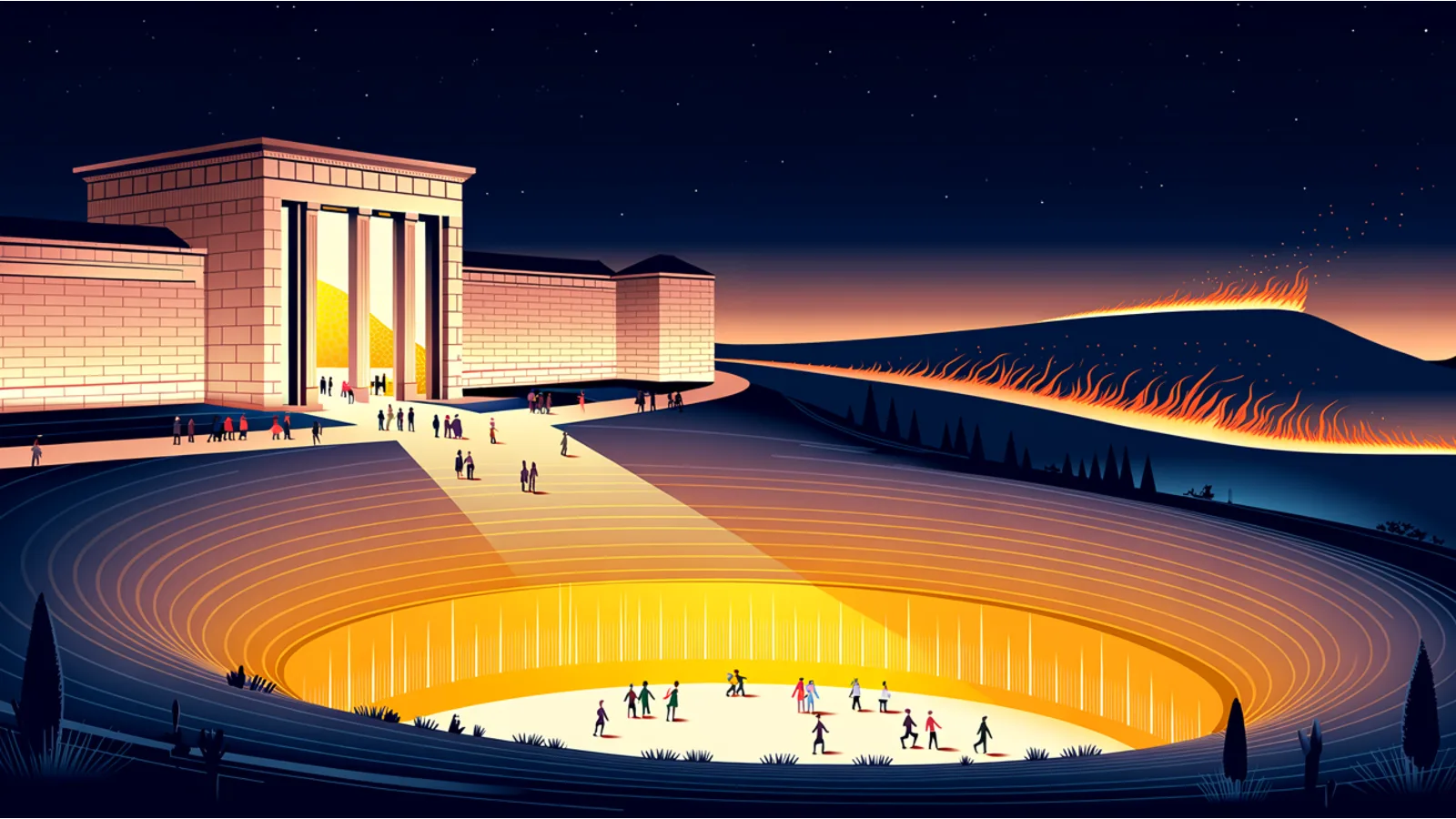
The physical risk arrived in January 2025, when the Palisades Fire burned through the hills around the Getty Villa. The grounds and vegetation burned, but the structures, the staff, and more than 44,000 antiquities were saved, because the Getty had cleared brush for exactly this and had built its galleries of reinforced concrete designed to keep fire out (NPR; Getty statement). An endowment can be rebuilt after a market crash. A collection cannot be rebuilt after a fire, which is why the building that houses it was engineered to survive one. The Getty's president and chief executive, Katherine Fleming, the former New York University provost who in 2022 became the first woman to lead the trust, wrote the public statements as the fire approached.
For how long
Forever, in the way an endowment means forever, with two live caveats the Getty itself demonstrates. As long as the portfolio compounds and the 5 percent smoothed draw stays below the long-run return, the free museum funds itself indefinitely, the way a perpetual endowment is designed to. The caveats are the two risks above. A prolonged market decline would force the same cuts 2008 forced, because there is no ticket revenue to fall back on. And the physical plant, the Center and the Villa and the collection, is exposed to the Southern California hazards that nearly reached the Villa in 2025. The Getty has answered this series' four questions in the most single-minded way possible. It invests like a large endowment, it stays solvent on its investment income alone, it continues its work by spending a disciplined slice of a smoothed average, and it lasts as long as the markets and the fire lines hold. J. Paul Getty made his money pulling oil out of the ground. The institution that carries his name now makes its money the way every large endowment does, in the markets, and it spends that money buying the public something unusual in America: a world-class museum that costs nothing to enter.
Related reading
- The New Fortunes: the Getty among two dozen of the largest new foundations, read from their filings.
- The MacArthur Foundation: another multi-billion-dollar endowment, and its decision to break the 5 percent spending rule.
- The Endowment That Employs Its Scientists: HHMI, the same perpetual-endowment model funding science instead of art.
- How Deathless Money Invests: where an operating endowment fits in the taxonomy of institutional money.
Fact-check notes and sources
- The financial figures (total assets at fair value of $16,876,948,065; total expenses of $420,555,483; charitable-purpose disbursements of $337,441,114; and net investment income of $585,014,638): read directly from the J. Paul Getty Trust's IRS Form 990-PF for the fiscal year ending June 30, 2024 (EIN 95-1790021), available free at ProPublica's Nonprofit Explorer.
- The 1953 founding, J. Paul Getty's roughly $660 million bequest delayed to 1982, the four-entity operating structure, the free admission and roughly 1.6 million annual visitors, the roughly $8.4 billion investment endowment, and the 2008 fall from about $8 billion to roughly $4.5 billion: Wikipedia, "J. Paul Getty Trust", attributed. The endowment being a subset of total assets, distinct from the buildings and land, is noted there and in the trust's own reporting.
- The roughly 5 percent of a 36-month rolling-average spending rule: the Getty's financials page.
- The January 2025 Palisades Fire, the burned grounds, and the saved structures, staff, and more than 44,000 antiquities: NPR and the Getty's own statement from president and CEO Katherine E. Fleming; Fleming's 2022 appointment as the first woman to lead the trust per Wikipedia.
This post is informational and historical, not financial or investment advice. All figures are reproduced from the cited public filing and the public record. Individuals are discussed from the public record as nominative fair use, with no affiliation implied and nothing endorsed by the J. Paul Getty Trust.
