
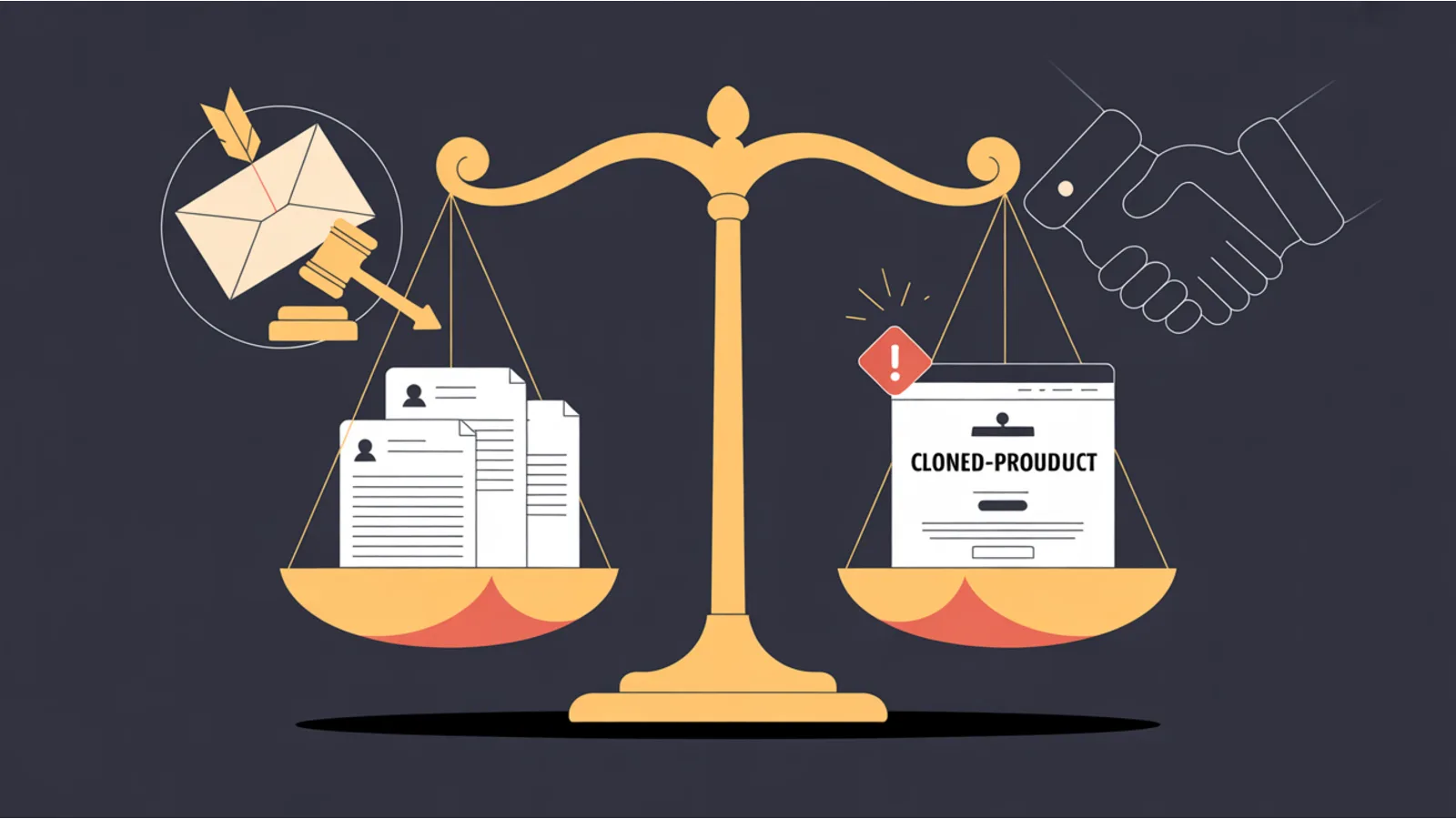
If someone clones your site or a tool you built, the Digital Millennium Copyright Act is almost always the fastest lever to pull. A valid DMCA takedown notice sent to the clone's hosting provider typically gets a response within 24–72 hours. You do not need a lawyer to send one. You do need to understand the mechanics.
This post covers: what a valid notice has to contain, where to send it, what a Terms of Use page should say to make the notice airtight, and the safe-harbor rules that make hosts cooperate. It is informational, not legal advice — and a real lawyer is still worth the $300 for anything complex.
For the detection side that precedes takedown, see HTML Watermark Tokens for Clone Detection.
Safe harbor, in one paragraph
The reason DMCA works as a dev tool at all is Title II of the DMCA — 17 U.S.C. § 512 — which creates a "safe harbor" for online service providers. A host is not liable for infringement by its users if it takes action on valid takedown notices. Hosts who ignore notices lose safe harbor. Hosts who act promptly keep it. That's the entire incentive structure: the host wants to take down infringing content because their legal protection depends on it.
This is why targeting the host works better than targeting the cloner. The cloner doesn't care about your feelings. The host cares about losing their immunity shield for every other customer on their platform.
What a DMCA takedown notice must contain
17 U.S.C. § 512(c)(3)(A) lists six required elements. If your notice is missing any of them, the host can legally ignore it. A compliant notice has:
- A physical or electronic signature of the rights-holder or their authorized agent. Typing your full name at the bottom counts as an electronic signature.
- Identification of the copyrighted work claimed to be infringed. Example: "The original [pagename] page at https://jwatte.com/tools/[slug]/, including all HTML, CSS, JavaScript, and hero image at /images/blog-[slug].webp."
- Identification of the allegedly infringing material and where it is located. Give specific URLs on the clone. One URL per item, not "the whole site."
- Your contact information — name, address, phone, email.
- A good-faith belief statement. The exact language used in most notices: "I have a good-faith belief that the use of the material in the manner complained of is not authorized by the copyright owner, its agent, or the law."
- A statement under penalty of perjury that the information in the notice is accurate and that you are authorized to act on behalf of the rights-holder. Exact language: "I swear, under penalty of perjury, that the information in this notification is accurate, and that I am the owner (or authorized to act on behalf of the owner) of the exclusive right that is allegedly infringed."
That's it. Six elements. Miss any one and the host has a legal reason not to act.
Where to send the notice
Every qualifying host has a registered DMCA agent. Two ways to find the contact:
- Host's website. Search
[hostname] DMCA agent— Netlify, Cloudflare, Vercel, AWS, GoDaddy, Namecheap, Squarespace all publish this prominently. Most have a web form. - The U.S. Copyright Office's DMCA agent directory. Every registered agent's contact info is at dmca.copyright.gov/osp. Use this when the host is obscure or you can't find a published contact.
Which host to notify? The one actually hosting the infringing content. Identifying that can require a chain:
dig +short cloned-site.com→ gives the IP or CDN hostname- If CDN-fronted (e.g., Cloudflare), notify Cloudflare even though they're "just a CDN" — Cloudflare's stance is that they forward notices to the origin host and disclose the origin host's IP to you if the claim is well-formed
- If the IP resolves to a hosting company (DigitalOcean, AWS, OVH, Linode), notify them directly
- Where ads are involved, file a parallel notice with the ad network (Google AdSense, Mediavine, Ezoic) — many ad networks will cut the cloner's revenue within 48 hours even before the host acts
On jwatte.com we keep a running template with placeholders for [clone URL], [specific infringing element], [date observed] so a verified clone match → sent notice is 10 minutes of work.
The counter-notice risk
When you file a DMCA notice, the cloner can file a counter-notice under § 512(g). If they do, the host is required to put the content back up 10–14 business days later unless you file a lawsuit within that window. If you're not prepared to sue, a counter-notice wins.
In practice this is rare. Most clones are low-effort wget jobs run by someone who doesn't want legal attention. Counter-notices require the filer to "consent to the jurisdiction of Federal District Court" and provide a real name and address. Cloners who put fake info on a counter-notice have committed perjury; counter-notices with real info from real operators are rare.
If you start getting counter-notices frequently, your situation has escalated past the DIY phase. Get a lawyer.
What your Terms of Use page should say
A Terms of Use page isn't required for DMCA notices to work — copyright exists without a terms page. But a clear terms page:
- Makes your ownership claim unambiguous in the DMCA good-faith statement
- Gives you a URL to link in the notice ("see prohibited uses at [yoursite.com/terms]")
- Clarifies what is allowed — so legitimate users know they can use the tool without asking
- Documents your attribution policy if a good-faith user wants to reference your content
The jwatte.com Terms covers:
- Ownership — "All content, code, audits, blog posts, and hero images on jwatte.com are © J.A. Watte."
- Permitted use — "Free for end-users to run tools against their own sites. Free to read and share blog posts with attribution."
- Prohibited use — "Redistribution of the source HTML, re-hosting of tools, automated scraping beyond the
/ai.txtallow-list, or re-packaging without permission." - DMCA contact — name, email, mailing address for the designated agent. The site owner is the DMCA agent; we don't need to register separately because we're the rights holder, not a service provider.
- Nominative fair use — "Third-party product and service names mentioned are used nominatively; no affiliation is implied."
- Attribution request — how to cite blog posts or tool output in academic or commercial contexts.
A full template we use is published at jwatte.com/terms/. Copy, swap the specifics, publish.
If you offer a service (not just content)
If your site hosts user-generated content — comments, forum posts, uploads — you are a service provider under DMCA and need to do more than just publish a terms page:
- Register a DMCA agent with the U.S. Copyright Office via dmca.copyright.gov. Small fee; required for safe-harbor protection.
- Publish a designated-agent contact prominently on your site.
- Implement a notice-and-takedown process — when you get a notice, you act on it; when the user files a counter-notice, you put it back unless the rights-holder sues.
- Terminate repeat infringers — have a policy, document enforcement.
That's a different phase. Most indie tool sites don't host user content and skip the agent registration. If you're building a tool that ships user-generated audits or saves user scans, revisit the question.
Enforcement patterns that actually work
Ordered by what we've seen hit fastest:
- Ad-network takedown — if the clone is monetized via AdSense, Mediavine, or similar, filing an abuse notice with the ad network often kills the cloner's revenue within 24 hours. They frequently abandon the clone at that point.
- DMCA notice to the host — 24–72 hours. High hit rate because the host's safe harbor is on the line.
- Registrar abuse complaint — slower (1–2 weeks) but can ultimately deregister the domain if the host doesn't act. Last resort.
- Search-engine delisting request — Google accepts DMCA takedowns to remove infringing URLs from search results. Doesn't remove the clone, but stops it from ranking. File at support.google.com/legal. Sometimes the highest-leverage move if the cloner is ad-supported and depends on SERP traffic.
We do not recommend:
- Contacting the cloner directly — usually zero effect, can escalate into harassment, and gives them a tip to move.
- Public shaming on social media — backfire risk is high; Streisand effect exists.
- Trying to reverse-hack the clone — illegal in most jurisdictions under CFAA and equivalents, even if they stole from you first.
A minimal notice template
This is what we actually send — adapt to your situation:
To: [host abuse email or form]
From: [your name]
Subject: DMCA Takedown Notice — [infringing URL]

I am the copyright owner of the content at:
  - https://yoursite.com/page/
  - https://yoursite.com/tool/
  - [all relevant canonical URLs you own]

The following URLs contain my copyrighted material, reproduced without
authorization:
  - https://clone-site.com/page/
  - https://clone-site.com/tool/
  - [all infringing URLs]

Specific elements infringed include the HTML, CSS, JavaScript, and images
at those locations, published first on my site on [date]. Evidence of
prior publication includes the watermark string "[your-token]" which
survives on the clone's pages (searchable in Google).

Contact information:
  Name: [your full name]
  Address: [your mailing address]
  Phone: [your phone]
  Email: [your email]

I have a good-faith belief that the use of the material in the manner
complained of is not authorized by the copyright owner, its agent, or
the law.

I swear, under penalty of perjury, that the information in this
notification is accurate, and that I am the owner (or authorized to
act on behalf of the owner) of the exclusive right that is allegedly
infringed.

Signed,
[your full name]
[today's date]
Sent by email to the host's DMCA agent address or pasted into their web form. That's the complete notice.
The layering view
DMCA is one layer. The complete content-defense stack is:
- Detection — HTML watermark tokens + Google Alerts.
- Perimeter — Netlify's Application Firewall or Cloudflare's Bot Management to prevent the scrape from succeeding in the first place.
- Code posture — Serverless Posture Audit — Origin allowlist on your API functions prevents cloned sites from using your proxy even if they clone the HTML.
- Legal — DMCA + Terms of Use (this post).
No single layer is a complete defense. Detection without takedown is informational only. Takedown without detection is reactive after damage. Terms without a watermark-backed evidence chain is hard to enforce. Ship all four.
If you're building an indie tool-and-content business, The $20 Dollar Agency covers the whole GTM plus defense stack for sites under $100/mo total operational cost.
Fact-check notes and sources
- 17 U.S.C. § 512 — the DMCA safe-harbor and notice-and-takedown statute: copyright.gov/title17/92chap5.html#512.
- U.S. Copyright Office DMCA agent directory — required for service providers to register: dmca.copyright.gov.
- Google DMCA / legal removal tool — for search-result delisting: support.google.com/legal.
- Cloudflare DMCA policy — including how they handle notices when they're the CDN (not the host): cloudflare.com/trust-hub/abuse-approach/.
- Counter-notice procedure — § 512(g), which governs what happens after a counter-notice is filed.
- Electronic Frontier Foundation DMCA guide — general background and common pitfalls: eff.org/issues/dmca.
- CFAA (why reverse-hacking a cloner is a bad idea): 18 U.S.C. § 1030.
Related reading
- HTML Watermark Tokens for Clone Detection — the detection layer that feeds this notice
- The Content Protection Playbook — the full defense stack
- Netlify WAF vs Cloudflare Bot Management — perimeter that prevents cloning from succeeding
- Serverless Posture Audit — protect the API layer your clone would try to reuse
This post is informational, not legal advice. DMCA law is complex and has jurisdictional wrinkles outside the U.S. For anything beyond a single-clone takedown, consult a lawyer licensed in your jurisdiction.
