
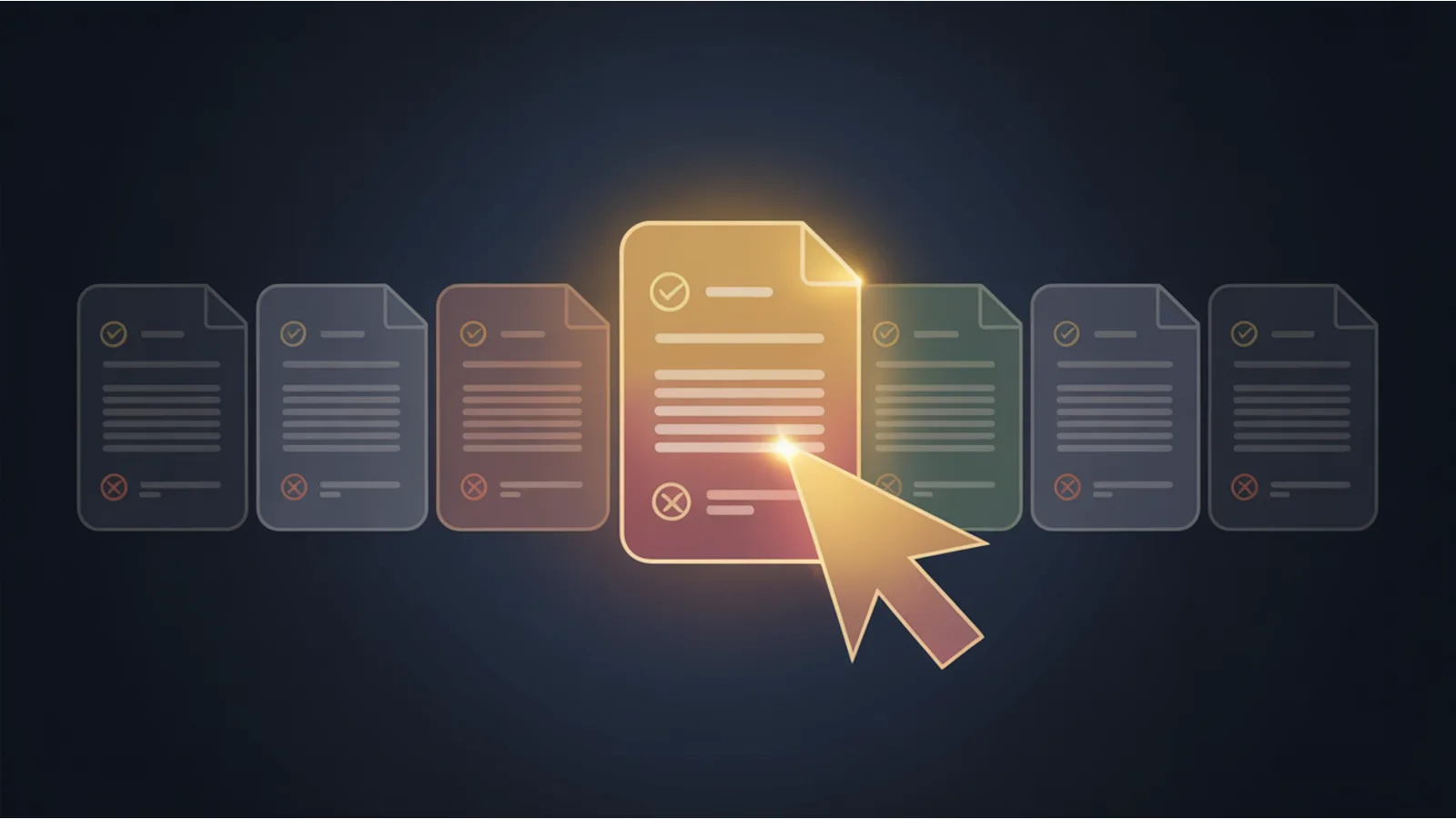
Google ranks at the page level. Perplexity and ChatGPT Search rank at the passage level. This is the single biggest measurement shift between traditional SEO and AEO, and most audits still don't account for it.
The practical implication: a page with one retrieval-ready paragraph outperforms a page with ten average paragraphs. A paragraph is retrieval-ready when it's 40-120 words long, opens with a declarative noun phrase, has no unresolved pronouns, contains concrete facts (numbers, proper nouns), and stands alone without needing the surrounding context.
The Passage Retrievability Scorer fetches a URL, splits it into passages, and scores each on six signals. You learn which paragraphs are retrieval-ready and which ones need rewriting.
The six signals
1. Citation-length (40-120 words). Too short (under 40) = the passage doesn't carry enough context to stand alone as a citation. Too long (over 120) = the LLM truncates and loses the signal. 40-120 is the sweet spot that matches how AI engines display citations — roughly one to two sentences of lead plus one to two sentences of detail.
2. Direct-answer opener. Does the first sentence begin with a concrete subject, or with a pronoun / transition ("This", "That", "However", "For example")? Passages that open with a direct declaration get retrieved more often because they stand alone without needing the prior paragraph.
3. Low pronoun density. Pronouns require antecedents. A paragraph full of "it", "this", "they" needs the surrounding text to resolve. Ripped out of context, the meaning is ambiguous. Target is under 6% pronoun tokens.
4. Fact density. Three or more combined numeric tokens and proper nouns in the paragraph. Facts are what LLMs prefer when citing — they're verifiable, concrete, and unambiguous. A paragraph without facts reads as opinion, which is less cite-worthy.
5. Self-contained. A paragraph that passes the first three checks is usually self-contained. The scorer double-checks by looking for a named subject (the or a + noun phrase, or any proper noun) and word count above 30.
6. Subject clarity. The first sentence's subject should be a noun phrase, not a pronoun. Passages that pass this check correlate strongly with which paragraphs actually get lifted into AI answers.
What the output shows
Each paragraph on the page gets:
- A score 0-100% (hits / 6 × 100)
- A per-check breakdown showing which signals passed and failed
- A color-coded left border (green ≥ 75%, amber 50-74%, red < 50%)
- The paragraph itself in a scrollable view
A page summary at the top reports average retrievability, strong-passage count, and weak-passage count.
Typical first-run pattern
Most articles score 40-60% on average retrievability. Common failure modes:
- Pronoun openers. ~50% of paragraphs start with "This", "That", "It", or a transition word. Fix: rewrite the first sentence to name the subject explicitly.
- Too short. ~20% of paragraphs are under 40 words. Fix: merge with adjacent paragraph, or expand with an example.
- No facts. ~30% of paragraphs contain no numbers or proper nouns. Fix: add a specific number, date, or named entity.
A single editing pass targeting these three fixes typically lifts average retrievability from 50% to 70%. That's the difference between "occasionally cited" and "reliably cited" for the content.
What the scorer doesn't measure
- Topical relevance. A perfectly retrieval-ready paragraph about an off-topic subject won't get cited for the seed query. Relevance is an upstream problem solved by content planning — use the Query Fan-Out Generator for that.
- Authority. A retrievable paragraph on a domain with zero AEO signals still loses to an average paragraph on a high-authority domain. Check AI Citation Readiness for page-level signals.
- Freshness. Dated content de-ranks in retrieval regardless of passage quality. Update dates and ensure
dateModifiedis correct.
The workflow
- Pick your most-important article.
- Run the scorer.
- For every passage scoring under 50%, rewrite the first sentence to include a direct subject + add one fact.
- Re-run. Average should move 15-25 percentage points.
- Repeat for next article.
Apply to the top 10 articles and your site's overall AEO posture changes meaningfully. Paid AEO tools promise this kind of per-passage feedback as a $199/mo subscription. The scorer gives you the same diagnostic without the bill.
Related reading
- AI Citation Readiness — 14 page-level signals complement the passage-level check.
- Speakable Generator — mark the strongest passages as Speakable for voice + AI citations.
- Voice Tone — Flesch, grade, passive voice at the article level.
- Query Fan-Out Generator — upstream content planning for what to write about.
Fact-check notes and sources
- Google passage indexing announcement (2020, relevant foundation): blog.google/products/search/search-on-explained-series
- Dense Passage Retrieval paper (Karpukhin et al. 2020): arxiv.org/abs/2004.04906
- RAG retrieval at passage level in production systems: langchain.com/docs/modules/data_connection/retrievers
The $100 Network covers writing retrieval-ready content across a site network at scale. The passage scorer is how you verify the writing actually landed.
