
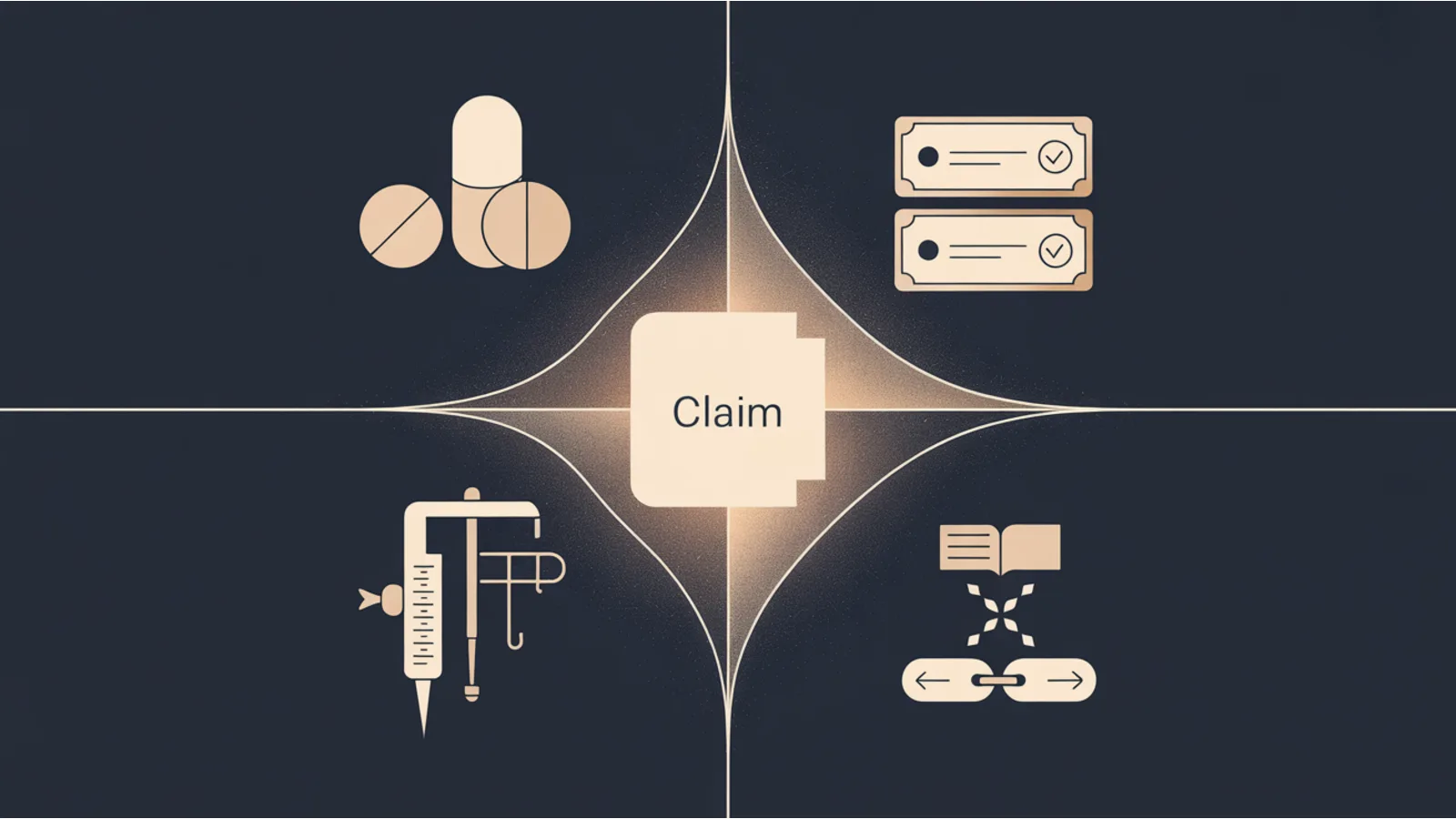
Four related rows in the Mega Analyzer look at whether your page says anything specific enough to be citable. Quantified claims. Compliance badges. License markers. Source attribution. Each one is informational because its absence isn't a fail, but the four together tell you whether your page reads as a careful publication or a marketing brochure.
AI answer engines, and Perplexity in particular, have a strong preference for sources with specific numbers attached to citations. Generic claims get skipped. If your page says "we help thousands of businesses," no AI is citing that. If it says "we've processed 14,382 permits across 480 California cities since 2021," you're getting cited.
Quantified claims. At least two numbers with units
Vague marketing language trips an LLM's low-trust filter. "Leading," "best," "trusted," "cutting-edge" are tagged as unverifiable in most retrieval-augmented systems. A page needs at least two specific numbers with units before it reads as substantive.
Numbers that work:
- Time-bound. "Cut onboarding from six weeks to nine days."
- Scale-bound. "Over 480 California cities deployed since 2019."
- Cost-bound. "250 million dollars deployed through the platform."
- Count-bound. "14,000 permits processed in the 2024 fiscal year."
Numbers that don't:
- Unsourced percentages. "95% customer satisfaction" without a survey source looks made up.
- Round thousands. "Over 10,000 users" reads as an estimate. "10,384 users as of March 2026" reads as a fact.
- Internal metrics nobody can verify. "Zero security incidents in five years" is plausible, but without a third-party audit claim it's still just your word.
Two real numbers with units outperform ten round-number pitch-deck claims.
Compliance and security badges
If you handle customer data and you've actually earned certifications, say so. SOC 2 Type II, ISO 27001, HIPAA, GDPR, CCPA, PCI-DSS, SOX, FedRAMP. Missing these when you have them is a conversion and an AEO loss. Claiming them when you don't is a legal loss.
The right way to surface them:
- Logo strip of the certifications near the footer.
- A
/securityor/trustpage that names each certification, the issuing body, the audit date, and a contact email for enterprise security review. - Machine-readable claim in schema markup.
Organization.hasCertificationwith the specific certification name and issuing body.
AI engines are starting to cite the /security page directly in B2B comparison answers. A 1-page /security URL that lists your SOC 2 Type II auditor and audit date is often the single citation that wins the comparison.
Industry license and bonded-and-insured markers
Only relevant if you're a licensed profession. Contractors, attorneys, medical practitioners, CPAs, real-estate agents, licensed therapists, commercial drivers. For these, the license number is not optional. It's the thing that differentiates you from every person with the same domain name who is NOT licensed.
Visible placement matters:
- Contact page, with state and license number. "Licensed general contractor, California CSLB 1082473."
- Footer, one line, same info abbreviated.
- About page, alongside the owner bio.
For trades, "bonded and insured" with the policy limits is also worth saying. "Bonded and insured, 2 million dollar general liability" is a real claim a careful customer can verify. "Bonded and insured" alone reads as filler.
Source attribution on your own claims
When your page cites a statistic, say where it came from. "According to Gartner's 2024 B2B Buyer Behavior research" beats "according to research." Specific attribution does two things. It tells human readers you're not making it up, and it tells AI engines that your content is grounded in third-party data they can verify.
Formats that work:
- Inline attribution. "Gartner's 2024 B2B Buyer Behavior research found that 75 percent of buyers prefer self-serve pricing."
- A
<cite>tag wrapping the source name. - A "Sources" or "Fact-check notes and sources" section at the bottom of a post with bulleted citations.
AI citation engines read inline attribution and <cite> markup as high-confidence signals. A post with zero citations and a post with six citations can have identical text quality and get wildly different AI-citation rates. The citations are the difference.
The combined effect
Two specific numbers. One badge or certification. One license or credential if applicable. Two cited sources per long-form post. That's the minimum bar for a page that reads as substantive to both human and AI readers.
The $20 Dollar Agency has a chapter on turning vague service-business marketing into specific claims, with worked before-and-after examples from real agency landing pages.
Related reading
- AI Citation Readiness, the tool that flags unattributed claims
- Trust Signal Surface Audit, the 12 structural trust artifacts
- Social Proof Signals, the adjacent testimonial and case-study layer
Fact-check notes and sources
- Gartner, 2024 B2B Buying Behavior Research, self-serve and transparency findings.
- California Contractors State License Board (CSLB) public license lookup, for the contractor example.
- Perplexity's 2025 citation-source disclosures, for the AI-engine citation preference claim.
This post is informational, not legal or compliance advice. Claims about certification standards and licensing are general. Verify specifics with your own auditor, attorney, or licensing board.
