
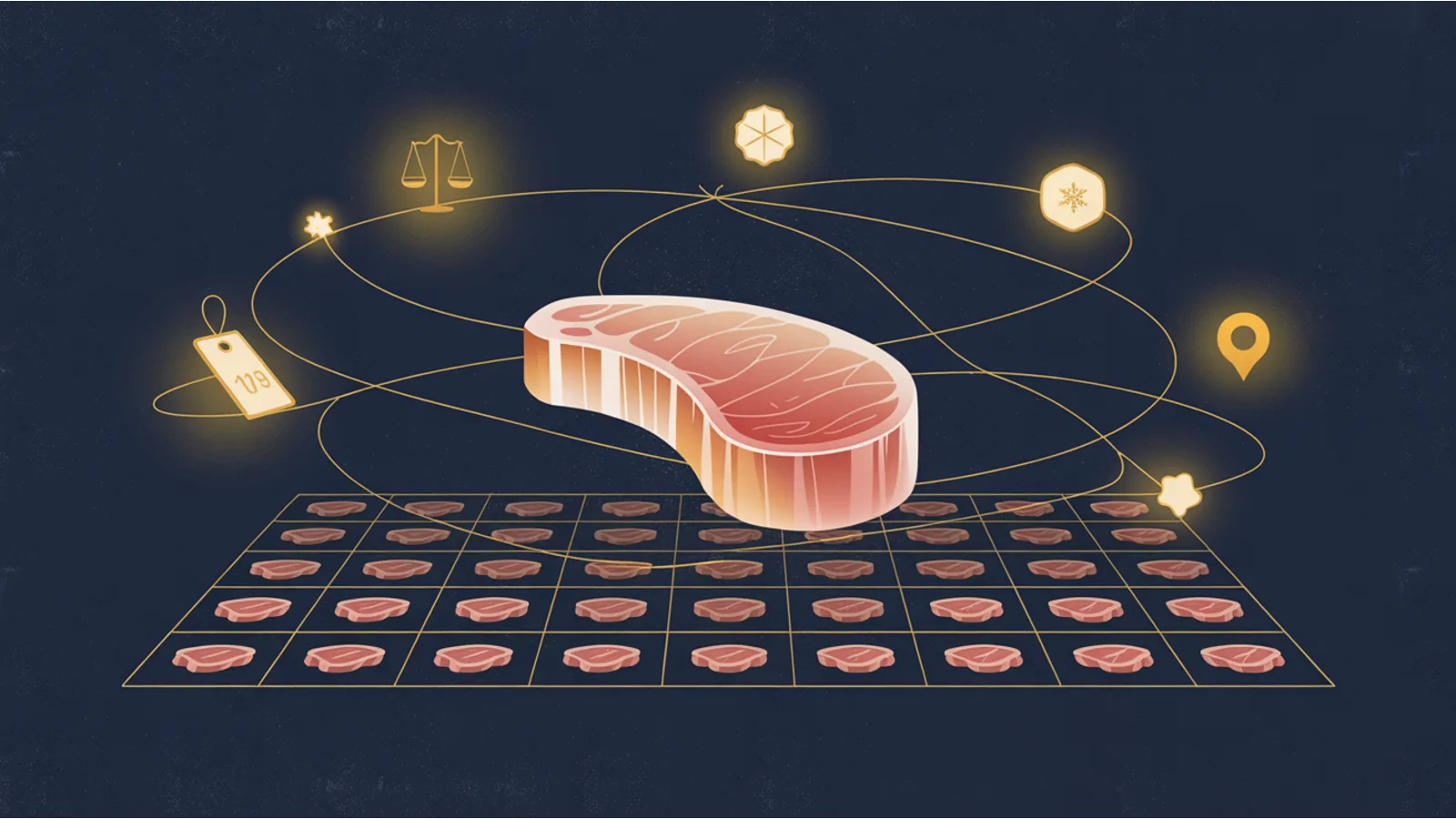
I was asked to look at a regional craft butcher recently. The real kind: a counter you can walk up to, a named-rancher sourcing story, grass-fed and heritage-breed product, local same-day delivery in town, and frozen shipping to the rest of the country. Genuinely good. The photography made you hungry. And when I asked an AI shopping assistant about it the way a customer would, almost nothing came back.
That gap, between a meat shop that looks great to a person and a meat shop that is legible to a machine, is now its own check in the Mega Analyzer. When the analyzer detects a butcher or direct-to-consumer meat brand (meat-cut language plus a real store: "grass fed", "dry-aged", "fill your freezer", a cart, a Product block), it runs a craft-butcher / meat-DTC readiness pass on top of the general e-commerce check. Here is what it looks for, and why each one decides whether AI will find, trust, and sell your meat.
The gap: a meat brand that looks great to a human is often invisible to an AI shopper
AI shopping surfaces (the AI Overviews shopping panels, ChatGPT, Perplexity, Gemini) do not see your photography. They read your Product and Offer JSON-LD, your shipping and return nodes, your reviews, and your provenance claims, and they answer the shopper from that. The butcher I looked at shipped only a bare Organization, a WebSite, and Product blocks with an empty sameAs. No LocalBusiness, no hours, no FAQPage, no Recipe, no shipping schema, and the provenance that justified the price lived only in About-page prose. That is the typical greenfield gap, and it is the exact gap the leaders have closed.
So this is the free self-help version: here is what ButcherBox, Crowd Cow, Snake River Farms, Omaha Steaks, and Porter Road make machine-readable, the specific moves a small meat-DTC owner can copy, and the USDA, FTC, and FDA guardrails that gate the claims. None of it is a rebuild. On Shopify it is theme JSON-LD, metafields, an app, and a settings change.
Claims are compliance, not copywriting: the USDA rules that gate your provenance story
This is the part most web people get wrong, because a meat label is regulated differently from a web headline, and the rules reach your structured data too. The rule of thumb: never put a claim in your page copy or your schema that you could not document to USDA on request.
- Jurisdiction first. USDA FSIS, not FDA, regulates beef and pork labeling under the Federal Meat Inspection Act and pre-approves (or generically approves) labels. FDA governs your non-meat SKUs, the rubs, sauces, sides, and seafood. Bison is the odd one out: it is not covered by mandatory FMIA inspection, so it is inspected under a voluntary FSIS program and carries a distinct voluntary mark, not the round beef-and-pork legend. If you sell all three, know which mark your processor uses.
- Grass-fed has had no federal definition since 2016, when USDA's AMS withdrew the marketing-claim standard. It is now an FSIS label-approval claim: you need a written birth-to-harvest description plus a signed diet statement, and the 2024 FSIS guideline (FSIS-GD-2024-0006) strongly favors third-party certification over a self-affidavit, partly because residue testing found antibiotics in roughly 20 percent of "raised without antibiotics" samples.
- Hormone claims are species-specific. On beef, the approved phrase is "no hormones administered," allowed with FSIS documentation. The "Federal regulations prohibit the use of hormones" disclaimer is required on poultry (and veal, goat, and lamb). For pork, FSIS revised its disclaimer policy around 2020, so do not assume the old "prohibited in pork" line is still required or still accurate; confirm the current wording with your processor before it goes in copy or schema.
- "Natural" is FSIS-defined: no artificial ingredients, minimally processed, plus a short explanatory statement. It speaks only to the finished product, not to how the animal was raised.
- "Organic" means certification. Under the National Organic Program (7 CFR Part 205), only "100% organic" and "organic" (95 percent or more) may carry the USDA Organic seal; "made with organic" (70 to 94.9 percent) may not. A very small operation can be certification-exempt but is still bound by the standards.
- "Aged," "dry-aged," and "heritage breed" have no regulatory definition. They are special claims that still must be truthful and generally need FSIS sketch approval with supporting records (aging logs, breed lineage).
- Breed and grade claims are an enforcement magnet. "USDA Prime / Choice / Select" may be stated only if the product was actually graded by USDA AMS (7 CFR Part 54). "Wagyu," "Kobe," and "Akaushi" need registry or percentage substantiation (true Kobe is a narrow certified import). "Certified Angus Beef" is a licensed program. An unsubstantiated grade or breed claim is FSIS misbranding and an FTC deceptive-practices risk.
The analyzer flags each of these where it sees the claim, in your copy or your schema, and reminds you the machine-readable version carries the same liability as the visible one.
"Product of USA" and "Made in USA": two agencies, one January 2026 deadline
These two get conflated and they are different tracks.
The USDA FSIS final rule (89 FR 19470) set a voluntary compliance date of January 1, 2026: "Product of USA" or "Made in the USA" on meat is allowed only when the animal was born, raised, slaughtered, and processed in the United States, with written substantiation kept for FSIS. That is a real change. Mandatory country-of-origin labeling for beef and pork muscle cuts was repealed in 2015, so a U.S.-origin claim is now voluntary, which is exactly why the new rule defines what it has to mean.
The FTC Made in USA Labeling Rule (16 CFR Part 323) is the separate track for your non-meat merch and multi-ingredient gift boxes. It requires "all or virtually all" U.S. content for an unqualified claim, it explicitly reaches online and catalog claims, and it carries penalties up to $53,088 per violation.
Practical move: if the born-raised-slaughtered-processed chain is documented, encode origin once (Offer.countryOfOrigin or a Product.additionalProperty pointing at the substantiation). If it is not, drop the badge rather than ship a false structured-data claim. "Locally raised" should name the region or the ranches, not imply a blanket origin.
The structured-data stack that makes a hybrid butcher legible
Emit one connected graph per page and reference shared nodes by @id.
- Brand, once. Define the brand as
["Organization","OnlineStore"]with a stable@id, a real non-emptysameAs, acontactPoint, and a brand-level return policy, then point to it everywhere by@id. - A separate Store node. schema.org has no "Butcher" or "FoodStore" type, and
FoodEstablishmentis for dining venues, soStore(orGroceryStore) is correct. Give it its own@id,address,geo,telephone,priceRange, andopeningHoursSpecification, put the local delivery zone onareaServed, and link it to the brand. This is the local-plus-ship advantage a hybrid shop actually has, and most small shops never mark it up. - Real Offers, with price per pound. Upgrade every
Productfrom name-image-description to a fullOffer:price,priceCurrency,availability,itemCondition,url,seller. Add per-pound pricing withOffer.priceSpecificationas aUnitPriceSpecificationandreferenceQuantityof oneLBR, so a packaged steak shows both pack price and price-per-pound, the way a meat shopper actually compares. - Food fields and bundles. Attach
NutritionInformationto processed and multi-ingredient items (single-ingredient raw cuts are nutrition-label-exempt). Encode breed, cut, aging, and origin asProduct.additionalPropertyentries that link to the substantiation. Model freezer boxes as aProductGroupwith variants, or anOfferwitheligibleQuantity, and itemize what is inside, instead of shipping a $599 box as a bareProduct. - Recipe schema for your cooking content. "How to cook a ribeye," "reverse-sear," "smoke a brisket" is the dominant query that brings meat buyers in, and
Recipeis one of the few rich-result-eligible types left in this vertical and a heavily cited AI-answer surface. Naming your own cuts inrecipeIngredientpulls those queries toward your products. - Reality check.
JSON.parseevery block on the rendered HTML after every change.Product,Offer, shipping, return, andReciperender in the Rich Results Test;Organization,Store, andWebSiteare knowledge-graph only.
Perishable shipping and returns, modeled the way the leaders do it
This is where meat differs from every other store, and where the structured data is most often missing.
- Ship Monday through Wednesday, never Thursday or Friday, with an order cutoff (say 10am local) so a weekend carrier delay never leaves dry ice sublimating in a warehouse. Crowd Cow publishes a cutoff and an except-Alaska-and-Hawaii rule; Snake River Farms and Omaha Steaks describe the multi-layer dry-ice pack and a "cold to the touch, not guaranteed frozen solid" promise. Make the honest promise, because transit, weather, and carriers are outside your control.
- Encode it. Use
OfferShippingDetailswith a continental-USDefinedRegion, adeliveryTimeasShippingDeliveryTimecarryinghandlingTime.businessDaysof Mon/Tue/Wed, acutoffTimein ISO-8601 with a timezone offset, and atransitTime. Add a second entity scoped to AK and HI withdoesNotShipset true, so "do you ship to my state" is machine-answerable. - Returns: meat is non-returnable. Set
returnPolicyCategorytoMerchantReturnNotPermittedwithapplicableCountryUS. A theme-default 30-day return window on perishable meat is both false in your structured data and an FTC deceptive-practices risk. schema.org has no replacement-guarantee field, so carry the satisfaction / replacement promise and the report-an-issue window (commonly 48 hours to 7 days) in on-page copy andFAQPageanswers. - Publish thaw safety as trust copy. Per USDA, meat with ice crystals or at 40°F or below is safe to refreeze; the 40°F to 140°F danger zone has a two-hour limit (one hour above 90°F). Put that in an FAQ, because it is exactly what an anxious first-time frozen-meat buyer asks, and the FTC Mail Order Rule expects any stated ship-day window to have a reasonable basis and a cancel-or-refund path when timing slips.
Provenance and reviews: where a small brand can actually out-rank the giants
Provenance is the one axis where the small shop wins. The big incumbents tell brand-level stories; Crowd Cow lets you shop by farm and Grass Roots prints the farm of origin on the package. A genuine named-rancher story beats them, but only if it is structured, not buried in About-page prose. Bind the story to entities: real sameAs links on the brand, an about/our-farms page, and per-product additionalProperty for breed, feed, and origin that points at documentation, so the trust signal actually reaches an answer engine.
Reviews are both data and a legal surface. A review app (Junip, Stamped, Okendo, Yotpo) is what pushes AggregateRating into Product schema and earns the star result; thin native reviews get none. And the FTC Reviews and Testimonials Rule (16 CFR Part 465, effective October 21, 2024) bans fake, bought-by-sentiment, undisclosed-insider, and suppressed-negative reviews, and your AggregateRating must reflect genuine, unfiltered reviews. If you ever add review schema, the number has to be real.
One more: Google deprecated the FAQ rich result in 2026, but FAQPage markup is still valid and still read by Bing, Perplexity, and the RAG crawlers, so it stays the AEO workhorse for your claim explanations, shipping, and thaw-safety copy.
What the leaders ship that small meat brands usually do not
Scroll to compare columns and rows when the table extends beyond the box.
| Feature | What the leaders do | What small brands miss |
|---|---|---|
Recipe content with Recipe schema |
ButcherBox, Omaha Steaks, Crowd Cow, and Snake River Farms run real recipe libraries with Recipe markup |
Most regional shops have no recipe library and ship zero Recipe markup, so they never surface for cooking queries |
Product + Offer completeness |
Shopify leaders ship price, currency, and availability by default; the strong ones add per-pound unit pricing | Thin page-builder stores ship Product with only name/image and no Offer, so AI cannot quote or sell the item |
Reviews feeding AggregateRating |
Porter Road (Junip), Force of Nature (Stamped), others on Okendo or Yotpo, so real stars ride along in schema | Thin native reviews, no AggregateRating, no star result (and still owing FTC compliance if they add one) |
Cold chain in OfferShippingDetails |
Published cutoff, except-AK/HI rule, multi-layer dry-ice packing, cold-to-the-touch promise | Ship days buried in prose, AK/HI implicit, no shipping schema, so "what days / which states" is unanswerable |
| Perishable return policy | A short report-an-issue window mapped to MerchantReturnNotPermitted plus a guarantee in copy |
A theme-default 30-day return window on meat, false in schema and an FTC exposure |
| Provenance, structured | Shop-by-farm, farm-of-origin, story bound to the brand entity and product additionalProperty |
The most authentic named-rancher story, left as unstructured prose with an empty sameAs |
| Dual entity for shop + ship | Real LocalBusiness/Store plus in-store-pickup availability that pure-DTC peers cannot offer |
A counter and local delivery that are never modeled, forfeiting the local-plus-ship edge |
A short do-this-this-week checklist
- Audit your claims against your documentation. For every grass-fed, no-antibiotics, hormone, organic, breed, grade, and Product-of-USA claim, confirm you hold the records FSIS could ask for. Soften or drop anything you cannot prove.
- Fix the return node first. Swap any 30-day return policy on meat for
MerchantReturnNotPermittedplus a conditioned guarantee in copy and FAQ. Highest risk, lowest effort. - Build the dual-entity graph. One
Organization+OnlineStorebrand node, oneStorenode with address/geo/hours/areaServed, everyProductupgraded to a realOfferwith per-pound pricing. - Encode the cold chain. Ship-day window, cutoff, AK/HI
doesNotShip, and a thaw-safety FAQ, mirrored in human copy. - Stand up one recipe with
Recipeschema and a real review app feedingAggregateRating. Then run the page through the Mega Analyzer craft-butcher vertical andJSON.parseevery block on the rendered HTML.
If you run a store on Shopify, almost all of this is a theme JSON-LD edit, a few product metafields, an app, and a settings change, the kind of work you can hand to whoever maintains your theme as a named list. If you are doing it yourself, the broader playbook for building agency-grade web work on a near-zero budget is the thesis of my book The $97 Launch, the same "you can do this yourself with free tools" approach these analyzers are built on. The Mega Analyzer vertical itself is free to run.
Fact-check notes and sources
- USDA FSIS labeling jurisdiction over beef and pork under the Federal Meat Inspection Act, 21 U.S.C. 601 et seq.: fsis.usda.gov
- Bison as a non-amenable species under voluntary FSIS inspection, 9 CFR Part 352: ecfr.gov
- Official inspection legend / establishment number and the mandatory Safe Handling Instructions, 9 CFR 317.2: law.cornell.edu
- AMS withdrawal of the grass-fed marketing-claim standard (effective Jan 12, 2016): usda.gov
- FSIS Guideline on Substantiating Animal-Raising or Environment-Related Labeling Claims (FSIS-GD-2024-0006), Sept 10, 2024: federalregister.gov
- FSIS animal-raising / hormone / no-antibiotics claim documentation: fsis.usda.gov
- USDA National Organic Program composition thresholds and seal use, 7 CFR 205.301: law.cornell.edu
- USDA FSIS final rule, Voluntary Labeling with U.S.-Origin Claims, 89 FR 19470 (voluntary compliance date Jan 1, 2026): govinfo.gov
- Removal of mandatory COOL for beef and pork muscle cuts, 81 FR 10755 (2016): federalregister.gov
- FTC Made in USA Labeling Rule, 16 CFR Part 323: ecfr.gov
- FTC 2025 inflation-adjusted civil penalties (Made in USA up to $53,088 per violation): ftc.gov
- FTC Rule on the Use of Consumer Reviews and Testimonials, 16 CFR Part 465 (effective Oct 21, 2024): federalregister.gov
- USDA grade claims require USDA AMS grading, 7 CFR Part 54: ecfr.gov
- FDA FALCPA major-allergen labeling, 21 U.S.C. 343(w) (nine allergens incl. sesame): fda.gov
- FSMA Sanitary Transportation of Human and Animal Food, 21 CFR Part 1 Subpart O (under $500,000 revenue exempt): ecfr.gov
- FTC Mail, Internet, or Telephone Order Merchandise Rule, 16 CFR Part 435: ecfr.gov
- USDA FSIS, Freezing and Food Safety (refreeze and Danger Zone guidance): fsis.usda.gov
- schema.org
OfferShippingDetails,DefinedRegion,MerchantReturnPolicyand Google's return-policy structured-data docs: developers.google.com - Google Search Central,
RecipeandProductstructured data (per-lb pricing viaUnitPriceSpecification): developers.google.com
Related reading
- The Mega Analyzer now reads DTC stores: what an online shop has to make machine-readable
- FAQ schema parity: the answer surface that survives the rich-result deprecation
- Cross-platform brand presence: the sameAs breadth that makes a young brand citable
- The agents.md root spec: the surface modern stores ship to AI buyers
- Email infrastructure for a small business that ships
This post is informational, not legal advice. References to USDA, FTC, and FDA rules are general; route meat-label, origin, allergen, hormone, and grade claims through your USDA-inspected processor and counsel before they ship. Mentions of named brands are nominative fair use; no affiliation is implied. Any business audited was either my own, a site I was given permission to use, or anonymized as "a brand I was asked to audit".
