
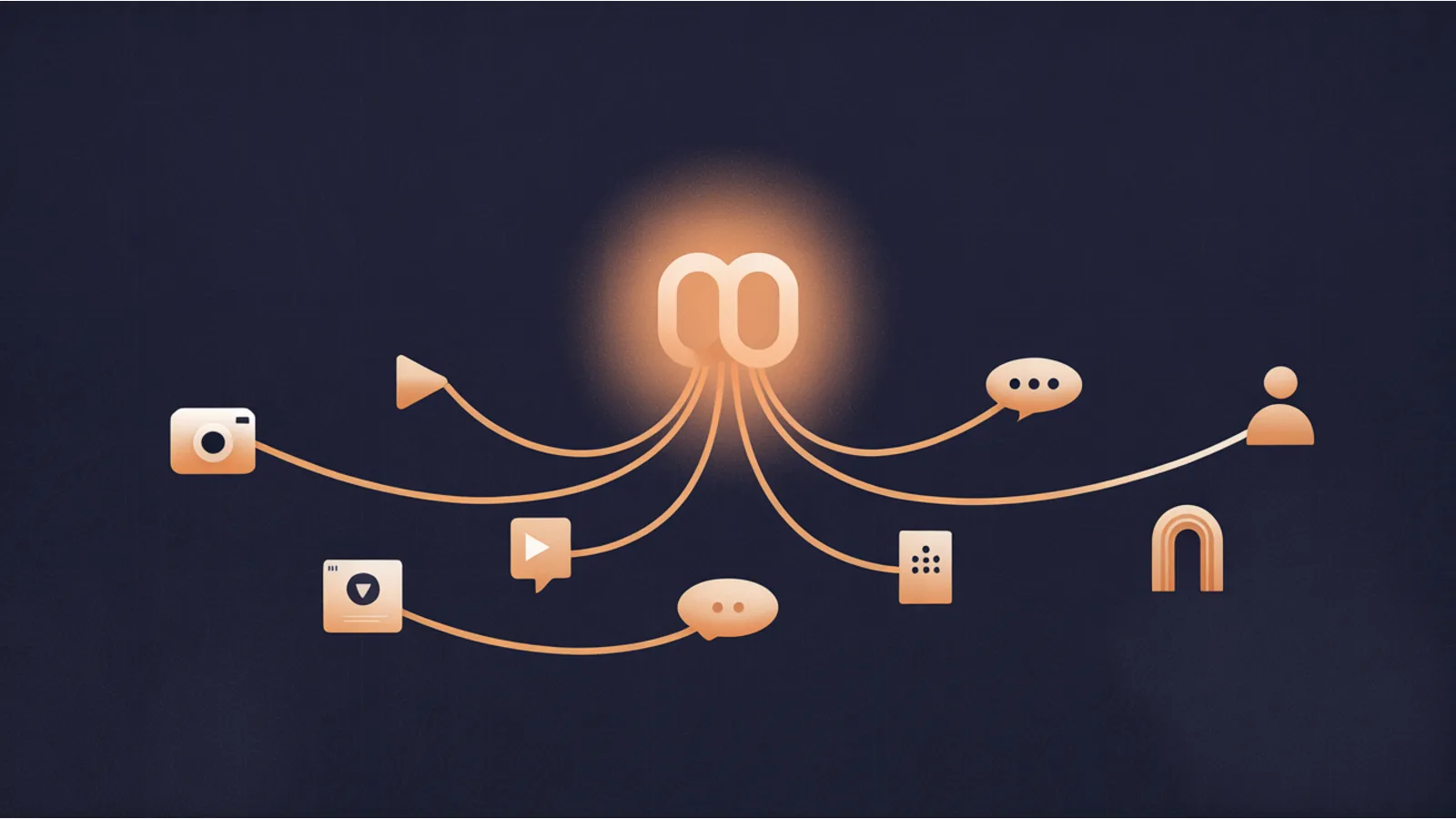
There is a check the Mega Analyzer can run on your store's home page: how many of the major brand channels are linked, and whether they are wired in as sameAs anchors. It can tell you that you are missing Pinterest, or TikTok, or a Facebook catalog, and that your Pinterest link is a pin.it short link instead of a real profile.
What a single-page audit cannot do is the rest of the work: actually standing those profiles up, keeping them consistent, and making them all point back at one brand. That part is human, and it is the difference between a young store that reads as a scattered side project and one that reads as an established brand, to both shoppers and to the AI answer engines that increasingly decide what gets recommended.
Here is the playbook I gave a founder-led DTC brand after auditing it. None of it costs more than time.
Why this is an entity problem, not just a marketing one
AI answer engines do not rank pages so much as they reconcile entities. When someone asks "is [brand] legit" or "who makes [brand]" or "where can I buy a real leather work bag," the engine assembles an answer from everything it can tie to that brand: the website, the founder, the social profiles, the marketplace listings, the press. The more of those that exist, agree with each other, and link back to a single canonical identity, the more confidently the engine treats the brand as real and recommends it.
The connective tissue is sameAs: an array on your Organization (and your founder's Person) schema that lists every official profile. Every channel below is two things at once: a place customers discover you, and a sameAs anchor that strengthens the entity. Do them together.
The one rule that makes all of it work: use the exact same name, handle, logo, and bio everywhere. If you are "Brand" with an accent on the e, use the accent on every profile. Inconsistency is what makes an engine think it is looking at several different things instead of one.
The channels, in priority order
Google Merchant Center and a knowledge panel
The highest-leverage, lowest-glamour move. A free Merchant Center feed puts your catalog into the Google Shopping tab, the free product listings, and the shopping side of AI Overviews. Separately, a consistent Organization entity plus a complete sameAs list is what earns a Google brand knowledge panel. Connect the Google channel in your store, submit the feed, and let your structured product data do the rest.
Pinterest, done properly
For handbags, home, beauty, and fashion, Pinterest is a discovery and purchase-intent engine, not a vanity profile. Claim your domain in Pinterest, turn on Rich Pins so price and availability pull from your product schema, and replace any pin.it short link with the canonical pinterest.com/handle URL in your sameAs. Short links are weak, breakable anchors; the full profile URL is a real one.
TikTok, and TikTok Shop later
For a young brand, TikTok is the single biggest organic-discovery upside. Craft clips, the founder's story, styling, the "one bag that goes from boardroom to dinner" transformation. Stand up the profile, add it to sameAs, and once you have reviews and inventory rhythm, evaluate TikTok Shop to turn the reach into checkout.
Facebook and a Meta catalog
Even if you live on Instagram, the Facebook Page plus a Meta Commerce catalog is what powers Instagram Shopping tags and retargeting. The Page is also a sameAs anchor and a review surface. Build the catalog from your product feed.
LinkedIn: the founder and a company page
A founder-led brand has an asset most brands do not: a real person with a story. Put the founder's LinkedIn in the Person sameAs, and create a company page for the brand for press, wholesale buyers, and B2B credibility. Both are stable, high-trust anchors.
YouTube
You almost certainly already have content for it. That leather-care explainer, the brand film, the founder interview. YouTube is also a Google-owned entity signal, so a channel that links back to the store does double duty. Repurpose, do not reinvent.
Google Business Profile
If there is any physical footprint at all, a showroom, by-appointment fittings, local pickup, a Google Business Profile unlocks local discovery and a review stream. Even with no storefront, the consistent Organization schema and sameAs is what surfaces the brand panel in Google.
Gravatar for the founder
This one is quietly powerful and almost no one does it. A Gravatar attached to the founder's email propagates her photo, one-line bio, and links across WordPress, comment systems, and a long tail of apps and developer tools that read it. It is cheap reinforcement of the founder Person entity that AI engines increasingly consume. Set it up with her photo, a short bio, and links to the store, her newsletter, and her LinkedIn.
Link-in-bio: prefer your own domain
Linktree is convenient, and it also quietly hands your hard-won social clicks to a third-party domain. An owned /links page on your store keeps the click equity and the sameAs value on your own domain. If you keep Linktree for convenience, point it back at the store and do not treat it as a primary entity anchor.
Marketplace and press as authority anchors
Third-party listings (a Wolf and Badger or Faire storefront) and editorial coverage are off-site signals that engines weigh heavily for a young brand, precisely because you do not control them. Add the marketplace profile to sameAs, link any press from an about or press page, and keep pursuing local and trade coverage. Each credible mention is another vote that the brand is real.
The owned channels: newsletter and the founder's writing
A founder newsletter or Substack humanizes the brand and is another sameAs anchor. The email list is the one channel no algorithm can throttle, which makes it the most valuable audience you own. Grow it deliberately, with a CAN-SPAM-compliant footer and one-click unsubscribe.
Wiring it back together
Once the profiles exist, the last step is the one that compounds: list all of them in your Organization sameAs, list the founder's in her Person sameAs, and publish a founder ProfilePage that ties the person to the brand. That is the moment the engines stop seeing a website here, an Instagram there, a marketplace listing somewhere else, and start seeing one established brand with a real person behind it.
You can sanity-check the schema side with the Schema Validator and the entity-and-authority side with the E-E-A-T analyzer. The Mega Analyzer's brand-presence check will tell you which channels are still missing from the page.
Building an audience and a presence across platforms on a near-zero budget is the entire subject of my book The $100 Network - the same self-reliant, own-your-channels approach this playbook is built on.
Fact-check notes and sources
- schema.org
sameAs(the canonical mechanism for entity reconciliation): schema.org/sameAs - Google: provide your business information and entity signals to surface a knowledge panel: support.google.com
- Google Merchant Center free product listings: support.google.com/merchants
- Gravatar (globally recognized avatar and profile): gravatar.com
- Pinterest Rich Pins and domain claiming: help.pinterest.com
Related reading
- The Mega Analyzer now reads DTC stores: making your shop legible to AI shopping
- The ProfilePage and mainEntity binding that AI Mode actually reads
- Entity anchors: kgmid, Maps CID, GBP, and the sameAs chain
This post is informational, not legal or marketing advice. References to platforms and services are nominative. No affiliation is implied. Any business audited was either my own, a site I was given permission to use, or anonymized as "a brand I was asked to audit."
