
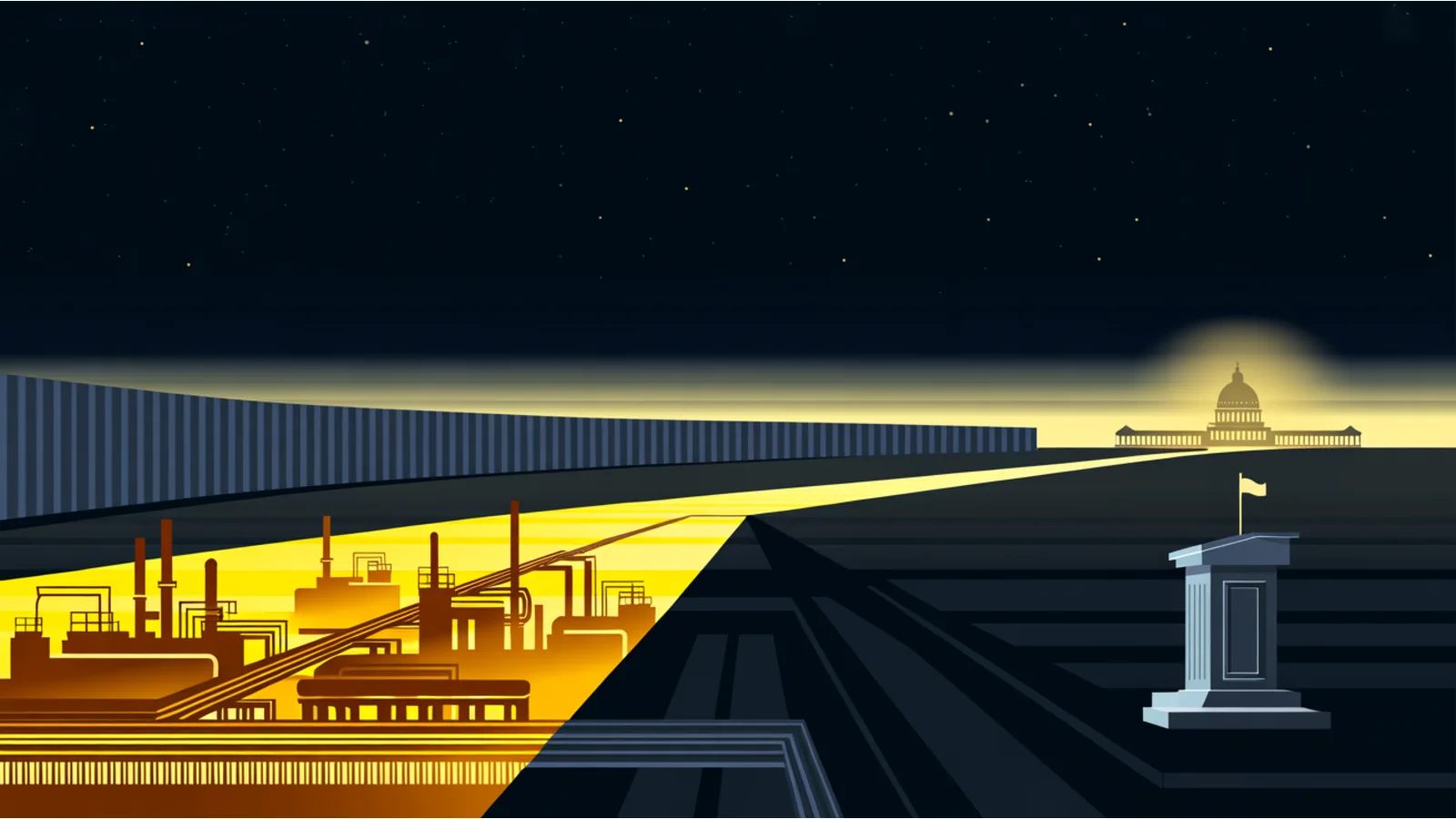
There is a company with about $125 billion in annual revenue, 120,000 employees, and operations in more than fifty countries, and you cannot buy a single share of it. That is not an accident; it is the entire strategy. Koch, Inc., the industrial conglomerate the Koch family has held privately since Fred Koch built its first refinery process in the 1920s, is the second-largest private company in the United States, behind only Cargill, and it has stayed out of public hands on purpose for a century (Forbes, America's Top Private Companies). What makes the Kochs distinctive in this series is that their reach comes in two forms. One is economic, an enormous private industrial base. The other is political, one of the most powerful influence networks in the country. This post reads both from the record.
From a cracking process to a colossus
The company began with an engineer and a grievance. Fred C. Koch, an MIT-trained chemical engineer, co-founded the Winkler-Koch Engineering Company in Wichita in 1925, and in 1927 he developed a more efficient process for cracking crude oil into gasoline that let small refiners compete with the majors (Wikipedia, "Fred C. Koch"). The established oil companies responded by burying him in 44 patent-infringement lawsuits; he won all but one, and that loss was later overturned when it emerged the judge had been bribed (Wikipedia, "Fred C. Koch"). Effectively pushed out of the American market, Koch took the process abroad, building refineries in Stalin's Soviet Union between 1929 and 1932 and, in 1934, partnering to build a refinery in Nazi Germany, a chapter documented by the journalist Jane Mayer and worth stating plainly as historical fact (HuffPost). Back home, he founded the Wood River Oil company in 1940, the corporate ancestor that was renamed Koch Industries in 1968 in his honor (Wikipedia, "Koch, Inc.").
His son Charles Koch, who became head of the company in the mid-1960s and has run it ever since, turned that refining base into a sprawling conglomerate through decades of acquisitions. Today Koch spans refining through Flint Hills Resources (more than 700,000 barrels a day), paper and building products through Georgia-Pacific, which it bought in 2005 for about $21 billion, electronic connectors through Molex ($7.2 billion in 2013), chemicals and fibers through Invista, which it bought from DuPont ($4.2 billion in 2004), glass through Guardian Industries, fertilizer through Koch Ag and Energy, enterprise software through Infor, and newer ventures in batteries and technology (Koch, Inc. companies; Wikipedia, "Koch, Inc."). It is a genuine industrial base, the kind that touches most American households daily and that almost no one thinks about, because there is no stock ticker to remind them.
Over his dead body
The reason there is no ticker is a decision Charles Koch has stated as bluntly as a person can. When Forbes profiled him in 2006, it reported that shares in Koch Industries would be offered to the public "literally over my dead body" (Forbes, "Mr. Big"). His stated reason is the same one this series keeps finding behind private fortunes: freedom from the short term. "We remain private so we can focus on the long term," he has said, and he has called public companies "feeding grounds for lawyers and lawsuits" (Wikipedia, "Charles Koch"). The company reinvests roughly 90 percent of its earnings rather than paying them out, which Koch credits, in his self-reported figures, for enormous compounded growth (Koch, Inc.). He built a management philosophy around it, "Market-Based Management," and wrote several books on it.
That private structure is held tightly. It became concentrated in 1983, when Charles and his brother David bought out their brothers Bill and Frederick for roughly $1.1 billion after a dispute over whether to pay dividends or reinvest, a fight the reinvestment side won (Wikipedia, "Koch, Inc."). After that buyout Charles and David each held about 42 percent. Today, following David's death in 2019, Charles holds his 42 percent, David's widow Julia Koch and her children hold his 42 percent, and the Marshall family holds the remaining 16 percent (Wikipedia, "Koch, Inc."). Julia Koch alone is now worth somewhere around $75 billion (Forbes). A private company, a family that reinvests almost everything, and a public that cannot see inside: it is the Walton and Cargill logic, at industrial scale.
The other reach
What sets the Kochs apart from every other family in this series is a second kind of reach. Beginning in the 2000s, Charles and David Koch built a political and policy network of a scale that reporters came to compare to a political party. Its best-known arm, Americans for Prosperity, was founded in 2004 with David Koch as founding chairman, and it grew into a nationwide organization that claims millions of activists and dozens of state chapters (Wikipedia, "Americans for Prosperity"). The family has convened invitation-only donor seminars since 2003, gathering hundreds of wealthy donors who each commit at least six figures a year, and the network's fundraising reached remarkable totals: reporting found it raised more than $400 million for the 2012 elections and set a target of $889 million for the 2016 cycle, figures that rivaled the official party committees (Washington Post; CBS News).
The reach extends into ideas as much as elections. Charles Koch was a co-founder of the libertarian Cato Institute in 1977, and Koch foundations have poured money into universities: one watchdog analysis found Koch organizations gave $458.7 million to colleges from 2018 to 2022 and have funded more than 550 institutions since 2005 (Center for Media and Democracy). How to characterize all of this depends on where you stand, and honesty requires giving both sides. Critics, most prominently the journalist Jane Mayer in her book "Dark Money," describe an interlocking machine built to shift American politics toward the family's interests, much of it routed through nonprofits that do not disclose donors (Wikipedia, "Dark Money"). The network describes itself in the opposite terms, as a philanthropic community advancing free markets and, in its current "Stand Together" branding, "a society of mutual benefit" (Stand Together). Both descriptions point at the same undisputed fact: a private family fortune converted into sustained, large-scale political and intellectual influence.
What the two reaches add up to
Put the industrial base and the influence network side by side and you get the fullest version of a theme this series keeps circling. The private company is a structure that keeps the world from looking, and the Kochs used that privacy twice over. It let them build one of the largest industrial fortunes in America without the scrutiny a public company faces, and it let them fund one of the most consequential political operations in the country while shielding much of it from disclosure. A family that will not sell you a share of its business also became, for a generation, one of the most powerful forces in its politics, and it did both largely out of public view. The lesson is the one underneath every private fortune here, sharpened to a point: what stays private stays powerful, and the Kochs turned that principle into reach of two entirely different kinds. The economic empire you cannot invest in, and the political one you cannot fully see, are the same family's, run on the same conviction that the most valuable position is the one no outsider can touch.
Related reading
- The Hidden Owners: the private companies, including Cargill, that stay out of public view.
- How the Waltons Keep Half a Trillion Dollars: the private-control playbook at another scale.
- Save the Tax, Park the Savings: where the tax and political interests of the very wealthy meet.
- The Working Ledgers: the market and the money underneath every private empire.
Fact-check notes and sources
- The company's history and scale (Fred Koch's Winkler-Koch engineering firm in 1925, the 1927 cracking process and the 44 patent suits, the Soviet and German refinery work documented by Jane Mayer, and the Wood River company of 1940 renamed Koch Industries in 1968; and Koch as the second-largest private US company at about $125 billion in revenue with 120,000 employees, behind Cargill): Wikipedia, "Fred C. Koch", HuffPost, Wikipedia, "Koch, Inc.", Forbes private-companies list, and Koch, Inc. companies page. Revenue is an estimate because the company is private; the Nazi-era refinery's military-fuel characterization is Jane Mayer's reporting, attributed.
- The businesses and the deals (Flint Hills Resources refining, Georgia-Pacific bought in 2005 for about $21 billion, Molex for $7.2 billion in 2013, Invista from DuPont for about $4.2 billion in 2004, Guardian Industries completed in 2017, Koch Ag and Energy, Infor, and the battery and technology ventures): Koch, Inc. companies page and Wikipedia, "Koch, Inc.".
- The private structure and ownership (the "literally over my dead body" quotation, the "focus on the long term" and "feeding grounds for lawyers" quotations, the roughly 90 percent reinvestment policy and Market-Based Management, the 1983 buyout of Bill and Frederick Koch for about $1.1 billion, and the current ownership of about 42 percent each for Charles Koch and Julia Koch's family with 16 percent for the Marshall family): Forbes "Mr. Big", Wikipedia, "Charles Koch", Koch, Inc., Wikipedia, "Koch, Inc.", and Forbes on Julia Koch. The reported growth multiples are Koch's own self-reported figures.
- The political network (Americans for Prosperity founded in 2004 with David Koch as founding chairman; the donor seminars since 2003; the reported more than $400 million raised for 2012 and the $889 million target for 2016; the Cato Institute co-founding in 1977; the university funding of $458.7 million from 2018 to 2022; and the contrasting characterizations by Jane Mayer's "Dark Money" and by the network itself): Wikipedia, "Americans for Prosperity", Washington Post, CBS News, Center for Media and Democracy, Wikipedia, "Dark Money", and Stand Together. The Heritage Foundation is an independent organization, not a Koch entity, and is not characterized as one here.
This post is informational, not financial or political advice. All figures are reproduced from the cited public sources, with estimates of the private company flagged as such, and it presents both the network's own framing and its critics'. Individuals and organizations are discussed as nominative fair use from the public record, with no affiliation implied.
