
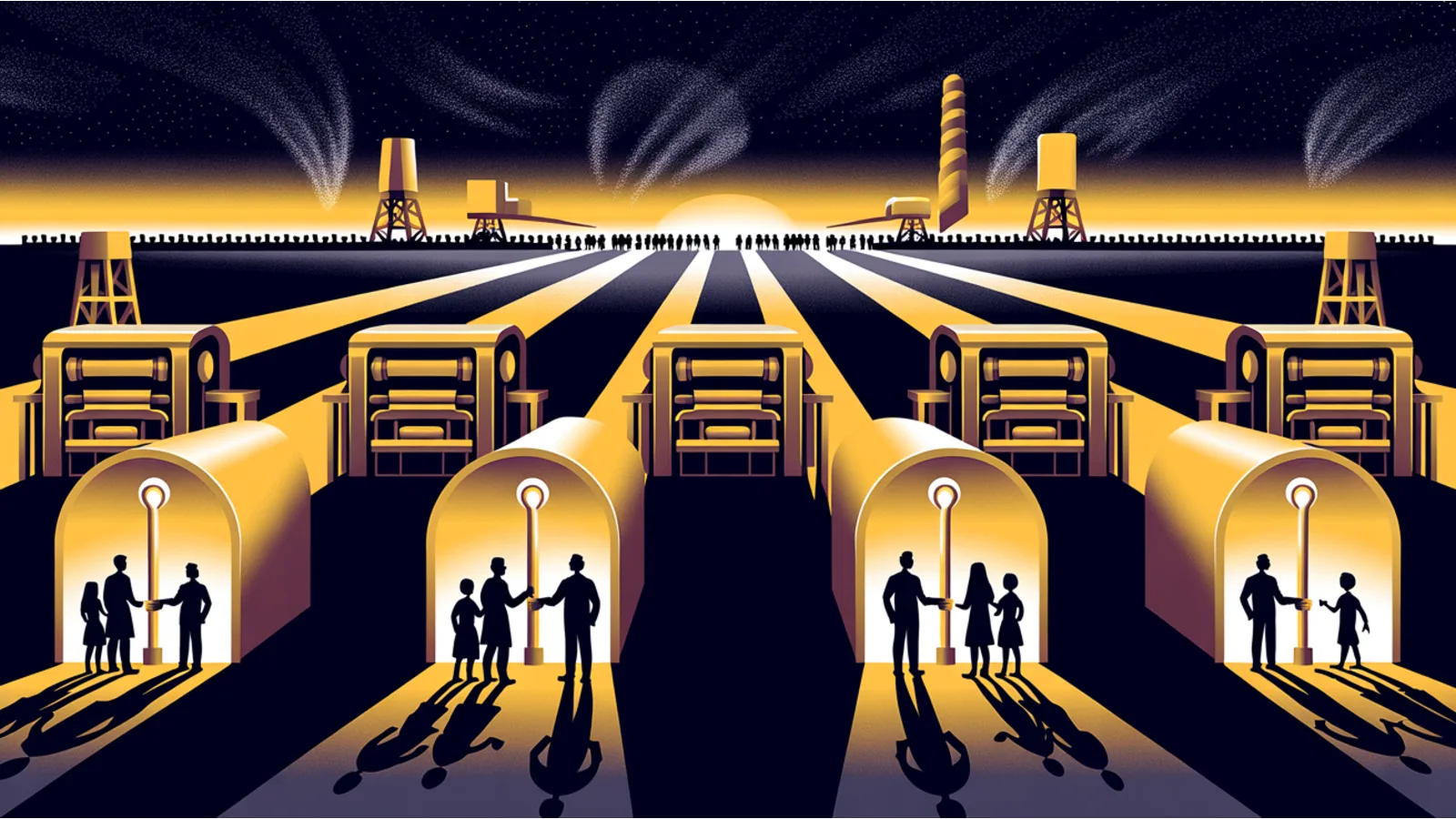
The news you read and watch is, to a surprising degree, controlled by a handful of families, and they hold that control the same way every dynasty in this series holds its wealth: through a trust that keeps the block undivided, and a share structure that lets a family with a minority of the money command a majority of the votes. The Ford family uses that combination to run a carmaker; these families use it to run newspapers and television networks. It is worth understanding precisely, because control of the press is a special kind of power, and the mechanics of who holds it are hidden in plain sight in corporate filings. This post reads them, from the proxies.
The New York Times: a family that elects the board
The Ochs-Sulzberger family has controlled The New York Times since Adolph Ochs bought the failing paper in 1896 for $75,000 in borrowed money, and the role of publisher has passed down an unbroken family line for five generations, to the current publisher, A.G. Sulzberger (New York Times 2025 proxy; Wikipedia, "Adolph Ochs"). The mechanism is worth getting exactly right, because it is commonly described wrong. The Times has two classes of stock, public Class A and family Class B, but the family's control does not come from super-voting shares; the proxy states that each share, of either class, gets one vote (New York Times 2025 proxy). Instead, control comes from a class-based board election. Class A shareholders, voting as a group, elect 30 percent of the directors, and Class B shareholders, voting as their own group, elect the other roughly 70 percent, nine of thirteen directors in 2025 (New York Times 2025 proxy). And the Class B shares that decide that supermajority of the board amount to less than half of one percent of all the company's stock.
Those Class B shares are held together in a trust, so no individual heir can peel off and sell. The Ochs-Sulzberger Trust, created in 1997, holds about 95 percent of the Class B stock, is governed by eight trustees who need six votes to act, and exists explicitly to preserve "the editorial independence and the integrity" of the Times and to keep the family's control from ever being transferred (New York Times 2025 proxy). The family owns only a minority of the company's economics, but through the trust and the class-based election, it elects the board that runs the most influential newspaper in the country.
The Murdochs: a trust, and a war over it
Rupert Murdoch built the other pole of American news the same way, and his family's control has just been through the most dramatic test of any in this series. Murdoch's empire split in 2013 into News Corp, which owns The Wall Street Journal and Dow Jones, and what became Fox Corporation, which owns Fox News (CNN Money). The controlling stakes in both, held through super-voting Class B shares, sit in the Murdoch Family Trust, which owns exactly 40 percent of the votes of News Corp and about 43 percent of Fox on a much smaller slice of the economics (News Corp 2023 proxy; Fox 2024 proxy). The trust was built so that, on Rupert's death, control would pass equally to his four eldest children, Lachlan, James, Elisabeth, and Prudence, no one of them in charge.
That equal split is exactly what Rupert and his son Lachlan tried to override, and the attempt became a courtroom saga. In 2023 they moved to amend the supposedly irrevocable trust to cement Lachlan's sole control, and a Nevada probate commissioner ruled against them in 2024, finding they had acted in "bad faith" and calling the plan a "carefully crafted charade" (PBS). Then, in September 2025, the family settled it with money. A new arrangement gave voting control of both companies solely to Lachlan, together with trusts for the two youngest Murdoch children, while Prudence, Elisabeth, and James were bought out, reportedly for around $1.1 billion each, and ceased to be beneficiaries of the media trusts (Fox Corporation). Control now runs through a new holding company, with the trust set to last until 2050 (Fox Corporation). It is the clearest illustration in this series of both the power and the fragility of the trust: it held the empire together for decades, and keeping it together in the end cost billions and tore the family apart.
Hearst: the trust that outlived the founder by a century
The oldest and most private of the media dynasties is the Hearst family. William Randolph Hearst, the model for "Citizen Kane," built a chain of newspapers beginning in 1887 and, at his death in 1951, left the company not to his sons to run but into a trust (Wikipedia, "William Randolph Hearst"). The Hearst Family Trust controls the private company to this day, holding the controlling stock and distributing income to the founder's descendants, and it is designed to terminate only when the last of his grandchildren alive at his 1951 death has died, which pushes its expiration decades into the future (Wikipedia, "Hearst Communications"). Hearst's will deliberately barred his own children from running the business, placing operations with professional managers overseen by a board of thirteen trustees, five family and eight outside (Wikipedia, "Hearst Communications").
The result is a media and information empire most people do not realize is one family's. Hearst today reports record revenue of around $13.5 billion, owns newspapers and more than a hundred magazines from Cosmopolitan to Esquire, holds about a fifth of ESPN and half of A&E Networks, and fully owns the credit-rating agency Fitch (Hollywood Reporter). It is entirely private, ranks among the largest private companies in America, and has stayed under continuous family control for more than 130 years, all through a trust written into a dead man's will (Forbes).
The families that let go
The counterexamples prove the rule, because when a media family abandons these tools, control leaves quickly. The Bancroft family controlled Dow Jones and The Wall Street Journal for a century through super-voting shares, but the family was large, divided, and not especially wealthy, and in 2007 it accepted Rupert Murdoch's roughly $5 billion offer; some members later voiced regret (ProPublica). The Graham family owned The Washington Post for eighty years, but in 2013 it sold the paper to Jeff Bezos, who bought it personally, through a private holding company rather than Amazon, for $250 million in cash (Washington Post). In both cases a family that had held a great newspaper for generations simply chose the money, and the press passed to a single richer owner. The Newhouse family, by contrast, still holds its media privately: Advance Publications, owner of Condé Nast and its magazines like Vogue and The New Yorker, remains family-owned, and it turned out to be the largest shareholder of Reddit as well (Wikipedia, "Advance Publications").
Set them all together and the picture is clear, and it is the same picture as the rest of this series, applied to an unusually consequential asset. A small number of families, the Sulzbergers, the Murdochs, the Hearsts, the Newhouses, and formerly the Bancrofts and Grahams, have kept control of major news outlets across generations, and they have done it with exactly two tools: an irrevocable trust that holds the controlling block so it cannot be split among heirs, and a dual-class or class-based structure that separates voting control from economic ownership. Media companies were among the pioneers of these structures, and they justify them on the grounds of protecting editorial independence from short-term market pressure, which is a real argument and also, critics note, a shield from accountability. Both things are true. The same devices that let the Fords keep a carmaker and the Wallenbergs keep half of Swedish industry let a handful of families decide who edits the news, and they work until the day a family decides it would rather have the cash, at which point the press, like any other asset, goes to whoever can pay.
Related reading
- Two Percent of the Company, Forty Percent of the Vote: the dual-class share, the same voting device these media families use.
- To Act, Not to Seem: control of an industrial empire through the same trust-and-voting structure.
- The Candy Fortune That Raises Two Thousand Children: a trust controlling a public company through supervoting stock.
- The Working Ledgers: the market and the money underneath every controlled company.
Fact-check notes and sources
- The New York Times (the Ochs-Sulzberger family's control since Adolph Ochs bought the paper in 1896 for $75,000 and the five-generation publisher line to A.G. Sulzberger; the two-class structure with one vote per share; the class-based board election in which Class A elects 30 percent and Class B about 70 percent of directors; the Class B being under half a percent of all stock; and the 1997 Ochs-Sulzberger Trust holding about 95 percent of Class B under eight trustees to preserve editorial independence and family control): New York Times 2025 proxy statement and Wikipedia, "Adolph Ochs". The Times does not use super-voting shares; control is the class-based board election, and the family's total economic stake is a minority not given as a single figure in the proxy.
- The Murdochs (the 2013 split into News Corp and what became Fox Corporation; the Murdoch Family Trust holding 40 percent of News Corp's votes and about 43 percent of Fox's on a smaller economic stake; the trust's design to pass equal control to the four eldest children; the 2023 to 2024 attempt to amend it and the probate commissioner's "bad faith" and "carefully crafted charade" ruling; and the September 2025 settlement giving Lachlan sole control with the two youngest children, buying out Prudence, Elisabeth, and James for a reported roughly $1.1 billion each, with a trust running to 2050): CNN Money, News Corp 2023 proxy, Fox 2024 proxy, PBS, and Fox Corporation settlement release. The new controlling trust benefits Lachlan and the two youngest children, Grace and Chloe, not "the four youngest"; the per-sibling buyout figure is corroborated by multiple outlets but not stated in the official release; the courtroom quotations come from a sealed opinion reported by the New York Times.
- Hearst (William Randolph Hearst building his newspaper chain from 1887 and dying in 1951, leaving the company in the Hearst Family Trust that controls the private company, distributes income to descendants, and terminates only when the last grandchild alive at his death dies; his will barring his children from running the business under a thirteen-member board of five family and eight outside trustees; and the company's roughly $13.5 billion in revenue, its magazine and newspaper holdings, its stakes in ESPN and A&E and full ownership of Fitch, and 130-plus years of continuous family control): Wikipedia, "William Randolph Hearst", Wikipedia, "Hearst Communications", Hollywood Reporter, and Forbes. Hearst is private, so revenue, descendant counts, and net-worth figures are reported estimates; the descendant count is best given as more than 65.
- The families that sold and the private holder (the Bancroft family's century of control of Dow Jones and The Wall Street Journal through super-voting shares, sold to Murdoch for about $5 billion in 2007; the Graham family's eighty years at The Washington Post, sold to Jeff Bezos personally for $250 million in 2013; and the Newhouse family's continued private ownership of Advance Publications and Condé Nast, including its Reddit stake): ProPublica on the Bancrofts, Washington Post on the Bezos sale, and Wikipedia, "Advance Publications". The Dow Jones price is the equity value; total transaction value including debt was higher. The widely shared claim that six companies control 90 percent of American media is a contested, meme-origin statistic and is not used here; documented consolidation figures, such as corporate chains accounting for more than 70 percent of daily newspaper circulation, are better supported.
This post is informational, not financial or media-industry advice. All figures are reproduced from the cited SEC filings, company releases, and reputable reporting, with reported and sealed-record items flagged as such. Individuals and companies are discussed as nominative fair use from the public record, with no affiliation implied.
