
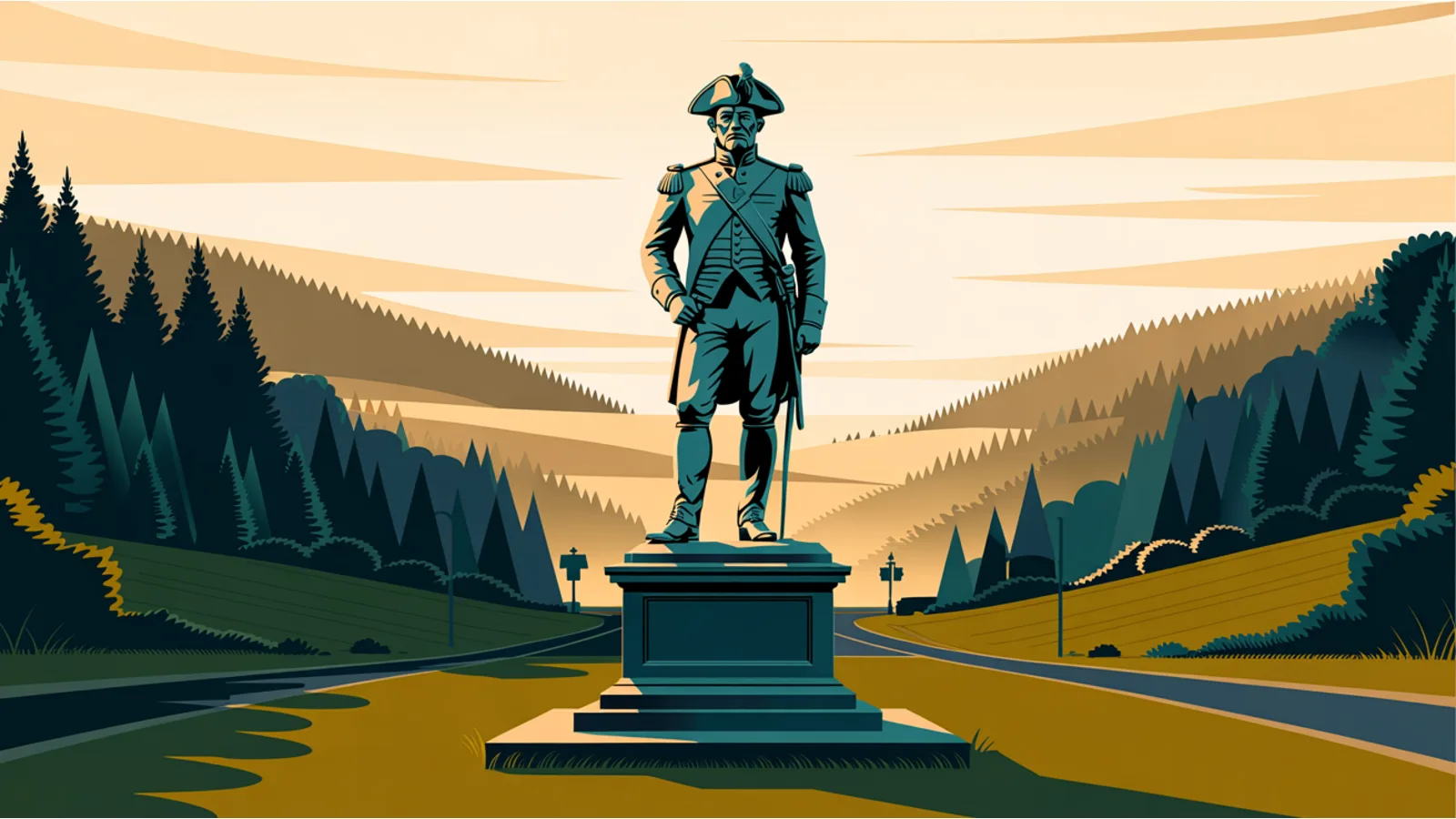
At a rural crossroads in Pleasant Mount, Pennsylvania, where Route 371 meets the Bethany Turnpike in the state's forested northeast corner, stands a six-foot granite general on a plinth. The Commonwealth paid $3,000 to put him there, the statue was modeled on the famous Washington of the Boston Common, and when it was unveiled on June 8, 1901, the honor of pulling the cord went to the general's own granddaughter. The state came back in 1948 and added a historical marker that explains, in one breath, why a Continental officer is standing in the woods:
"The first Treasurer of the U.S., 1789-1801, and Revolutionary patriot, spent the last years of his life at Pleasant Mount. Died here in 1817, on his estate, called Belmont."
His name was Samuel Meredith, and this series has been circling him for four waves without saying so. Time to close the loop.
The house Washington stayed in
Meredith was born in Philadelphia in 1741, the son of Reese Meredith, a merchant the DSDI records rank second in wealth among Philadelphia's traders only to Robert Morris. If you read our George Clymer piece, you already know this family. Reese Meredith was the man who once struck up a conversation with a lonely young Virginia planter in a public house and invited him home, after which George Washington stayed with the Merediths whenever he came to Philadelphia. Samuel grew up with the future first president as a recurring houseguest.
The family web tightened from there. Samuel's sister Elizabeth married George Clymer in 1765, and Samuel and Clymer became partners in the family trading firm. Samuel himself married Margaret Cadwalader in 1772, tying into another of the city's power clans. When the Revolution came, the counting house went to war together: Clymer took the treasury and supply jobs, and Samuel took the field.
He did it in the city's most famous outfit. Commissioned major and then lieutenant colonel of the so-called Silk Stocking battalion in 1776 (the gentlemen volunteers of Philadelphia; Clymer had briefly been one of its captains), Meredith fought at Trenton, Princeton, Brandywine, and Germantown, the entire brutal middle of the war in the mid-Atlantic, and Pennsylvania promoted him to brigadier general of militia in 1777. He resigned his commission in 1778 and went back to the ledgers, serving in the Pennsylvania Assembly through 1783, in the Confederation Congress in 1786, and as surveyor of the port of Philadelphia.
September 11, 1789
Readers of the Michael Hillegas installment know what happened next, from the other side of the desk. On September 11, 1789, the brand-new Treasury Department opened under Alexander Hamilton; Hillegas, who had carried the treasurer's office since 1775, resigned that day; and Washington needed a first Treasurer of the United States under the Constitution. He picked the merchant general whose family table he'd been eating at for thirty years.
It was, in the least cynical sense, a credibility appointment. The Treasurer's signature had to convince a skeptical public that the new government's money was real, and Meredith brought exactly what the moment needed: a known fortune, a war record from Trenton to Germantown, and the confidence of the president. He held the office for twelve years and, in the judgment of the Pennsylvania historical marker program's essay, backed Hamilton's Federalist financial program throughout: the funding system, the bank, the whole architecture this series has watched get built.
Then the political weather changed. Jefferson's Republicans took the presidency in 1801, and Meredith resigned on December 1, 1801, a decision the ExplorePAhistory essay describes flatly as made to avoid serving under the incoming Republican president. Twelve years of signing the republic's money, ended on a point of party principle.
Belmont
Here the story goes quiet, which is the point of telling it. Meredith withdrew to Belmont, his estate near Pleasant Mount in Wayne County, then close to wilderness. The man raised in the second-richest merchant house in Philadelphia, who had hosted Washington and signed the currency, spent his last years as a country landholder in the state's far northeast, and died at Belmont on February 10, 1817. He was buried in the family cemetery on the estate; decades later his remains were moved to the village, where the granite general now stands over them.
One caution for fellow history readers, because this series has made a habit of it: you will find claims online that Meredith advanced the government more than $100,000 from his own pocket and was never repaid, and that he died in straitened circumstances because of it. That claim appears in none of the sources consulted for this article, and the Pennsylvania marker essay describes him simply as living comfortably on his estate. It would rhyme beautifully with Salomon's unpaid receivables and Hillegas's reported sacrifices, which is exactly why it deserves suspicion: stories that rhyme too well with a series' theme are the ones to check hardest. It stays out of the body of this one.
The quietest kind of founder
Meredith completes a succession this series can now draw end to end: Clymer and Hillegas took the purse in 1775; Hillegas carried it alone through the Continental collapse; Morris's Finance Office stabilized it; Hamilton institutionalized it; and on the day the institution opened, the signature passed to Clymer's own brother-in-law, who kept it for twelve years of the republic's most fragile finance. One family's counting house, in various combinations, touched the nation's money from Bunker Hill to Jefferson.
And like Clymer, like Hillegas, like Thomas Willing, Meredith paid the memory tax that quiet competence always pays. No collapse, no prison, no fresco. It took his neighbors organizing a monument association, and the Commonwealth writing a $3,000 check, and his granddaughter pulling a cord in 1901, to put up the one statue. The loud founders got remembered by the country. The quiet ones got remembered by their counties, which might be the more honest kind of monument.
Related reading
- Michael Hillegas Was America's First Treasurer. His Reward Came 103 Years Late.: the man who handed Meredith the office on September 11, 1789.
- George Clymer: The Founder Who Took the Jobs Nobody Wanted: brother-in-law, business partner, and co-founder of the family's public-service habit.
- Thomas Willing Voted No on Independence. Then He Ran America's Money for 26 Years.: the other quiet Philadelphian running the era's money.
- Albert Gallatin Ran the Treasury Longer Than Anyone. America Remembers the Man He Fought.: what happened to the department after Meredith's resignation year.
Fact-check notes and sources
- Marker text (quoted verbatim), Treasury service September 11, 1789 to December 1, 1801, the resignation "to avoid serving under President Thomas Jefferson," major and lieutenant colonel of the Silk Stocking battalion in 1776, the battles of Trenton, Princeton, Brandywine, and Germantown, promotion to brigadier general of Pennsylvania militia in 1777, army resignation in 1778, Pennsylvania Assembly 1778-1783, Confederation Congress 1786, surveyor of the port, support for Hamilton's program, the Cadwalader marriage, living comfortably at his estate: ExplorePAhistory, Samuel Meredith marker page (Pennsylvania Historical and Museum Commission marker, erected 1948).
- Monument details (unveiled June 8, 1901 by granddaughter Sarah Maria Meredith, the Commonwealth's $3,000 appropriation, six-foot Vermont granite statue modeled on the Washington statue on Boston Common, remains moved from the Belmont family cemetery to Pleasant Mount, death at Belmont February 10, 1817): Wayne County Historical Society, "General Samuel Meredith Monument".
- Biography (born 1741 Philadelphia, son of Reese Meredith, Dr. Allison's Academy, the family firm with George Clymer, marriage to Margaret Cadwalader May 19, 1772, death near Pleasant Mount February 10, 1817): Wikipedia, "Samuel Meredith (American politician)", attributed as the consolidated account.
- The Meredith-Clymer-Washington family background (Reese Meredith second in wealth only to Robert Morris, Washington lodging with the Merediths, the Clymer partnership): DSDI, George Clymer.
- The widely repeated claim that Meredith lent the federal government more than $100,000 that was never repaid appears in none of the sources above and is omitted from this article; it is flagged here so readers know the omission is deliberate.
This post is informational, not financial advice. Historical institutions are mentioned as nominative fair use; no affiliation is implied.
