
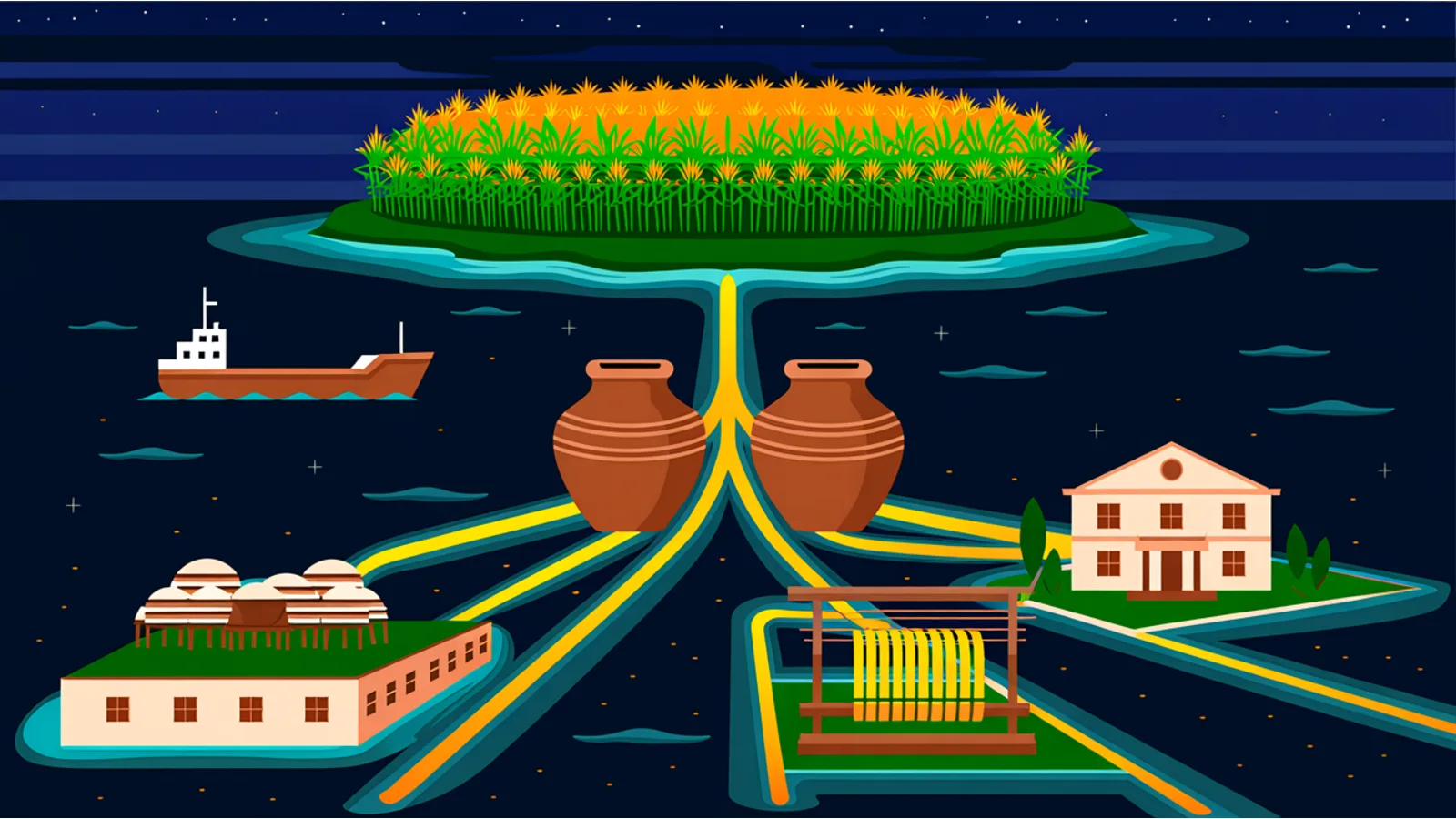
Mauritius is a small island in the Indian Ocean, and like a lot of small places its economy is anchored by a very small number of families. They are mostly Franco-Mauritian, descendants of French settlers who arrived before the British took the island in 1810, and though they make up only about 2 percent of the population, they own many of the largest businesses and, historically, nearly all the great sugar estates (Wikipedia, "Franco-Mauritians"). This post is about two of them, and about the single most interesting thing they did, which is the same thing the du Ponts and the Waltons did in their own ways: they refused to stay in the one business that made them rich. Starting from colonial sugar, they spent a hundred years diversifying into hotels, banking, and textiles, exactly as the guaranteed sugar price that built them was taken away. One of them now owns a sugar producer, the Four Seasons resort, a bank, and garment factories in Bangladesh. This is how that happened, from the filings.
The sugar that started it
For most of its modern history Mauritius grew one thing for money: sugar cane. At independence in 1968 sugar and its by-products were more than 90 percent of the island's exports, and cane still covers roughly 85 percent of its farmland (Wikipedia, "Economy of Mauritius"). The estates were built on slavery until Britain abolished it in 1835, and then on roughly half a million indentured laborers brought from India between 1834 and 1920, whose arrival point, the Aapravasi Ghat, is now a UNESCO World Heritage Site (UNESCO). Out of that plantation economy came the family fortunes, and both families in this story trace to a sugar estate.
The first is the Dalais family, whose group, CIEL, was founded in 1912 and marked its 110th anniversary in 2022; its original root is the Deep River-Beau Champ sugar estate in eastern Mauritius, and the modern listed holding company took the CIEL name in 2014 (GlobeNewswire; IDE-JETRO). The second is the Lagesse family, whose group, IBL, has trading-house ancestors going back to Blyth Brothers in 1830, but whose sugar root is the Mon Loisir estate that Joseph Lagesse bought in 1939, the origin of the family holding company GML (Wikipedia, "Ireland Blyth Limited"; IBL Group). These two families are usually named as a trio with a third, the Espitalier-Noël family, whose separate group ENL merged with Rogers in 2025 (Africa Press). But it is the first two that share a single corporate root, which is where the story gets interesting.
The Dalais family and CIEL: sugar, a bank, the Four Seasons, and Bangladesh
CIEL is the group that matches the striking profile, because it really does own all of those things at once. It operates across six clusters, textile, finance, healthcare, hotels, property, and agriculture, in about ten markets across Africa and Asia, employing more than 38,000 people, and in its 2025 financial year it reported revenue of about 38 billion Mauritian rupees (CIEL Group; CIEL Group results).
The textile arm is where Bangladesh comes in. CIEL Textile runs 19 manufacturing sites across four countries, Mauritius, Madagascar, India, and Bangladesh, employing about 22,000 people and making roughly 31 million garments a year for brands including Levi's, Tommy Hilfiger, and Puma (CIEL Textile). The banking is Bank One, which CIEL owns in a fifty-fifty joint venture with the I&M Group of Kenya (Shore Africa). The Four Seasons is part of the hotel cluster: CIEL owns just over half of the hotel group formerly called Sun Resorts, which in 2024 placed its trophy assets, including the Shangri-La at Le Touessrok and the Four Seasons Resort Mauritius at Anahita, into a vehicle called Riveo (CIEL Group hotels). The Four Seasons operates the resort under its brand, while the hotel asset sits inside CIEL's hospitality arm, on the Anahita estate (Anahita Mauritius). And the sugar is still there too, held through a roughly 21 percent stake in Alteo, the island's largest sugar producer (CIEL Agro). One family, through one listed group, holds a sugar producer, a bank, a Four Seasons, and garment plants in Bangladesh. The family runs it today through Jean-Pierre Dalais, its chairman, and Guillaume Dalais, its chief executive, with control exercised through holding vehicles rather than large personal stakes (CIEL Group).
The Lagesse family and IBL: the other half of a split empire
The second family, the Lagesses, built IBL, and the connection between the two groups is the best detail in the whole story. IBL took its modern shape in 2016, when the family holding company GML amalgamated with Ireland Blyth Limited and the combined company was renamed IBL Ltd, approved unanimously by both sets of shareholders (AfrAsia Bank). But GML had first taken control of Ireland Blyth in 2010, and it bought that control from CIEL (Wikipedia, "Ireland Blyth Limited"). The two family empires literally share a root: the Dalais family's CIEL owned Ireland Blyth until 2010, then sold control to the Lagesse family's GML, and each has grown separately since. Two of the island's dominant conglomerates were, until fifteen years ago, one.
IBL is now the larger of the two, and describes itself as Mauritius's biggest conglomerate outside banking, with revenue of about 120 billion rupees in its 2025 financial year, more than 40,000 employees, and around 300 companies across 20 countries (IBL Group results; IBL integrated report). Its businesses include the Winner's supermarket chain, the Princes Tuna seafood operation, and the LUX hotel resorts (Princes Tuna). And it holds the family's control through a mechanism worth pausing on, because it is the same trick the dynasties in this series keep using: as of 2022 the family holding company held about 69 percent of IBL's voting rights, largely through a special class of restricted shares that sits above the ordinary shares traded on the stock exchange (Stock Exchange of Mauritius). The public can buy the ordinary shares; the family keeps the votes. It is the Walton holding company and the Hershey supervoting stock, running on an Indian Ocean island.
The hundred-year pivot out of sugar
The reason both families diversified so hard is not restlessness. It is that the guaranteed money in sugar was going to disappear, and they saw it coming. For decades, Mauritius had an extraordinary arrangement with Europe: the ACP-EU Sugar Protocol of 1975 guaranteed the island a fixed quota, around 500,000 tonnes a year, at near-European prices, and Mauritius was its single largest beneficiary (Wikipedia, "Sugar industry of Mauritius"). That guarantee was the cushion the whole economy rested on, and Europe took it away. A 2005 reform cut the guaranteed price by 36 percent, phased in over four years; the Sugar Protocol itself was terminated in 2009; and the European sugar quota system ended entirely in 2017 (Mauritius Chamber of Agriculture; EU). By 2019, raw sugar was down to about 8 percent of the island's exports, and the number of sugar mills had collapsed from nearly 300 in 1860 to just three (Wikipedia, "Sugar industry of Mauritius").
The families had already been moving. They used the cash from an earlier sugar boom in the mid-1970s to build the first luxury hotels, when Ireland Blyth helped open the Saint Géran resort in 1975 (Info Ile Maurice). They moved into textiles when Mauritius opened an Export Processing Zone in 1970, and CIEL Textile was founded in 1972 (UNIDO; CIEL Textile). They moved into offshore finance when the island built that sector from 1989. And as local costs rose, they followed cheaper labor abroad, which is exactly why CIEL Textile ended up in Madagascar, India, and Bangladesh. The diversification that looks like ambition was, underneath, a century-long hedge against the day the guaranteed sugar price ended, and it worked: the day came, and the families were already somewhere else.
The structure, and the honest context
Both families hold their empires the same way, through a family holding company sitting atop listed operating companies, with cross-holdings between them, the two groups even sharing ownership of the sugar producer Alteo (Food Business Africa). It is a compact, legible version of the same architecture this series keeps finding: a private family vehicle that holds the control, and public shareholders who hold the rest.
And it deserves the same honest caveat. This concentration is real and it is documented. A World Bank review found the Mauritian economy "dominated by a few large conglomerates," and a 2026 governance assessment described the "oligopolistic nature" of sugar, tourism, financial services, and real estate, run by "vertically integrated conglomerates and high levels of cross-directorships" (IR Impact; BTI 2026). A 2 percent minority owns much of the island's private wealth and land, a fact Mauritian scholars study directly (Taylor & Francis). The fair counterpoint is also real: Mauritius has the highest wealth per capita in Africa, its stock exchange has more than 100,000 individual local shareholders, the conglomerates are the country's largest private employers, and income inequality has fallen over the past decade (Daily Maverick; BTI 2026).
Set all of it together and the lesson is the one this series keeps arriving at, transplanted to an island. Two families took a single guaranteed cash crop and, over a hundred years, turned it into diversified, listed empires spanning hotels, banking, textiles, seafood, and healthcare, held through family vehicles that keep the control while the public holds the shares, and they did it precisely because they could see the guaranteed money in sugar ending. The Four Seasons on the beach and the garment plant in Bangladesh are not separate stories. They are the same family, hedging its way out of sugar, one business at a time, for a century.
Related reading
- The du Pont Fortune, Two Centuries On: another old dynasty that survived by diversifying and restructuring across generations.
- How the Waltons Keep Half a Trillion Dollars: the family-holding-company and special-voting-share mechanism, at a different scale.
- Two Quiet Dynasties: diversified family wealth held through private vehicles.
- The Working Ledgers: the market and the money underneath every family conglomerate.
Fact-check notes and sources
- The families and their sugar origins (Franco-Mauritians as roughly 2 percent of the population owning many of the largest businesses; sugar as the colonial monocrop, more than 90 percent of exports at independence, built on slavery abolished in 1835 and then indentured Indian labor via the Aapravasi Ghat; CIEL founded in 1912 with its Deep River-Beau Champ sugar root and renamed in 2014; and IBL's trading-house ancestry from 1830 with its Mon Loisir sugar root bought by Joseph Lagesse in 1939): Wikipedia, "Franco-Mauritians", Wikipedia, "Economy of Mauritius", UNESCO, GlobeNewswire, IDE-JETRO, Wikipedia, "Ireland Blyth Limited", and IBL Group. Note on family names: GML and IBL are controlled by the Lagesse family, not the Espitalier-Noël family, which controls the separate ENL group (merged with Rogers into ER Group in 2025); the three are commonly named together as the island's dominant business families.
- CIEL and the Dalais family (six business clusters, about ten markets, more than 38,000 employees, and roughly 38 billion rupees of 2025 revenue; CIEL Textile's 19 sites across Mauritius, Madagascar, India, and Bangladesh with about 22,000 employees and 31 million garments a year; the Bank One fifty-fifty joint venture with I&M Group; the ownership of just over half of the former Sun Resorts and the placement of the Four Seasons at Anahita into the Riveo vehicle, with Four Seasons as operator; the roughly 21 percent stake in the sugar producer Alteo; and the Dalais family leadership): CIEL Group, CIEL Group results, CIEL Textile, Shore Africa, CIEL Group hotels, Anahita Mauritius, CIEL Agro, and CIEL Group leadership. The specific names of the Bangladesh factory units are not stated in the sources; the Anahita ownership is presented as a Four Seasons-managed, CIEL-held asset without asserting a clean land-versus-building split.
- IBL and the Lagesse family (the 2016 amalgamation of GML and Ireland Blyth into IBL Ltd; GML's 2010 purchase of Ireland Blyth control from CIEL; about 120 billion rupees of 2025 revenue, more than 40,000 employees, and roughly 300 companies in 20 countries; the Winner's, Princes Tuna, and LUX businesses; and the family's roughly 69 percent voting control held largely through a restricted share class above the traded ordinary shares): AfrAsia Bank, Wikipedia, "Ireland Blyth Limited", IBL Group results, IBL integrated report, Princes Tuna, and Stock Exchange of Mauritius. Both groups co-own the sugar producer Alteo, with IBL the larger shareholder (Food Business Africa).
- The diversification and the sugar-price context (sugar as more than 90 percent of exports at independence; the 1974-75 sugar boom funding the first hotels and Ireland Blyth's role in the 1975 Saint Géran; the 1970 Export Processing Zone and CIEL Textile's 1972 founding; offshore finance from 1989; the ACP-EU Sugar Protocol guaranteeing about 500,000 tonnes a year at near-European prices with Mauritius the largest beneficiary; the 36 percent price cut phased from 2006, the Protocol's 2009 termination, and the 2017 end of EU quotas; sugar falling to about 8 percent of exports by 2019; and mills consolidating from nearly 300 to three): Info Ile Maurice, UNIDO, CIEL Textile history, Mauritius Chamber of Agriculture, EU, and Wikipedia, "Sugar industry of Mauritius".
- The structure and concentration (the family-holding-company and cross-holding architecture; the documented critique of a conglomerate-dominated, oligopolistic economy with much private wealth and land held by the Franco-Mauritian minority; and the fair counterpoints of high wealth per capita, broad local share ownership, and falling inequality): IR Impact, BTI 2026, Taylor & Francis, and Daily Maverick. Individual family stakes and net-worth figures reported by rich lists are estimates and are not relied on here.
This post is informational, not financial advice. All figures are reproduced from the cited company reports, filings, and public record, with reported estimates flagged as such. Companies and families are discussed as nominative fair use from the public record, with no affiliation implied.
