
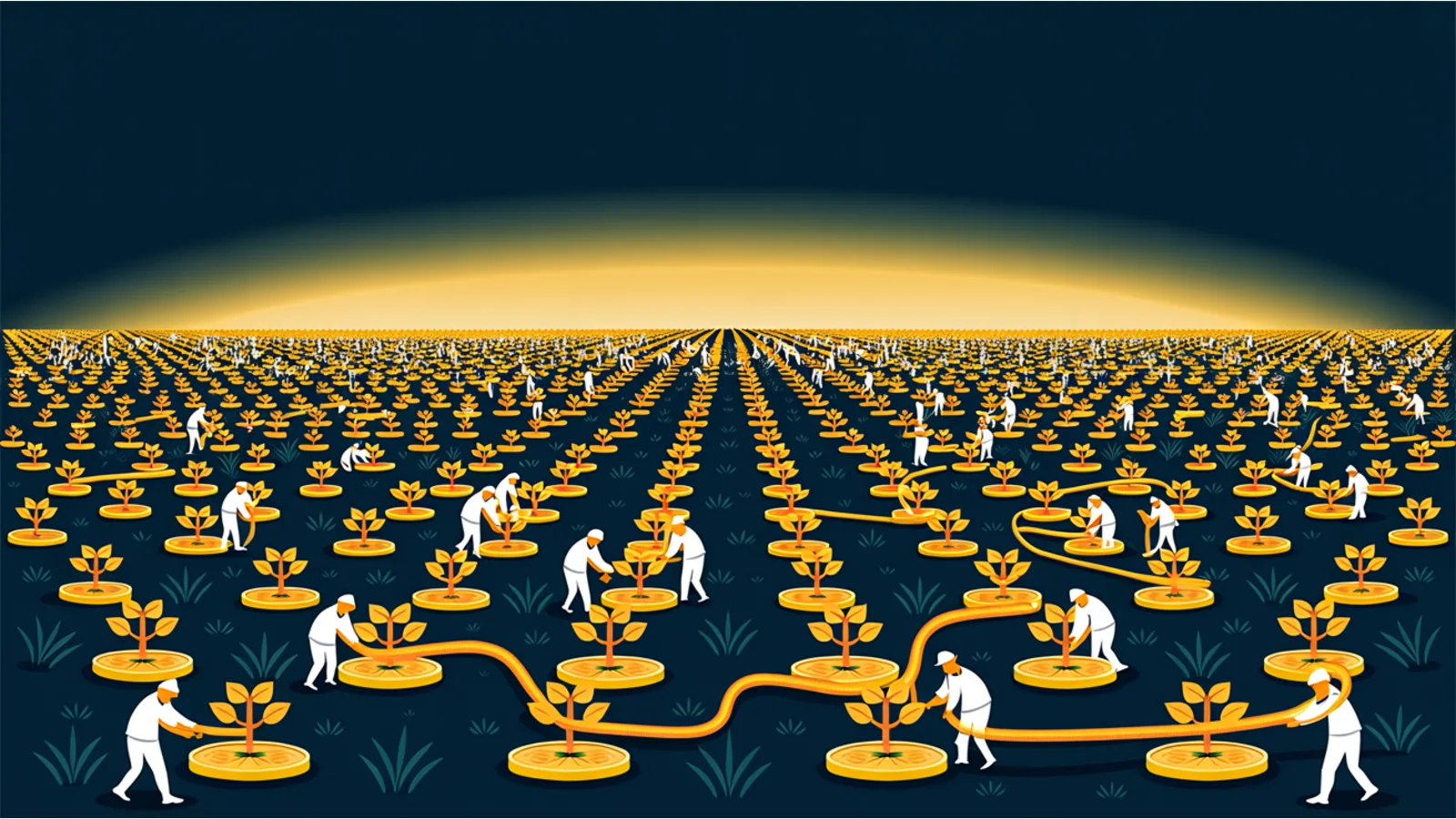
Most of this series is about advantages that are hard to reach: the insurance float only a company can hold, the oil endowment only a state can build, the dynasty trust that mainly helps the very rich. This post is about the exception, the one place where the quiet advantage of the wealthy, low-cost index-fund compounding held patiently for decades, has been handed to millions of ordinary people. It is the Thrift Savings Plan, the retirement plan for federal workers and the military, and it is quietly the best-run and largest retirement plan in the country. Almost no one outside government thinks about it, which is a shame, because it is a working model of how compounding is supposed to feel.
The largest plan in the country
The Thrift Savings Plan, or TSP, is a defined-contribution retirement plan, the government's version of a 401(k), created for federal civilian employees and members of the uniformed services by the Federal Employees' Retirement System Act of 1986 (Congressional Research Service). It is run by an independent agency, the Federal Retirement Thrift Investment Board, whose members are statutory fiduciaries required by law to act "solely in the interest of the participants and beneficiaries," and which "receives no appropriations from Congress" (U.S. Code, 5 U.S.C. 8472; Congressional Research Service).
Its scale is enormous and largely unknown. The Government Accountability Office called it "the largest retirement plan in the U.S.," with about $895 billion in assets and approximately seven million participants as of 2024 (GAO). It crossed a trillion dollars in June 2025 and reached roughly $1.156 trillion by May 2026 (FedSmith). By most accounts outside the government's own cautious "largest in the U.S." language, it is the largest defined-contribution plan in the world (Morningstar). A trillion dollars, seven million savers, and it is run by a small agency almost no taxpayer could name.
A few cents per thousand dollars
What makes the TSP a model rather than merely a large plan is the cost, and here the numbers are almost hard to believe. The plan offers a short menu of index funds: the G Fund of government securities, the F Fund tracking the Bloomberg U.S. Aggregate bond index, the C Fund tracking the S&P 500, the S Fund of small and mid-sized companies, the I Fund of international stocks, and a set of lifecycle funds that mix them and grow more conservative as retirement nears (TSP funds; TSP lifecycle funds). The expense ratios on those funds run between about 0.034 and 0.051 percent, which is roughly 34 to 51 cents per thousand dollars invested per year (TSP expenses). The plan notes that its expenses are "lower than 99% of investment options" (TSP expenses). By one regulator's illustration, the TSP's fee on a large-cap U.S. stock fund is about one twenty-fifth of the average equity mutual fund, roughly $2.90 per $10,000 against $74 (Texas State Securities Board).
Fees are the silent tax on compounding, the drag that, over decades, quietly transfers a large share of an ordinary investor's returns to the financial industry. The TSP has all but eliminated that drag for seven million people. It gives a firefighter or a soldier or a postal clerk the same rock-bottom-cost index compounding that a wealthy investor with a private advisor spends real money to obtain, and it does it by default.
Compounding, by default
The other half of the model is that it makes saving automatic and matched. A newly hired federal worker is automatically enrolled at 5 percent of pay, and the government adds to it: a 1 percent automatic contribution regardless of what the employee does, plus a match of up to 4 percent more, so a worker who contributes 5 percent gets another 5 percent from the government, and 10 percent of pay flows into the account (TSP contribution types). The default does the hard part, the matching doubles the input, and the low-cost funds keep almost all of the return. That is the entire recipe for building retirement wealth, and it runs on autopilot.
The proof is in a number the plan tracks. At the end of 2025 there were a record 194,722 TSP accounts holding more than a million dollars, up from around 64,000 a decade earlier (FedSmith). These are not executives. They are career federal employees, and the ones who reached a million dollars had, on average, contributed for 27.93 years (FedSmith). No stock-picking genius, no leverage, no dynasty trust. Just steady contributions, a government match, ultra-low fees, and time, which is the same engine that turned Franklin's small bequest into millions over two centuries, running inside an ordinary worker's account.
The quiet advantage, democratized
The TSP is the answer to a question the rest of this series keeps raising: does the ordinary person get any version of the structural advantages the wealthy enjoy? Usually the honest answer is "a scaled-down one, if any." Here the answer is genuinely yes. The plan is so well regarded that Morningstar calls its lineup "a well-edited menu of mostly index strategies" with "ultra-low costs," and reformers keep proposing to extend it to everyone; a bipartisan bill is "modeled after the highly successful federal Thrift Savings Plan" to reach private-sector workers who have no plan at all (Morningstar; Economic Innovation Group).
It is not flawless. A botched switch to a new recordkeeper in 2022 produced heavy complaints and a lawsuit, and the international fund's index was reworked to exclude China after a political fight (GAO; Government Executive). But the core is close to ideal, and the lesson for anyone with any retirement account is exactly what the TSP institutionalizes: contribute automatically, capture every dollar of employer match, keep costs as close to zero as you can, hold broad index funds, and let time do the rest. The wealthy protect their fortunes with elaborate structures most people will never touch. The single most powerful one, low-cost compounding held for decades, is the one the government already built for seven million ordinary workers, and the one anyone with a 401(k) can copy for free.
Related reading
- Other People's Money: the compounding advantage at the top of the wealth ladder, and the discipline behind it.
- The Codicil That Ran Two Hundred Years: compound interest as a two-century experiment.
- America's Hidden Sovereign Wealth: the other well-run public funds most Americans have never heard of.
- The Working Ledgers: the market underneath every account that compounds.
Fact-check notes and sources
- What the TSP is (a defined-contribution plan for federal civilian and uniformed-service members created by the Federal Employees' Retirement System Act of 1986; administered by the independent Federal Retirement Thrift Investment Board, whose members are statutory fiduciaries acting solely in participants' interest and which receives no congressional appropriations): Congressional Research Service and 5 U.S.C. 8472.
- The size (about $895 billion and roughly seven million participants as the largest US retirement plan per GAO in 2024; crossing $1 trillion in June 2025 and reaching about $1.156 trillion by May 2026; and the "largest defined-contribution plan in the world" framing attributed to Morningstar rather than to government sources): GAO, FedSmith, and Morningstar. The post-2025 asset figures are reported by federal-workforce press citing FRTIB data.
- The funds and the fees (the G, F, C, S, and I funds and the lifecycle funds and what each tracks; the expense ratios of about 0.034 to 0.051 percent; the "lower than 99% of investment options" claim; and the roughly one-twenty-fifth-of-average illustration): TSP funds, TSP lifecycle funds, TSP expenses, and Texas State Securities Board.
- The compounding mechanics and the millionaires (automatic enrollment at 5 percent, the 1 percent automatic agency contribution and up to 4 percent match for 10 percent total, and the record 194,722 accounts over $1 million at the end of 2025, up from about 64,000 a decade earlier, with the millionaires averaging 27.93 years of contributions): TSP contribution types, FedSmith on the record, and FedSmith on consistency.
- The framing and caveats (the "well-edited menu" and low-cost praise, the proposal to extend the TSP model to private workers, and the 2022 recordkeeper transition complaints and the international-fund China exclusion): Morningstar, Economic Innovation Group, GAO on the transition, and Government Executive.
This post is informational, not financial advice. All figures are reproduced from the cited government and public sources. Nothing here is an endorsement by any agency.
