
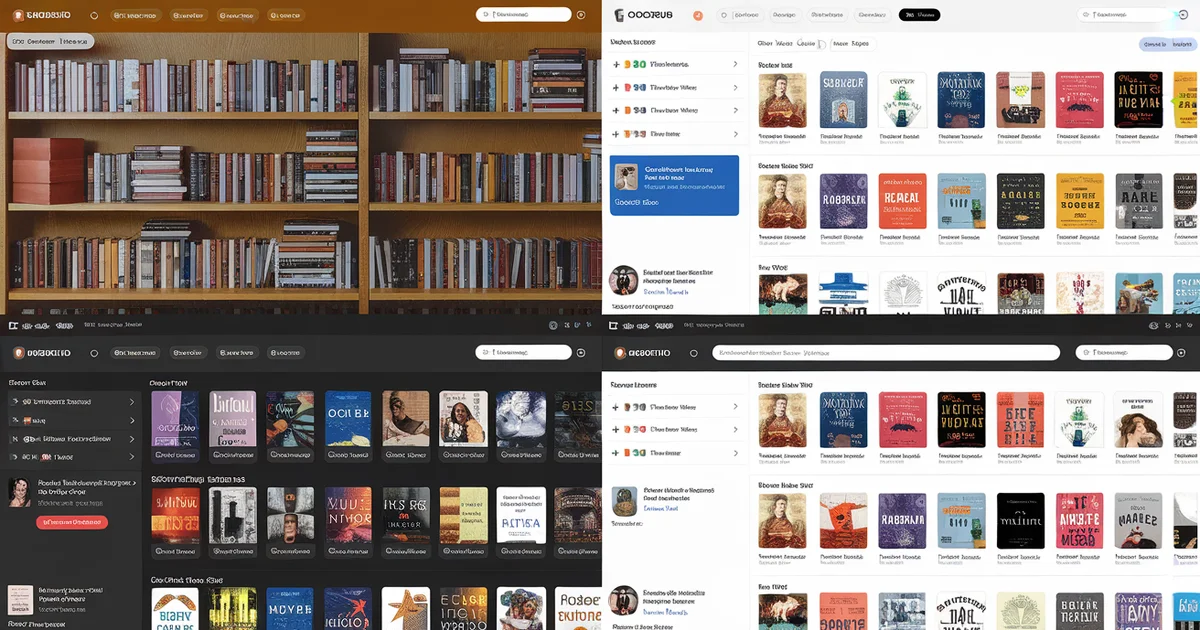
There are three platforms where readers actively discover, discuss, and recommend books. Goodreads has 90 million members. LibraryThing has 2.5 million members who catalog an average of 200+ books each. StoryGraph is the fastest-growing alternative, built specifically around algorithmic book recommendations without the social noise.
Most self-published authors either ignore these platforms entirely or set up a bare-minimum profile and never return. This is leaving money on the table. Not hypothetical future money, but actual book sales from readers who are on these platforms right now, looking for their next read, and who will never find your book through Google or Amazon browse.
I set up and optimized author profiles across all three platforms for our six-book catalog. Here is how each platform works, what makes them different, and how to use their unique discovery mechanics.
Goodreads: The Giant
Goodreads is owned by Amazon and has roughly 90 million registered members. It is the largest book-focused social network on the internet, and it has features that no other platform replicates.
Claiming Your Author Profile
If your book is on Amazon, there is likely already a Goodreads page for it. Auto-generated from Amazon's catalog data. Your first step is to claim your author profile at goodreads.com/author/program. This gives you control over your author page, lets you add a bio and photo, link to your website and social accounts, and. Most importantly. Interact with readers who review or discuss your books.
Once claimed, your author dashboard lets you:
- Write blog posts that appear on your author page and in followers' feeds
- See real-time reviews and ratings
- Run giveaways (more on this below)
- Create and participate in Listopia lists
Listopia: The Hidden Discovery Engine
Listopia is Goodreads' community-curated list system. Members create lists like "Best Personal Finance Books of 2026" or "Best Books for First-Time Homebuyers" and vote books up or down. These lists rank in Google search results, which means a well-positioned book on a popular Listopia list gets both Goodreads discovery and organic search traffic.
The strategy is straightforward: search Listopia for lists relevant to your book's topic. If your book is not on the list, add it. Then share the list with your existing audience and ask them to vote. You are not gaming the system. You are participating in a community curation process that exists specifically for this purpose.
For our catalog, I added each book to relevant Listopia lists:
- The W-2 Trap. "Best Personal Finance Books," "Books About Escaping the Rat Race," "Financial Independence Books"
- The $97 Launch. "Best Books for Starting a Business," "Entrepreneurship Books for Beginners," "Side Hustle Books"
- The Resale Trap. "Best Real Estate Books," "Books About Building a House," "Home Buying Guides"
- The Condo Trap. "Real Estate Investing Books," "Condo Buying Guides," "HOA Books"
- The $20 Dollar Agency. "Best Marketing Books," "Small Business Marketing Guides," "Digital Marketing Books"
- The $100 Network. "Best SEO Books," "Content Marketing Books," "Website Building Guides"
Giveaways
Goodreads Giveaways let you offer free copies of your book (ebook or print) to Goodreads members. The value is not the giveaway itself. It is the exposure. When you run a giveaway, your book appears in Goodreads' giveaway listings, and every member who enters the giveaway automatically adds your book to their "Want to Read" shelf. That shelf addition is a permanent discovery signal that increases your book's visibility in Goodreads' recommendation algorithm.
A 10-book print giveaway costs you roughly $50-80 in books plus shipping. The typical entry count for a nonfiction book is 500-2,000 people, each of whom now has your book on their radar.
Reading Challenges
Goodreads' annual Reading Challenge drives significant discovery. Members commit to reading a certain number of books per year and track progress publicly. Books that are being read as part of challenges get boosted visibility on friends' feeds and in Goodreads' trending metrics. Encourage your readers to add your book to their annual challenge. This is a one-line call-to-action in your email newsletter or social media.
LibraryThing: The Cataloger's Platform
LibraryThing is smaller than Goodreads. About 2.5 million members. But its members are fundamentally different readers. LibraryThing users are catalogers. They meticulously organize their personal libraries, tag books with detailed subject headings, and write thoughtful reviews. The average LibraryThing member has cataloged over 200 books.
Why LibraryThing Matters
The audience is smaller but more engaged and more likely to buy. LibraryThing members are serious readers who maintain detailed libraries and actively seek out new titles in their subject areas. A recommendation from a LibraryThing member carries significant weight because the platform's culture values quality over popularity.
LibraryThing also offers something Goodreads does not: a strong tagging system. Members tag books with their own subject headings, creating a folksonomy that other users browse. If your book gets tagged with specific, niche terms. "W-2 income," "new construction vs resale," "zero-budget marketing". It becomes discoverable to every member browsing those tags.
Author Profile Setup
Claim your author profile at librarything.com/authors. Add your bio, photo, and website link. LibraryThing allows a detailed author page with multiple sections for biography, influences, favorite books, and event listings. Fill out every section. Completeness signals authority.
Early Reviewers
LibraryThing's "Early Reviewers" program is the equivalent of Goodreads Giveaways but with higher-quality engagement. You provide copies of your book, LibraryThing distributes them to members who match your book's genre and subject tags, and those members are expected to write reviews. The review rate on Early Reviewers is significantly higher than on Goodreads Giveaways because LibraryThing's community culture emphasizes reciprocity.
StoryGraph: The Algorithm-First Platform
StoryGraph is the newest of the three platforms and the one growing fastest, particularly among readers under 35. Its core innovation is algorithmic book recommendations based on mood, pace, and content rather than social connections.
How StoryGraph Discovery Works
StoryGraph asks readers to rate books on multiple dimensions: pace (fast, medium, slow), mood (dark, lighthearted, hopeful, reflective), and content focus (plot-driven, character-driven, informative). These multi-dimensional ratings feed a recommendation algorithm that matches readers with books based on reading preference profiles rather than just "readers who liked X also liked Y."
For nonfiction authors, this is powerful. A reader who prefers "informative, medium-paced, reflective" nonfiction will be matched with your book if your ratings profile aligns. Regardless of whether they have heard of you or seen your marketing. The algorithm does the discovery work.
Profile Optimization
StoryGraph author profiles are simpler than Goodreads or LibraryThing. Focus on ensuring your book metadata is accurate: correct genre tags, accurate page counts, and a compelling description. StoryGraph pulls from multiple data sources, so verify that your book's information is correct rather than assuming it imported cleanly.
Encourage your readers to rate your book on StoryGraph using the multi-dimensional system. The more ratings your book has, the more accurately the algorithm can match it with potential readers. A book with 50 detailed StoryGraph ratings will be recommended far more frequently than a book with 500 simple star ratings on Goodreads, because StoryGraph's algorithm has richer data to work with.
Cross-Platform Strategy
The three platforms serve different audiences and different discovery mechanics:
- Goodreads drives volume. Large audience, social discovery, Listopia SEO value
- LibraryThing drives quality. Engaged catalogers, detailed tags, high-quality reviews
- StoryGraph drives algorithmic discovery. Mood-based matching, growing younger audience
Set up all three. It takes an afternoon. Then maintain them with minimal ongoing effort:
- When you publish a new book, add it to all three platforms and relevant Listopia lists
- When you get a new review on Amazon, share it on your Goodreads blog
- Quarterly, check your LibraryThing tags and add any missing subject headings
- Encourage different segments of your audience to rate on different platforms. StoryGraph for younger readers, LibraryThing for avid catalogers, Goodreads for everyone else
The combined reach is over 95 million readers. most whom discover books through platform-native features, not Google search. If your book discovery strategy is limited to Amazon ads and SEO, you are missing the platforms where readers browse.
For the complete strategy behind building a six-book catalog and cross-promoting across every available platform, see The $100 Network. For the marketing automation that makes multi-platform presence manageable, start with The $20 Dollar Agency. Buy The $20 Dollar Agency on Amazon.
