
Part of the AEO / GEO / AI-search audit tool stack. See the pillar post for the full catalog of sibling audits and where this one fits in the lineup.
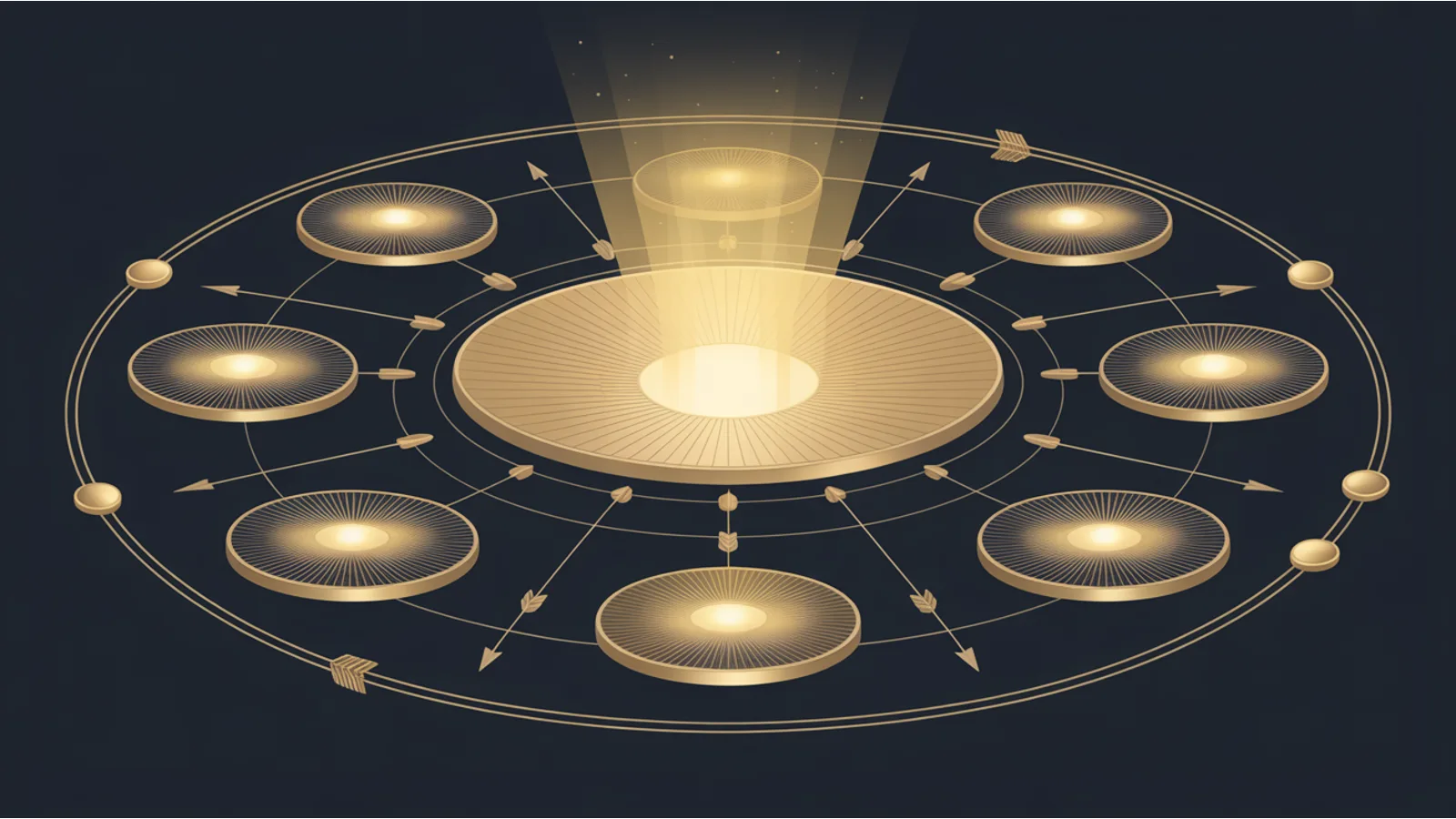
Here's the shape of authority that keeps coming up in AEO writeups: a long pillar page covering a topic broadly, surrounded by 8-12 focused subtopic articles, with bidirectional links between the pillar and each subtopic. The pillar gets cited for broad queries. The subtopics get cited for long-tail queries. Both reinforce each other's rank because the internal linking reads to a retrieval system as curated expertise rather than drive-by content.
Most blogs I look at don't have this. They have 40 posts on 40 topics, no hub, no spokes. Or they have a "pillar page" that's 800 words long and links to nothing. Or subtopic posts that never link back up.
The problem isn't lack of effort. It's that the shape isn't legible from any single page. You can have a perfect pillar, and if its subtopic siblings don't link back, the architecture is broken — but the pillar alone passes every single-page audit I can throw at it.
So I built a tool that tries to read the topology from one URL. Paste in what you think is your pillar, and it'll classify: does this look like a pillar (2,500+ words, 6+ H2 sections, 8+ outbound internal links)? Like a cluster subtopic (600-3,000 words, fewer H2s, linked back to a parent path)? Or something in between that doesn't fit either role?
For a candidate pillar, it audits whether there are enough outbound links to siblings and whether the sections look broad enough to support 8-12 subtopic expansions. For a candidate cluster, it checks whether there's a link back to the parent path, whether there are cross-links to 3+ siblings, whether the subtopic scope is tight enough.
The tool is at /tools/pillar-cluster-topology-audit/.
What it won't do is tell you what to write. It can't look at your cluster of "content marketing for law firms" posts and suggest the three subtopics you haven't written yet — that's a Content Gap TF-IDF problem. What this does is expose the structural gap. Once you see that your pillar links to four subtopics and all four clusters link only to the homepage, the fix-order becomes obvious: write the missing back-links first, publish the missing siblings second, and polish the pillar last.
If you're starting clean rather than retrofitting, the build order is different. Pick one topic with eight distinct sub-questions. Write the pillar first, aim for 3,000 words covering each sub-question in about 300 words as a pointer. Publish eight cluster articles, each 1,000-1,500 words going deep on one sub-question. Then go back to the pillar and link every H2 section to the matching cluster article, and on each cluster article link back to the pillar inside the first 150 words.
That last step — the link inside the first 150 words — is the one people skip. Retrievers heavily weight outbound links near the top of body copy for authority flow. A cluster that links to its pillar in the footer scores differently than one that does it in the intro.
The book I'd point you at if you want the whole playbook end-to-end is The $100 Network — it's about building interconnected small-sites rather than a single big one, but the content-architecture principles translate directly.
Related reading
- AI-Citation Specificity Audit — paired gap-fill tool
- Ideal Customer Declaration Audit — paired gap-fill tool
- Internal Link Equity Flow
- Content Gap TF-IDF
Fact-check notes and sources
- Topic-cluster architecture: HubSpot — Topic Clusters: The Next Evolution of SEO.
- Topical authority in Google guidance: Google Search Central — Creating helpful, reliable content.
- Retrieval-augmented generation: Lewis et al. (2020) — RAG paper, arXiv.
- Pillar-cluster spec for AEO (3,000+ words, 8-12 subtopics): broworks — AEO Strategies for Claude Answers.
Informational, not SEO-consulting advice. Mentions of Google, HubSpot, Anthropic, Perplexity, and similar products are nominative fair use. No affiliation is implied.
