
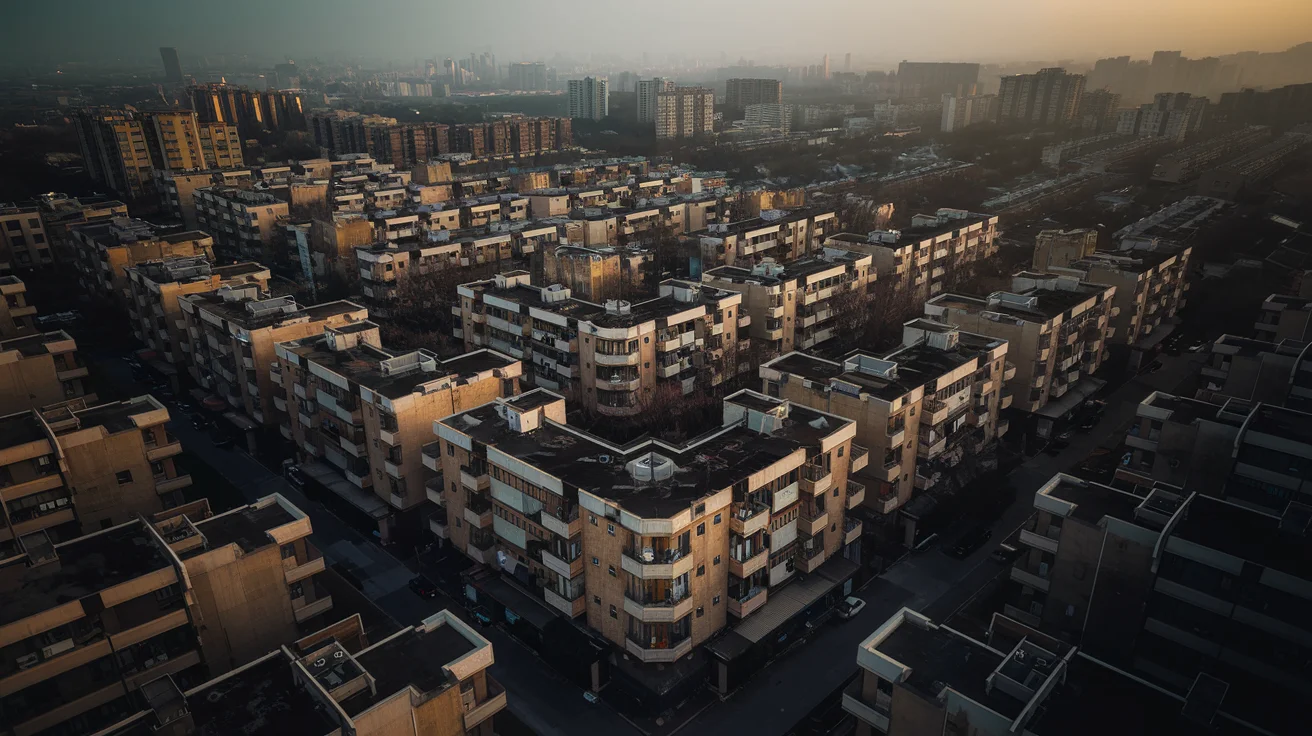
I spent over a year researching condo economics across America. I analyzed HOA data, insurance trends, energy mandate costs, special assessment histories, property tax trajectories, and structural engineering reports. The result was The Condo Trap. A 380-page book documenting the 7 financial forces destroying condo values.
Here's the honest answer to the question everyone asks: for most buyers in most markets, condos are a bad investment in 2026. Not because of market timing. Not because of interest rates. Because of structural cost forces that are accelerating, not improving.
Let me show you why.
The $1,900/Month Mortgage-Free Condo
The example that shocks everyone: a mortgage-free condominium in Denver, Colorado. Fully paid off, zero balance owed. Still costs about $1,900 per month in unavoidable carrying costs as of 2026. That's a 233% increase from 2006 levels.
Where does $1,900/month go when there's no mortgage?
- HOA fees: $450-$650/month (and rising 6-8% annually in most Denver buildings)
- Property taxes: $350-$500/month (driven by assessed value increases and mill levy adjustments)
- Insurance (unit owner's policy + building assessment share): $150-$250/month
- Special assessment reserves or active assessments: $200-$400/month
- Utilities: $150-$200/month
That's $22,800 per year. Gone. Not building equity. Not appreciating. Just keeping the lights on and the building standing.
The 7 Forces
The Condo Trap identifies 7 financial forces that are compounding against condo owners. These aren't temporary market conditions. They're structural trends that are accelerating.
1. Energy Mandates
Cities across America are implementing building performance standards that require older buildings to reduce energy consumption or face escalating fines. Denver's Energize Denver ordinance, New York City's Local Law 97, and Boston's BERDO are forcing buildings to retrofit HVAC systems, windows, insulation, and mechanical systems at costs of $30,000-$80,000 per unit. These costs are passed through to unit owners as special assessments.
2. The Condo Special Assessment Crisis
Post-Surfside (the 2021 Champlain Towers collapse in Florida), states across the country have implemented mandatory structural inspection laws and HOA reserve funding mandates. These inspections are revealing decades of deferred maintenance. Crumbling parking garages, corroded rebar, failing waterproofing membranes, outdated fire suppression systems. The repairs are funded through special assessments that can range from $10,000 to $150,000+ per unit. Florida's SB 4-D and SB 154 now require full reserve funding. No more waiving reserves. Meaning assessments are accelerating across the state.
3. The Condo Insurance Crisis 2026
Property insurance carriers are exiting entire states and markets. In Florida, Louisiana, and California, carrier exits have left buildings scrambling for coverage at 2-3x previous premiums. If they can get coverage at all. Is your condo even insurable? Some Florida buildings have lost all carrier options and been forced into Citizens Property Insurance, the state's insurer of last resort, at vastly higher premiums. Nationally, condo insurance premiums are escalating at 8-10% annually. A rate that doubles your insurance cost every 7-9 years. Some buildings have seen 40-60% single-year premium increases.
4. Metro District Taxation
In states like Colorado, metro district taxes add 50-80 mills on top of standard property tax rates. Many condo buyers don't discover these taxes until after closing. A metro district mill levy of 60 mills on a $400,000 condo adds $24,000 per year in taxes. On top of the county property tax.
5. Pension-Driven Property Taxes
Municipal pension funds across America hold $5.1 trillion in unfunded liabilities. The primary mechanism for closing these gaps is property tax increases. In Chicago, Denver, New York, San Francisco, and dozens of other metros, property taxes are rising 4-8% annually as cities scramble to fund pension obligations. Condo owners bear the full weight of these increases.
6. Environmental Risk
Radon, wildfire smoke infiltration, flood zone reclassification, and seismic risk all affect condos differently than single-family homes. Condo owners are dependent on the HOA board's response to environmental hazards and have no individual control over building-level mitigation.
7. Utility Cost Inflation
Electricity and natural gas costs are rising 3-5% annually in most markets, with some seeing 8-12% spikes. Condo owners in buildings with outdated mechanical systems and poor insulation bear disproportionate utility costs. And have no ability to individually upgrade the building's efficiency.
What About "Good" Condos?
Are there exceptions? Yes. But they're rare. A condo can be a reasonable purchase if:
- The building is less than 10 years old (minimizing near-term capital expenditure risk)
- The reserve fund is at 70%+ of the reserve study recommendation
- There's no metro district taxation
- HOA fees have increased less than 4% annually over the past 5 years
- The building is not subject to energy performance mandates
- Insurance premiums have been stable (less than 6% annual increases)
- No special assessments in the past 5 years and none anticipated
How many buildings meet all seven criteria? In most major metros, less than 10%.
The Property Investability Score
The Condo Trap introduces the Property Investability Score. A quantitative framework for evaluating any residential property before purchase. Instead of relying on "gut feel" or a real estate agent's enthusiasm, you score the property across multiple dimensions: HOA trajectory, special assessment risk, insurance escalation, tax trend, energy mandate exposure, structural reserve adequacy, and utility cost trend.
Each dimension produces a score. The aggregate tells you whether the property is a wealth-building asset or a wealth-destroying liability. In testing this framework across dozens of properties, the majority of condos in major metros score poorly.
What to Do Instead
If condos are out, what should you do?
-
Rent and invest the difference. If the total cost of condo ownership (mortgage + HOA + taxes + insurance + assessments) exceeds what you'd pay in rent, renting and investing the savings in index funds or a business entity will build more wealth over time.
-
Build new if buying a home. The Resale Trap documents how a $400K new build saves $318K-$506K over a $400K resale over 25 years. Single-family new construction avoids HOAs, special assessments, and most of the 7 forces destroying condo values. Buy The Resale Trap on Amazon. To pressure-test the math against your specific market, use the free state and metro data at HomeStats — every U.S. state's median price, property tax rate, insurance, FMR, and price-to-income ratio is published with primary-source citations, plus an interactive Rent vs. Buy calculator at homestats.app/tools/rent-vs-buy.
-
Build income-producing assets first. Rather than sinking $50,000-$100,000 into a condo down payment, use that capital to build a business. The $97 Launch shows you how to start for under $97. And The W-2 Trap explains why business income builds wealth faster than W-2 savings.
And if You Still Buy: The Home Warranty Caveat
If you do close on a condo (or any resale property) and the seller offers a home warranty as part of the deal, read the actual contract before treating it as coverage. The standard plan carries an aggregate cap of roughly $5,000 across the entire contract year, with per-occurrence HVAC caps of $1,500 to $3,000 on basic plans, and refrigerant either excluded outright or sublimited per pound. In Colorado, a fair-market in-unit HVAC replacement runs $7,000 to $12,000 today, and equipment tied to a shared building loop (VRF, fan-coil off the chiller, rooftop condenser on a sub-meter) often runs $15,000 or more. The warranty pays roughly a third of the bill on an approved claim, and the exclusion list (pre-existing conditions, improper prior maintenance, code upgrades, rust, mismatched components, refrigerant phase-out, shared-system equipment) is designed around exactly the equipment age and configuration the warranty is being offered to cover.
When the listing agent says "it's all covered by the warranty," remember the compensation structure. Listing agents and your buyer's agent are both paid at closing, not six months later when the claim is denied. They are transaction coordinators first; their incentive ends when the deal funds. The warranty closes the deal, not the claim. Pull the sample contract, not the marketing summary, and budget the replacement gap into year-one cash reserves regardless of what the warranty document promises.
Condo vs New Construction: The 25-Year Cost Difference
If you're comparing a condo to building a new single-family home, the math gets even worse for condos. The Resale Trap models the full 25-year total cost of homeownership and finds that new construction eliminates most of the 7 forces destroying condo value: no HOA, no special assessments, no shared insurance liability, no energy mandate retrofit costs, and no board-level mismanagement risk. The 25-year cost difference between a condo and new construction can exceed $500,000 in high-cost markets.
The Bottom Line
Condos aren't investments. In 2026, they're monthly bills disguised as equity. The 7 financial forces documented in The Condo Trap are accelerating, not reversing. Energy mandates are expanding to more cities. Insurance carriers are exiting more markets. Pension obligations are growing. The condo special assessment crisis is deepening as reserve funding mandates take effect.
Before you buy any condo. Or any property. Score it with the Property Investability Score framework. The math doesn't lie.
Buy The Condo Trap on Amazon or visit thecondotrap.com for more.
Pressure-test it on your state
Before any purchase decision, run your state through HomeStats. Every state has a published Buy-vs-Rent ratio, Value/Income, Value/Rent, property tax rate, insurance burden, and a Paycheck Reality breakdown showing how much income actually clears taxes against what a mortgage takes. The Resale Trap math is general; HomeStats puts your specific market against it.
