
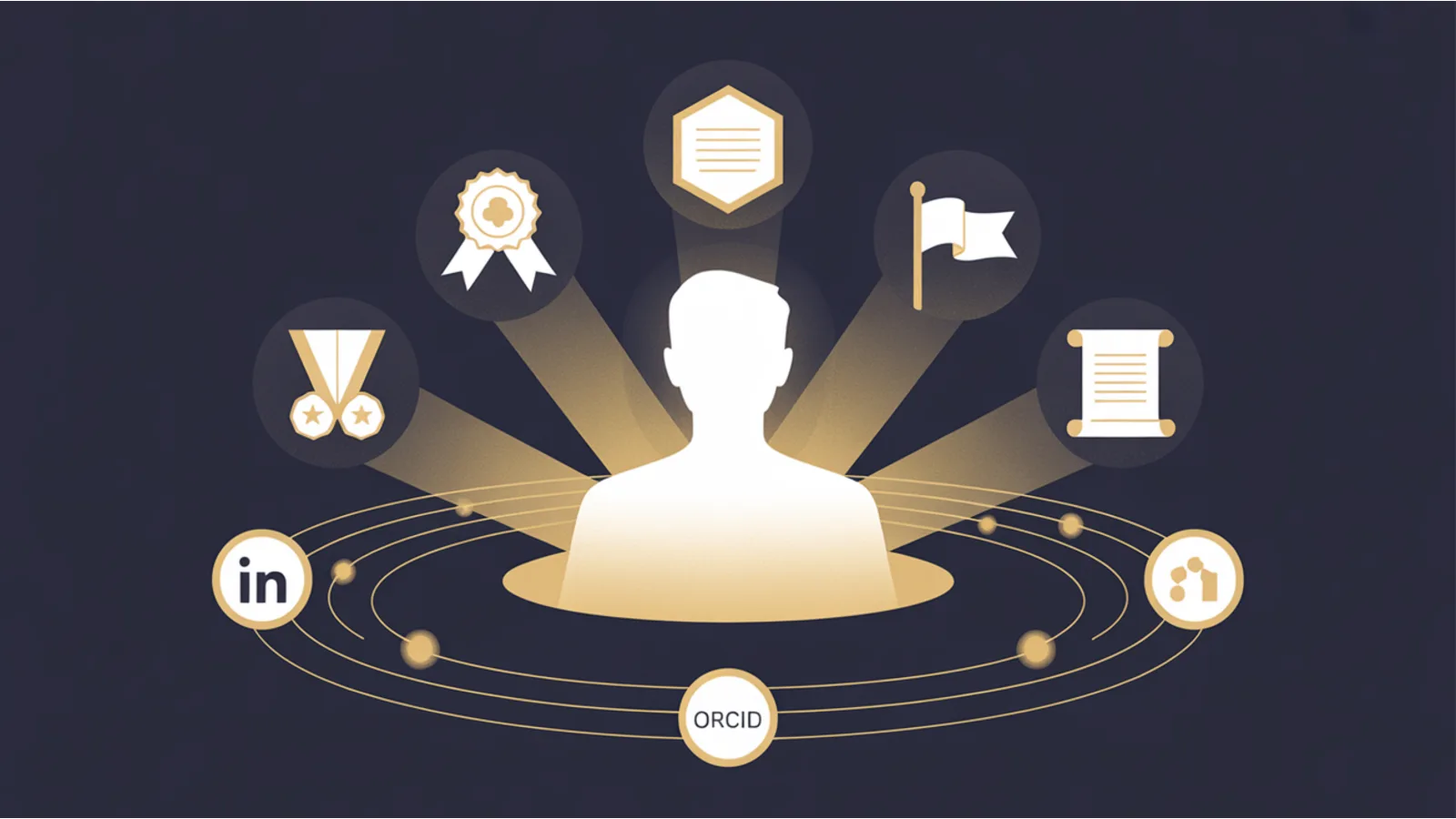
Most SMB blogs have bylines. Almost none have author entities.
The difference: a byline is "By John Smith" as plain text at the top of the article. An author entity is a schema.org/Person node with name, jobTitle, hasCredential, sameAs links to LinkedIn / Wikipedia / ORCID, knowsAbout topics, and a connection back from the article to that Person via author.
Google's E-E-A-T system resolves bylines to entities. If the byline doesn't resolve — because there's no schema, no sameAs, no external verification — the byline is decorative. It carries zero authorship signal.
Which means a site with 50 articles bylined to three authors can have identical E-E-A-T signal to a site with 50 unbylined articles. Both look like "machine-generated" content to the ranker.
The entity-chain E-E-A-T signal
Google and every modern LLM evaluate authorship in roughly three layers:
Layer 1: Does the byline resolve to a Person entity? If yes, move to layer 2. If no, stop.
Layer 2: Does the Person have credentials + topical knowledge + external profiles? This is where hasCredential, knowsAbout, and sameAs do their work. An author with a degree schema, three knowsAbout topics matching the article subject, and LinkedIn + Wikipedia sameAs links carries genuine E-E-A-T weight. An author with just name and jobTitle doesn't.
Layer 3: Do external sources corroborate the entity? The sameAs links are probed. If LinkedIn says this person worked at the companies their schema claims; if Wikipedia has a page about them; if their ORCID lists the publications they claim — the entity is verified. If any of those don't resolve or contradict, the entity weakens.
What the E-E-A-T Author Entity Graph does
You paste a site URL. The tool:
- Fetches the homepage and detects author-index pages (
/author/,/team/,/people/, etc.). - Crawls up to 10 author pages.
- Extracts every
Personentity from JSON-LD across all crawled pages. - Deduplicates by name and merges
sameAs,hasCredential, andknowsAboutper author. - Renders the author-entity graph as an interactive SVG: center = site, middle ring = authors, outer ring = credentials + sameAs external profiles.
- Scores the overall author-entity depth (persons × 5 + sameAs × 2 + credentials × 5 + externally-linked-authors × 3).
- Emits an AI fix prompt that proposes the specific schema additions per author.
Zero Person entities found = the site has decorative bylines only. The AI fix prompt routes straight to "add Person schema to every author" as the first action.
Reading the score
Score 70+: strong author-entity layer. Your E-E-A-T signal chain is intact.
Score 40-70: partial. Some authors have depth, others are thin. The tool surfaces which are which.
Score below 40: decorative bylines. Every article on the site is effectively unbylined from Google's perspective. Fix is architectural — add Person schema to author pages + connect every article's byline to its Person via author property.
The minimum viable author entity
Every Person entity should have:
{
  "@type": "Person",
  "name": "Jane Smith",
  "url": "https://yoursite.com/authors/jane-smith/",
  "jobTitle": "Senior Roofing Consultant",
  "worksFor": { "@type": "Organization", "name": "Acme Roofing" },
  "alumniOf": { "@type": "EducationalOrganization", "name": "Idaho State University" },
  "hasCredential": [
    { "@type": "EducationalOccupationalCredential", "credentialCategory": "license", "recognizedBy": { "@type": "Organization", "name": "Idaho Division of Building Safety" } }
  ],
  "knowsAbout": ["Residential roofing", "Storm damage assessment", "Asphalt shingle installation"],
  "sameAs": [
    "https://www.linkedin.com/in/janesmith-roofing/",
    "https://en.wikipedia.org/wiki/Jane_Smith_(contractor)",
    "https://orcid.org/0000-0001-2345-6789"
  ]
}
Two sameAs is the minimum. Three is comfortable. Five+ is strong.
Why this is about AI readiness, not just Google
Every modern LLM — ChatGPT, Claude, Gemini, Perplexity, Copilot — grounds author signals the same way. When a user asks "who wrote this?" or "what's this author's background?" the LLM resolves the byline through the same entity chain Google uses.
An author with rich entity data gets cited by name, described accurately, and trusted. An author with plain-text-only bylines gets ignored (the LLM says "the article doesn't credit an author"), misattributed, or hallucinated ("the article appears to be written by an AI").
The E-E-A-T author-entity layer is the same investment for Google + every LLM. Build it once, reap it across every AI-mediated query about the business.
The 30-day entity-depth roadmap
Week 1: Audit. Run this tool. Identify every author. List what's missing per author (sameAs, credentials, knowsAbout, worksFor).
Week 2: LinkedIn URLs. Every author should have a LinkedIn profile linked as sameAs. If any author doesn't have a LinkedIn, create one. LinkedIn is the universal entity-depth signal Google trusts most.
Week 3: Credential schema. For each author, add the specific hasCredential entry appropriate to their field. Licenses, certifications, degrees, memberships.
Week 4: knowsAbout alignment. For each author, list their topics of expertise. The topics should match the categories of articles they're bylined on. Mismatch (a "finance" author bylined on "roofing" articles) is a negative signal.
At day 30 you'll have a defensible author-entity layer. Expect Google to re-crawl within 2-4 weeks and for LLMs to pick up the changes within 6-8 weeks.
Related reading
- E-E-A-T Analyzer — page-level E-E-A-T scoring (companion)
- E-E-A-T Generator — generates schema for E-E-A-T gaps
- Author Authority Per Article — article-level authorship
- Knowledge Graph + Wikidata Audit — the external-verification layer
Fact-check notes and sources
- E-E-A-T framework: Google Search Quality Evaluator Guidelines
- Person schema.org specification: schema.org/Person
- sameAs property for entity resolution: schema.org/sameAs
- hasCredential / EducationalOccupationalCredential: schema.org/EducationalOccupationalCredential
This post is informational, not SEO-consulting advice. Mentions of LinkedIn, Wikipedia, Wikidata, ORCID, and GitHub are nominative fair use. No affiliation is implied.
