
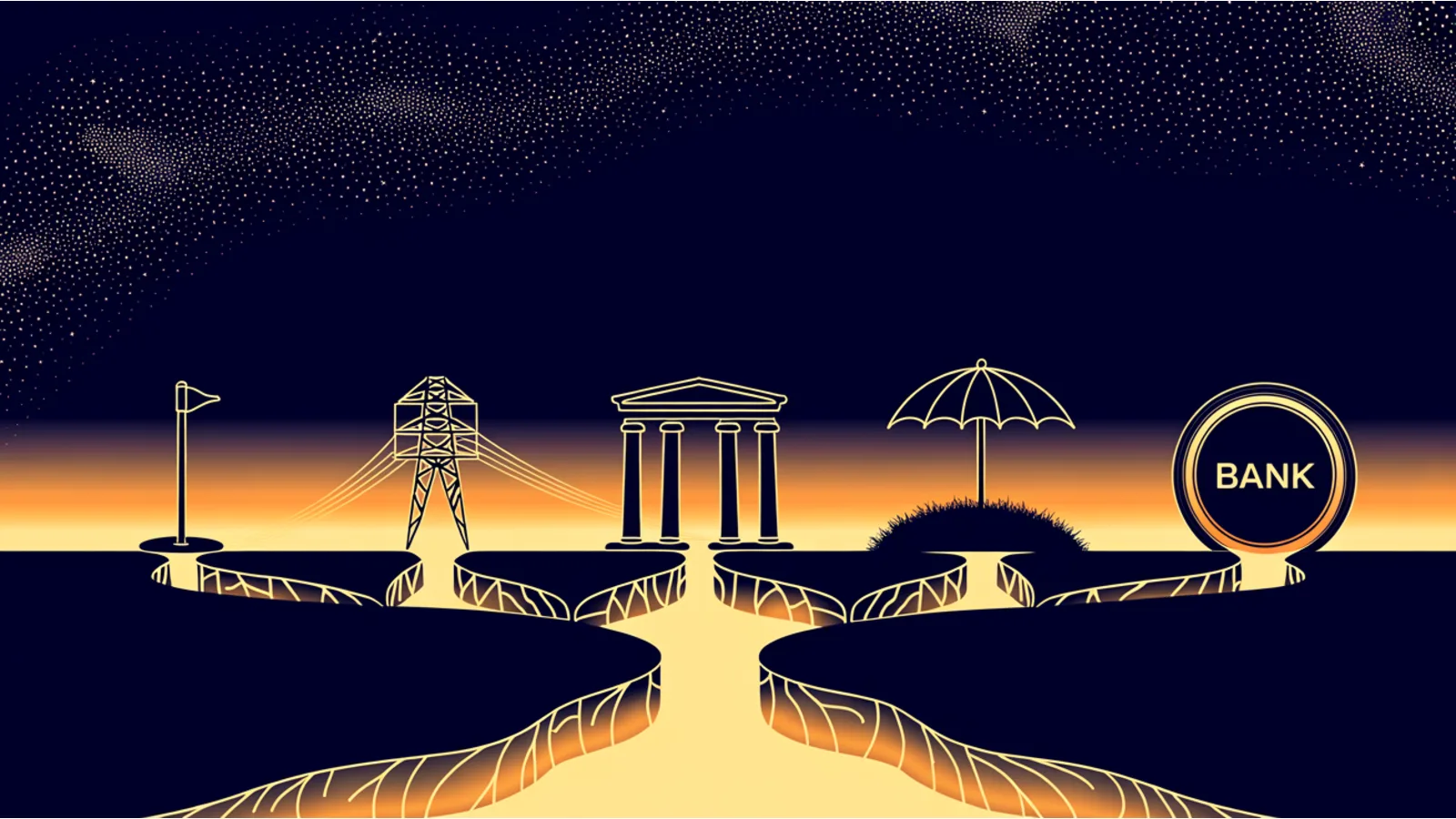
Say nonprofit and most people picture a charity. The tax code is far stranger than that. It exempts business leagues, social-welfare organizations, mutual insurers, credit unions, and employee-benefit trusts, and many of them behave nothing like a soup kitchen. This post reads a handful that filed returns this week: the organization that runs professional golf, the one that runs the Texas power grid, a workers-compensation insurer, a credit union, a great museum, and a set of benefit trusts holding billions. What unites them is not their mission, because they barely share one. It is that each holds a reserve, and each reserve is invested in the same markets a pension fund and a retiree use. Everything below is from the Form 990s, free at ProPublica.
The business leagues: golf and tennis
The PGA Tour is not a charity. It is a 501(c)(6) business league, the same tax category as a chamber of commerce, on the theory that it promotes the common business interest of professional golfers. It reported $760.6 million in revenue and holds $3.86 billion in assets, and its compensation page reads like a leaderboard: Tiger Woods at $18.3 million, Jordan Spieth at $10.1 million, and Commissioner Jay Monahan at $8.58 million (ProPublica). A tax-exempt nonprofit paying an athlete $18 million has drawn exactly the scrutiny you would expect, and its collision with Saudi Arabia's Public Investment Fund and LIV Golf makes it worth its own post. The ATP Tour, the men's professional tennis circuit, is the same species, a 501(c)(6) with $293.7 million in revenue and $427 million in net assets, launched in 1990, and it too has taken Saudi money, moving events to Jeddah and adding a Saudi tournament, while facing a 2025 antitrust suit from a players' association co-founded by Novak Djokovic (Sportico).
The grid, the insurer, and the credit union
Some tax-exempt nonprofits run critical infrastructure. The Electric Reliability Council of Texas, ERCOT, is a 501(c)(4) social-welfare organization that operates the electric grid for about 90 percent of Texas, 25 million customers, and it is worth its own post because the 2021 winter blackout that killed hundreds put a nonprofit at the center of a public-safety catastrophe. Its filing carries a telling shape: $7.43 billion in assets but only $344 million in net assets, because most of what flows across its books is the settlement money moving between generators and utilities, not ERCOT's own wealth. It is a nonprofit that clears a market.
Texas Mutual Insurance Company is stranger still: a 501(c)(27) tax-exempt organization that is a full-blown commercial workers-compensation insurer, the largest in Texas, owned by its policyholders. It reported $1.53 billion in revenue and holds $5.05 billion in net assets, and because it is owned by the businesses it insures, it returns surplus to them as dividends: $350 million for 2024, $330 million for 2025, nearly $4.8 billion since 1999 (Insurance Journal). It invests its reserves in the markets exactly as the University of California's captive insurer does, and it competes head-to-head with for-profit insurers while paying no federal income tax. And Texas Dow Employees Credit Union, chartered in 1954 by Dow Chemical workers, is a 501(c)(14) financial cooperative, a member-owned nonprofit bank with more than 400,000 members and over $5 billion in assets, exempt because any surplus returns to members as better rates rather than to outside shareholders. It even bought the naming rights to the University of Houston's football stadium. A nonprofit bank, a nonprofit insurer, and a nonprofit grid operator, none of which looks remotely like charity, all invested in the same markets.
The museum and the benefit trusts
The Art Institute of Chicago is the most conventional nonprofit here, a 501(c)(3) museum and art school founded in 1879, but at $2.19 billion in assets and a roughly $1.5 billion endowment it too is a large financial institution with paintings, and in 2025 it was ordered by a New York judge to return a Nazi-looted Egon Schiele drawing to the heirs of a man murdered at Dachau, a ruling the museum is appealing (ARTnews).
And then there is the category almost nobody thinks of as nonprofit at all: the employee-benefit trust, the 501(c)(9) VEBA. These exist only to hold and invest the money that pays workers' health and retirement benefits, and they are the purest illustration of this series' thesis. The Teamsters' Central States Health and Welfare Fund holds $16.6 billion and earned about $452 million of investment income in a year. An AAFES retiree health trust holds $2.18 billion. A United Airlines pilots' retiree-health trust holds $953 million, and in 2024 it lost about $29.1 million in the market, a benefit trust taking a drawdown exactly like any other investor (ProPublica). Two more, a United employee sick-leave trust and a Hyatt welfare trust, are near-pure pass-throughs, hundreds of millions flowing in and out each year with only a few million held at year end. These trusts have no mission you would put on a poster. Their entire job is to sit in the markets and pay claims, which makes them the cleanest evidence that the money an institution holds, whatever the institution is for, ends up in the same well as everyone else's.
The one thing that makes them all nonprofits
Read together, these organizations show how loosely the word nonprofit fits its legal reality. A body can pay a golfer $18 million, run a state's electricity market, sell insurance against for-profit competitors, take deposits like a bank, or hold sixteen billion dollars of a union's benefit money, and still be tax-exempt, because tax exemption in America is not a statement that an organization is charitable. It is a statement about how the organization is owned and what it may do with a surplus. What every one of these shares, and what ties them to the research institutions and the foundations and the universities, is the surplus itself, invested in the same public and private markets that carry every pension and every retirement account. The missions could not be more different. The money all goes to the same place.
Related reading
- The $760 Million Nonprofit That Runs Pro Golf: the PGA Tour, the Saudi fund, and the fight over its tax status.
- The Nonprofit That Runs the Texas Grid: ERCOT, the 2021 blackout, and a market that clears billions.
- The Trademark Is the Business: the trade associations that run on intellectual property.
- The Working Ledgers: the market underneath every institution that holds money.
Fact-check notes and sources
- All financial figures are from each organization's most recent IRS Form 990 via ProPublica's Nonprofit Explorer: PGA Tour (EIN 52-0999206, revenue $760.6M, assets $3.86B), ATP Tour (EIN 95-2833251, revenue $293.7M), ERCOT (EIN 74-2587416, assets $7.43B, net assets $344M), Texas Mutual (EIN 74-2615873, revenue $1.53B, net assets $5.05B), Texas Dow Employees Credit Union (EIN 74-1260543, assets $4.77B), the Art Institute of Chicago (EIN 36-2167725, assets $2.19B), the Central States Health and Welfare Fund (EIN 36-2154936, assets $16.6B), and the United Airlines Pilot Retiree Health trust (EIN 90-0166428).
- The PGA Tour's compensation of Tiger Woods, Jordan Spieth, and Jay Monahan: the Tour's Form 990 Part VII via ProPublica. The ATP Tour's Saudi partnership and the 2025 players' antitrust suit: Sportico.
- Texas Mutual's policyholder dividends of $350 million for 2024 and nearly $4.8 billion since 1999: Insurance Journal. Texas Dow Employees Credit Union's founding, membership, and structure: Wikipedia, "Texas Dow Employees Credit Union", attributed.
- The Art Institute of Chicago's 2025 order to return the Schiele drawing: ARTnews.
- The VEBA structure is defined under Internal Revenue Code section 501(c)(9); the United pilots' retiree-health trust's roughly $29.1 million 2024 investment loss and the Central States fund's investment income are from their respective Form 990s via ProPublica.
This post is informational, not financial or legal advice. All figures are reproduced from public filings and the public record. Organizations and individuals are discussed from the public record as nominative fair use, with no affiliation implied and nothing endorsed by any of them.
