
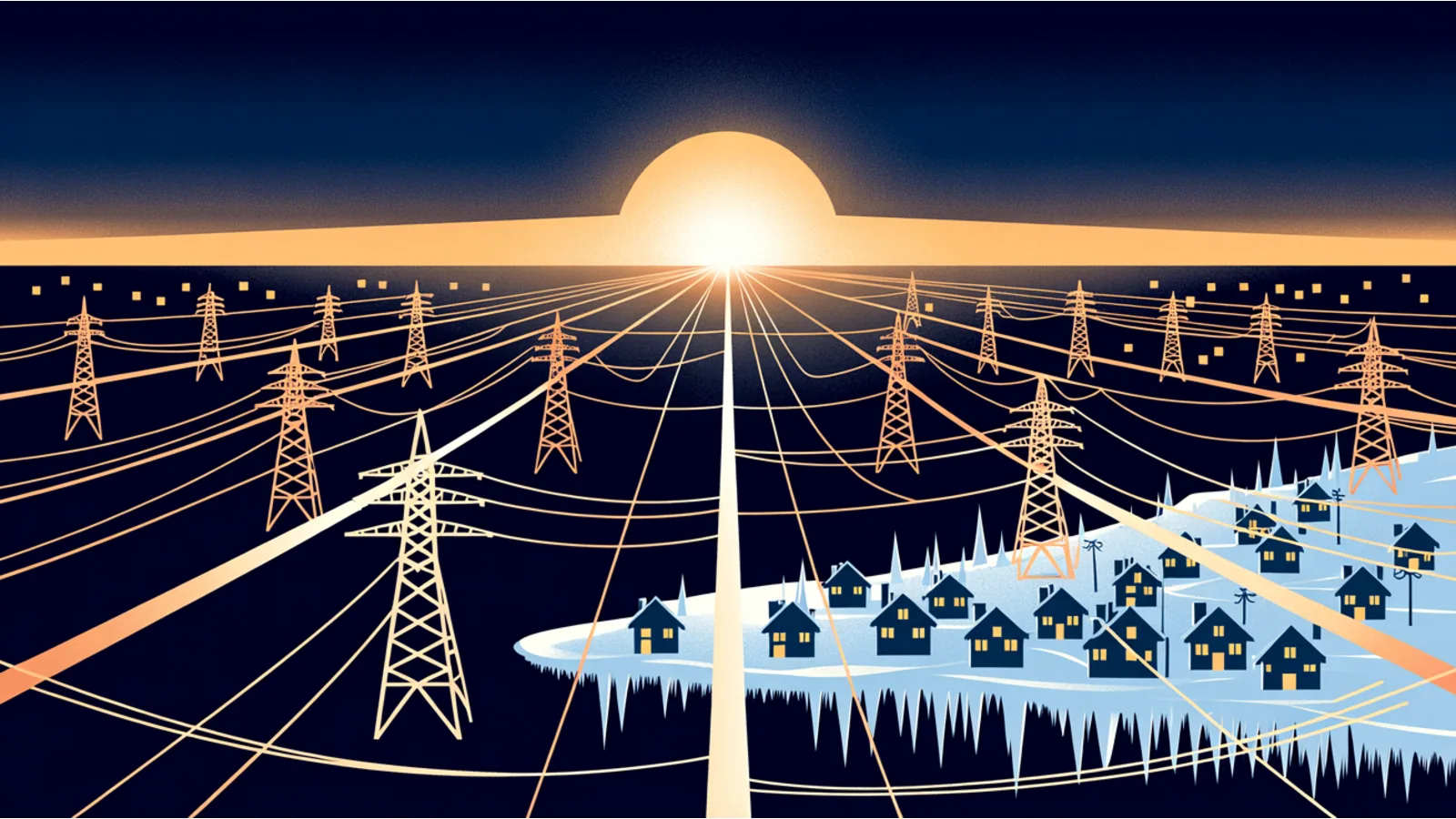
Most people in Texas have never heard of the organization that decides whether their lights stay on, and almost no one thinks of it as a nonprofit. The Electric Reliability Council of Texas, ERCOT, is a tax-exempt 501(c)(4) that operates the electric grid for about 90 percent of the state, 25 million customers, balancing supply and demand every few seconds and clearing the market through which power is bought and sold. Its most recent tax return is a strange and instructive document: $7.43 billion in assets but only $344 million of its own, a nonprofit that clears billions it does not keep. And its recent history is the most consequential in this series, because in February 2021 the grid this nonprofit runs failed, and hundreds of people died. Everything below is from the filing and the public record.
A nonprofit that clears a market
ERCOT was established in 1970 and became the first independent system operator in the United States, the neutral party that manages the flow of electricity across a grid owned by many separate companies (Wikipedia, "Electric Reliability Council of Texas"). It is not a utility and it does not own power plants or wires. It is the referee and the marketplace: it forecasts demand, dispatches generators, and settles the payments between the companies that produce power and the ones that deliver it. That role explains the odd shape of its balance sheet. The $7.43 billion in assets is mostly market-settlement money in transit, funds cleared between generators and utilities, not ERCOT's own wealth. Its actual net assets are $344 million, and even that modest reserve is invested the way every institution in this series invests its reserve, in the markets.
It is funded not by taxes and not by charity but by a fee. ERCOT charges a system administration fee on every megawatt-hour of electricity that moves across the grid, set by the Public Utility Commission of Texas, which approved budgets of roughly $405.7 million and $414.3 million for 2024 and 2025, raising the fee for the first time since 2016 (PUCT order). Every Texan pays for ERCOT, a fraction of a cent at a time, folded invisibly into the electric bill. A nonprofit funded by a metered toll on the flow of electrons.
The February that the grid failed
For most of its history ERCOT was invisible, which is how a well-run utility operator prefers to be. That ended in February 2021, when Winter Storm Uri hit Texas and the grid ERCOT manages came within minutes of a total, monthslong collapse. A generation shortfall of roughly 34,000 megawatts forced rolling blackouts that cut power to about 4.5 million homes and businesses, some for days, in freezing temperatures (Wikipedia, "2021 Texas power crisis"). The official death toll from the Texas Department of State Health Services was 246, and independent excess-mortality estimates ran far higher (Texas DSHS). A nonprofit almost no one could name was suddenly at the center of one of the deadliest infrastructure failures in modern American history.
The institutional fallout was immediate and revealing. ERCOT's chief executive, Bill Magness, was fired within weeks (Texas Tribune). Five members of its board resigned on February 23, 2021, including the chair and vice chair, and the detail that inflamed the politics was that several of them lived outside Texas (CNN). A nonprofit that runs a state's most critical system had been governed, in part, by directors who did not live in the state, and the crisis made the governance itself a scandal. In the reforms that followed, regulators lowered the systemwide offer cap, the maximum price generators can charge in a shortage, from $9,000 to $5,000 per megawatt-hour, dialing back the very price mechanism that had sent power costs to catastrophic levels during the freeze.
For how long, and the stakes it carries
ERCOT will keep running the grid, and the stakes are only rising. Its current leadership, under chief executive Pablo Vegas, describes a grid that is now among the most stressed in North America, as record demand from data centers and industrial growth pushes against supply (Utility Dive). The organization sits at a genuinely unusual intersection: a tax-exempt nonprofit, funded by a metered fee, clearing a multi-billion-dollar market, holding almost none of the money that flows through it, and responsible for whether 25 million people have electricity in a heat wave or a freeze. It is the sharpest example in this series of how far the word nonprofit stretches. ERCOT is not charitable and not commercial; it is essential, a piece of public infrastructure organized as a private nonprofit corporation. The foundations and endowments elsewhere in these posts hold their wealth and invest it in the markets. ERCOT holds almost nothing and passes the money through, and what it actually manages is not money at all but risk, the risk that the lights go out. In 2021 that risk came due, and 246 people are the reason ERCOT is no longer invisible.
Related reading
- The Nonprofits That Do Not Look Like It: ERCOT among the golf tour, the insurer, and the benefit trusts.
- The $760 Million Nonprofit That Pays Tiger Woods: the PGA Tour, another tax-exempt body running a commercial operation.
- Two and a Half Billion Dollars, No Endowment: MITRE, a nonprofit that passes federal money through rather than accumulating it.
- The Working Ledgers: the market underneath every institution that holds money.
Fact-check notes and sources
- The financial figures (total assets $7,427,062,983; net assets $343,921,981; chief executive compensation of $3,558,528): from ERCOT's IRS Form 990 for 2024 (EIN 74-2587416) via ProPublica's Nonprofit Explorer.
- ERCOT's 1970 establishment, its role as the first US independent system operator, and its coverage of about 90 percent of Texas load for 25 million customers: Wikipedia, "Electric Reliability Council of Texas", attributed.
- The system administration fee and the 2024 to 2025 budgets of roughly $405.7 million and $414.3 million: the PUCT order approving ERCOT's biennial budget.
- Winter Storm Uri, the roughly 34,000 megawatt shortfall, the 4.5 million homes and businesses without power, and the official death toll of 246: Wikipedia, "2021 Texas power crisis" and the Texas Department of State Health Services mortality report.
- The firing of chief executive Bill Magness and the February 23, 2021 resignation of five board members, several living outside Texas: Texas Tribune and CNN. The current grid-stress description under chief executive Pablo Vegas: Utility Dive.
This post is informational and historical, not financial or legal advice. All figures are reproduced from the public filing and the public record. The organization and individuals are discussed from the public record as nominative fair use, with no affiliation implied and nothing endorsed by them.
