
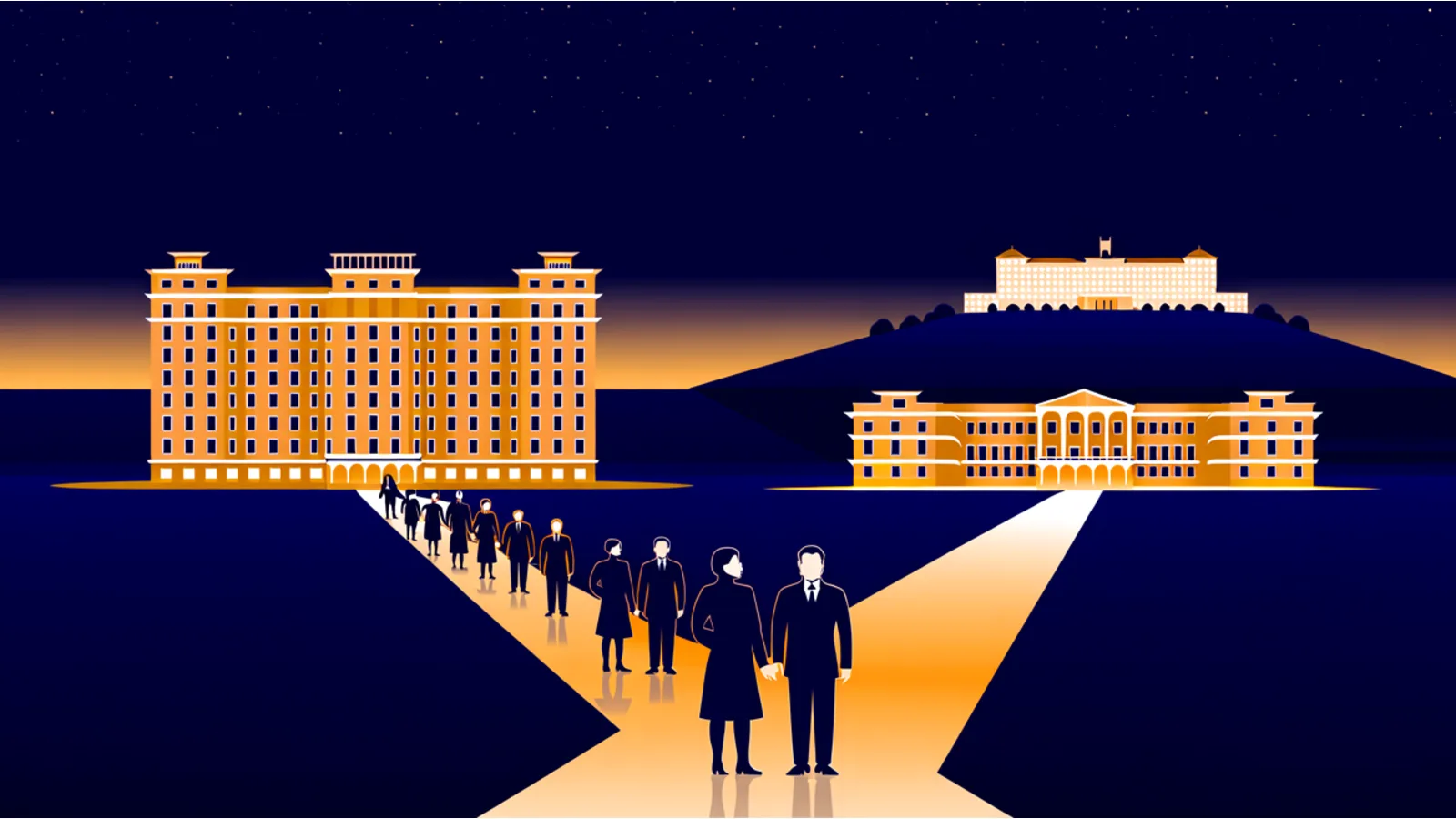
Two American families built the modern hotel business, and they made opposite choices about the oldest question a fortune poses: what does a founder owe his heirs, and what does he owe the world? The Marriotts kept everything together, the company, the control, and the money, and three generations later they still run the largest hotel company on earth. The Hiltons, founder and son alike, routed almost the entire fortune into a charitable foundation, let private equity take the operating company, and left the famous name to heirs who inherited comparatively little of it. Put side by side, they are the clearest illustration in this series of the difference between keeping a fortune and giving it away. Read from the record.
The Marriotts: the dynasty kept intact
The Marriott story starts with a nine-stool root beer stand. In 1927, J. Willard Marriott and his wife Alice opened an A&W franchise in Washington, D.C., added hot food when the weather turned cold, and called it the Hot Shoppes (Wikipedia, "J. Willard Marriott"). The company went public in 1953, and in 1957 it opened its first hotel, the Twin Bridges Motor Hotel in Arlington, Virginia, the beginning of what became Marriott Corporation in 1967 (Encyclopedia.com; Wikipedia, "Twin Bridges Motor Hotel"). The family's Mormon faith ran through it from the start. J. Willard was born near Ogden, Utah, into a Latter-day Saint family, and he began a tradition of placing a Book of Mormon alongside the Gideon Bible in every hotel room (Wikipedia, "J. Willard Marriott").
Today Marriott International is the largest hotel company in the world, a position it took with its 2016 acquisition of Starwood for roughly $13 billion (CBS News). At the end of 2024 it operated more than 9,300 properties with over 1.7 million rooms across 144 countries under more than 30 brands (Marriott 2024 results). And the family still holds it. The Marriott reporting group owns about 13 percent of the company's stock through its family vehicle, and Forbes estimates the family's overall stake at "at least 18 percent" (Forbes). J.W. "Bill" Marriott Jr. ran the company for decades, as chief executive from 1972 and chairman from 1985, handing the CEO job to the first non-family chief, Arne Sorenson, in 2012 (Wikipedia, "Bill Marriott"). Control stayed in the bloodline through the boardroom: Bill's son David Marriott has been chairman since 2022 (Asian Hospitality). The payoff is a fortune passed to the heirs, not away from them: Forbes ranked the Marriott family seventeenth on its 2026 list of America's richest families at $23.5 billion (Forbes). The dynasty is intact.
The Hiltons: the fortune given away
Conrad Hilton built his empire on the opposite instinct. He bought his first hotel, the Mobley in Cisco, Texas, in 1919, opened the first property to carry the Hilton name in Dallas in 1925, took over the Waldorf Astoria in 1949, and expanded across the world (Wikipedia, "Conrad Hilton"; Hilton). Then he did something few founders do. When he died in 1979, his will left "nearly all his wealth," about $160 million in Hilton stock, not to his children but to the Conrad N. Hilton Foundation, the charity he had established in 1944, with only relatively small bequests to his heirs (Conrad N. Hilton Foundation). It was a choice in the tradition of Andrew Carnegie, who believed a great fortune left to heirs was a curse, though Conrad framed it in his own religious terms, as a duty to relieve suffering (NCFP).
His son Barron Hilton fought part of that will and, after roughly a decade of litigation, a California appeals court in 1988 upheld an option that let him keep voting control over a large block of the company (Wikipedia, "Barron Hilton"). Barron ran Hilton for thirty years. But the operating company eventually left the family entirely: in 2007 the Blackstone Group bought Hilton Hotels for about $26 billion, ending family control, and after a 2013 re-listing Hilton became a widely held public company (Blackstone; Wikipedia, "Hilton Worldwide"). Barron then matched his father. Under the Giving Pledge in 2010 he committed to "donate 97 percent of my wealth to the Hilton Foundation," and on his death in 2019 he did (Giving Pledge). The result is one of the largest humanitarian foundations in America, with roughly $7 billion in assets giving away about $300 million a year to fight homelessness, provide safe water, and support refugees (ProPublica Nonprofit Explorer). And the famous heirs, Paris and Nicky Hilton among them, the children of Barron's son Rick, inherited comparatively little of the core fortune and built their own, Rick through a Beverly Hills brokerage and Paris through a largely self-made media and product business (Wikipedia, "Richard Hilton").
The contrast
Set the two families against each other and the lesson is stark, because they answered the founder's question in opposite ways and got opposite results. The Marriotts concentrated: they kept the company, held a controlling influence through ownership and the chairmanship across three generations, and passed a $23.5 billion fortune down the family line. The Hiltons dispersed: the founder gave the bulk of his estate to his foundation, his son gave 97 percent of his, the operating company passed to private equity, and what endures in the family's name is a great charitable foundation and a set of heirs who mostly had to make their own money. Neither path is obviously wrong. The Marriotts built a dynasty; the Hiltons built an institution that will outlast any Hilton. But the mechanics are worth seeing clearly, because they are the same mechanics that run through every fortune in this series. Keeping wealth in a family requires the deliberate machinery of concentration, ownership held together, control locked in, succession planned. Give that machinery away, as the Hiltons twice chose to, and the fortune flows to the foundation and the company flows to whoever can buy it. The name on the hotel stays the same. What sits behind it could hardly be more different.
Related reading
- Control Without a Supervoting Share: the Marriott half in full, and how the family holds a public company without the dual-class device most dynasties reach for.
- The Fortune That Left: the Hilton half in full, from the contested will to the foundation to the buyout that ended family ownership.
- The Man Who Refused to Found a Dynasty: Andrew Carnegie, whose choice to give it all away the Hiltons echoed.
- The Archetype: the family that kept it together through trusts and a family office, the Marriotts' deeper cousin.
- Shirtsleeves in Three Generations: what happens when a family neither keeps the machinery nor gives it away on purpose.
- The Working Ledgers: the market and the money underneath every fortune, kept or given.
Fact-check notes and sources
- The Marriotts (the 1927 A&W stand founded by J. Willard and Alice Marriott that became the Hot Shoppes, the 1953 public offering and the 1957 first hotel, the Mormon faith and the Book of Mormon tradition; Marriott International as the world's largest hotel company after the roughly $13 billion 2016 Starwood acquisition, with more than 9,300 properties and over 30 brands at the end of 2024; the family's roughly 13 percent reporting-group stake and Forbes' "at least 18 percent" figure; Bill Marriott Jr.'s tenure and David Marriott's chairmanship from 2022; and the family's $23.5 billion, seventeenth-place ranking on Forbes' 2026 list): Wikipedia, "J. Willard Marriott", Encyclopedia.com, CBS News, Marriott 2024 results, Forbes, and Asian Hospitality. The roughly 13 percent (a family reporting group's SEC filing) and the "at least 18 percent" (Forbes' broader family figure) are not interchangeable. The Starwood deal is cited at its roughly $13 billion headline value; the final consideration was closer to $13.6 billion.
- The Hiltons (Conrad Hilton's first hotel in 1919, the first Hilton-named hotel in 1925, the Waldorf Astoria in 1949, and his 1979 death; his will leaving "nearly all his wealth," about $160 million in Hilton stock, to the Conrad N. Hilton Foundation with small bequests to his children; Barron Hilton's contest and the 1988 ruling upholding his option; the 2007 Blackstone purchase for about $26 billion and the 2013 re-listing; Barron's Giving Pledge commitment of 97 percent of his wealth and his 2019 death; the foundation's roughly $7 billion in assets and roughly $300 million in annual grants; and the Rick Hilton branch's largely self-made wealth): Wikipedia, "Conrad Hilton", Conrad N. Hilton Foundation, Wikipedia, "Barron Hilton", Blackstone, Giving Pledge, ProPublica Nonprofit Explorer, and Wikipedia, "Richard Hilton". Two separate "97 percent" figures should not be blurred: Conrad left about 97 percent of his personal estate (which was only about a quarter of the company's stock) to the foundation in 1979, and Barron separately pledged 97 percent of his own wealth decades later. Barron's fortune is often reported at roughly $4.5 billion, a press estimate; the foundation's own framing described a gift of roughly $2.9 billion. The comparison to Carnegie is this article's framing, not a claim Conrad Hilton made. The widely repeated line that Paris Hilton "got nothing" is reported as rumor and is not asserted here.
- The Blackstone deal was about $26 billion in enterprise value including debt (roughly $20 billion in equity), at a 40 percent premium per Blackstone's own announcement.
This post is informational and historical, not financial advice. Figures are reproduced from the cited public sources, filings, and foundation records, with estimates and reported items flagged as such. Individuals and companies are discussed as nominative fair use from the public record, with no affiliation implied.
