
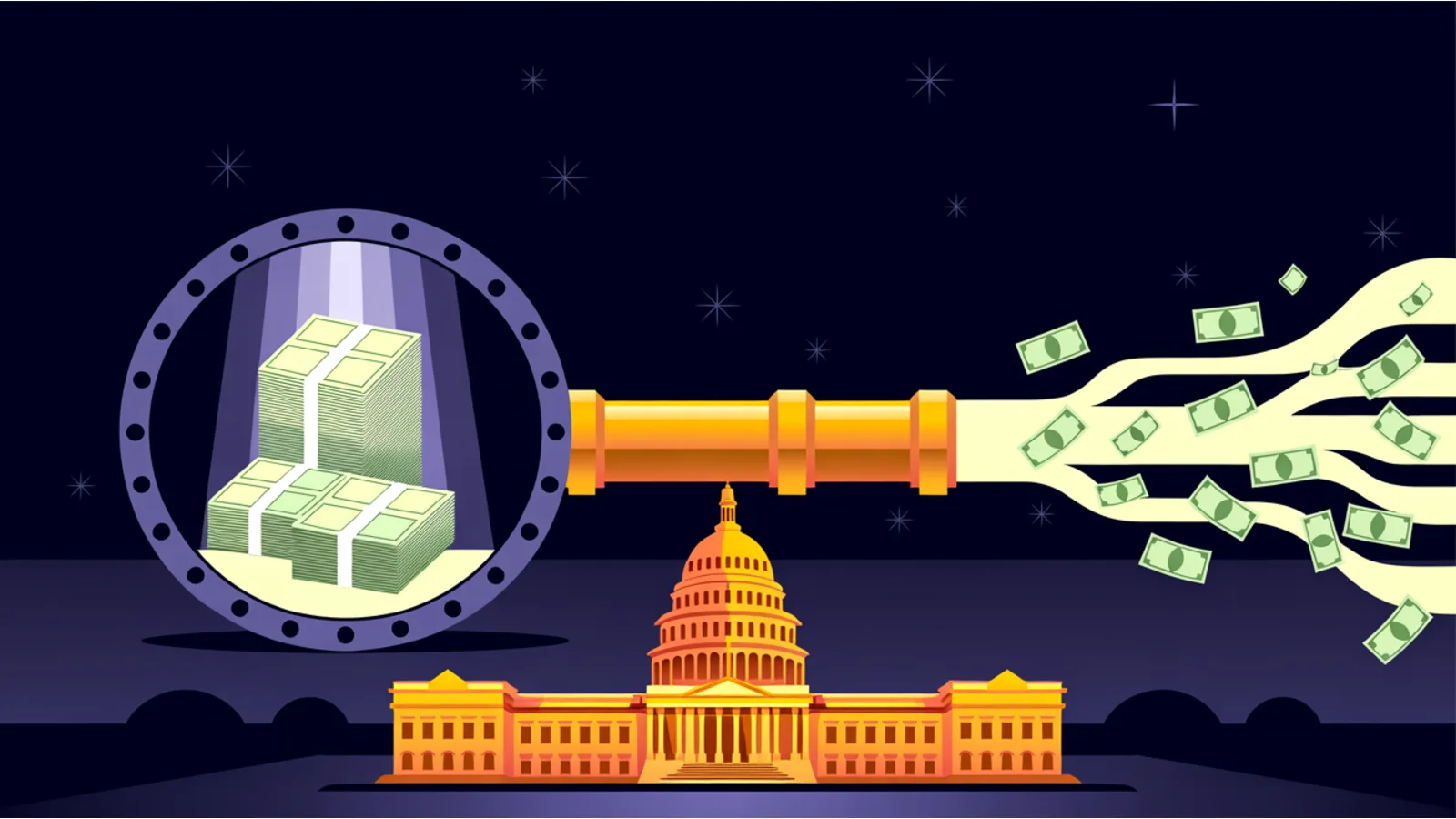
An earlier piece in this series compared public trust funds to sovereign wealth funds, and drew a sharp contrast: Norway's fund holds real assets out in the world economy, while America's Social Security trust holds something stranger. This post follows that thread to its natural question. When people say the Social Security trust fund holds trillions of dollars, who exactly is holding that money, who borrowed it, and what did they do with it? The answer is both simpler and more disorienting than most people expect. The trust fund is, by law, permitted to lend to a single borrower, the United States federal government, which spends the proceeds on everything else it does. That arrangement is simultaneously as real as any government bond and, to its critics, an accounting of the government owing itself. Both descriptions are true, and this is how they fit together, from the primary sources.
How the trust fund works
Social Security runs through two legally separate trust funds: Old-Age and Survivors Insurance, which pays retirement and survivors benefits, and Disability Insurance, which pays disability benefits (SSA). When those funds take in more in payroll taxes than they pay out, the law does not let the surplus be invested in stocks or corporate bonds. By statute, trust-fund reserves may be invested only in interest-bearing obligations of the United States, and in practice that means special-issue Treasury securities, non-marketable bonds issued exclusively to the trust funds (Cornell Law, 42 U.S.C. 401; SSA on special issues). As of the end of 2025, the Old-Age fund held about $2.34 trillion in these securities and the two funds combined held about $2.56 trillion (2026 Trustees Report). That is the "trust fund." It is, almost entirely, a pile of IOUs from the federal government.
Who borrows from it
Here is the mechanism that answers the question. When the trust fund buys a special-issue Treasury security, it hands cash to the Treasury and receives a bond in return. The Social Security Administration states plainly what happens to that cash: it "goes into the general fund of the Treasury and is indistinguishable from other cash in the general fund," and "the government spends this borrowed cash" (SSA). So the borrower is the U.S. Treasury, which is to say the federal government as a whole, and it uses the money for general federal spending, whatever the government happens to be paying for, from defense to interest to everything else. The SSA's own historians put it most cleanly: the payroll taxes "are in effect being lent to the federal government to be expended for whatever present purposes the government requires" (SSA history). There is no vault of cash sitting somewhere marked "Social Security." There is a fund that lent its surplus to the government, and a government that spent it.
The debt is real in the legal sense. The securities are backed by the full faith and credit of the United States, and the government pays interest on them, roughly $69 billion in 2025, at an effective rate around 2.5 percent (2026 Trustees Report). The SSA is emphatic on the point: "Far from being worthless IOUs, the investments held by the trust funds are backed by the full faith and credit of the U.S. Government," which "has always repaid Social Security, with interest" (SSA).
The honest debate
And yet there is a serious, respectable critique, and it comes not only from outside skeptics but from the government's own budget accountants. The point they make is that the trust fund is money one part of the government owes another. The Government Accountability Office describes the holdings as "debt the government owes itself," noting the trust funds are "lending their surpluses to the Treasury" (GAO). The sharpest version appeared in the White House's own budget documents years ago, which stated that the balances are available "only in a bookkeeping sense," that "they do not consist of real economic assets that can be drawn down in the future to fund benefits," and that they are instead "claims on the Treasury that, when redeemed, will have to be financed by raising taxes, borrowing from the public, or reducing benefits or other expenditures" (OMB, FY2000 Budget).
The two sides do not actually disagree about the facts. Both accept the bonds are legally binding and interest-bearing. What they disagree about is whether a claim by the government on itself counts as net wealth for the government as a whole. To the household holding a Treasury bond, it is a real asset. To the government that must one day redeem it, honoring the trust fund's bonds means finding the money the same way it finds any money, by taxing, cutting, or borrowing from the public. Both things are true at once, and an honest account states both.
What happens as it runs down
This is not an abstract debate, because the Old-Age fund is now being drawn down as the baby boomers retire and payroll taxes no longer cover benefits. The most recent Trustees Report, released in June 2026, projects the Old-Age trust fund's reserves will be depleted in the fourth quarter of 2032, one quarter earlier than the previous year's report, an acceleration attributed largely to a 2025 law that cut income taxes on benefits and so reduced projected revenue (2026 Trustees Report highlights; Bipartisan Policy Center). But depletion is not bankruptcy, and this is widely misunderstood. Once the reserves are gone, continuing payroll taxes are still projected to cover about 78 percent of scheduled benefits, declining gradually thereafter; the combined funds, considered together, reach that point in 2034 at about 83 percent payable (2026 Trustees Report highlights). In other words, running out of the trust fund does not mean the checks stop. It means the government loses the cushion of the bonds it owes itself and falls back on the taxes coming in the door, which is precisely the point the budget accountants were making all along.
The bottom line
The Social Security trust fund, then, is a fund with exactly one permitted borrower, the government that created it, and that borrower spends what it lends. This is what most distinguishes it from a true sovereign wealth fund. Norway's fund converts a nation's savings into claims on the global economy, shares of companies and bonds that someone outside the government is obligated to pay. Social Security's fund converts its surpluses into claims on Washington, obligations the same government owes itself. Both are called trust funds, and both are real. But only one holds assets that someone outside the government has to make good. Understanding that is the difference between thinking the trust fund is a myth, which it is not, and thinking it is a giant invested nest egg, which it also is not. It is a ledger of what the government has borrowed from tomorrow's benefits and already spent, and it will be honored the only way the government ever honors anything, out of the taxes, cuts, or borrowing of the future.
Related reading
- Trust Funds and Sovereign Wealth: the fuller comparison to Norway's fund and other public trusts.
- The Working Ledgers: the market and the money underneath every fund that claims to hold a fortune.
Fact-check notes and sources
- How the fund works (the two separate Old-Age and Survivors Insurance and Disability Insurance trust funds; the statutory requirement that reserves be invested only in interest-bearing U.S. obligations, in practice non-marketable special-issue Treasury securities; and the roughly $2.34 trillion Old-Age balance and $2.56 trillion combined balance at the end of 2025): SSA trust fund FAQ, Cornell Law, 42 U.S.C. 401, SSA on special issues, and the 2026 OASDI Trustees Report.
- Who borrows (the cash from buying the securities going into the general fund of the Treasury and being spent, so the borrower is the federal government, which uses it for general spending; the roughly $69 billion in interest earned in 2025 at an effective rate around 2.5 percent; and the securities being backed by the full faith and credit of the United States): SSA trust fund FAQ, SSA history on budget treatment, and the 2026 Trustees Report.
- The debate and the drawdown (the Government Accountability Office describing the holdings as debt the government owes itself; the Office of Management and Budget's statement that the balances are available only in a bookkeeping sense and do not consist of real economic assets; and the 2026 Trustees Report projecting Old-Age depletion in the fourth quarter of 2032 with about 78 percent of benefits payable thereafter, the combined funds in 2034 at about 83 percent, the acceleration tied to a 2025 tax change, and the fact that depletion is not the end of benefits): GAO, OMB FY2000 Budget Analytical Perspectives, 2026 Trustees Report highlights, and the Bipartisan Policy Center explainer. Several SSA, Treasury, and related pages return errors to automated fetching; the figures were verified against the primary Trustees Report tables and are cited to the canonical URLs.
This post is informational and historical, not financial advice. Figures are reproduced from the cited primary government sources, chiefly the 2026 OASDI Trustees Report, with the honest range of interpretation presented rather than either side's spin.
