
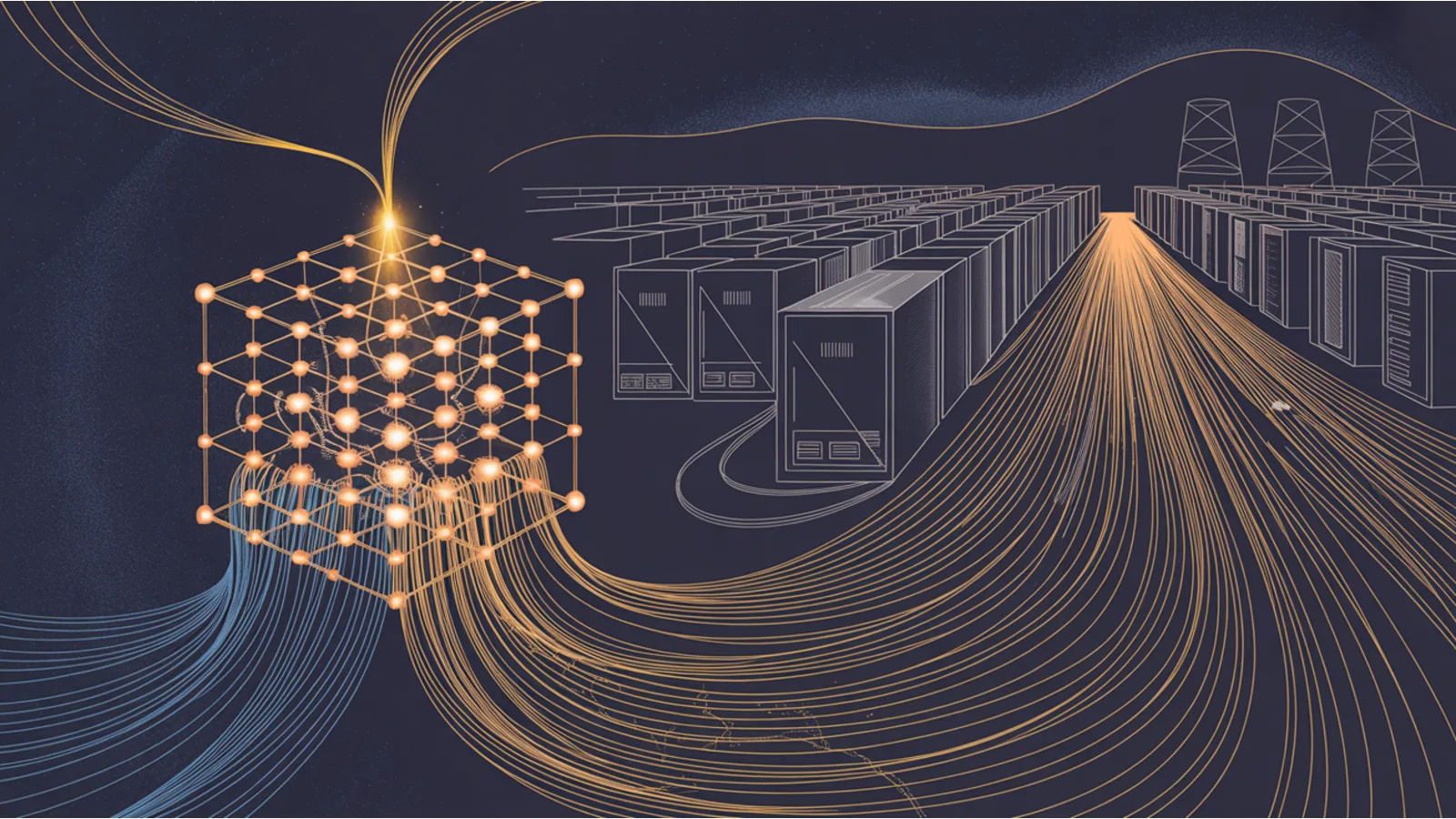
A piece is making the rounds claiming that a D-Wave quantum computer solved in minutes what would have taken the Frontier supercomputer nearly a million years, on 12 kW of power, and that this single result quietly invalidated the trillion dollar AI data center buildout. The article names real things. Real Science paper. Real Three Mile Island restart. Real Meta campus in Louisiana. Real bill moving through Congress.
It also flattens a contested narrow physics result into a sweeping claim about AI compute, then uses that flattened claim to argue you can stop worrying about the energy and capital pouring into AI infrastructure. That is not the read.
If you are building with AI, or paying for it as a small business, what follows is the version with the rebuttals included and the numbers cited. The short version: quantum is real, the energy story is real, and they are complements, not substitutes.
What the D-Wave Science paper actually showed
The paper exists. "Beyond classical computation in quantum simulation" was published in Science on March 12, 2025. D-Wave's Advantage2 prototype simulated quantum spin glass dynamics in roughly minutes of wall clock time, with the largest instances completing in about 36 microseconds of quantum processing time. D-Wave estimated the equivalent calculation on Frontier would take on the order of a million years. The Advantage2 system draws roughly 12.5 kW of total system power, not 12 kW flat.
Three things the original article elided.
One. This is a quantum simulation of a specific physics problem (the dynamics of programmable quantum spin glasses). It is not a general purpose computation. You cannot point a D-Wave annealer at a transformer training run, or an inference workload, or even a typical optimization problem outside its native form, and expect this kind of speedup. The result is narrow by design.
Two. The "million years on Frontier" claim was contested within days. EPFL, the Flatiron Institute, and an NYU group published classical simulations that reproduced large portions of D-Wave's result. Flatiron used belief propagation and tensor networks. NYU reported similar simulations running on a laptop in roughly two hours. HPCwire ran the headline "D-Wave Reports Quantum Supremacy, Stirs Immediate Challenge and Rebuttal" the day after publication. IEEE Spectrum, Quantum Computing Report, and Data Center Dynamics all covered the back and forth. The supremacy framing is actively disputed, not settled.
Three. The "more energy than the entire planet uses in a year" line that the original article quotes is D-Wave's own marketing math, derived from the disputed million year extrapolation. Once classical methods finish the same problem in hours to days on commodity hardware, the energy comparison collapses to near parity or favors classical. It is not an independently verified physical measurement, and it should not be repeated as one.
The honest summary: D-Wave published a real, peer reviewed quantum simulation result that classical methods have largely caught up with on the same problem, in a niche where annealing hardware is well suited. That is interesting. It is not the end of the AI compute story.
The real data center energy numbers
The energy crunch the original article points at is real. The framing is just stretched in places.
EPRI's "Powering Intelligence 2026" report projects US data centers will consume 9 percent to 17 percent of US electricity by 2030, and 10 percent to 20 percent by 2035, up from roughly 4 to 5 percent today. That is all data centers, not solely AI workloads. The AI share is the fastest growing slice inside that envelope but it is not the whole envelope.
Long lead infrastructure does take a long time. New transmission lines and new large nuclear units typically take 10 to 20 years to permit and build. Data center buildings themselves take 6 to 18 months for permits and roughly 1 to 3 years to construct. The original article folded all of that into a flat "10 plus years" line, which is true for the grid and generation pieces and misleading for the buildings.
Three Mile Island is coming back online. The framing matters. Constellation Energy, not Microsoft, owns and is restarting TMI Unit 1, which has been renamed the Crane Clean Energy Center after the late Exelon and Constellation CEO Chris Crane. Microsoft signed a 20 year power purchase agreement to take the output. Target restart is 2028, potentially as early as 2027 if the PJM interconnection moves quickly. Microsoft is the off taker, not the operator. Worth getting right because the operator distinction shows up in every other "AI is restarting nuclear" headline.
Meta's Hyperion campus in Richland Parish, Louisiana is real. Designed for 5 GW of IT compute, with another roughly 2.5 GW for cooling and support. Entergy is planning roughly 10 new gas fired plants to feed it. Initial budget was 10 billion dollars in late 2024, raised to 27 billion dollars in 2025. Bloomberg's 2026 reporting cites a long horizon build out projection above 200 billion dollars. That 200 billion figure is not a signed off capex number. It is a long range estimate. Treating it as a confirmed price tag, as the original article does, overstates contracted spend by roughly an order of magnitude.
Small modular reactors are not the clean substitute they get pitched as. A UBC and Stanford led study (Krall, Macfarlane, Ewing) published in PNAS in 2022 found that most SMR designs increase nuclear waste volume by factors of 2 to 30 per unit energy compared with conventional reactors, and produce roughly 50 percent more plutonium radiotoxicity at 10,000 years per unit energy. Argonne and Idaho National Labs publicly dispute the methodology. So this is a contested finding, not a settled one. But it deserves to be in the conversation when an AI buildout pitch claims SMRs solve the waste problem.
Why AI and quantum are complements, not competitors
The original article frames quantum as if it is going to crowd out the AI data center buildout. That is the part that does not survive a careful read.
Quantum annealing is good at a narrow class of problems. Combinatorial optimization, certain physics simulations, certain sampling problems. Gate based quantum computers are still pre fault tolerant and are best suited to specific chemistry, materials, and cryptanalysis workloads that have hard structure. None of these overlap meaningfully with the workloads that drive AI data center demand: training large neural networks via gradient descent on dense matrix multiplies, and running inference on those networks at scale.
The real industry pattern is hybrid. Forschungszentrum Jülich is coupling a D-Wave Advantage annealer to JUPITER, Europe's first exascale supercomputer. Jülich became the first HPC center in the world to own a D-Wave Advantage system. The integration runs through JUNIQ, Jülich's quantum user infrastructure. The point of that pairing is not that the quantum machine replaces the exascale machine. It is that certain subproblems get handed off to the annealer while the bulk of the work stays on classical silicon. That is the realistic shape of quantum's contribution for at least the next decade.
D-Wave and Japan Tobacco's pharma arm announced a quantum hybrid LLM workflow for drug discovery in March 2025 that, in their reported results, generated more valid and more drug like molecules than a classical only baseline. Worth noting: I could not find a peer reviewed paper or an arXiv preprint for this work. Coverage is company press releases and trade news. The original article describes it as "published on arXiv, peer review confirmed," which I cannot verify. Call this a vendor reported proof of concept, not validated science.
The pattern holds for the rest of the live examples. GE Vernova received 12.6 million dollars from the Department of Energy to research quantum level cybersecurity protections for power grid assets. That is R and D and pilot work, not an operational quantum protected grid. Treating R and D pilots as deployed capability is one of the cleanest ways to mislead readers about where a technology actually sits on the curve.
On the policy side, the National Quantum Initiative Reauthorization Act (S.3597, Cantwell and Young) passed Senate Commerce unanimously on April 14, 2026 (World Quantum Day), and the House Science Committee marked it up in April 2026. The bill extends NQI authorities through December 2034 and authorizes roughly 2.7 billion dollars FY2025 to FY2029. That is a real funding signal, and it is consistent with the hybrid story above. Federal money is going into quantum on the timeline of a decade, on a budget that is roughly 1 percent of what a single hyperscaler is spending on AI in a single year. That ratio tells you who the substitute would have to be.
What to actually do if you are building with AI
Strip out the "quantum will save us from the data center buildout" framing and the operational implications are unchanged.
Pay attention to compute price, not paradigm shifts. The model layer is commoditizing on classical hardware. Inference prices on the major frontier APIs have compressed roughly an order of magnitude in 18 months. That is the trend that affects your AI bill in 2026 and 2027, not a quantum breakthrough that affects narrow physics workloads.
Push more work to the edge where it makes sense. Apple Silicon is now a genuinely usable inference target for sub 14B models thanks to MLX. Ollama 0.19 (March 30, 2026) replaced its Apple Silicon inference engine with Apple's MLX framework. Ollama's own benchmark on Qwen3.5-35B-A3B (a real Qwen MoE model, 35B total and 3B activated) on M5 Max shows prefill rising from 1,154 to 1,810 tok/s (+57 percent) and decode from 58 to 112 tok/s (+93 percent) after the MLX switch. For sub 14B models on M3 and M4 Macs, MLX outperforms llama.cpp by anywhere from roughly 20 percent to 87 percent on generation, with the gap converging to near zero above about 27B as memory bandwidth becomes the bottleneck. So "MLX is 20 to 30 percent faster" is an under reading.
If you build a workload that runs locally on a Mac instead of round tripping to a data center for every token, you have already done more for your own AI cost structure than any quantum breakthrough is going to do for you this decade. The forthcoming /tools/apple-silicon-local-ai-advisor/ walks through which models fit which chips honestly, with the engineering judgment labeled as engineering judgment.
Spend the boring capital on observability. Cost caps, iteration limits, lint clean skills, read only by default permissions. The AI agent cost controls post covers the SMB version. The bigger investor framing in the boring AI layer post covers the strategic version. Either way, none of it depends on what D-Wave publishes next.
And read the source articles, not the takes about the source articles. The Science paper is online. EPRI's report is online. Constellation's press release is online. The Stanford and UBC SMR study is online. None of them say what the viral Medium piece said they said. When a narrative is too clean ("one quantum result killed a trillion dollar bet"), the cleanness is usually doing the lying for you.
The deeper version
The pattern of "infrastructure layer wins while the headline layer commoditizes" is the spine of The $100 Network (Digital Empire series, 9.99 dollars on Kindle). The book covers why the boring layer underneath any technology stack is where the durable value sits, which is exactly the read that survives even if quantum hardware moves faster than the rebuttals suggest.
Related reading
- Wall Street is betting on the wrong AI layer, the longer version of the model versus infrastructure argument.
- How a small business runs AI agents without a 47K dollar surprise bill, the observability discipline that matters more than any compute paradigm shift.
- The 50 dollar per month AI stack for an SMB, the practical floor for what AI should actually cost a small business.
- AI terminal kickstart, the install side of getting local AI working on your own machine.
- Two CLI workflow with Codex and Claude Code, the working pattern for a builder who wants AI on the desk instead of always in the cloud.
Fact-check notes and sources
- D-Wave's Science paper, "Beyond classical computation in quantum simulation," March 12, 2025: D-Wave press release.
- Classical simulation rebuttals (EPFL, Flatiron, NYU): HPCwire, March 13, 2025, IEEE Spectrum, Quantum Computing Report reconciliation.
- D-Wave Advantage2 power draw (about 12.5 kW): see Data Center Dynamics coverage and The Quantum Insider.
- EPRI "Powering Intelligence 2026," 9 to 17 percent of US electricity by 2030: EPRI press release, executive summary.
- Permitting timelines for transmission and nuclear versus data center buildings: Camus Energy, ITIF report, November 2025.
- Three Mile Island restart as Crane Clean Energy Center, Constellation operator, Microsoft as 20 year PPA off taker: Constellation press release, Utility Dive, CNBC.
- UBC and Stanford led SMR waste study (Krall, Macfarlane, Ewing, PNAS 2022): Stanford News, UBC SPPGA. DOE labs dispute the conclusion.
- Meta Hyperion campus, 5 GW design, 10 gas plants, 27 billion dollars current spend with long range projections above 200 billion: Meta Data Centers page, Bloomberg feature, 2026, The Next Web, NOLA.com.
- D-Wave and Japan Tobacco quantum hybrid LLM drug discovery POC, March 31, 2025 (company reported, no peer reviewed paper located): D-Wave press release, The Quantum Insider.
- Jülich Supercomputing Centre purchases D-Wave Advantage and couples it to JUPITER (Europe's first exascale supercomputer): Forschungszentrum Jülich press release, D-Wave press release, EE Times.
- GE Global Research, 12.6 million dollars DOE award for quantum cybersecurity research on power assets: GE press release.
- National Quantum Initiative Reauthorization Act (S.3597), 2.7 billion dollars FY2025 to FY2029, extends NQI through December 2034: Congress.gov S.3597, Senate Commerce release, House Science markup notice, The Quantum Insider.
- Ollama 0.19 MLX switch on Apple Silicon, March 30, 2026, and the M5 Max Qwen3.5-35B-A3B benchmark (prefill 1,154 to 1,810 tok/s, decode 58 to 112 tok/s): Ollama blog.
- MLX versus llama.cpp on Apple Silicon, sub 14B advantage of roughly 20 to 87 percent with convergence above 27B: Andreas K benchmark, Antek Apetanovic Qwen3.5 benchmark.
This post is informational, not investment advice. Mentions of D-Wave, Microsoft, Constellation, Meta, Entergy, Apple, NVIDIA, Anthropic, OpenAI, Google, GE Vernova, Forschungszentrum Jülich, Japan Tobacco, Ollama, EPRI, and other third parties are nominative fair use. No affiliation is implied.
