
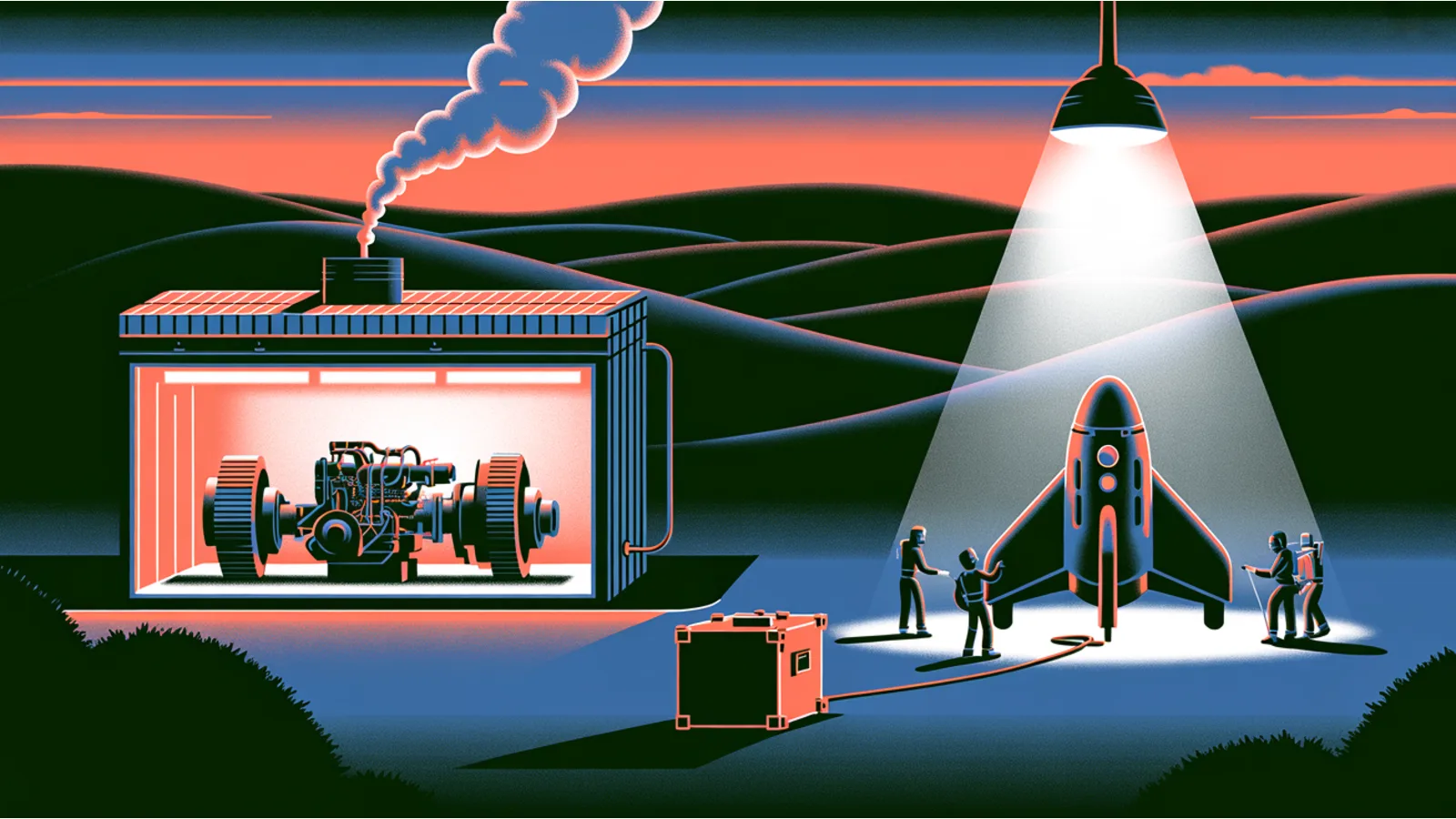
Southwest Research Institute is the strangest institution in this series, and the strangeness is the point. On one campus, in San Antonio, it runs engine test cells for oil and chemical companies, evaluating fuels and lubricants the way it has for seventy years, and it also employs the scientists who lead NASA's missions to Jupiter, Pluto, and the Trojan asteroids. It is not a university and it grants no degrees. It is not a company and sells no product. It is an independent nonprofit that does contract research for anyone who pays, government or industry, and its most recent Form 990, for the fiscal year that ended September 27, 2024, shows how a place like that keeps itself alive: a fat conservative reserve, a diversified customer base, and a habit of plowing its surplus back into its own work. All figures below are from the filing.
An oilman's institute
Southwest Research Institute was founded in 1947 by Thomas Baker Slick Jr., a San Antonio oilman and rancher, on land next to his Essar Ranch, and the ranch name itself was a tell: Essar came from the initials of scientific research, S and R (Texas State Historical Association). Slick's idea was a place that would do practical research for industry and government without being either, a public trust for applied science in a part of the country that had little of it. It marked its 75th anniversary in 2022 (SwRI, "SwRI celebrates 75 years"). Today it describes itself, in its own words, as neither a university nor a commercial lab, a client-funded organization that solves problems on contract (SwRI FAQ), spread across more than 1,500 acres and 2.4 million square feet of laboratories with a staff of more than 3,200.
The range of the work is genuinely hard to believe until you read the filing's own list. In one year SwRI published 559 papers and was awarded 35 U.S. patents across chemistry, fire safety, automotive and powertrain engineering, emissions, space systems, planetary science, fuels and lubricants, and defense. Its automotive side runs cooperative research consortia where competing manufacturers pool money for pre-competitive engine work. Its space side is a NASA powerhouse: SwRI staff lead, as principal investigators, NASA's Juno mission to Jupiter (Scott Bolton), the New Horizons mission that flew past Pluto (Alan Stern), the Lucy mission to the Trojan asteroids (Hal Levison), and the Magnetospheric Multiscale mission (James Burch), and SwRI's Robin Canup is a leading theorist of how the Moon formed (SwRI Juno release; SwRI on Alan Stern; Wikipedia, "Lucy (spacecraft)"). Several of those names are right on the compensation schedule, Bolton at $510,829, Canup at $502,992, Burch at $735,215, sitting a few lines away from the vice presidents who oversee diesel-engine test stands.
How the money moves
Revenue for the year was $926,409,362, and $914,546,152 of it was program service revenue, meaning contract research. Investment income was $11,254,470 and contributions a negligible $405,403. This is a client-funded lab, and the numbers show it as plainly as the defense labs do, with one crucial difference: SwRI's clients are not one government sponsor. They are hundreds of companies and agencies, which is the entire secret of its durability. Expenses were $892,381,723, salaries and benefits $451,047,184, and the surplus was $34,027,639. The chief executive, Adam Hamilton, only the fourth president in the institute's history and in the role since 2014, earned $1,661,889 plus $56,831 (SwRI, "Adam L. Hamilton"). The largest outside vendors tell the story of the two SwRIs at once: a space-hardware firm at $19 million, a construction company at $10.5 million, and a chemical company at $6.87 million, which is a fuel supplier for the engine research.
On the government side of that customer base, the federal spending record confirms what the mission list already implies. SwRI's largest federal sponsor, by a wide margin, is NASA, and its NASA contracts are named for the very missions its scientists lead: New Horizons, Lucy, and Solar Orbiter, the largest a single award of more than $387 million. The Department of Defense and the Department of Energy follow well behind (USAspending.gov). The engine test cells are paid by industry; the planetary science is paid, overwhelmingly, by the space agency.
How it invests, which is cautiously
SwRI's balance sheet holds a reserve, but not the way Draper or HHMI hold theirs. There is no line of publicly traded securities and no alternatives sleeve here. Instead SwRI carries $270,174,971 in savings and short-term cash investments and another $133,401,871 in other assets, a large and deliberately conservative pool. Net assets total $822,586,232, and the institute has no endowment in the donor-restricted sense at all. Everything it holds is unrestricted, which means it belongs to the mission and can be spent on the mission.
That conservatism is a choice with a logic. SwRI does not need an endowment throwing off investment income, because its diversified contract base already does that job: when one industry slows, another is still paying, so the institute does not depend on a portfolio to smooth its revenue the way a single-sponsor lab might. So it parks its reserve in cash and short-term instruments, close to Treasuries and money markets, and keeps its market risk low. It touches the same markets everyone relies on, but through the cautious end of them, the end a careful saver uses, not the end a sovereign wealth fund plays. And what it does not park, it reinvests. The filing describes an internal research and development program that funded 119 new projects and more than $11 million of self-directed research in the year, the institute buying its own next capability before a client asks for it. A place that reinvests its surplus into its own frontier is choosing to compound in capability rather than in the market.
What it owes, and what wears out
SwRI's liabilities are modest for its size, $302,307,283 in all, dominated by $249,790,228 in payables and $52,517,055 in other liabilities. There are no bonds and no big debt load. The depreciation, though, is heavy, and it should be, because this is a place full of engine dynamometers, test chambers, and spacecraft cleanrooms. SwRI holds $1,001,031,164 of land, buildings, and equipment at cost against $516,866,130 of accumulated depreciation, leaving $484,165,034 net. More than half its physical plant has been written down. A research institute's equipment is its edge, and its edge is always depreciating, which is exactly why the reinvestment program matters: the internal research and the capital spending are the same fight against obsolescence, fought on the income statement and the balance sheet at once.
For how long
Seventy-seven years and counting, on a model that looks more resilient the longer you study it. SwRI does not depend on a single congressional line the way MITRE and Aerospace do, and it does not depend on a market portfolio the way an endowed institution does. It depends on being useful to a very large number of paying customers across industries that rarely all slump at once, and on keeping a conservative cushion so a slow year is an inconvenience rather than a crisis. In May 2025 the Air Force awarded it a research contract worth about $250 million (ClearanceJobs), and its 2025 research volume set a record (EurekAlert). The institute Tom Slick built to do useful science for whoever needed it has answered the four questions this series keeps asking in the most self-reliant way available: it invests cautiously, stays solvent by staying useful to many, continues by reinvesting in itself, and lasts because no single patron can pull the floor out from under it.
Related reading
- From the Apollo Guidance Computer to a Reserve Fund: Draper, which keeps its reserve in a more aggressive, endowment-style pool.
- Two and a Half Billion Dollars, No Endowment: MITRE, the single-sponsor pass-through with no reserve.
- The Working Ledgers: SwRI placed on the full spectrum of research-institution finance.
- The Endowment That Employs Its Scientists: HHMI, the opposite pole, where the portfolio is the institution.
Fact-check notes and sources
- All financial figures (total revenue $926,409,362; program service revenue $914,546,152; investment income $11,254,470; contributions $405,403; total expenses $892,381,723; salaries and benefits $451,047,184; program service expenses $753,294,792; savings and short-term cash investments $270,174,971; other assets $133,401,871; total liabilities $302,307,283; payables $249,790,228; land, buildings, and equipment $1,001,031,164 at cost less $516,866,130 accumulated depreciation; net assets $822,586,232; the 559 papers, 35 patents, and 119 internal research projects with more than $11 million invested; and the compensation for Adam Hamilton, Scott Bolton, Robin Canup, and James Burch): read directly from Southwest Research Institute's IRS Form 990 for the fiscal year ending September 27, 2024 (EIN 74-1070544), available free at ProPublica's Nonprofit Explorer.
- The 1947 founding by Thomas Baker Slick Jr., the Essar Ranch location, and the Essar name from the initials of scientific research: Texas State Historical Association; the 75th anniversary in 2022 per SwRI.
- SwRI's self-description as neither a university nor a commercial lab, its client-funded model, and the campus size and staff of more than 3,200: SwRI's FAQ and boilerplate.
- The NASA principal-investigator roles: Scott Bolton on Juno per SwRI; Alan Stern on New Horizons per SwRI; Hal Levison on Lucy per Wikipedia, "Lucy (spacecraft)"; James Burch on the Magnetospheric Multiscale mission and Robin Canup's Moon-formation work per SwRI's own releases.
- The federal agency breakdown (NASA as the largest federal sponsor by a wide margin, with contracts named for the New Horizons, Lucy, and Solar Orbiter missions, one award over $387 million, and the Department of Defense and Department of Energy behind it): from a search of federal awards to Southwest Research Institute on USAspending.gov for federal fiscal year 2024; the figures are total award values.
- Adam Hamilton as the fourth president since 2014: SwRI leadership page. The May 2025 Air Force contract of about $250 million: ClearanceJobs. The record 2025 research volume: EurekAlert.
This post is informational and historical, not financial or investment advice. All figures are reproduced from the cited public filing. Individuals are discussed from the public record as nominative fair use, with no affiliation implied and nothing endorsed by Southwest Research Institute.
