
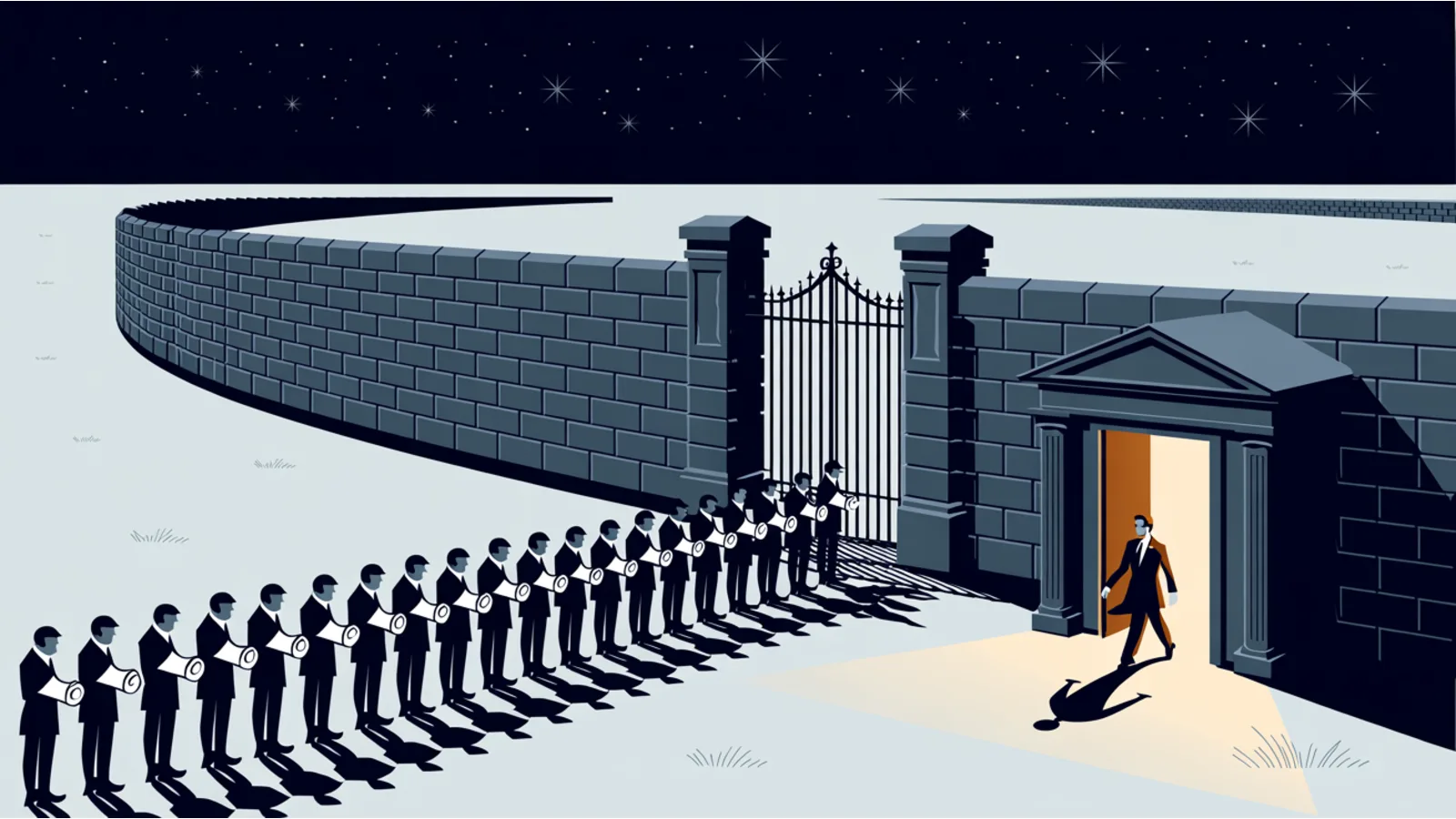
For most of American history, if you had capital and nerve, you could start a bank. Communities did it constantly; from 1990 to 2008 the country chartered more than two thousand new ones, well over a hundred a year (Federal Reserve). Then it stopped. From 2009 through 2013, the United States chartered a total of seven new banks, fewer than two a year (Federal Reserve). The door to the banking business, which had stood open for a century, effectively closed. Understanding why it closed, and who can still get through it, explains a great deal about how wealth works in America, including why a family like the Waltons has owned a bank since before the first Walmart opened.
The drought
The numbers are stark. The FDIC's own acting chairman noted in 2025 that from 1995 to 2007, the fewest new banks in any single year was 93; since 2010, the country has averaged fewer than six a year, with only 86 formed in fifteen years (FDIC). The "replenishment rate," new banks as a share of banks disappearing, collapsed from about 32 percent before the crisis to roughly 3 percent after (Banking Strategist). The result is a quiet consolidation: the number of bank charters fell from about 8,500 at the start of 2008 to roughly 4,500 by the end of 2024, and the FDIC is explicit that "the decline in banks since the start of the Great Financial Crisis is less a product of increased merger activity and much more a product of the steep decline in new bank formation" (FDIC). The country did not mostly merge its way to fewer banks. It stopped making new ones.
Honesty requires noting the cause is not purely regulatory. Federal Reserve economists concluded that even without any post-crisis rule changes, the weak economy and near-zero interest rates, which crushed the profitability a new bank needs to survive, would have caused 75 to 80 percent of the decline (Federal Reserve). But the regulation mattered too, and it was designed to. After a wave of de novo bank failures in the crisis, the FDIC in 2009 extended the period of heightened supervision for new banks from three years to seven, a change that deterred applicants until it was rolled back to three years in 2016 (JD Supra). A weak economy discouraged new banks, and a wary regulator made sure the discouraged had a harder road.
The wall
Say you want to try anyway. The barriers form a wall that structurally favors people who already have scale. You need two approvals, not one: a charter from a state regulator or the Office of the Comptroller of the Currency, and separately, deposit insurance from the FDIC, each decided independently (Congressional Research Service). You need capital, and while there is no fixed legal minimum, the FDIC expects enough to hold an 8 percent leverage ratio for the first three years, which in practice means raising "at least $20 million," and often between $20 million and $40 million; the average initial capital roughly doubled after the crisis, from about $15 million to about $32 million (Fredrikson and Byron; Banking Strategist). You need a detailed three-year business plan you are then bound to follow, needing FDIC approval to deviate more than 25 percent from it (FDIC). And you need time: the full process, from planning to opening day, runs 18 months to two years or more (Legal Clarity).
Then there is the cost, before you take a single deposit. Legal fees for the application and compliance setup can run $200,000 or more, consultants add another $150,000 or more, and the total preparation cost often exceeds seven figures (CCG Catalyst). Worse, the ongoing compliance burden falls hardest on exactly the small new banks the system supposedly wants. A St. Louis Fed study found compliance costs averaged nearly 10 percent of noninterest expenses for the smallest banks, versus under 3 percent for banks with $1 billion to $10 billion in assets (St. Louis Fed). The regulatory machine is a fixed cost, and fixed costs crush the small. Community banks' share of US banking assets fell from over 40 percent in 1994 to around 20 percent by 2015 (Harvard Kennedy School). The wall does not just block new entrants. It slowly favors the giants over the small banks that already exist.
The charter as an asset
When something valuable becomes scarce and hard to create, it becomes an asset you buy rather than build, and that is exactly what happened to the bank charter. A charter confers, as one bank-licensing expert puts it, "direct access to federal payment rails, the ability to become a member of the Visa and Mastercard networks, low-cost funding in the form of insured deposits and a direct relationship with regulators" (American Banker). Rather than spend two years and seven figures applying for one, the ambitious buy an existing small bank and inherit its charter. When LendingClub wanted a charter it bought Radius Bank for $185 million; when SoFi wanted one it bought Golden Pacific Bancorp for about $22 million, explicitly converting its pending de novo application into a purchase to move faster (CNBC; SoFi). There is even a cottage industry: Bloomberg profiled the advisory firm Klaros Group under the headline "Fintechs Call Klaros Group When They Want Bank Charters," noting it had guided at least a dozen charter-seekers (Bloomberg). A charter you cannot practically create is a charter you pay a premium to acquire.
A separate side door, the industrial loan company, lets a commercial firm own an FDIC-insured bank without becoming a Federal-Reserve-supervised bank holding company, thanks to a 1987 legal exemption (GAO). This is the door Walmart tried to walk through in 2005, applying for an ILC charter, and the fierce opposition from community bankers led the FDIC to impose a moratorium; Walmart withdrew in 2007 (American Banker). The door reopened in 2020 for the payments firm Square and the lender Nelnet (FDIC). Commercial ILC owners today include BMW, Toyota, UBS, USAA, and UnitedHealth's Optum (Wikipedia, "Industrial loan company"). The banking business, closed to new community banks, has quiet side entrances for large corporations.
Why the wealthy buy banks
Underneath all of this is a simple reason the wealthy have always wanted to own a bank: the spread. A bank earns the difference between what it pays depositors and what it charges borrowers, which makes control of a low-cost deposit base a genuine wealth and lending tool (UCLA Anderson Review). The template is Sam Walton. In 1961, before the first Walmart, he and his wife Helen bought the Bank of Bentonville, which held $3.5 million in deposits, for a reported price around $300,000 (Arvest history; Wikipedia, "Arvest Bank"). The family bought more small banks, consolidated them, and grew that Bentonville bank into Arvest Bank, now holding more than $26 billion in assets and chaired by Sam's son Jim Walton (Arvest history; Forbes on Jim Walton). A bank bought for the price of a nice house in 1961 is a multibillion-dollar family asset today, entirely separate from the Walmart stock, which is the whole point.
The Waltons are not alone. The Texas billionaire Andy Beal founded Beal Bank in 1988 and owns it outright, using it to buy distressed loans; it holds nearly $23 billion in assets (Wikipedia, "Beal Bank"). Vernon Hill started Commerce Bancorp as a single New Jersey branch in 1973 and grew it into a business he sold to TD Bank for $8.5 billion in 2007 (Wikipedia, "Vernon Hill"). The pattern is consistent: a bank is a machine for earning the spread on other people's deposits, and in an era when almost no one is allowed to build one, the ones that already exist, bought early and held, are quietly among the most durable assets a fortune can own. The door closed behind the people who were already inside.
Related reading
- How the Waltons Keep Half a Trillion Dollars: the family whose 1961 bank purchase became Arvest.
- Other People's Money: the related structural edge of holding and investing money you will later pay out.
- The Trademark Is the Business: another look at scarce, valuable, hard-to-replicate assets.
- The Working Ledgers: the market underneath every institution that holds money.
Fact-check notes and sources
- The de novo drought (more than 2,000 new banks from 1990 to 2008 versus only 7 from 2009 to 2013; fewer than six a year since 2010 with only 86 in fifteen years; the replenishment rate falling from about 32 percent to about 3 percent; charters falling from about 8,500 in 2008 to roughly 4,500 in 2024 mainly from a lack of new formation; and the finding that a weak economy and low rates would have caused 75 to 80 percent of the decline): Federal Reserve, FDIC, and Banking Strategist.
- The barriers and costs (the dual charter and deposit-insurance approval; the practical $20 million to $40 million capital requirement and the doubling of average initial capital to about $32 million; the three-year business plan and 18-month-plus timeline; the 2009 extension of heightened supervision from three to seven years, rolled back in 2016; the seven-figure preparation cost; and the compliance burden hitting the smallest banks hardest, with community banks' asset share falling from over 40 percent to around 20 percent): Congressional Research Service, Fredrikson and Byron, Banking Strategist, FDIC business-plan guidance, Legal Clarity, JD Supra, CCG Catalyst, St. Louis Fed, and Harvard Kennedy School.
- The charter business (the value a charter confers; buying an existing bank as the faster path, with LendingClub's $185 million Radius purchase and SoFi's roughly $22 million Golden Pacific purchase; the Klaros Group charter-advisory business; and the industrial-loan-company route, Walmart's failed 2005 to 2007 bid, and the 2020 reopening for Square and Nelnet): American Banker on charters, CNBC, SoFi, Bloomberg, GAO on ILCs, American Banker on Walmart, FDIC on Square and Nelnet, and Wikipedia, "Industrial loan company".
- Why the wealthy buy banks (the spread as the underlying economics; Sam and Helen Walton's 1961 purchase of the Bank of Bentonville with $3.5 million in deposits for a reported roughly $300,000, grown into Arvest Bank with more than $26 billion in assets chaired by Jim Walton; Andy Beal's Beal Bank; and Vernon Hill's Commerce Bancorp sold to TD for $8.5 billion): UCLA Anderson Review, Arvest history, Wikipedia, "Arvest Bank", Forbes on Jim Walton, Wikipedia, "Beal Bank", and Wikipedia, "Vernon Hill".
This post is informational, not financial or legal advice. All figures are reproduced from the cited regulator, government, and public sources. Individuals and companies are discussed as nominative fair use from the public record, with no affiliation implied.
