
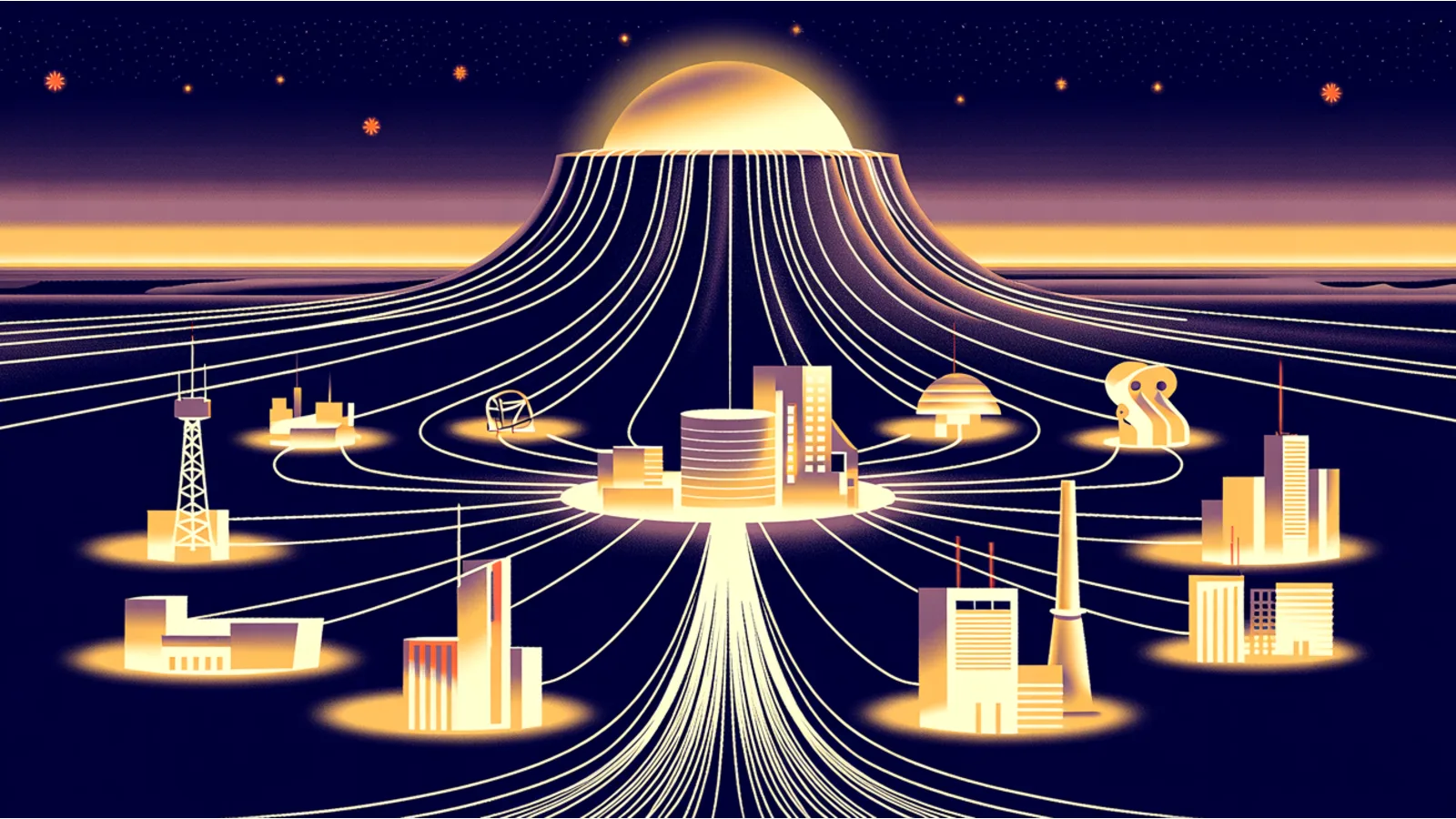
The Hershey trust controls a candy company on behalf of a school. The Ford family controls a carmaker through a supervoting share. Both are versions of the same idea, control without ownership, and the purest and largest example of that idea is not American at all. It is Swedish. For more than a century, the Wallenberg family has controlled a commanding share of Sweden's industry, ABB, Ericsson, Atlas Copco, the bank SEB, the defense firm Saab, and more, without personally owning most of it. They do it through a set of charitable foundations that control a holding company that owns the operating businesses, and the profits flow up to the foundations and back out to Swedish science. It is the foundation-control model scaled up to dominate a national economy, and the family's motto captures the whole style of it: esse, non videri, which the Wallenbergs translate as "to act, not to seem to be." This post reads the structure from the record.
The bank and the family
The empire began with a bank. André Oscar Wallenberg founded Stockholms Enskilda Bank, Stockholm's first private bank, in 1856, with the stated aim of supplying capital to inventors and entrepreneurs (SEB; Wallenberg family). That bank is the direct ancestor of today's SEB, one of Sweden's largest (Wikipedia, "Wallenberg family"). Over six generations the family built outward from banking into industry, and it developed the distinctive philosophy that still defines it. The motto esse, non videri, adopted by an early-twentieth-century Wallenberg, expresses a preference for quiet, durable influence over visible display, and the family has lived by it, wielding enormous power while remaining, to most outsiders, nearly anonymous (Wallenberg family).
Today the family is led by a fifth-generation trio, often called the troika: Jacob Wallenberg, who chairs the holding company Investor AB; Marcus Wallenberg, who chairs the bank SEB; and Peter Wallenberg Jr., who chairs the largest of the family foundations (Investor AB). A sixth generation, some thirty members, is already in training, and in 2025 the family publicly began placing its first members onto the boards of the key companies (Wallenberg Investments). The empire is passing, intact, to its sixth generation, which is the whole point of the structure.
Investor AB and the scale of it
The visible top of the empire is Investor AB, the family's listed holding company, founded in 1916 (Wikipedia, "Investor AB"). It is not a small vehicle. At the end of 2025 its net asset value stood at about 1.09 trillion Swedish kronor, roughly $105 to $110 billion, and through it the family is the largest single owner of a remarkable roster of companies (Investor AB year-end report). The holdings read like a list of Swedish industry itself: the engineering giant ABB, the compressor and tool maker Atlas Copco, the defense company Saab, the telecom firm Ericsson, the bank SEB, the mining-equipment firm Epiroc, the appliance maker Electrolux, and a stake in the pharmaceutical company AstraZeneca, among others (Investor AB year-end report). A second, privately held vehicle holds still more, including SKF and Stora Enso. Through these companies, the family has long been estimated to control on the order of a third of the Stockholm stock market's value, a scale of concentration that has no real parallel in a major Western economy (Wikipedia, "Wallenberg family").
Crucially, Investor is not a passive investor. In most of those companies it is the largest owner, with board seats and real control, holding not just shares but the dominant share of the votes: nearly 40 percent of the votes at Saab, about 30 percent at Electrolux, nearly 25 percent at Ericsson (Investor AB year-end report). The family, through Investor, does not merely own pieces of Swedish industry. It steers it.
The foundation at the top
Here is the mechanism that makes it all work, and it is the same trick this series keeps finding, executed at the largest scale of any of them. The family does not personally own Investor AB. The controlling stake in Investor is held by the Wallenberg Foundations, a set of sixteen charitable foundations, the largest of which is the Knut and Alice Wallenberg Foundation, established in 1917 (Wallenberg ecosystem). And they control it through the same device the Fords use: dual-class shares. In Sweden, A shares carry ten times the votes of B shares, and the foundations hold predominantly A shares. The result is that the three largest foundations own about 23 percent of Investor's economic capital but control 50 percent of its votes (Wallenberg ecosystem). The Knut and Alice Wallenberg Foundation alone holds about 20 percent of the capital and 43 percent of the votes (Investor AB ownership).
Follow the chain and the elegance is complete. Charitable foundations, run by the family, control Investor AB with a minority of the money but a majority of the votes. Investor AB controls the operating companies. The dividends from the companies flow up through Investor to the foundations, and the foundations give the money away to Swedish science. The family personally owns comparatively little of any of it, yet controls the whole thing, and because the controlling stake sits in perpetual foundations rather than in any individual's hands, it can never be divided among heirs, sold off in a divorce, or lost to a spendthrift generation. This is the same structure that lets the Milton Hershey School Trust control the Hershey Company and India's Tata Trusts control the Tata group, except the Wallenbergs use it to control not one company but a diversified holding company that dominates much of a country's economy.
The philanthropy that pays for itself
What the foundations do with the money is fund research, on an enormous scale. The Knut and Alice Wallenberg Foundation describes itself as the largest private funder of research in Sweden, and the family's foundations together have given more than 50 billion kronor to Swedish science, funding programs in medicine, technology, and, more recently, a major national artificial-intelligence research effort (Knut and Alice Wallenberg Foundation). In 2025 the sixteen foundations awarded just over 3.1 billion kronor (Knut and Alice Wallenberg Foundation, 2025).
And here is the part that makes the model self-sustaining, the same flywheel this series has traced elsewhere: despite giving away tens of billions, the main foundation's endowment has grown to roughly 300 billion kronor, because its wealth is chiefly its stake in Investor AB, which keeps compounding (Knut and Alice Wallenberg Foundation). The foundation gives away hundreds of millions a year and gets richer, because the underlying industrial empire grows faster than the giving. The philanthropy is real and large, and it is also the engine that legitimizes and perpetuates family control of a nation's industry.
That is the Wallenberg model in full, and it is worth seeing plainly because it is the logical endpoint of everything else in this series. A family that wants to control assets across generations without those assets fragmenting has a simple problem: people die, divorce, and disagree, and every one of those events splits ownership. The solution the Wallenbergs perfected is to put the control not in people but in institutions, foundations that never die, hold their votes forever, and answer to the family that runs them. The family personally owns little; the foundations own the votes; the empire stays whole. Over 160 years it has let one family steer a large share of Swedish industry through six generations, funding world-class science along the way, all while remaining, per the motto, present but unseen. It is the du Pont trusts and the Ford supervoting share and the Hershey trust combined and taken to their limit: control without ownership, made permanent, at the scale of a country.
Related reading
- The Candy Fortune That Raises Two Thousand Children: the Hershey trust, the American version of a foundation controlling a company.
- Two Percent of the Company, Forty Percent of the Vote: the dual-class share, the same voting device the Wallenberg foundations use.
- The Archetype: the trust-and-family-office model that the Wallenberg foundations extend to national scale.
- The Working Ledgers: the market and the money underneath every controlled empire.
Fact-check notes and sources
- The bank and the family (André Oscar Wallenberg founding Stockholms Enskilda Bank in 1856, the ancestor of today's SEB; the six generations and the motto esse, non videri translated by the family as "to act, not to seem to be"; and the current fifth-generation troika of Jacob, Marcus, and Peter Wallenberg Jr. with a sixth generation in training and entering the boards from 2025): SEB history, Wallenberg history, Wallenberg family page, Wikipedia, "Wallenberg family", Investor AB on Jacob Wallenberg, and Wallenberg Investments. The motto's translation is the family's own; a looser "to be, not to be seen" is a common paraphrase.
- Investor AB and the scale (Investor AB founded in 1916, with a net asset value of about 1.09 trillion kronor at the end of 2025; its position as the largest single owner of ABB, Atlas Copco, Saab, Ericsson, SEB, Epiroc, Electrolux, and a stake in AstraZeneca, with dominant voting stakes; and the long-standing estimate that the family controls roughly a third of the Stockholm market): Wikipedia, "Investor AB", Investor AB year-end 2025 report, and Wikipedia, "Wallenberg family". The "third of the stock market" and "third of GDP" figures are journalistic estimates, some dated, and are presented as such; Investor's holding of Ericsson rose in 2025 above the older, much-cited figure.
- The foundation-control model (the sixteen Wallenberg Foundations, the largest being the Knut and Alice Wallenberg Foundation of 1917; the three largest foundations owning about 23 percent of Investor's capital but controlling 50 percent of the votes through Sweden's dual-class share structure, with the main foundation alone holding about 20 percent of capital and 43 percent of votes; and the cascade by which the foundations control Investor, which controls the operating companies, with dividends flowing up to the foundations): Wallenberg ecosystem and Investor AB ownership structure. The comparison to the Hershey and Tata trust-control models is drawn from those institutions' own disclosures.
- The philanthropy (the Knut and Alice Wallenberg Foundation as the largest private research funder in Sweden, more than 50 billion kronor given to Swedish science, just over 3.1 billion awarded across the foundations in 2025, and the main foundation's endowment growing to roughly 300 billion kronor chiefly through its Investor AB holding): Knut and Alice Wallenberg Foundation and the 2025 foundation figures.
This post is informational and historical, not financial advice. All figures are reproduced from the cited company reports, foundation disclosures, and public sources, with journalistic estimates flagged as such. The family, companies, and foundations are discussed as nominative fair use from the public record, with no affiliation implied.
