
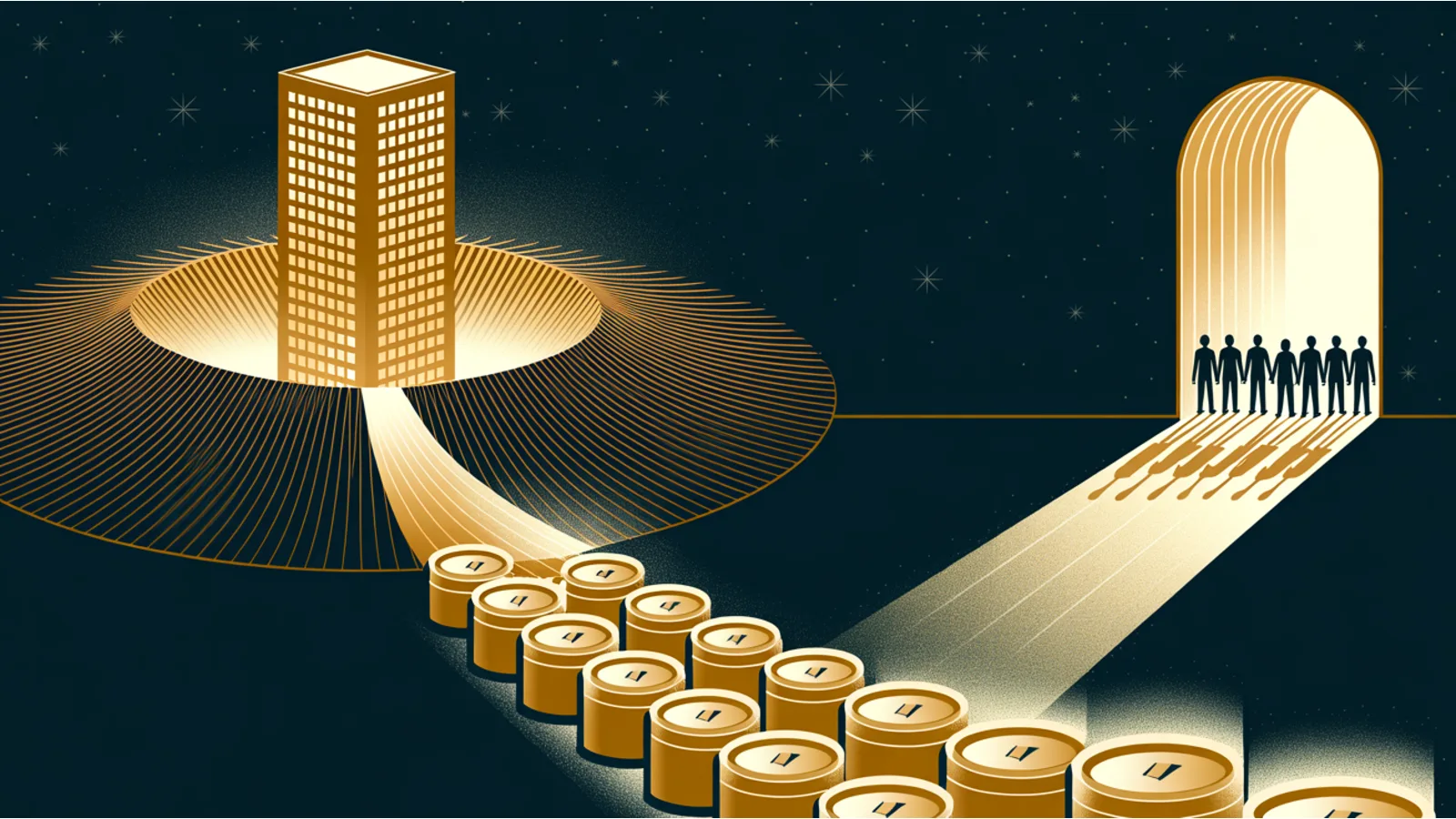
The Kennedy family is often said to have run a tax-free money machine built on a famous New York skyscraper. Half of that is true and half is a mix-up worth correcting, because the correction is where the useful lesson lives. The Kennedys never owned the Chrysler Building. What they owned was the Merchandise Mart in Chicago, and it was, in fact, a tax-advantaged cash machine, held in trust, throwing off income for half a century. And the machine itself was not a secret or a trick. It was ordinary, legal, income-producing real estate wrapped in trusts, the same toolkit today's billionaires use and the same toolkit that has scaled-down, perfectly legal versions available to ordinary households. This post separates the myth from the mechanism, and pulls out what actually transfers.
What the Kennedys actually owned
Joseph P. Kennedy Sr. built a fortune estimated at somewhere between $200 million and $500 million, from several sources (Fortune, 1963; PBS). He made money in the stock market and got out before the 1929 crash, though the famous story that a shoeshine boy's stock tips warned him is legend, not fact, and the widely cited figure for his short-selling profit is, in Fortune's word, "wildly improbable" (Wikipedia, "Joseph P. Kennedy Sr."; Fortune). He made money in Hollywood, assembling the pieces that became the studio RKO (Wikipedia, "RKO Pictures"). And after Prohibition ended he made money importing Scotch and gin through Somerset Importers, which he sold around 1946 for about $8 million on a stake that had cost roughly $100,000 (Fortune).
But the family's true income engine, held for generations, was real estate. In 1945 Kennedy bought the Merchandise Mart, the colossal wholesale building in Chicago, for roughly $12.5 to $13 million, buying it into a trust (CBS News; Wikipedia, "Merchandise Mart"). Its rents, PBS notes, "became a principal source of Kennedy family wealth," and the family held it for about fifty-three years before selling it, in January 1998, to Vornado Realty Trust for $625 million (PBS; Spokesman-Review). A building bought for about $13 million threw off income for five decades and sold for $625 million. That is the machine.
The Chrysler Building, corrected
The Chrysler Building belongs to a different family entirely. Every ownership source credits Walter P. Chrysler, who bought the development in 1928 and, notably, financed the construction out of his own pocket precisely so it would be a personal asset for his children to inherit, not a corporate one (Wikipedia, "Chrysler Building"). Walter Chrysler died in 1940, his family inherited the tower, and they sold it in 1953 to the developer William Zeckendorf; later owners have included Tishman Speyer, an Abu Dhabi fund, and most recently the developer Aby Rosen (Automotive History; Bisnow). There is no credible source placing the Kennedys in that chain at any point. The likely root of the mix-up is simple: a famously real-estate-rich dynasty whose signature asset was one monumental landmark, but the landmark was the Merchandise Mart in Chicago, not the Chrysler Building in New York.
The actual tax machine: trusts and real estate
What made the Kennedy fortune a durable, low-tax income stream was the combination of trusts and the nature of real estate itself. Joseph Kennedy set up trusts for his children, reportedly beginning in the 1920s and 1930s, that gave each of them lifelong financial independence; the biographer David Nasaw describes a million-dollar trust for each child, roughly $10 million in the money of the day (Fresh Air Archive). Kennedy's own stated purpose was to free his children for public life: "I'm making all this money so you don't have to make money so that you can go into public service" (Fresh Air Archive). Forbes traced the tax mechanics right through to the end: when the family sold the Merchandise Mart in 1998, it took partnership units instead of cash, which "defers capital gains tax, as well as taxes on historical depreciation, for as long as the units are not cashed out" (Forbes).
The real estate did the rest, because income-producing property is one of the most tax-favored assets in the code. A landlord depreciates a building over 27.5 years, a paper deduction that shelters the actual rental income, so a cash-flowing property can show little or no taxable profit, and land itself cannot be depreciated (IRS Publication 527). And borrowing against a property that has risen in value is not a taxable event, because a loan is not income (Bankrate). Put those together and you get the pattern: buy appreciating real estate, deduct depreciation against its income, borrow tax-free against its rising value instead of selling, and pass it to heirs, whose cost basis resets at death so the built-in gain is never taxed. That is the machine the Kennedys ran, and it was entirely legal.
How everyone since has copied it
The same toolkit runs at the top of the wealth ladder today, and it is now well documented. The strategy has a name, "buy, borrow, die," coined by a law professor: buy appreciating assets, borrow against them to spend rather than selling, and hold until death, when the step-up in basis erases the unrealized gain (USC Gould). ProPublica's investigation of leaked IRS data found the 25 richest Americans saw their wealth grow $401 billion from 2014 to 2018 while paying $13.6 billion in federal income tax, a "true tax rate" of 3.4 percent, with Jeff Bezos paying zero federal income tax in 2007 and 2011 and Elon Musk zero in 2018, because unsold gains are not income and loans are not income (ProPublica).
The rest of the modern toolkit is equally documented. The step-up in basis at death wipes out unrealized gains, and the Congressional Budget Office scores repealing it as raising tens of billions, confirming how much gain otherwise goes permanently untaxed (Tax Policy Center; CBO). The 1031 exchange lets real-estate investors defer gains indefinitely by swapping one property for another, "swap till you drop" (IRS). Dynasty trusts, in states that abolished the old limits, let families shield fortunes from estate tax across generations; ProPublica documented the Scripps, Mellon, and Mars families using them (ProPublica). Grantor-retained annuity trusts, the technique the Tax Court validated in the Walton case, let the wealthy pass appreciation gift-tax-free; ProPublica reported that more than half of the 100 richest Americans have used special trusts, and that Laurene Powell Jobs used GRATs to pass about $500 million estate-tax-free (ProPublica). Add opportunity-zone funds, tax-exempt municipal bonds, and donor-advised funds, and you have the full modern version of the Kennedy playbook, run by today's billionaires (IRS on opportunity zones).
What the average person can actually use
Here is the part worth taking away, because scaled-down and perfectly legal versions of most of this are available to ordinary households, and honesty requires flagging which ones mainly help the rich. The most egalitarian tools are the tax-advantaged accounts: a traditional 401(k) or IRA defers tax, a Roth grows tax-free, and the health savings account offers a rare triple advantage of deductible contributions, tax-free growth, and tax-free withdrawals for medical costs (IRS on retirement accounts; IRS Publication 969). The everyday real-estate equivalents are real: an ordinary landlord gets the same depreciation deduction and can use a 1031 exchange, and a homeowner can exclude up to $250,000 of gain on a primary residence, $500,000 for a married couple, entirely tax-free (IRS Publication 527; IRS on the home-sale exclusion). And the step-up in basis is not just for billionaires: most middle-class inheritances, a long-held house or a stock portfolio, pass to heirs income-tax-free through it (IRS Publication 551).
Then there are the tools that mainly pay off at the top, and it is worth saying so plainly. Borrowing against assets instead of selling works, but it requires a large portfolio and carries real risk, since a market drop can force a sale at the worst time. Municipal-bond tax exemption mostly benefits high tax brackets. And the elaborate trusts and permanent-insurance structures matter chiefly above the estate-tax exemption, which is $15 million per person in 2026, so an ordinary estate owes no federal estate tax and does not need them, with the step-up already doing the work (IRS on the estate-tax exemption). The honest lesson of the Kennedy machine is not that you can become the Kennedys. It is that the engine was never exotic. It was appreciating assets held for the long term, income sheltered where the law allows, gains deferred rather than realized, and wealth passed at a stepped-up basis, and the ordinary-scale, legal versions of those moves, retirement accounts, a home, patience, are the closest thing to a tax-free money machine that most people will ever get, and they are sitting in plain sight.
Related reading
- How the Waltons Keep Half a Trillion Dollars: the trust techniques, including the GRAT case that bears the family's name.
- What the Rothschilds Actually Did With Money: another separation of wealth myth from real, legal mechanism.
- The Biggest Charity in America Is a Waiting Room: the donor-advised fund, one more tool in the modern kit.
- The Working Ledgers: the market underneath every fortune that compounds.
Fact-check notes and sources
- The Kennedy fortune (the roughly $200 million to $500 million estate; the pre-1929 stock exit with the "shoeshine boy" tip and the large short-selling profit both flagged as legend or improbable; the Hollywood and RKO ventures; the Somerset Importers liquor business sold around 1946 for about $8 million; and the Merchandise Mart bought in 1945 for roughly $12.5 to $13 million into a trust, held about 53 years, and sold to Vornado in January 1998 for $625 million): Fortune, PBS, CBS News, Wikipedia, "Joseph P. Kennedy Sr.", Wikipedia, "RKO Pictures", Wikipedia, "Merchandise Mart", and Spokesman-Review.
- The Chrysler Building correction (no credible evidence the Kennedys ever owned it; Walter Chrysler buying the development in 1928 and financing construction personally for his children, the family selling to William Zeckendorf in 1953, and later owners): Wikipedia, "Chrysler Building", Automotive History, and Bisnow.
- The trusts and the tax mechanics (the million-dollar-per-child trusts and Kennedy's public-service quotation; the 1998 sale taking partnership units to defer capital-gains and depreciation-recapture tax; and the tax treatment of real estate, with 27.5-year depreciation sheltering rental income, land not depreciable, and borrowing against appreciated property not being a taxable event): Fresh Air Archive, Forbes, IRS Publication 527, and Bankrate.
- The modern equivalents ("buy, borrow, die"; ProPublica's finding of a 3.4 percent true tax rate for the 25 richest and zero-tax years for Bezos and Musk; the step-up in basis and its CBO scoring; 1031 exchanges; dynasty trusts used by the Scripps, Mellon, and Mars families; GRATs and the finding that more than half of the 100 richest use special trusts, including Laurene Powell Jobs; and opportunity zones and municipal bonds): USC Gould, ProPublica on the Secret IRS Files, Tax Policy Center, CBO, IRS on 1031 exchanges, ProPublica on dynasty trusts, ProPublica on GRATs, and IRS on opportunity zones.
- What the average person can use (traditional and Roth retirement accounts and the health savings account's triple advantage; real-estate depreciation and 1031 for ordinary landlords; the $250,000 and $500,000 home-sale exclusion; the step-up in basis for middle-class inheritances; and the $15 million 2026 estate-tax exemption above which the elaborate trust and insurance structures mainly apply): IRS on retirement accounts, IRS Publication 969, IRS Publication 527, IRS on the home-sale exclusion, IRS Publication 551, and IRS on the estate-tax exemption.
This post is informational, not tax, legal, or financial advice. All figures are reproduced from the cited public sources. Individuals are discussed as nominative fair use from the public record, with no affiliation implied.
