
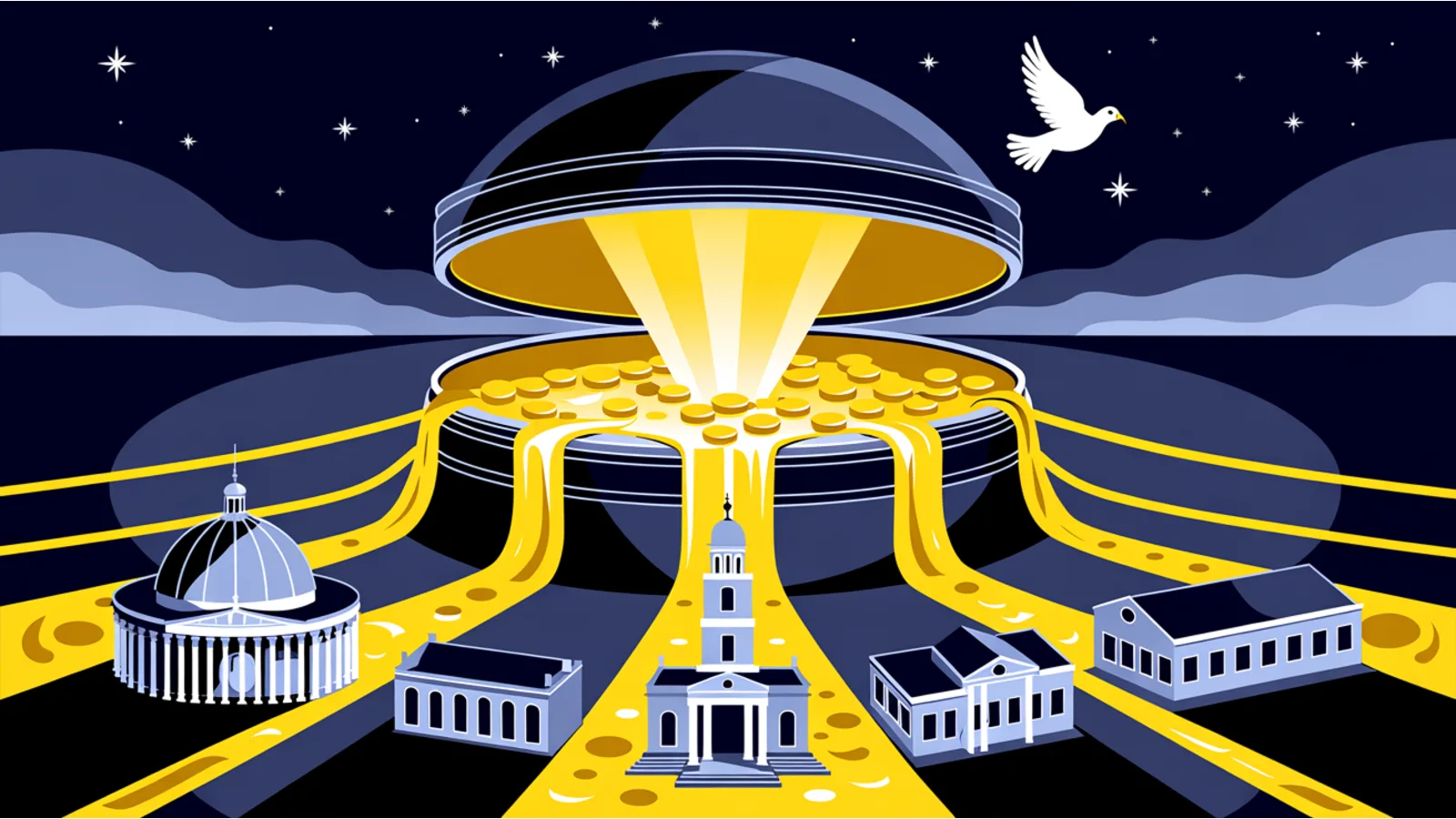
Every other story in this series is about keeping a fortune: the trusts that hold it across generations, the holding companies that keep control together, the tax havens that shelter it. This one is the exact opposite, and it belongs here precisely because it inverts everything else. Andrew Carnegie, once the richest man in the world, set out deliberately not to found a dynasty. He believed that dying rich was a kind of disgrace, and he spent the last two decades of his life giving nearly the entire fortune away, on purpose, to the point that the man who had made one of the largest fortunes in history died without a dynasty to leave it to. This is the counter-case, and it is worth reading against all the others.
Bobbin boy to the richest man in the world
Carnegie's rise is the immigrant story in its purest form. He was born in 1835 in Dunfermline, Scotland, to a weaver's family that was impoverished when the power loom displaced his father, and they emigrated to Allegheny, Pennsylvania, in 1848 (Britannica). His first job, at about twelve, was as a bobbin boy in a cotton mill for $1.20 a week (History.com). He worked up through the telegraph office, where a Pennsylvania Railroad superintendent named Thomas Scott made him his personal telegrapher, and from there into the businesses that made him: bridges, then steel (Britannica). He built Carnegie Steel into the dominant American steelmaker, and in 1901 he sold it to J.P. Morgan, who folded it into the new United States Steel Corporation, the first company in the world capitalized at more than a billion dollars (Wikipedia, "Andrew Carnegie").
The sale made him almost unimaginably rich. Carnegie Steel sold for about $480 million, and Carnegie's personal share, which he insisted be paid in gold bonds rather than stock, came to somewhere around $225 to $250 million (History.com; PBS). By the reckoning of the time it made him the richest man in the world, and the story goes that Morgan told him so at the closing (PBS). At that moment Carnegie had every option the other families in this series took: trusts, heirs, a dynasty built to last centuries. He chose none of them.
The Gospel of Wealth
He had, in fact, already told the world what he intended to do, twelve years before he sold the company. In 1889 Carnegie published an essay, "The Gospel of Wealth," that laid out a philosophy directly opposed to the one that runs through the rest of this series. The rich, he argued, are not owners of their surplus but trustees of it, obligated to give it away wisely during their own lifetimes rather than hoard it or pass it down. His most famous line is a rebuke to every dynasty-builder: "the man who dies thus rich dies disgraced" (Britannica). He believed, and said, that leaving great wealth to one's children generally harmed them more than it helped, deadening the very talents that a person needs to make their own way.
This was not a deathbed conversion or a public pose. It was a stated program, and Carnegie spent the rest of his life executing it with the same drive he had brought to steel. The point of the Gospel of Wealth was that the accumulation was only the first half of a life's work; the giving was the second, and the harder, half.
Giving it away
And he gave. By the end of his life Carnegie had distributed roughly $350 million, close to 90 percent of his entire fortune, to a set of institutions many of which still shape American life (Carnegie Corporation). He funded some 2,509 public libraries around the world, more than 1,600 of them in the United States, on the theory that a library was a ladder any poor striver could climb, as he had (Carnegie Corporation library legacy). He built Carnegie Hall, which opened in 1891. He endowed the Carnegie Corporation of New York in 1911 with about $125 million, then the largest single philanthropic trust ever created (Carnegie Corporation history). He founded the Carnegie Institution for scientific research in 1902, the Carnegie Endowment for International Peace in 1910, and the Carnegie Hero Fund in 1904 to honor ordinary people who risk their lives for others. He founded the Carnegie Technical Schools in 1900, which became the Carnegie Institute of Technology and, in a 1967 merger with Andrew Mellon's research institute, Carnegie Mellon University (Carnegie Mellon University). And his effort to provide pensions for college professors, begun in 1905, led directly to the creation of the retirement giant TIAA in 1918 (Carnegie Corporation on TIAA).
What he left his own family was, by design, modest against all of that: a comfortable provision for his wife and daughter, not a fortune meant to compound into a dynasty. He had written in the Gospel of Wealth that this was the right and moderate thing to do, and he did it.
The disgrace he avoided, and the one he did not
Honesty requires the shadow in the story, because Carnegie was not a saint, and the money he gave away so nobly was made in ways that were sometimes brutal. The 1892 Homestead strike, at a Carnegie Steel plant, turned violent and deadly in a confrontation between workers and Pinkerton guards, and Carnegie, though abroad at the time, bore real responsibility for the labor conditions and the hard line that produced it (Britannica). The Gospel of Wealth can be read, uncharitably, as a rich man's theory for feeling good about a fortune extracted from underpaid and dangerous work. Both things are true at once, and the article does not tidy them away.
But set against the theme of this series, Carnegie's choice stands out sharply, and it is the point of including him. The du Ponts built trusts to make their fortune deathless. The Vanderbilts, by contrast, dissipated theirs across a few generations without meaning to. Carnegie did something neither: he looked at the largest fortune in the world, decided that keeping it in the family would be a moral failure and a practical harm to his heirs, and gave it away so thoroughly and so deliberately that there is no Carnegie dynasty on any rich list today, only his name on libraries and concert halls and a university. The most remarkable thing Andrew Carnegie ever did with his money was refuse to keep it. In a series full of families who solved the problem of how to hold wealth forever, he is the one who decided the problem was not worth solving, and that the disgrace lay in trying.
Related reading
- The du Pont Fortune, Two Centuries On: the opposite choice, a fortune structured to endure for centuries.
- The Dynasty That Became a Museum and a Bank: the Mellons, whose research institute merged with Carnegie's to form Carnegie Mellon.
- The New Fortunes: the modern foundations that echo Carnegie's giving, and the rules around them.
- The Working Ledgers: the market and the money underneath every fortune, kept or given.
Fact-check notes and sources
- The fortune (Carnegie born in 1835 in Dunfermline, Scotland, to a weaver's family, emigrating to Pennsylvania in 1848; his first job as a bobbin boy at $1.20 a week and his rise through the telegraph office under Thomas Scott; building Carnegie Steel and selling it to J.P. Morgan in 1901 to form U.S. Steel, the first billion-dollar corporation, for about $480 million with Carnegie's personal share of roughly $225 to $250 million in gold bonds; and his standing as the richest man in the world): Britannica, History.com, PBS, and Wikipedia, "Andrew Carnegie". Sources vary on the sale figures; the company price is best supported at about $480 million and Carnegie's share is reported at roughly $225 to $250 million.
- The Gospel of Wealth (his 1889 essay arguing the rich are trustees who should give away their surplus in their lifetimes, the "the man who dies thus rich dies disgraced" dictum, and his belief that leaving great wealth to heirs harms them): Britannica.
- The giving (roughly $350 million given away, close to 90 percent of his fortune; some 2,509 libraries worldwide with more than 1,600 in the United States; Carnegie Hall opened in 1891; the Carnegie Corporation of New York endowed with about $125 million in 1911; the Carnegie Institution of 1902, the Carnegie Endowment for International Peace of 1910, and the Carnegie Hero Fund of 1904; the Carnegie Technical Schools of 1900 that became Carnegie Mellon University through the 1967 merger with the Mellon Institute; and the teachers' pension effort that led to TIAA in 1918; along with the moderate provision he left his wife and daughter): Carnegie Corporation, Carnegie Corporation library legacy, Carnegie Corporation history, Carnegie Mellon University, and Carnegie Corporation on TIAA. The total is cited as a round figure of about $350 million; a precise figure of $350,695,653 appears in biographies.
- The complication (the 1892 Homestead strike and its violence, and Carnegie's responsibility for the underlying labor conditions): Britannica.
This post is informational and historical, not financial advice. All figures are reproduced from the cited public sources, with reported ranges flagged as such. Individuals are discussed as nominative fair use from the public record, with no affiliation implied.
