
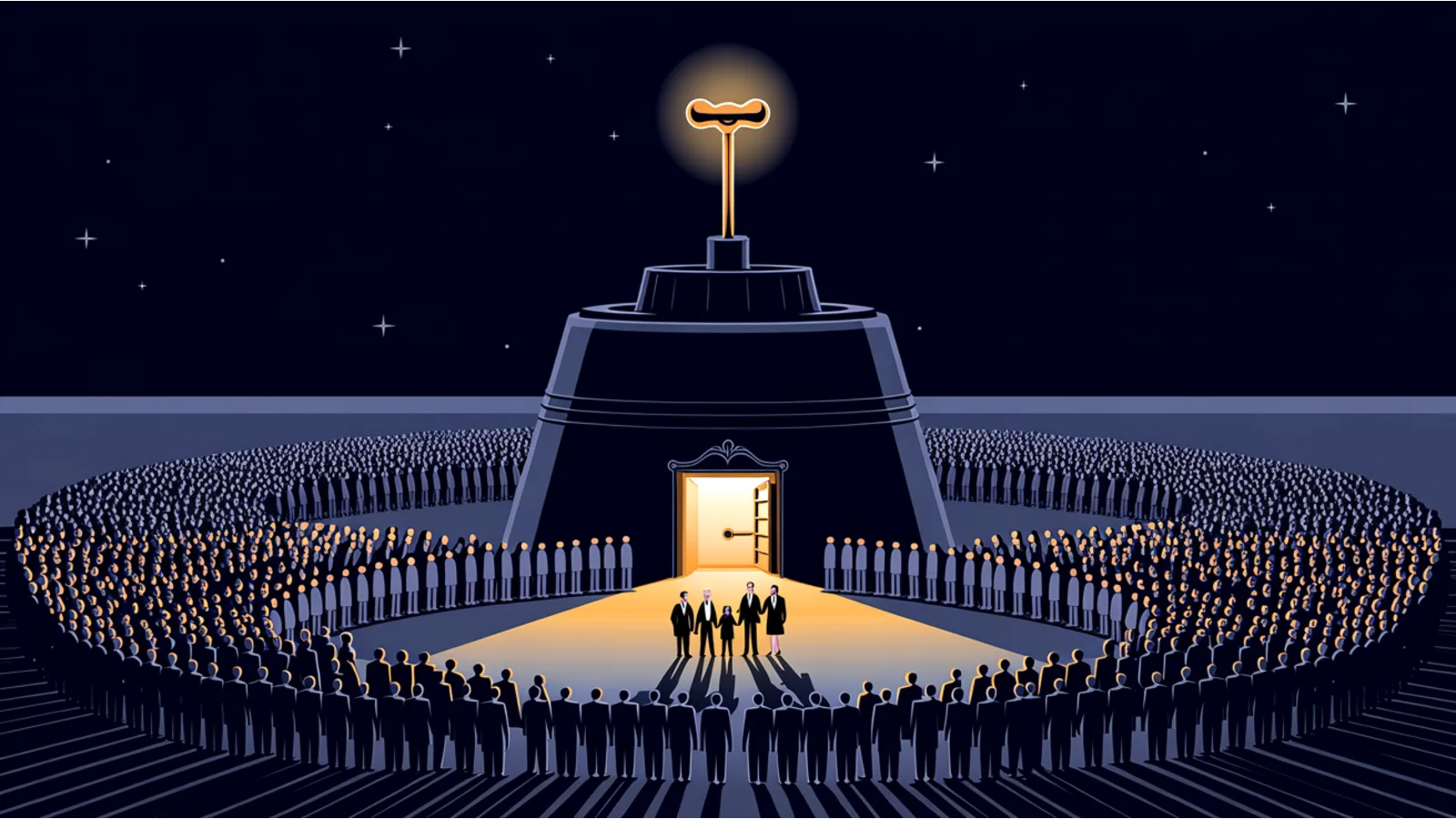
Ford Motor Company is a public company worth tens of billions of dollars, owned overwhelmingly by ordinary shareholders. And yet, for 122 years, it has been controlled by one family that today owns less than 2 percent of it. That is not a contradiction; it is a mechanism, and it is spelled out precisely in Ford's filings with the Securities and Exchange Commission. The Ford family holds a special class of stock that carries a permanent 40 percent of the company's voting power, a share that no outside investor is allowed to buy and that the family cannot rebuild if it ever sells. It is the same supervoting device the Hershey trust uses to control a candy giant and the Sulzbergers use to control a newspaper, and Ford is its most durable industrial example. This post reads how it works, from the proxy.
The company
Ford Motor Company was incorporated in Detroit on June 16, 1903, with $28,000 in cash from twelve investors (History.com; Wikipedia, "Ford Motor Company"). Its Model T, introduced in 1908, and the moving assembly line Henry Ford installed at Highland Park in 1913, which cut the time to build a chassis from more than twelve hours to about ninety minutes, remade both the car and the century (History.com on the assembly line). Some fifteen million Model Ts were built before production ended in 1927, and in 1914 Ford famously doubled the prevailing wage with the "five-dollar day" (The Henry Ford).
Today Ford is headquartered in Dearborn, Michigan, employs around 170,000 people, and trades on the New York Stock Exchange. Its most recent year was a hard one and worth stating honestly: in its 2025 fiscal year the company reported record revenue of about $187.3 billion but a net loss of roughly $8.2 billion, driven by some $10.7 billion in write-downs and cancellations in its electric-vehicle business, though its adjusted operating profit stayed positive (Ford Q4 2025 release). Its stock-market value fluctuates in the range of $55 to $60 billion. The public owns essentially all of that. The family owns the control.
The mechanism
Here is how a family holds a company it barely owns. Ford has two classes of stock. There is Common Stock, which anyone can buy, and there is Class B Stock, which only members of the Ford family, their descendants, and their trusts are permitted to hold (Ford Exhibit 4-B). The proxy states the split in one sentence: "Holders of common stock have 60% of the general voting power. Holders of Class B Stock have the remaining 40% of the general voting power" (Ford 2025 proxy).
The elegance, from the family's point of view, is that the 40 percent is fixed regardless of how much the stock dilutes. It is not a fixed number of votes per share; it is a formula. All shares vote together in one pool, each common share gets one vote, and each Class B share gets whatever multiple is required to keep the whole Class B block at exactly 40 percent, currently around 37 votes per share (Ford Exhibit 4-B). So as the company has issued more and more common stock over the decades, the family's economic slice has shrunk to about 1.8 percent, but its voting power has stayed pinned at 40 percent (Ford 2026 proxy). And the lock is one-directional: Class B can be converted to common stock only in order to sell it, and once converted it can never be turned back, so the family's block can shrink but never be rebuilt, and it can never fall into an outsider's hands (Ford Exhibit 4-B). On top of the 40 percent bloc, Class B carries a veto over the big structural decisions, mergers, selling the company, issuing more Class B, that a majority of the family must approve (Ford Exhibit 4-B).
You can watch the mechanism work. At Ford's annual meeting in May 2026, ordinary shareholders put forward a proposal to abolish the dual-class structure and move to one share, one vote. It was rejected, with about 2.17 billion votes in favor and 2.85 billion against (Ford 2026 results). Because the family's block counts as a fixed 40 percent of the total, the arithmetic implies that a majority of the actual economic owners, the common shareholders, voted to end the family's control, and were simply outvoted by it. The people who own 98 percent of Ford asked for democracy and did not get it, because the rules were written in 1956 to make sure they could not.
The Foundation, given up
The family's grip on the company is the more remarkable because it deliberately let go of something else enormous: the Ford Foundation. Edsel Ford, Henry's son, established the Foundation in 1936 with a $25,000 gift, and when Edsel and then Henry died in the 1940s, their bequests of Ford stock turned it into the largest philanthropy in the world (Ford Foundation). In 1956, the Foundation sold a huge block of Ford shares to the public in what was then the largest common-stock offering in history, and it is that sale that both took Ford public and set up the dual-class structure that preserved family control (Goldman Sachs). Over the following two decades the Foundation sold off the rest of its Ford stock to diversify, and in 1976 Henry Ford II resigned from its board with a stinging letter calling it "a creature of capitalism" that had forgotten its debt to the economic system that funded it (Inside Philanthropy).
The result is a clean split that is worth stating precisely. The Ford Foundation, which today holds an endowment it puts at about $16 billion, is entirely independent of both the family and the company; it owns no Ford stock and no family member controls it (Ford Foundation). But independent of family control is not the same as absent of family: after a 43-year estrangement, Henry Ford III joined the Foundation's board in 2019, the first Ford on it since his grandfather resigned (Fortune). The family gave up the foundation and kept the company, which tells you which one it valued.
The lock today
What holds it all together now is a trust. Almost all of the family's Class B stock, about 99.9 percent of it, sits in a single perpetual Ford family voting trust, whose trustees include William Clay Ford Jr. and other senior family members and which votes the whole block as one (Ford 2025 proxy). That is the same idea as the Walton holding company: pool the family's control into one entity so it votes as a bloc and cannot be picked apart by the disagreements of dozens of heirs. William Clay Ford Jr., a great-grandson of Henry Ford, has been chairman of the company since 1999 and was its chief executive in the 2000s; other family members hold executive roles as well (Wikipedia, "William Clay Ford Jr."). Because Class B is paid the same dividend per share as common stock, the family's roughly 71 million supervoting shares also pay them on the order of $40 to $50 million a year, quite apart from the control they confer (Ford dividend release).
That is the whole architecture, and it is the purest example in this series of a family separating control from ownership. Most of the dynasties here hold their wealth privately, out of public view. The Fords did the opposite: they took the company public, sold the world 98 percent of the equity, kept a supervoting share that guarantees 40 percent of the vote, locked that share in a trust that cannot be bought or rebuilt, and have run the company for their own descendants for 122 years while ordinary shareholders supplied the capital and, as the 2026 vote showed, could not change a thing. It is not a loophole and it is not hidden; it is written plainly in the charter, approved by the market that keeps buying the stock anyway. A supervoting share is simply the most efficient control device a family can own, and the Fords have owned the best-preserved one in America since the year they went public.
Related reading
- The Candy Fortune That Raises Two Thousand Children: the Hershey trust's supervoting Class B stock, the same device controlling a public company.
- How the Waltons Keep Half a Trillion Dollars: the family voting bloc, held together so heirs vote as one.
- The Archetype: a fortune preserved by trusts and a family office rather than supervoting shares.
- The Working Ledgers: the market and the money underneath every family-controlled company.
Fact-check notes and sources
- The company (Ford Motor Company incorporated in Detroit on June 16, 1903, with $28,000 from twelve investors; the Model T of 1908, the 1913 Highland Park moving assembly line cutting chassis time from over twelve hours to about ninety minutes, the roughly fifteen million Model Ts through 1927, and the 1914 five-dollar day; and the company today in Dearborn with about 170,000 employees, its 2025 record revenue of about $187.3 billion but a net loss of roughly $8.2 billion driven by about $10.7 billion in electric-vehicle write-downs): History.com on the incorporation, Wikipedia, "Ford Motor Company", History.com on the assembly line, The Henry Ford, and Ford's Q4 2025 release.
- The dual-class control (the Common and family-only Class B stock; the proxy's statement that common holders have 60 percent and Class B holders 40 percent of the general voting power; the fixed-aggregate formula that keeps Class B at 40 percent regardless of dilution, currently around 37 votes per share, against a Class B economic stake of about 1.8 percent; the one-way conversion that means the block can shrink but never rebuild and can never pass to outsiders; the Class B veto over structural changes; and the May 2026 shareholder vote against one-share-one-vote of about 2.17 billion to 2.85 billion): Ford Exhibit 4-B, Ford 2025 proxy, Ford 2026 proxy, and Ford 2026 meeting results. Ford elects its entire board by a single combined weighted vote rather than by separate class slates, so the family's power runs through the 40 percent bloc and the class veto; the reading that common holders were outvoted is an inference from the tallies.
- The Foundation (established in 1936 by Edsel Ford with $25,000, turned into the world's largest philanthropy by the Ford bequests, taken public in the record 1956 offering that set up the dual-class structure, with the Foundation divesting its Ford stock by the 1970s and Henry Ford II resigning from its board in 1976 with the "creature of capitalism" letter; the Foundation now fully independent of family control with no Ford stock and a roughly $16 billion endowment, but with Henry Ford III joining its board in 2019): Ford Foundation origins, Goldman Sachs on the 1956 IPO, Inside Philanthropy, Ford Foundation about page, and Fortune. The Foundation was founded by Edsel, not Henry, and is independent of family control though not free of any family presence.
- The lock today (about 99.9 percent of Class B held in a perpetual Ford family voting trust; William Clay Ford Jr., a great-grandson of Henry, as chairman since 1999 and a former CEO; and Class B paid the same per-share dividend as common, implying roughly $40 to $50 million a year to the family's block): Ford 2025 proxy, Wikipedia, "William Clay Ford Jr.", and Ford dividend release. The family dividend figure is an estimate from the confirmed share count and dividend rate; the family shareholder count is not precisely disclosed.
This post is informational and historical, not financial or investment advice. All figures are reproduced from the cited SEC filings and public sources, with estimates flagged as such. Individuals and institutions are discussed as nominative fair use from the public record, with no affiliation implied.
