
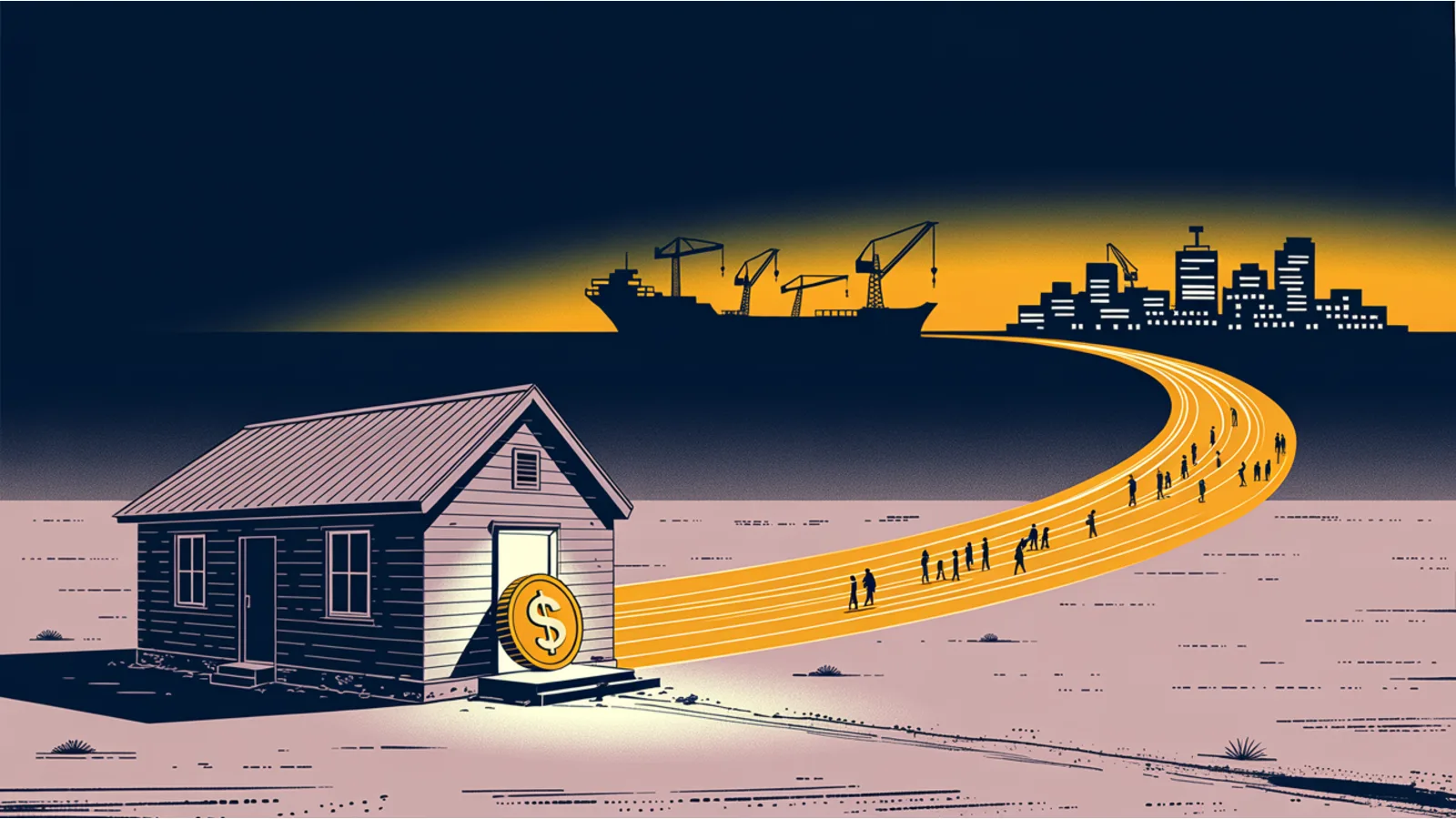
The companion to this post reads Kaiser Permanente as it is today: the largest nonprofit health system in the country, running its hospitals at close to break even and letting a fifty-billion-dollar investment portfolio decide whether the year ends in profit or loss. That is what it became. This post is about what it was, because the origin explains the institution better than the balance sheet does. Kaiser Permanente began as a six-bed hospital in the Mojave Desert and an idea that cost a nickel a day, and the whole hundred-billion-dollar machine still runs on the bargain a young doctor struck with a group of construction workers in 1933. Everything below is from the record.
A hospital in the desert
In 1933 a newly trained surgeon named Sidney Garfield built a small hospital in the Mojave, near Desert Center, California, to care for the roughly five thousand men building the aqueduct that would carry Colorado River water to Los Angeles (Kaiser Permanente history; Wikipedia, "Sidney Garfield"). Contractors General Hospital had six beds. Garfield had borrowed twenty-five hundred dollars from his father to open it and bought his equipment on credit against fees he had not yet collected (Permanente Journal history).
The fees did not come. Under the ordinary system of the day, Garfield billed the insurance companies for each injured worker he treated, and the insurers paid slowly when they paid at all, disputing claims and refusing coverage, while Garfield treated the men in front of him regardless (Kaiser Permanente on Sidney Garfield). Within months the little hospital was sliding toward bankruptcy. The problem was not medicine. It was the way medicine got paid for, and fixing that is the reason Kaiser Permanente exists.
The nickel a day
The fix came from an insurance man. Harold Hatch, an underwriter at Industrial Indemnity, proposed that instead of paying Garfield after the fact for each injury, the insurers pay him in advance, a fixed sum for every worker, every day, whether that worker got hurt or not. They settled on the insurer handing over 17.5 percent of the workers' compensation premiums, which worked out to about five cents per worker per day (Kaiser Permanente on Harold Hatch). Then they added a second nickel: for another five cents a day, deducted voluntarily from a worker's own wages, the plan would cover the injuries and illnesses that happened off the job too. About five thousand workers were eligible, and roughly ninety-five percent signed up (Wikipedia, "Sidney Garfield").
That nickel a day is the founding idea of the whole enterprise, because it quietly inverted the incentive that runs through almost all of American medicine. When a doctor is paid per procedure, he earns more when people are sick. When Garfield was paid a fixed nickel in advance, he earned more when people stayed well, because a healthy worker who never needed the hospital was pure margin. Prepayment turned prevention into a business model. Kaiser Permanente still describes this as its founding insight, that the arrangement "aligns incentives to keep people healthy, rather than seeking to generate revenues when they are sick" (Kaiser Permanente on integrated care). The desert hospital that was going broke on billing started making money on health.
The dams, and Henry Kaiser
The model needed a patron with a lot of workers in remote places, and in 1938 it found the biggest one in the West. Garfield was recruited to run the medical program at the Grand Coulee Dam in Washington, where the contract was held by a consortium chaired by the industrialist Henry J. Kaiser (Kaiser Permanente on Sidney Garfield; Wikipedia, "Grand Coulee Dam"). At Grand Coulee, Garfield found a community of some fifteen thousand workers and their families, and for the first time the plan was extended past the injured worker to cover his wife and children too, a change the unions pushed for (Wikipedia, "Kaiser Permanente"). Prepaid family medicine, delivered by a salaried group of doctors in the employer's own clinics, was now a working reality.
Henry Kaiser was the force that turned the reality into an institution. He had risen from paving roads to building Hoover Dam as part of the Six Companies consortium, and in the Second World War his shipyards became a legend of mass production, turning out hundreds of Liberty and Victory ships and once assembling a Liberty ship in under five days (Wikipedia, "Henry J. Kaiser"; Wikipedia, "Kaiser Shipyards"). Kaiser told the story of his commitment to health care through his mother, Mary, a practical nurse who died when he was young, and his often-quoted line was, "I see the day when no one need die for lack of medical care." The tender detail he sometimes added, that she died in his arms when he was sixteen, appears to be more legend than fact, and his own foundation's historian has said so (Kaiser Permanente history archive). The name the plan carried came from gentler ground: Permanente Creek, a stream in the hills of Santa Clara County that the early Spanish settlers called permanent because it ran all year, and beside which Kaiser had a cement plant and his first wife, Bess, had a lodge she loved. It was Bess who asked that the medical program take the creek's name (Kaiser Permanente on the Permanente Creek).
The shipyards, and the war
When the war came, the model scaled overnight. The Permanente Health Plan opened on June 1, 1942 to serve the workers pouring into Kaiser's Richmond, California shipyards, whose workforce would peak around ninety thousand (Wikipedia, "Kaiser Permanente"). By August 1944 more than ninety percent of Richmond's shipyard employees had joined, some seventy thousand members, and across all of Kaiser's California yards and its Fontana steel mill and the workers' families, wartime membership reached about two hundred thousand (Permanente Journal; Funding Universe company history). The first Permanente hospital, a hundred and seventy beds on the site of the old Fabiola Hospital in Oakland, opened on August 1, 1942, and a field hospital at Richmond followed ten days later (Wikipedia, "Kaiser Richmond Field Hospital"). For four years, a private industrialist ran one of the largest civilian health systems in the country as a wartime necessity.
Then the war ended, and the shipyards emptied. Membership tied to the Richmond yards collapsed from roughly ninety thousand to about fourteen thousand five hundred by October 1945 (Permanente Journal). Kaiser and Garfield faced a choice: let the plan shrink back to nothing with the shipyards, or open it to everyone. On July 21, 1945, they opened the Permanente Health Plan to the general public (Kaiser Permanente on opening to the public). That decision is the moment a wartime employee benefit became a public institution, and it is why the system exists at civilian scale at all.
The fight the doctors put up
Opening to the public meant competing with ordinary medicine, and ordinary medicine fought back hard. From 1944 onward the American Medical Association and the state and local medical societies treated prepaid group practice as a threat and something close to heresy. Bay Area, Los Angeles, and Portland medical societies refused Kaiser's physicians membership, which in practice denied them hospital privileges, referrals, and specialty board standing, and denounced the model as socialistic and unethical (The Health Care Blog on Garfield). As late as 1959, Kaiser doctors were still shut out of the San Francisco Medical Society (The Conversation). This was not new hostility. When a national commission endorsed group practice and prepayment back in 1932, the editor of the AMA's journal had called it "socialist" and "an incitement to revolution," and in 1943 the Supreme Court had upheld an antitrust conviction against the AMA for conspiring to crush a prepaid health plan in Washington, D.C. (Committee on the Costs of Medical Care; American Medical Assn. v. United States, 317 U.S. 519).
The campaign reached Garfield personally. In 1950 the California Board of Medical Examiners found him guilty of unprofessional conduct for employing unlicensed practitioners and suspended his license for a year, stayed on probation; a trial court set that ruling aside in his favor, but the Court of Appeal reversed and sent the penalty question back to the board, so he was not cleanly vindicated (Garfield v. Board of Medical Examiners, 99 Cal.App.2d 219). The organized profession spent more than a decade trying to strangle prepaid group practice in the cradle, and it lost, because the model had a constituency the doctors did not control.
Who it was built for
That constituency was organized labor, and the unions are the reason Kaiser Permanente grew instead of withering. In June 1945 the Longshoremen's union in Oakland voted to fold Permanente coverage into its contract, and by 1950 its president, Harry Bridges, had brought all six thousand West Coast longshore workers into the plan; the Retail Clerks signed on in 1951 (Kaiser Permanente on union support). Kaiser Permanente credits the longshoremen and the retail clerks with pushing enrollment past three hundred thousand in the plan's first ten years as a public program (Kaiser Permanente on opening to the public). The people it was built for came in order: first the isolated construction crews on the aqueduct, then their families at the dam, then the shipyard workers of the war, then the union members who made it a movement, and finally the general public. It was, from the desert forward, a working person's plan.
The structure that carried them is the one the system still uses, three interlocking parts settled in a 1955 agreement at Lake Tahoe: the nonprofit Kaiser Foundation Health Plan that enrolls the members, the nonprofit Kaiser Foundation Hospitals that runs the buildings, and the physician-owned Permanente Medical Groups whose doctors work for no one else (Kaiser Permanente history). The organization took the name Kaiser Permanente in 1953, when Henry Kaiser insisted his own name go on the door over the objections of Garfield and the physicians, who did not want a plan built on medical independence to look like one man's company (Kaiser Permanente history). And the idea itself became national policy: the federal Health Maintenance Organization Act of 1973, signed by President Nixon, was built on the model, and the very term "health maintenance organization" was coined by a doctor who had found his example in Kaiser Permanente (HMO Act of 1973; Paul M. Ellwood Jr.). The nickel a day had become the law of the land.
Where it stands
Ninety years from the desert, the plan is a giant. Kaiser Permanente reports 12.9 million members and 40 hospitals on its own, with more than 243,000 employees across eight states and Washington, D.C., and counting the community systems it has begun acquiring, close to 13.1 million members and 55 hospitals (Kaiser Permanente fast facts). Its operating revenue reached $127.7 billion in 2025, up from $100.8 billion two years earlier (Kaiser Permanente 2025 financial results). It is expanding again through a new nonprofit arm, Risant Health, created in 2023 with about five billion dollars to buy and run regional systems, which took in Geisinger of Pennsylvania in March 2024 and Cone Health of North Carolina that December (Risant Health). The plan that began by opening a hospital where there were none is now buying the hospitals other people built.
It is not a placid giant. The system was led for years by Bernard Tyson, its first Black chairman and chief executive, until he died in his sleep in November 2019 at sixty, and his successor Greg Adams runs it now (CNN on Bernard Tyson). And the labor movement that built it is now often at war with it. In October 2023 roughly seventy-five thousand of its workers walked out for three days in the largest health care strike in American history, winning a raise of about twenty-one percent (CNN on the 2023 strike). The unrest has not stopped: some forty-six thousand workers struck for five days in October 2025, and in March 2026 Kaiser's mental health clinicians walked out again, this time over the system's use of artificial intelligence in care (NPR on the 2025 strike; NUHW on the 2026 strike). The plan the longshoremen embraced is now bargaining across the table from their descendants.
The through-line from the desert is the thing to hold onto. Sidney Garfield's nickel a day was a promise that a health plan could make its money by keeping people well rather than billing them sick, delivered to people no one else would insure. That promise built a system that now covers thirteen million people and, as the financial ledger shows, rides the stock market for its bottom line. Whether an institution that large still keeps the desert bargain, or has become the very thing prepayment was invented to replace, is the argument its own workers are now striking over. The nickel a day is still in there somewhere. It is just harder to find under a hundred and twenty-eight billion dollars.
Related reading
- The Hundred-Billion-Dollar Nonprofit Whose Profit Rides on the Market: Kaiser Permanente's finances today, read from the filings.
- The Margin Is Thin, the Portfolio Is Not: how nonprofit hospitals, Kaiser included, actually make their money.
- The $10 Billion Endowment That Gives Away Medicine: a different answer to who pays for care.
- The Working Ledgers: the market underneath every institution that holds money.
Fact-check notes and sources
- The desert origin (Dr. Sidney Garfield's six-bed Contractors General Hospital, opened 1933 near Desert Center for about 5,000 Colorado River Aqueduct workers; the $2,500 loan from his father; and the near-bankruptcy under fee-for-service billing): Kaiser Permanente history, Kaiser Permanente on Sidney Garfield, Wikipedia, "Sidney Garfield", and the Permanente Journal.
- The prepayment breakthrough (Harold Hatch's proposal of about five cents per worker per day paid in advance from 17.5 percent of the workers' compensation premium, plus a voluntary second nickel for off-the-job coverage, with roughly 95 percent of about 5,000 workers enrolling; and the resulting prevention-based incentive): Kaiser Permanente on Harold Hatch, Wikipedia, "Sidney Garfield", and Kaiser Permanente on integrated care.
- The dams and the shipyards (Grand Coulee from 1938, the Kaiser-chaired consortium, about 15,000 workers and families with dependent coverage added; Henry Kaiser's industrial career and the Liberty-ship record; the Permanente Health Plan opening June 1, 1942, the Richmond workforce peaking near 90,000 with over 90 percent enrolled and about 70,000 shipyard members, roughly 200,000 system-wide, the 170-bed Oakland Permanente Hospital opening August 1, 1942; and the postwar collapse to about 14,500 members by October 1945): Wikipedia, "Kaiser Permanente", Wikipedia, "Henry J. Kaiser", Wikipedia, "Grand Coulee Dam", Wikipedia, "Kaiser Richmond Field Hospital", and the Permanente Journal. The "Permanente" name from Permanente Creek, and Bess Kaiser's role, per Kaiser Permanente; Henry Kaiser's "died in my arms" line is noted by his foundation's historian as more legend than documented fact (Kaiser Permanente history archive).
- The public opening and the fight (the plan opened to the public July 21, 1945; the AMA and medical-society opposition and exclusion of Kaiser physicians into 1959; the 1932 "incitement to revolution" quotation and the 1943 Supreme Court antitrust ruling against the AMA; and Garfield's 1950 license case, in which the Court of Appeal reversed a ruling in his favor and remanded, so he was not cleanly vindicated): Kaiser Permanente on opening to the public, The Health Care Blog, The Conversation, the Committee on the Costs of Medical Care, American Medical Assn. v. United States, 317 U.S. 519 (1943), and Garfield v. Board of Medical Examiners, 99 Cal.App.2d 219 (1950).
- The unions, the structure, and the HMO Act (the Longshoremen's 1945 vote and Harry Bridges bringing 6,000 members in by 1950, the Retail Clerks in 1951, and enrollment past 300,000 in ten years; the three-entity structure settled at Lake Tahoe in 1955; the adoption of the Kaiser Permanente name in 1953 over the physicians' objections; and the 1973 HMO Act modeled on Kaiser with the term coined by Paul Ellwood): Kaiser Permanente on union support, Kaiser Permanente history, Health Maintenance Organization Act of 1973, and Paul M. Ellwood Jr.. The KP name year is given as 1953 by Kaiser Permanente's own history; other sources say 1951 or 1952.
- Where it stands today (12.9 million members and 40 hospitals standalone, near 13.1 million and 55 hospitals with Risant, over 243,000 employees; operating revenue of $127.7 billion in 2025 and $100.8 billion in 2023; Bernard Tyson as first Black chairman and CEO, who died in November 2019, and Greg Adams succeeding him; Risant Health's 2023 creation and the Geisinger and Cone Health acquisitions; and the 2023, 2025, and 2026 strikes): Kaiser Permanente fast facts, Kaiser Permanente 2025 financial results, CNN on Bernard Tyson, Risant Health, CNN on the 2023 strike, NPR on the 2025 strike, and NUHW on the 2026 strike.
This post is informational and historical, not financial or medical advice. All figures are reproduced from the cited sources and public record. Individuals are discussed from the public record as nominative fair use, with no affiliation implied and nothing endorsed by Kaiser Permanente.
