
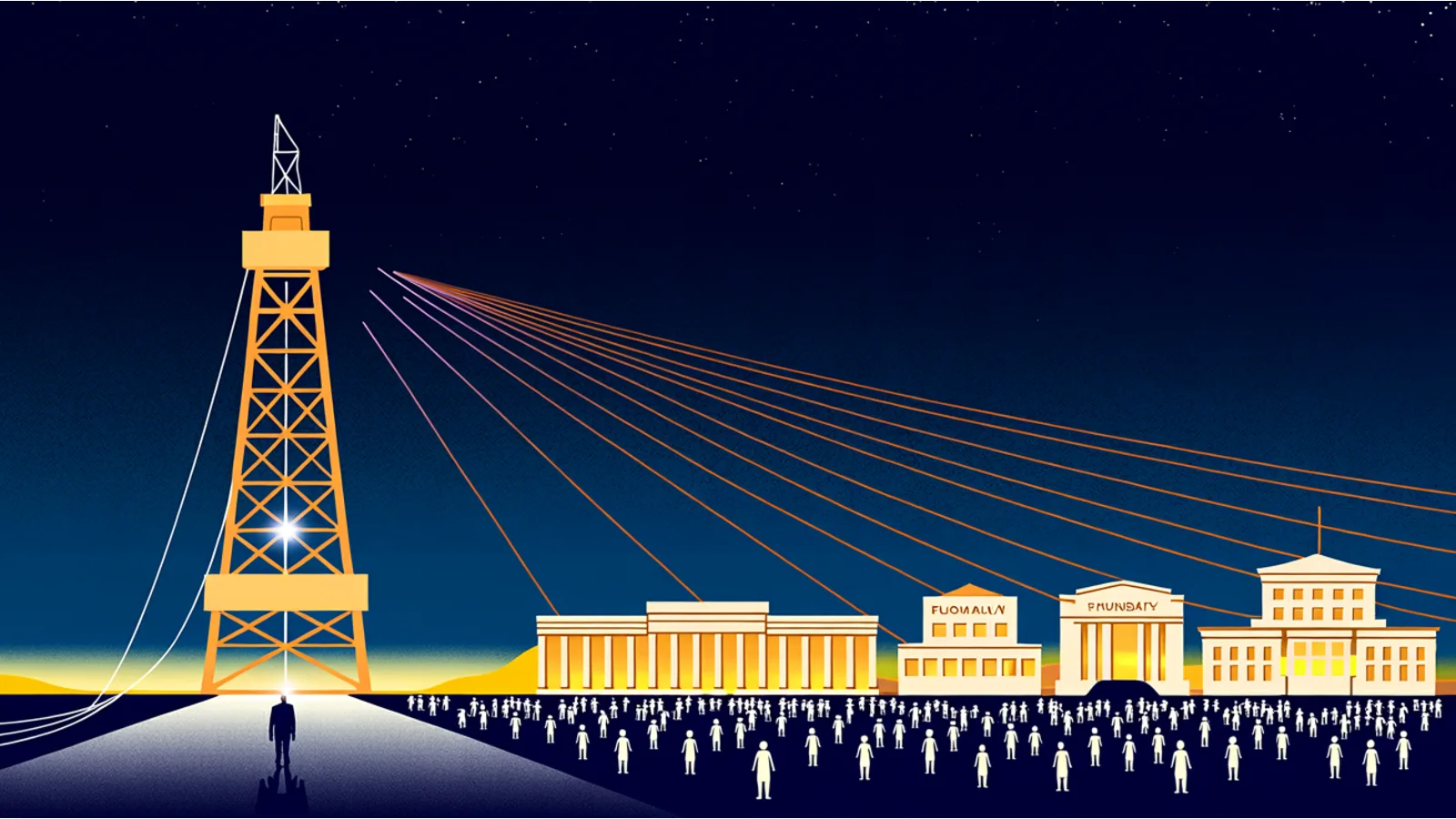
If this series has an archetype, a single family that most cleanly demonstrates how great wealth is made to outlive the person who made it, it is the Rockefellers. John D. Rockefeller built Standard Oil into a monopoly and became, by the measure most historians use, the richest American who ever lived. What his descendants did next is the actual lesson: they turned the fortune into institutions. A family office to manage it, trusts to hold it across generations, and foundations to give a controversial oil fortune a second, more durable life. A century and a half later there is no single Rockefeller billionaire, and yet the family's collective wealth endures at more than $12 billion across two hundred heirs, because it was deliberately built to survive the death of any one of them. This post reads that machinery from the record.
The fortune
Rockefeller incorporated the Standard Oil Company in Ohio on January 10, 1870, with a million dollars in capital, and over the next three decades built it into a monopoly that controlled the American oil business (Library of Congress). Guinness World Records calls him the richest person ever when adjusted for inflation (Guinness World Records). The exact size of his fortune depends entirely on how you measure it, and it is worth being careful: his wealth peaked as a share of the economy around 1913, at roughly $900 million, about 2 percent of US output, and peaked in plain dollars near $1.4 billion at his death in 1937 (Guinness World Records). The famous "$400 billion in today's money" figure comes from the share-of-the-economy method; a simple inflation adjustment yields far less. Even the claim that he became the first billionaire in 1916 is a contemporaneous press estimate, not a documented fact, since the rich then had no duty to disclose (CBS News).
The most important event in the fortune's history was, paradoxically, the government breaking it up. In 1911 the Supreme Court found Standard Oil an illegal monopoly under the Sherman Antitrust Act and ordered it dissolved into its component companies, some 34 of them (Cornell Law). Those pieces became the giants of the modern oil industry: Exxon, Mobil, Chevron, Amoco, Conoco, Marathon, and more (Wikipedia, "Successors of Standard Oil"). And here is the paradox: Rockefeller held about a quarter of Standard Oil and received proportionate stock in every one of those successors, whose share prices then rose sharply, so the breakup made him richer than ever (Wikipedia, "Standard Oil"). Theodore Roosevelt reportedly joked that Wall Street's new prayer was "Oh Merciful Providence, give us another dissolution" (Cato Institute).
The machinery of preservation
What turned that fortune into a dynasty was structure, and the Rockefellers built the most complete version of it in America. The first piece was a family office. When the RCA Building at 30 Rockefeller Plaza opened in the fall of 1933, the family moved its office there, onto the 56th floor, which is why it became known simply as "Room 5600" (Rockefeller Archive Center). It was a full-service operation: it handled the family's investments, accounting, legal work, security, and public relations, and it ran the family's philanthropies, all under one roof (Rockefeller Archive Center). At its height around 1937 it employed nearly 400 people; it had shrunk to about 44 by the time the family left the building in 2014, but its investment arm lives on, relaunched in 2018 as Rockefeller Capital Management (Boston Globe).
The second piece was trusts. In 1934, John D. Rockefeller Jr. created a set of trusts for his six children, and in 1952 a second set for his grandchildren, both administered by Chase Bank (Wikipedia, "Rockefeller family"). This is the same device the du Ponts and the Mellons used, and it works the same way: the trust holds the principal while distributing income, so the wealth passes down without being handed out and taxed at each generation, and control stays centralized rather than fragmenting among heirs. The precise size of those trusts has never been reliably known; the family's own financial records are closed, and Wikipedia notes that the total fortune "has never been known with any precision" (Wikipedia, "Rockefeller family"). That opacity is itself part of the design.
The third piece was philanthropy, at a scale that rebuilt the family's reputation. Rockefeller chartered the Rockefeller Foundation in 1913 "to promote the well-being of mankind throughout the world," and it has invested more than $26 billion in its mission since (Rockefeller Foundation). He founded the University of Chicago in 1890, which he called "the best investment I ever made," and what became Rockefeller University in 1901 (Rockefeller Archive Center; Rockefeller University). His lifetime giving came to roughly $530 million, and his descendants added the Rockefeller Brothers Fund in 1940 and the Rockefeller Family Fund in 1967 (Rockefeller Archive Center; Wikipedia, "Rockefeller Brothers Fund"). The oil monopoly that made the family notorious was slowly transformed, through the foundations, into a name associated with medicine, education, and public health.
The fortune today, and a final irony
The result of all that structure is exactly what it was designed to be: a fortune that no longer depends on any single person. The Rockefeller wealth is now dispersed across a seventh generation, spread among at least 200 heirs, and Forbes values the collective family fortune at about $12.5 billion, ranking it among America's richest families, with no single Rockefeller appearing as a standout billionaire on any individual list (Forbes). The last of the towering figures, David Rockefeller, the longtime chairman of Chase Manhattan Bank and the final surviving grandchild of the founder, died in 2017 at 101 and left most of his own $3.3 billion to charity (Forbes). The individuals pass; the structure holds.
And the structure has produced one final irony that captures the whole story. The family's own funds have turned against the source of the fortune. The Rockefeller Brothers Fund announced in 2014 that it was divesting from fossil fuels, its president noting that if the founder were alive "he would be moving out of fossil fuels and investing in clean, renewable energy" (Rockefeller Brothers Fund). The Rockefeller Family Fund went further in 2016, dumping its ExxonMobil stock and calling the company's conduct on climate "morally reprehensible," a pointed act given, in the fund's own words, that "ExxonMobil is Standard Oil's largest direct descendant" (Fortune). Even the Rockefeller Foundation divested its roughly $5 billion endowment from fossil fuels in 2020, acknowledging that the endowment "was built from proceeds of Standard Oil" (Rockefeller Foundation).
That is the archetype in full. A fortune made in oil, de-personalized into a family office, trusts, and foundations so thoroughly that it outlived not only its founder but, in a sense, its own origin, until the institutions carrying the Rockefeller name were divesting from the very company the founder built. The wealth endures precisely because it stopped being one man's money and became a set of institutions, and institutions, unlike people, do not die, split up, or spend the principal. They just keep going, even to the point of disowning where they came from. It is the trust-and-family-office model in its purest and most complete form, and every other dynasty in this series is, in some way, a variation on what the Rockefellers built first.
Related reading
- The du Pont Fortune, Two Centuries On: the same trust-and-family-office model in an even older fortune.
- The Dynasty That Became a Museum and a Bank: another fortune preserved through trusts and foundations.
- The Man Who Refused to Found a Dynasty: Carnegie, who chose the opposite path and kept nothing in the family.
- The Working Ledgers: the market and the money underneath every fortune that endures.
Fact-check notes and sources
- The fortune (Standard Oil incorporated in Ohio on January 10, 1870, with $1 million in capital; Rockefeller as the richest American in history by the inflation-adjusted measure, with wealth peaking around $900 million in 1913 as a share of the economy and near $1.4 billion at his 1937 death in nominal terms; the caveats on the "$400 billion" and "first billionaire" figures; the 1911 Supreme Court dissolution under the Sherman Antitrust Act into some 34 successor companies that became Exxon, Mobil, Chevron, and others; and the paradox that Rockefeller's roughly one-quarter stake in the successors made him richer as their shares rose): Library of Congress, Guinness World Records, Guinness World Records news, CBS News, Cornell Law, Wikipedia, "Successors of Standard Oil", Wikipedia, "Standard Oil", and Cato Institute. The successor count is most commonly given as 34, with some sources citing 33 to 39; the peak-wealth figures are method-dependent and flagged as such.
- The machinery (the family office at Room 5600 on the 56th floor of 30 Rockefeller Plaza from 1933, handling investments, accounting, legal work, security, public relations, and the family philanthropies, employing nearly 400 at its height and about 44 by 2014, with its investment arm relaunched as Rockefeller Capital Management in 2018; the 1934 trusts for his six children and 1952 trusts for his grandchildren administered by Chase Bank; and the fact that the fortune's precise size has never been reliably known): Rockefeller Archive Center on Room 5600, Boston Globe, and Wikipedia, "Rockefeller family". The 1934 trusts are described as being for the six children; a "wife" beneficiary is not verified, and no single reliable dollar value for the trusts exists, so none is stated.
- The philanthropy (the Rockefeller Foundation chartered in 1913 with a roughly $100 million founding endowment and more than $26 billion invested since; the founding of the University of Chicago in 1890 and Rockefeller University in 1901; roughly $530 million in lifetime giving; and the Rockefeller Brothers Fund of 1940 and Rockefeller Family Fund of 1967): Rockefeller Foundation, Rockefeller Archive Center, Rockefeller University, and Wikipedia, "Rockefeller Brothers Fund". The Rockefeller Brothers Fund was founded by the five sons, with the daughter joining the board in 1954. University of Chicago giving is reported in a range from about $35 million to $80 million.
- Today and the divestment (the fortune dispersed across a seventh generation among at least 200 heirs, the roughly $12.5 billion collective family figure with no standout individual billionaire, and David Rockefeller's 2017 death; and the fossil-fuel divestments by the Rockefeller Brothers Fund in 2014, the Rockefeller Family Fund in 2016 with its "morally reprehensible" and "Standard Oil's largest direct descendant" language, and the Rockefeller Foundation in 2020 acknowledging the endowment "was built from proceeds of Standard Oil"): Forbes on the family, Forbes on David Rockefeller, Rockefeller Brothers Fund, Fortune, and Rockefeller Foundation divestment. Net-worth and heir-count figures are estimates that vary by year and source.
This post is informational and historical, not financial advice. All figures are reproduced from the cited public sources, with method-dependent and estimated figures flagged as such. Individuals and institutions are discussed as nominative fair use from the public record, with no affiliation implied.
