
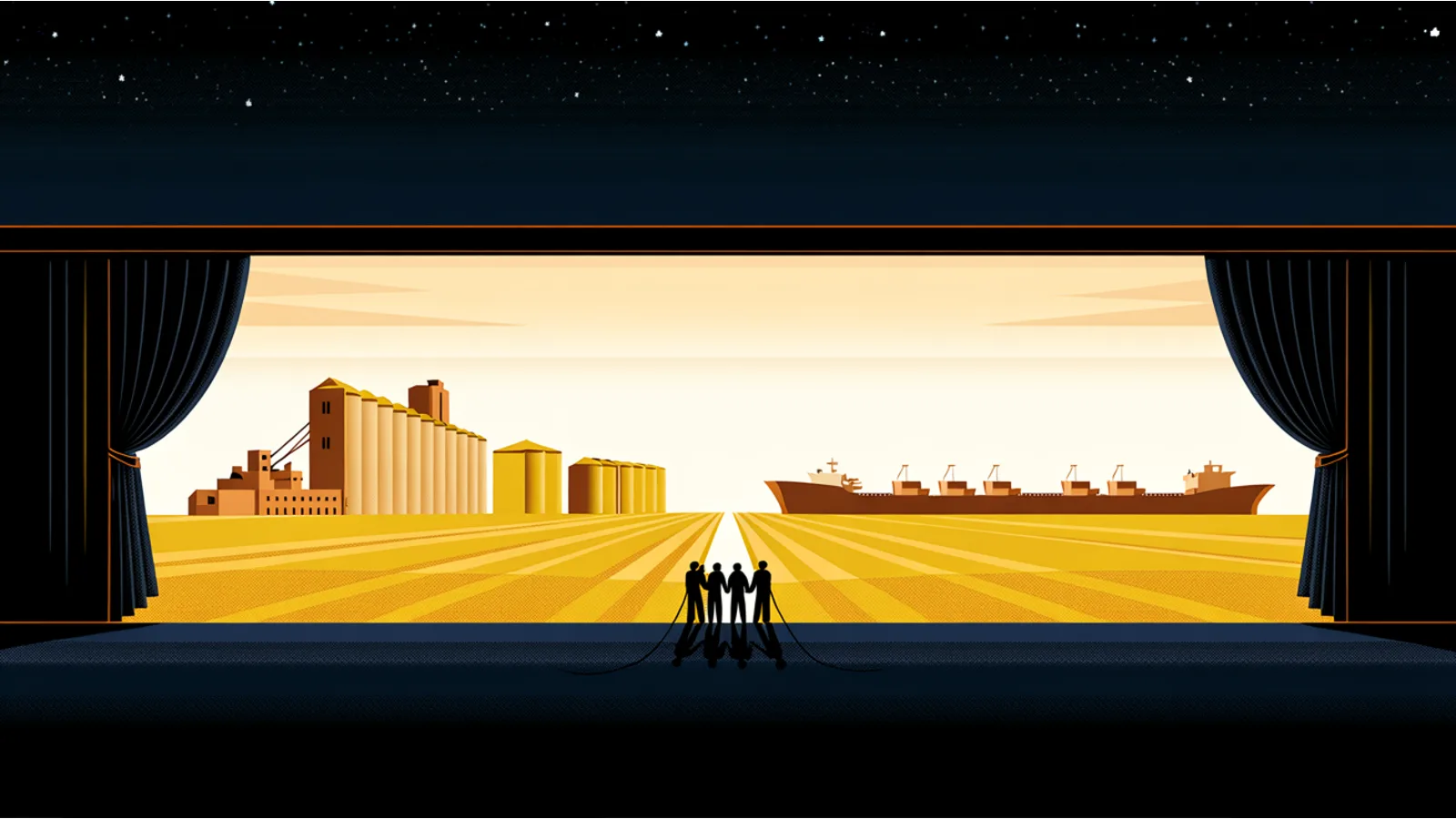
The hidden-owners post argued that the biggest American fortunes are often the quietest, held in private companies by families no one can name. The single best proof of that argument is a company most people have genuinely never heard of, even though it touches nearly every meal they eat. Cargill is the largest privately held company in the United States, a $154 billion trader and processor of the world's grain, meat, and food ingredients, and it has been owned by the same family since 1865. That family, the Cargills and MacMillans, includes more billionaires than any other family on earth, and it has spent a century and a half making sure you do not know their names. This post reads the biggest quiet fortune in America from the record.
The company no one sees
Cargill was founded in 1865, when W.W. Cargill bought a grain storehouse in Conover, Iowa (Cargill history). Over 161 years it grew into the largest private company in the United States, ranked number one on Forbes' list of America's top private companies for the fifth straight year, and for the 38th time in 40 years (Forbes). Its revenue was about $154 billion in its 2025 fiscal year, down from a record of roughly $177 billion in 2023, and it employs some 155,000 people across 70 countries (Forbes; Cargill). It trades agricultural commodities, processes grain and meat, manages commodity risk, and makes food ingredients and animal feed. It is, as one headline put it, one of "the most powerful companies you've never heard of" (The Conversation).
Part of the reason you have never heard of it is that Cargill has never had to tell you anything. As a private company it faces none of the disclosure a public company does, and in 2020 it stopped publicly reporting most of its financial results; it discloses annual revenue and little else (IATP). There is no stock ticker, no quarterly earnings call, no filings full of detail. A company that handles a large share of the food traded on the planet operates almost entirely out of public view, which is exactly how its owners want it.
The family with the most billionaires
Those owners are the Cargill and MacMillan families, descendants of the founder, who collectively own an estimated 88 percent of the company, with employees holding the rest through a stock plan (Forbes). At least a hundred family members share it, and the fortune is staggering. Forbes puts the collective family wealth at about $67.9 billion, ranking it among the very richest families in America, and, tellingly, Forbes counts 21 individual billionaires in the family, up from 14 a decade ago, more than in any other family (Forbes). The largest single shareholder, Pauline MacMillan Keinath, holds a stake worth around $9.6 billion by herself (Forbes). The last family member to run the company, Whitney MacMillan, stepped down as chief executive in 1995 and died in 2020 worth an estimated $4.6 billion (Forbes).
And they are, by every account, deliberately invisible. Bloomberg has called them "one of America's richest but least known corporate dynasties" (burninglegacy.org quoting Bloomberg). A former Cargill chief executive described the family's attitude to Forbes bluntly: "They want to draw the curtain down. A lot of rich people want to be on TV, love the attention. Not these people" (Forbes). Forbes describes the family as "famously quiet," many of them living private lives on ranches and farms in Montana (Forbes). Even the rare family member who surfaced publicly, during a real-estate spree in Duluth, did so only to tell reporters, "We're going to make it even more private than it is" (Racket MN). Secrecy is not incidental to this fortune. It is a family value, enforced across generations.
Twice they refused to go public
The most interesting thing about the Cargill family, though, is not that they are private, but how hard they have worked to stay that way, because staying private with a hundred-plus heirs and a $68 billion company is not easy. Heirs need liquidity, some want to cash out, and the obvious way to give them money is to sell shares to the public. Twice the family faced exactly that pressure, and twice they engineered an elaborate alternative rather than take the company public.
The first time was in 1992, amid rumors that Cargill would finally hold an initial public offering. Instead the family created an employee stock plan: family members were allowed to cash out a portion of their holdings, and about 17 percent of the family's stock was sold, for roughly $730 million funded by borrowing, with around 20,000 employees becoming eligible to own the resulting shares (FundingUniverse). It gave the family liquidity and the restless heirs an exit, without surrendering a single share to the public market. The second time came after 2006, when Margaret Cargill, a granddaughter of the founder who held about 17 percent of the company and died with no heirs, left essentially her entire fortune to charity. Rather than take her enormous stake public, which would have pressured the whole company toward an IPO, Cargill in 2011 executed a complex, tax-free transaction: it distributed its 64 percent stake in a separate public company, the fertilizer giant Mosaic, worth about $24.3 billion, to satisfy her charitable trusts and give family shareholders liquidity, explicitly structured, in the company's words, "to maintain its status as a private company" (TCB Magazine). Two moments when the natural gravity of a giant fortune pulled toward the public markets, and both times the family spent billions to resist it.
Underneath, the control is locked in the same ways this series keeps finding. The family runs its wealth through a single family office, Waycrosse, founded in 1991 (ALTSS). A rule written into the company's bylaws in the 1990s caps family representation on the board at six of seventeen seats, four MacMillans and two Cargills, preserving family control while professional managers run the business day to day (Wikipedia, "Cargill family"). And the family reinvests the great majority of the company's profits, reportedly around 80 percent, paying out the rest as dividends that in recent years have run well over a billion dollars annually (Wikipedia, "Cargill family"; Spokesman-Review).
That is the definitive quiet fortune, and it is the clearest single answer to the question this series keeps asking. The very biggest private fortune in America belongs not to a famous billionaire but to a hundred-odd members of a family almost no one can name, who have owned the largest private company in the country for 161 years, who count more billionaires among them than any other family, and who have twice spent billions of dollars for the specific purpose of staying out of the public markets and out of public view. The Waltons are richer and the Kochs are more political, but no one has hidden a fortune this size more successfully than the Cargills and MacMillans. When people say the biggest money is the quietest, this is the family they are describing, whether they know the name or not.
Related reading
- The Hidden Owners: the other quiet fortunes, and why private companies stay invisible.
- The Koch Family Empire: the second-largest private company in America, held on the same logic.
- How the Waltons Keep Half a Trillion Dollars: the richest family, and its own control structures.
- The Working Ledgers: the market and the money underneath every private empire.
Fact-check notes and sources
- The company (Cargill founded in 1865 by W.W. Cargill in Conover, Iowa; the largest private US company by revenue, ranked number one by Forbes for the fifth straight year and 38th of 40 years; roughly $154 billion in fiscal 2025 revenue, down from a record of about $177 billion in 2023; some 155,000 employees in 70 countries; and the 2020 halt to most public financial reporting): Cargill history, Forbes private-companies list, Cargill worldwide page, IATP, and The Conversation. The record revenue was fiscal 2023, and the $154 billion figure is fiscal 2025.
- The family (the Cargill and MacMillan families owning about 88 percent, with at least 100 members sharing it; the roughly $67.9 billion collective Forbes figure and the 21 billionaires, up from 14 a decade earlier, more than any other family; Pauline MacMillan Keinath as the largest single shareholder at about $9.6 billion; and Whitney MacMillan as the last family CEO, who died in 2020): Forbes on the family, Forbes on Pauline MacMillan Keinath, and Forbes on Whitney MacMillan. Ownership is reported at about 88 percent (a range of 87 to 90 percent across sources and years); net-worth and billionaire counts are Forbes estimates that vary by year, and Bloomberg counts fewer billionaires.
- The secrecy (Bloomberg's "one of America's richest but least known corporate dynasties," the former CEO's "draw the curtain down" quotation, the "famously quiet" description and Montana ranches, and the Duluth quotation): burninglegacy.org quoting Bloomberg, Forbes on the heirs, Forbes on the family, and Racket MN. The Bloomberg phrase is verbatim and Bloomberg-attributed via a secondary source, as the original article is paywalled.
- The structure and the two liquidity events (the 1992 employee stock plan created amid IPO rumors, with about 17 percent of family stock sold for roughly $730 million; the 2011 split-off of Cargill's roughly $24.3 billion Mosaic stake, structured to keep the company private and to fund Margaret Cargill's charitable trusts; the Waycrosse family office founded in 1991; the bylaw capping family board seats at six of seventeen; and the roughly 80 percent reinvestment with billion-dollar dividends): FundingUniverse, TCB Magazine, ALTSS on Waycrosse, Wikipedia, "Cargill family", and Spokesman-Review. The 1992 dollar figure is reported at about $730 million (with lower figures in some accounts); the reinvestment ratio is a reported long-run figure; and the family members who pushed for liquidity in the early 1990s are not named in available sources.
This post is informational, not financial advice. All figures are reproduced from the cited public sources, with estimates of the private company and family flagged as such. Individuals and the company are discussed as nominative fair use from the public record, with no affiliation implied.
