
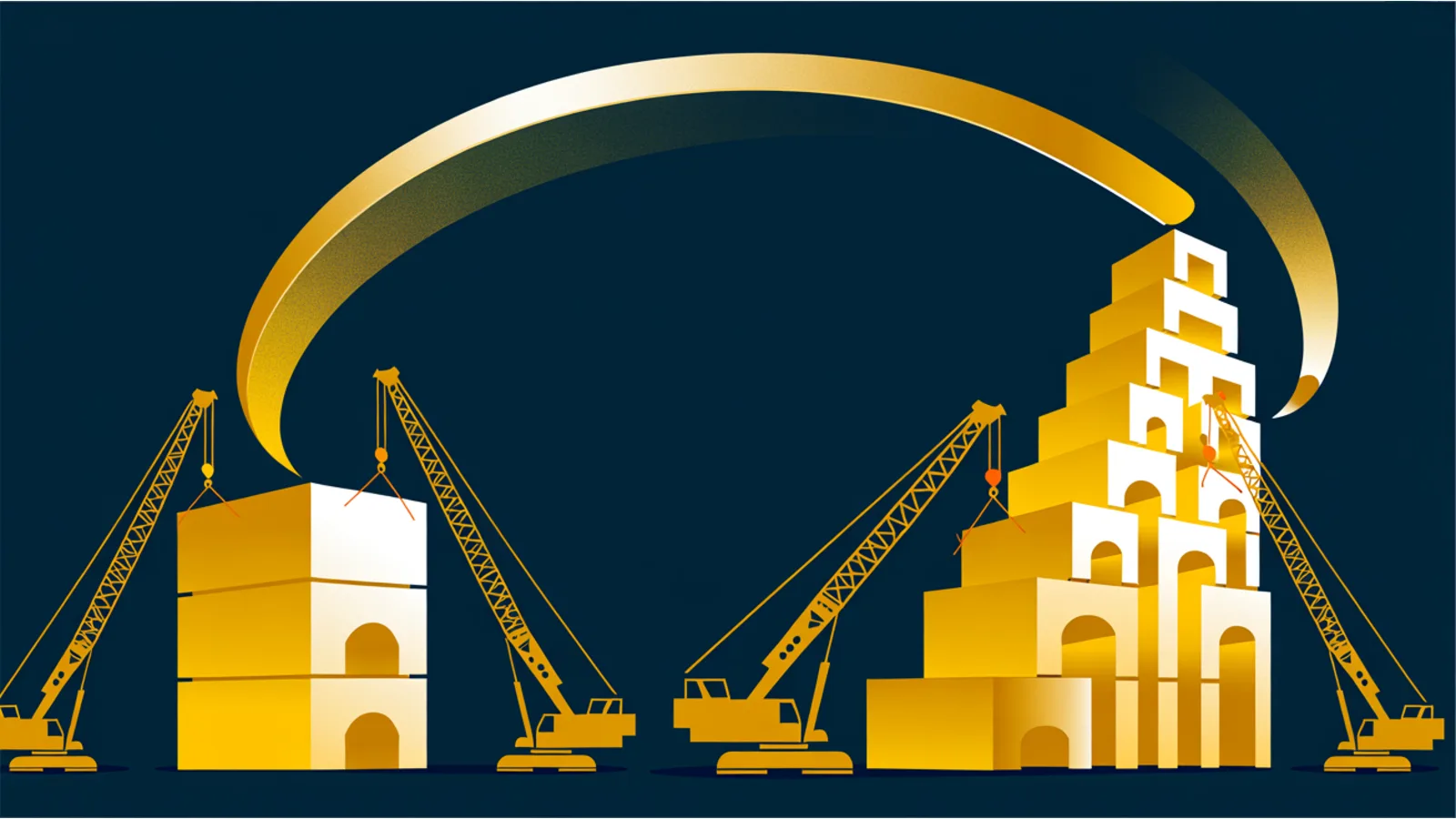
This is one profile in a set on cleared government contractors and the machine that turns them into fortunes. Most of the set works at the scale of a founder and a few hundred employees. Amentum is the same machine running at the top of its range, with a private equity sponsor, tens of thousands of cleared workers, and a going-public maneuver most people have never heard of. If you want to see the build, sell, and roll pattern at industrial scale, this is the specimen. It also answers a question the smaller stories raise but never quite settle: once the company is enormous, how does the owner actually cash out? Amentum's answer is unusually clever, and it did not involve an initial public offering at all.
The castoff
Amentum began as a business somebody else did not want. It was the Management Services group of AECOM, the giant engineering firm, the part that runs and maintains things for the government rather than designing buildings. AECOM first floated spinning it off tax-free, then decided to just sell it. In October 2019 it agreed to hand the unit to two private equity firms, American Securities and Lindsay Goldberg, for about 2.4 billion dollars, a price the buyers' law firm pegged at 2.405 billion dollars and 11.6 times the unit's earnings. The deal closed on the last day of January 2020.
A few days later the new owners launched the brand, and even the name told you the plan. Amentum refers to the leather strap the ancient world wrapped around a javelin to make it fly farther, a momentum metaphor the company chose on purpose. The company that came out of AECOM had roughly 4.1 billion dollars in revenue, more than 20,000 employees, and work in 28 countries. It was already large. The point of buying it was to make it much larger, and fast.
Bolt on, bolt on
The private equity playbook is to buy a platform and then bolt smaller companies onto it, and Amentum ran that play twice in twenty-four months, each time roughly with borrowed money, and roughly doubled and then doubled again.
The first was DynCorp International, the storied logistics-and-support contractor, which Amentum agreed to buy in September 2020 from another private equity firm, Cerberus, that had itself taken DynCorp private for 1.5 billion dollars back in 2010. Amentum never disclosed what it paid, so no honest account can put a figure on it, but the combination created a company with more than 6 billion dollars in revenue and about 34,000 people.
The second was PAE, and it is worth slowing down on, because PAE had already run the whole playbook on its own. Pacific Architects and Engineers dates to 1955. By the late twenty-tens it was owned by the private equity firm Platinum Equity, which took it public in early 2020 by merging it with a blank-check company, Gores Holdings III, at an enterprise value near 1.55 billion dollars. The executive Platinum installed to run PAE was named John Heller. In October 2021 Amentum agreed to buy PAE outright for about 1.9 billion dollars including debt, a cash deal at 10.05 dollars a share that PAE's stockholders approved in a vote in February 2022. The combined company now cleared 9 billion dollars in revenue. And John Heller, the man who had run PAE, would within weeks be running all of Amentum. The people move with the assets in this world, which is one of its quiet lessons.
The trick: public without an IPO
Here is the part that makes Amentum a teaching case. When the private equity owners were ready to turn their stake into something they could eventually sell, they did not take the company public through an initial offering, and they did not sell it to a strategic buyer. They used a maneuver called a Reverse Morris Trust.
The mechanics are worth understanding, because they explain a lot about how large corporate assets change hands. In November 2023, Jacobs Solutions, a big engineering company, agreed to shed two of its government units, its Critical Mission Solutions segment and its cyber and intelligence business, and merge them into Amentum. Rather than sell those units for cash, which would have made Jacobs pay corporate tax on the gain, Jacobs distributed them to its own shareholders and folded them into Amentum in a single tax-free step. The catch that makes it legal is a rule: the original company's shareholders have to end up owning more than half of the combined business. That single requirement is why the ownership math had to come out the way it did.
When the deal completed in late September 2024 and the stock began trading on the New York Stock Exchange as AMTM, the shares split roughly like this: former Jacobs shareholders held 51 percent, Jacobs itself kept 7.5 percent, another 4.5 percent went into escrow tied to performance targets, and the legacy Amentum owners, meaning the two private equity firms, held about 37 percent. The new Amentum paid Jacobs a 1 billion dollar cash dividend on the way out the door, funded by new borrowing of a 3.75 billion dollar term loan, an 850 million dollar revolver, and 1 billion dollars of bonds. In one move, a private company with about 9 billion dollars in revenue became a public one with roughly 13 to 14 billion, a partner, and a full public shareholder base, without ever selling a single share to the public in the way an IPO does.
Why do it this way instead of an ordinary IPO or a sale? Because an IPO of a company that size floats only a slice and carries the risk that the market is soft on the day you price it. A cash sale would have handed Jacobs a tax bill and required a buyer big enough to write a 13-billion-dollar check, of which there are few. The Reverse Morris Trust delivered scale, a public listing, a large instant float, and a clean tax result all at once. The tradeoff, and it is a real one, is that the private equity owners walked away with no immediate cash. They received something else: 37 percent of a public company and a clock ticking down to when they could sell it.
Where the money actually is
Line the story up against the rest of this series and the shape is identical, only the zeros are different. American Securities and Lindsay Goldberg bought a platform cheap, at 11.6 times earnings, from a seller that wanted out. They bolted on two big companies at ordinary government-services multiples and used the combined cash flow to carry the debt. Then they converted their private stake into public stock they can register and sell over time. The company's proxy shows the two firms holding equal blocks of about 18 percent each, roughly 37 percent together, which is the same rolled-equity idea the small founders in this series use, just expressed as a controlling position in a listed company rather than a minority slice of a platform.
The honest part, because this series does not sell a fantasy, is that the roll has not paid off yet. The sponsors' lock-up expired in the autumn of 2025, and in October the company registered up to about 90 million of their shares for eventual resale, but as of the middle of 2026 they still held more than a third of the company and had not sold the block. The stock has been a roller coaster, opening in the high twenties, falling to about 16 dollars in April 2025 on fears about federal budget cuts, climbing above 38 in early 2026, and sitting near 21 by that summer. A 37 percent stake that large is its own weight on the share price, the thing traders call an overhang. The second bite, at this scale, is a position you still have to sell into a nervous market, not a check that already cleared.
What it is now
Amentum today runs about 14.4 billion dollars in revenue across two segments, a larger Global Engineering Solutions arm at roughly 8.9 billion dollars that does nuclear and environmental and platform work, and a Digital Solutions arm near 5.5 billion doing cyber, intelligence, and space. It carries a backlog above 47 billion dollars and employs more than 53,000 people in around 80 countries, over 27,000 of them cleared. The customer list is a tour of the hardest work the government buys: the 28 billion dollar contract to run the Y-12 and Pantex nuclear-weapons plants with a partner, the 8.3 billion dollar Oak Ridge cleanup, launch operations at Kennedy Space Center, and a rare clean sweep of all eight domains of the government's OASIS+ contract vehicle, something fewer than one in fifty awardees managed. It is led by John Heller as chief executive, the same man who ran PAE, with Travis Johnson, hired from CACI, as chief financial officer.
The ledger reading
The smaller stories in this series can make the roll look like magic, a founder who sells and then watches a second check arrive. Amentum is the useful corrective, because it shows the same structure with its costs visible. The value was real and was created the same way, by buying a platform below the price the assembled whole would fetch and stacking scarce, cleared, hard-to-copy work onto it. But the harvest is slow, it depends on a market that moves, and the owners carry the risk of a big position they have not yet sold. That is the truthful version of the lesson underneath The W-2 Trap: owning the asset beats renting out your hours, and it beats it by a lot, but ownership is a claim on a future that has to actually arrive. The people who build these companies understand they are trading a sure paycheck for an uncertain, and usually much larger, share of what the enterprise becomes. Amentum is that trade written in ten figures.
Related reading
- Built to Be Bought: the founder-scale version of everything above, and why buyers pay so much for a cleared book of business.
- The Plumbing: The Funds, LPs, and Holding Companies Behind the Deals: how the private equity money is actually housed, and the other firms that run the identical structure.
- PeopleTec: The Cleared Contractor That Sold to Its Own Employees: the same logic taken the opposite direction, to the workforce instead of a sponsor.
- Maximus: How a Welfare-Reform Contractor Became a Public Giant: a different road to public scale, built by acquisition on the open market.
Fact-check notes and sources
- AECOM sold its Management Services business to American Securities and Lindsay Goldberg for 2.405 billion dollars (about 11.6 times earnings, including roughly 150 million dollars of contingent consideration), agreed October 2019 and closed January 31, 2020: the buyers' counsel Cravath and AECOM's announcement.
- The Amentum brand launch, the meaning of the name, and its launch scale (about 4.1 billion dollars revenue, 20,000-plus employees, 28 countries), founding CEO John Vollmer: Amentum, February 2020 and Washington Technology.
- DynCorp acquisition (agreed September 2020, closed November 2020) from Cerberus, which had taken DynCorp private for 1.5 billion dollars in 2010; price of Amentum's purchase not disclosed: Amentum and Defense Daily. No dollar figure is asserted here because none was published.
- PAE acquired for about 1.9 billion dollars including debt at 10.05 dollars per share, a one-step merger approved by PAE stockholders in February 2022; PAE's earlier path from Platinum Equity through a Gores Holdings III blank-check merger; John Heller as PAE and later Amentum CEO: American Securities, the closing notice, and the PAE and Gores Holdings III announcement.
- The Reverse Morris Trust with Jacobs (announced November 2023, completed late September 2024), the tax-free structure, the 51 / 7.5 / 4.5 / 37 percent ownership split, the 1 billion dollar cash dividend to Jacobs, and the financing: Jacobs' investor presentation, Amentum's completion release, and Cravath on the credit facilities and notes.
- The two sponsors' equal stakes of about 18 percent each (roughly 37 percent combined) and the October 2025 resale registration of up to about 90 million shares: the 2025 proxy statement and the shelf-registration coverage.
- Fiscal 2025 revenue of about 14.4 billion dollars, the two segments, the backlog above 47 billion dollars, and headcount above 53,000 in around 80 countries: Amentum's fiscal 2025 results. Stock-price history (high twenties at debut, about 16 dollars in April 2025, above 38 in February 2026, near 21 by mid-2026): stockanalysis.com.
- Marquee programs (the 28 billion dollar Y-12 and Pantex contract, the 8.3 billion dollar Oak Ridge cleanup, and selection on all eight OASIS+ domains) and leadership (John Heller as CEO, Travis Johnson as CFO): Amentum on Y-12 and Pantex, UCOR on Oak Ridge, ExecutiveBiz on OASIS+, and GovConWire on the CFO appointment.
This post is informational and journalistic, describing a publicly reported company, its people, and public transactions and filings. It is not investment, tax, legal, or M&A advice, and nothing here is a recommendation. All parties are discussed from public records and their own published statements as nominative fair use, with no affiliation implied and nothing endorsed by them.
