
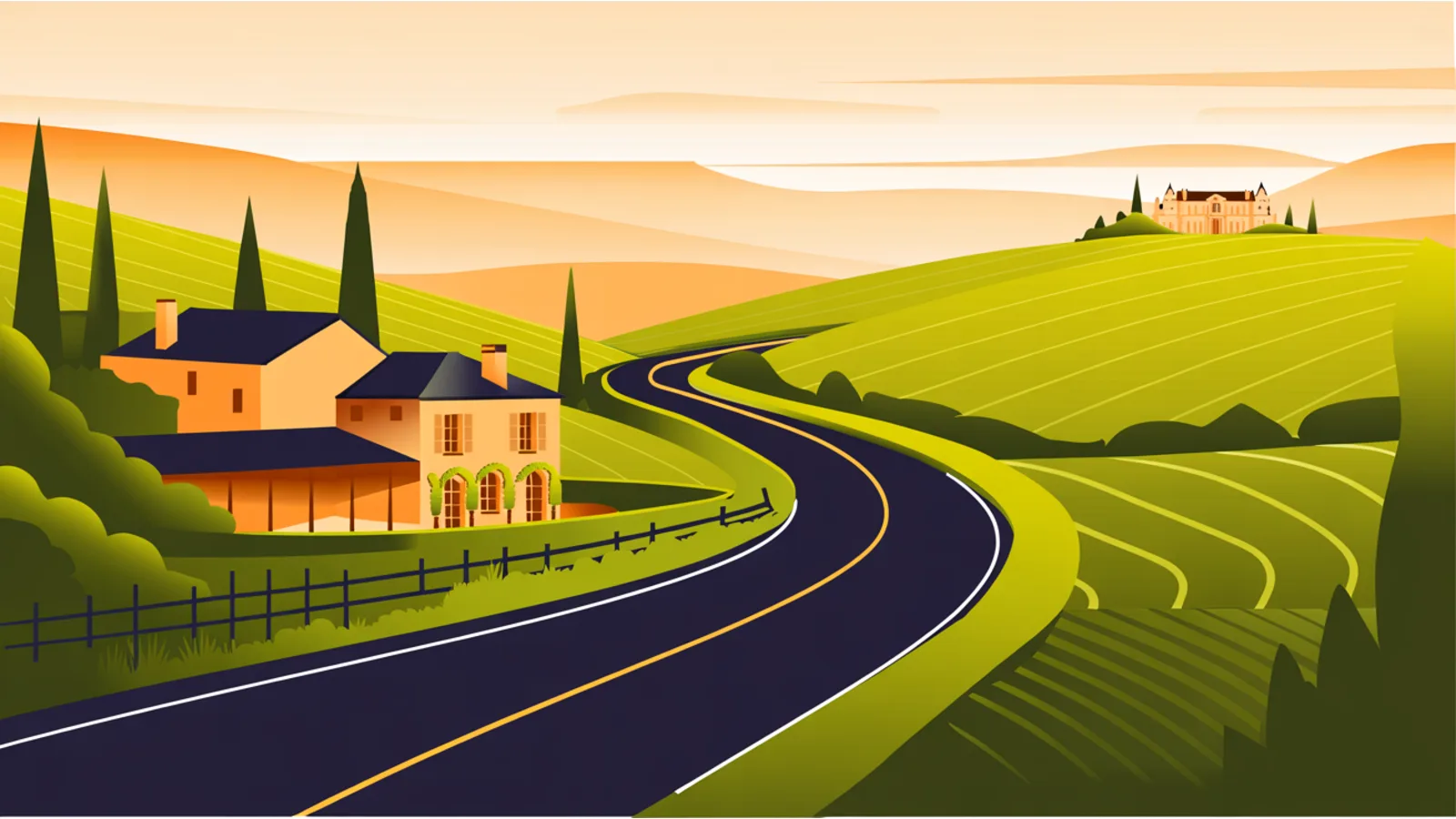
Most luxury brands tell an origin story, and most of those stories are marketing. Relais & Châteaux has one that happens to be true, and it is stranger than anything a brand consultant would invent. The network that today gathers 580 independently run hotels and restaurants across 65 countries (Relais & Châteaux) began with two music-hall performers, a country inn on the banks of the Rhône, and a single French highway. It was never designed to be a chain. It was designed to be a road.
An inn, a cardinal, and two entertainers
The story starts at La Cardinale, a hotel and restaurant on the right bank of the Rhône in the Ardèche, in the village of Baix. The building goes back to the first quarter of the seventeenth century, and it takes its name from Cardinal Richelieu, who reportedly stayed there in 1642 (Auberge La Cardinale). The word "reportedly" is doing real work in that sentence. The Richelieu visit comes from local heritage accounts rather than any scholarly source, so it belongs in the category of pleasant regional legend. What is solidly documented is the building itself, which was listed as a monument historique in December 1982.
By the early 1950s, La Cardinale belonged to Marcel and Nelly Tilloy, a husband-and-wife pair of music-hall entertainers who had swapped the variety stage for the hotel trade (Relais & Châteaux). They were not hoteliers by pedigree, and that turns out to matter. People who inherit a grand hotel tend to defend it as it is. People who arrive from somewhere else tend to want to connect it to something larger. The Tilloys did the second thing. Rather than run their inn as an island, they joined forces with a handful of hotelier friends and formed an organization they called Les Relais de Campagne, the country relays (Wikipedia).
The association was officially born on May 12, 1954, in Thoissey, a small town north of Lyon, at Le Chapon Fin, a property owned by Paul Blanc, uncle of the chef Georges Blanc (Relais & Châteaux). That founding date is why the network spent 2024 marking its seventieth anniversary, counting the years from 1954 (Relais & Châteaux). Two of the founding names are worth holding onto, because both families are still inside the network today. La Cardinale gave it the Tilloys. Le Chapon Fin was the room where the thing was signed into being, and the Blanc name it carried would later attach to one of the most celebrated member houses in France. That is not a coincidence. It is the whole model in miniature.
The Route du Bonheur
What held these first houses together was not a corporate parent. It was a highway. In total, eight establishments strung out between Paris and Nice planted the seed of what became Relais & Châteaux, and each of them sat near Route Nationale 7, at the time the main road carrying French families south on holiday (Relais & Châteaux). The founders gave the string of inns a name that reads like a slogan and functioned like a map: the Route du Bonheur, the Road to Happiness, running along RN7 from Paris down to Nice (Wikipedia).
The idea was simple and durable. A traveller driving south could break the journey at a series of good, independent houses, each with its own kitchen and its own owner, rather than surrender to whatever happened to stand beside the road. The concept had a built-in reason to grow. Every new member made the chain of stops a little more complete, and a more complete chain made every member more useful. Membership rose to 19 houses in 1955 and 29 in 1956, and by the early 1960s the association had begun crossing borders into the rest of Europe (Relais & Châteaux). The Route du Bonheur outlived the road that inspired it and became a permanent brand device. The network now markets a large set of curated itineraries under that same name. It is worth pausing on how backwards this is from the usual playbook. Most hospitality empires start with capital, buy or build properties, and stamp a single identity onto all of them. This one started with independent owners who already had their own identities and stitched them together with nothing more binding than a shared standard and a shared route. The glue was reputation, not ownership.
One honest caveat belongs here. Of the eight original establishments, only two are firmly documented in the sources that survive: La Cardinale, the Tilloys' inn at Baix, and Le Chapon Fin, the meeting house at Thoissey. The other six founding stops are not published on any official page. Anyone who hands you a confident list of all eight is filling gaps that the record does not fill.
The name, and what the association is
The name most people know did not exist at the start. For its first two decades the group traded as Les Relais de Campagne, later paired with a companion label, Relais Gourmands, for its restaurants. The modern name dates from 1974, when Relais de Campagne and Relais Gourmands merged with a separate group, the Châteaux-Hôtels, and the combined association adopted the title Relais & Châteaux (Relais & Châteaux). Wikipedia records the same event: in 1974 the country relays and the château hotels came together under a single name (Wikipedia). The merger is the moment the network stopped being only about roadside inns and started to include grand houses. The two halves of the name are literally the two halves of the deal. Relais, the modest country stops. Châteaux, the castles and old manors. The ampersand between them is the treaty.
It helps to be precise about what Relais & Châteaux actually is, because it is not the kind of corporation most global hotel brands are. It is a not-for-profit association governed by France's law of 1901, the same legal form that covers a great many French clubs and societies (Wikipedia). Its president is elected for a five-year term and may serve at most two terms, and its worldwide operations are divided into roughly 20 regional delegations (Wikipedia). That structure explains why the properties feel so unlike one another. No head office owns them. Each hotel and restaurant is independently operated, and membership is a standard the house has to meet rather than a franchise it can buy. The association's own description is blunt on the point: this is not a chain, and members are expected to differ from chain hotels (Relais & Châteaux).
The families who still run the houses
The most distinctive feature of the network is the one that connects it straight back to the Tilloys: many of its houses are run by families who pass their craft, in the association's own words their savoir-faire, from one generation to the next (Relais & Châteaux). That is not a marketing flourish laid over a corporate structure. It is the corporate structure.
Consider the Blanc family, whose name was already in the room in 1954. Georges Blanc Parc & Spa, in the village of Vonnas, is a Relais & Châteaux member and one of the best-known family kitchens in France (Relais & Châteaux). The line runs from Paul Blanc, whose Le Chapon Fin hosted the founding meeting, through the Blanc dynasty that still trades on the name. The Troisgros family is the other textbook case. Maison Troisgros is a long-standing member house, and Pierre Troisgros was an active figure in the network's early years (Relais & Châteaux). These are not tenants of a brand. They are the reason the brand means anything.
Then there is the family that runs the whole association today. Since January 2023 the president has been Laurent Gardinier, who, with his two brothers, co-owns two member properties: Domaine Les Crayères in Reims and Le Taillevent in Paris (Wikipedia). The people setting the standard, in other words, are themselves owner-operators who have to meet it. It is a governance model that would look strange in most industries and looks entirely natural here.
Not every famous member traces back to a founding stop, and it is worth being careful on this point. La Chèvre d'Or, perched in the hill village of Èze on the French Riviera, is a current member and a Route du Bonheur property (Relais & Châteaux). It is sometimes described as one of the original 1954 stops, but the sources do not support that specific claim. The roster of the eight founding houses was never fully published, so it is safer to call La Chèvre d'Or a member on the Road to Happiness than one of its first stones.
The scale today
Seventy years on, the road has become a map of the luxury world. Relais & Châteaux counts 580 unique, independently operated hotels and restaurants in 65 countries across five continents (Relais & Châteaux). A large part of its identity now runs through the kitchen. The association describes a network of more than 200 fine-dining restaurants worldwide, of which close to 100 are stand-alone restaurants with no rooms attached (Relais & Châteaux). That is an unusual shape for a hotel group. A meaningful part of the collection is not hotels at all.
To make that map concrete, the members are the kind of places that anchor a region rather than a brand. In the United States they include Auberge du Soleil above the vineyards of Napa Valley, Blackberry Farm in the Tennessee foothills, the Seattle dining room Canlis, Castle Hill Inn on the water in Newport, Rhode Island, and Castle Hot Springs in the Arizona desert, with the Auberge Saint-Antoine in Old Quebec City across the border in Canada (Relais & Châteaux, North America). The reach runs well past Europe and North America. Gôra Kadan, a ryokan in the hot-spring town of Hakone, and the centuries-old Asaba in Izu fly the flag in Japan, while Ceylon Tea Trails sits among the plantations of Sri Lanka (Relais & Châteaux, Asia). These sit alongside the French founding houses already named, the Blancs at Vonnas, the Troisgros, Domaine Les Crayères and Le Taillevent, and together they are the pattern the association exists to protect: independent, usually family-run, and unmistakably of their place.
The Michelin count is the headline the network likes to cite, and it deserves a footnote about arithmetic. A Relais & Châteaux press release, carried through Slow Food and the trade press, put the collective total at 376 Michelin stars including 40 Green Stars, the award for sustainability (Travel Daily News). That figure moves every year as new guides are published, so the honest way to state it is as a range anchored to its source: something above 300 stars across the network's 200-plus restaurants, with any exact tally only as good as the date attached to it. Precision here is false comfort. The direction of travel, upward, is the durable fact.
The admissions model is deliberately slow. In 2025 the association added roughly 34 new members across several induction rounds, reaching into Egypt, Norway, Portugal, Japan, Canada, Australia, and South Africa (Travel Daily News). A few dozen additions in a year, chosen one house at a time, is the opposite of a rollout. As for the human scale behind the map, the association reported employing roughly 42,000 people as of April 2023, a figure that is now dated and should be read as a snapshot from that year rather than a current headcount (Wikipedia).
The bottom line
Relais & Châteaux is what happens when a marketing idea turns out to be a governance idea. Two entertainers with an inn on the Rhône did not set out to build a global brand. They set out to link a handful of independent houses along a highway so that travellers would choose them over the anonymous alternative. Seventy years later the highway is symbolic and the network spans five continents, but the original bargain is intact: stay independent, keep the house in the family where you can, meet a common standard, and share a name. The road is longer now. It still runs on the same idea.
Related reading
- Marriott and Hilton: the family-versus-chain question that Relais & Châteaux answers from the other side.
- Mauritius sugar dynasties: family estates preserved and handed down across generations.
- Hidden owners, quiet fortunes: how quietly held property fortunes are actually structured.
- Aspen and Ketchum homes: where old money keeps its trophy real estate.
- The Working Ledgers: the money underneath the properties.
Fact-check notes and sources
- Founding date and La Cardinale (founded 1954, seventieth anniversary in 2024; the Tilloys and their inn at Baix in the Ardèche; the Richelieu-in-1642 detail): Relais & Châteaux 70th-anniversary history and Auberge La Cardinale. The Richelieu visit is a local heritage account and is flagged with "reportedly."
- Les Relais de Campagne and the 1954 meeting (the original name; the May 12, 1954 founding at Le Chapon Fin in Thoissey, owned by Paul Blanc): Relais & Châteaux and Wikipedia.
- The Route du Bonheur and RN7 (eight establishments between Paris and Nice near Route Nationale 7; the Road to Happiness; growth to 19 members in 1955 and 29 in 1956): Relais & Châteaux and Wikipedia. Only La Cardinale and Le Chapon Fin are documented among the eight founding houses; the remainder of the roster is not published.
- The 1974 merger and the name (Relais de Campagne and Relais Gourmands merging with the Châteaux-Hôtels group to form Relais & Châteaux): Relais & Châteaux and Wikipedia.
- Association structure (not-for-profit under France's 1901 law; five-year presidential term with a two-term maximum; roughly 20 delegations): Wikipedia.
- The member families (the Blanc family at Vonnas; the Troisgros family and Pierre Troisgros; president Laurent Gardinier and his brothers, co-owners of Domaine Les Crayères and Le Taillevent): Relais & Châteaux and Wikipedia.
- La Chèvre d'Or (a current member in Èze and a Route du Bonheur property, but not confirmed as one of the original 1954 stops): Relais & Châteaux.
- Scale and dining (580 hotels and restaurants in 65 countries; more than 200 fine-dining restaurants with close to 100 stand-alone; the family-run, non-chain model): Relais & Châteaux About and Relais & Châteaux fine dining.
- Member examples (Auberge du Soleil, Blackberry Farm, Canlis, Castle Hill Inn, and Castle Hot Springs in the United States and Auberge Saint-Antoine in Canada; Gôra Kadan and Asaba in Japan and Ceylon Tea Trails in Sri Lanka), each listed as a current member on the association's own destination pages: Relais & Châteaux, North America and Relais & Châteaux, Asia.
- Michelin stars (376 stars including 40 Green Stars per an association release; a date-dependent number best stated as a range): Travel Daily News.
- New members and employees (about 34 new members in 2025 across seven countries; roughly 42,000 employees as of April 2023, a dated figure): Travel Daily News and Wikipedia.
This post is informational and educational, not investment, legal, or travel advice. Figures are reproduced from the cited association materials, heritage records, and trade press, with contested or date-sensitive figures flagged as such. Relais & Châteaux and the individual properties named here are discussed as a matter of public record under nominative fair use, and no affiliation or endorsement is implied.
