
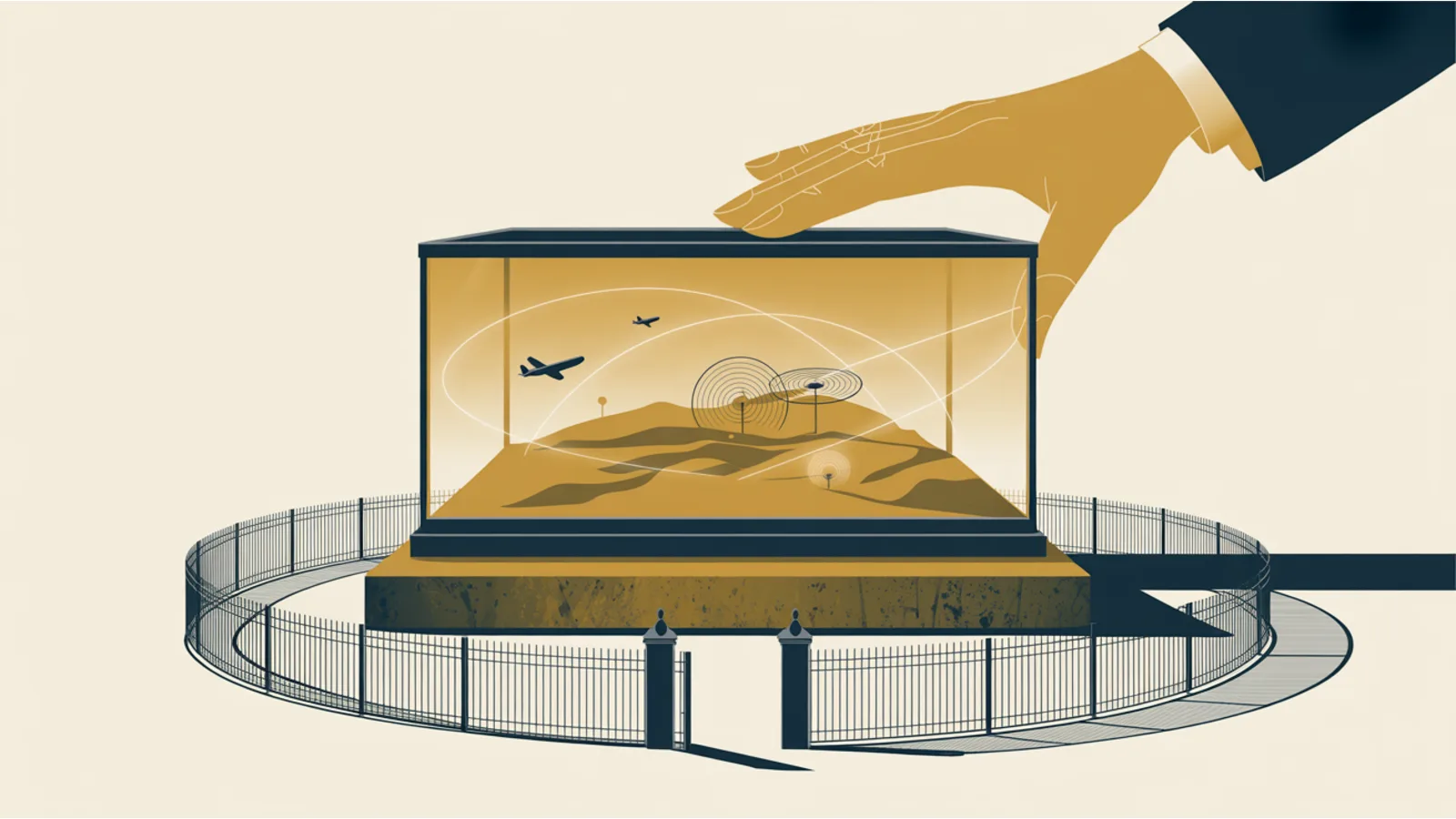
In February 2013, Boeing handed the Air Force a simulation framework it had spent roughly a decade building on its own dime. The transfer happened under contract, and the terms are the whole story. AFRL's own technical reference states it flatly: "Under contract, Boeing delivered AFNES to the Air Force (specifically AFRL/RQQD) with unlimited government rights, including source code, in Feb 2013. AFRL/RQQD rebranded AFNES as AFSIM," per the AFSIM Version 2.0 Overview and Technical Reference.
Unlimited government rights, including source code. Not a licence, not a maintenance contract with a renewal date and a vendor who owns the build system. The government walked away with the thing itself, and thirteen years later AFSIM is what a large chunk of Air Force concept analysis runs on.
What AFSIM actually is
AFSIM stands for Advanced Framework for Simulation, Integration, and Modeling. It is a C++ framework for building engagement-level and mission-level military simulations, and the cleanest definition comes from AFRL's own AFSIM Product Manager in a 2021 NATO briefing: "A U.S. government owned, open source, community-informed, military simulation framework" enabling "multi-domain, multi-resolution modeling, simulation, and analysis," cleared for public release in April 2021.
That briefing places AFSIM on a three-tier ladder: campaign-level military utility analysis, mission-and-engagement-level effectiveness analysis, and engineering-level performance analysis. AFSIM's "home turf," in AFRL's phrasing, "is mission effectiveness analysis (constructive, virtual, and/or live)." Each tier is defined as a comparative measure, which matters more than it looks. AFSIM is built to tell you option A beats option B under stated assumptions, not to hand you an absolute number.
One naming point, because it is easy to guess wrong. The core type namespace is prefixed WSF_, and WSF expands to World Simulation Framework. AFRL's body text is unambiguous: "The baseline AFSIM simulation application is called the World Simulation Framework Executive (Wsf Exec)." That is the only expansion any source I read supports, and the weapons-flavoured guess you may have seen appears in none of the documentation.
The origin story is better than the legend
Boeing built AFNES, the Analytic Framework for Network-Enabled Systems, with internal research and development money starting in 2003, adding a threat Integrated Air Defense Systems capability from 2005 that was operational by 2008. AFNES was explicitly an alternative to the Air Force's approved mission level model, and the stated gaps read like a wish list from an analyst who had been fighting a tool for years: electronic warfare representations, independent tracking and correlation, auto-routers, net-centric communications, space assets, and integration with external models such as AGI's System Tool Kit.
Then the competitive part. AFRL's reference says that in 2010 its Aerospace Vehicles Technology Assessment & Simulation Lab "commissioned a trade study of M&S Frameworks," whose result "was the selection of AFNES as the best M&S framework." A later account by AFRL authors calls it "a head-to-head showdown of available tools in 2011." Both are real and they do not quite line up, so read it as a study commissioned around 2010 and resolved by about 2011. Then the February 2013 delivery and the rebrand.
The money figure is where people get sloppy. Col Timothy D. West and Brian Birkmire, both AFRL, wrote that "Between 2003 and 2013, Boeing invested approximately $35M of Independent Research & Development (IR&D) funding into what it called the Analytic Framework for Network-Enabled Systems (AFNES)," in the CSIAC Journal, Winter 2020. Boeing-coauthored documents put the window at 2003 to 2014, probably IR&D continuing past the handover rather than a contradiction, so call it roughly 2003 to 2013 or 2014.
What that figure is not is a purchase price. Nobody paid Boeing 35 million dollars for AFSIM. Boeing spent 35 million dollars of its own money, and the government later received the result under contract with unlimited rights. What AFRL paid, if anything, is not in the public record.
Two caveats a careful reader deserves. The "frustrated with the proprietary, inflexible M&S tools available to the Government at the time" framing that underpins the whole own-it thesis is West and Birkmire's language, not a neutral finding. And the foundational documents are co-authored by the vendor: the definitive 2015 conference paper carries Clive, Johnson and Moss of Boeing alongside Zeh and Birkmire of AFRL and Hodson of AFIT, cleared for public release. Three of six authors worked for the company being praised, which is reason enough to read the superlatives with one eyebrow up.
"Open source" that you cannot download
This trips up everyone who reads the language. AFRL says open source. So does the 2025 FORGE solicitation: "government-owned, open-source, and community-informed."
None of that means public. The software carries "DISTRIBUTION STATEMENT F: Further dissemination only as directed by AFRL Aerospace Systems Directorate, or higher DoD authority," documentation carries Distribution Statement C, and everything is export controlled, per DSIAC's AFSIM model page. The 2015 paper is blunt: "AFSIM is currently ITAR restricted and AFRL only distributes AFSIM within the DoD community." Open source here means exactly one thing: licensed users get the source. That is genuinely different from a proprietary binary drop. It is not GitHub.
Access is paperwork, not a download button. AFSIM is free to US Government agencies and eligible DoD industry partners, who get it through an Information Transfer Agreement; other agencies use a Memorandum of Understanding. Per AFRL, "An Information Transfer Agreement (ITA) must be completed to receive either the unclassified or classified distribution, and an appropriate DD254 must be presented by government contractors to acquire the classified distribution." The public contact is an email address, afrl.rq.afsim-help@us.af.mil. Academia is eligible but needs "an approved ITAR-compliant environment" first. A small tell about how closed this is: a framework licensed to hundreds of organisations has no Wikipedia article at all.
Under the hood, and the renames that confuse everyone
The architecture is simple enough to explain over coffee, which is a compliment. "AFSIM platforms are composed of attributes, information, components and links." A platform is a participant: "aircraft, satellites, missiles, ships, submarines, ground vehicles, structures and life-forms." Components are movers, sensors, communications, weapons, and processors, and movers are optional, since "a platform without a mover is geographically fixed." The ten published mover types are the most concrete version of the seabed-to-space claim you will find, running from WSF_SUBSURFACE_MOVER through WSF_AIR_MOVER to WSF_NORAD_SPACE_MOVER. "Multi-resolution" means something checkable: "an aircraft can be modeled with a simple route mover or with a full pseudo 6-DOF (six degrees of freedom) aerodynamics and control model." You dial fidelity per component, per question.
The toolset today is Wizard (the IDE), Warlock (operator-in-the-loop wargaming, where Blue, Red and White cells each see only what their own platforms collected), and Mystic (recording, playback, statistics), plus Sensor Plot, Weapon Tools, and Astrolabe for orbital mission events. That trio is recent, though, and attributing it to 2013 is wrong: in August 2016 the suite was framework plus AFSIM IDE plus VESPA, a Boeing-built DIS-listener tool, and Warlock and Mystic appear nowhere in that document. What it does contain are two rename notes, the best evidence of the lineage anyone has: Wsf Exec "is likely to undergo a name change, to become 'AFSIM Mission'" and AFSIM IDE "is likely to undergo a name change, to become 'AFSIM Wizard.'" So the baseline application has been called SAGE in 2015, Wsf Exec in 2016, and simply mission by the time RAND wrote about it in 2024. VESPA is messier: it did both scenario setup and replay visualization, so its jobs split between today's Wizard and Mystic rather than renaming into either.
Where the machine learning actually lives
AFSIM has had an agent architecture since long before the current wave. RIPR, the Reactive Integrated Planning aRchitecture, uses behavior trees plus hierarchical tasking, and each agent carries a "tunable cognitive model" representing a limited brain with delayed or erroneous information. The 2015 example is delightfully concrete: an "expert" pilot agent can maintain knowledge of 16 threats that he updates every 5 seconds. AFRL's stated modern use case is blunt: "AFSIM utilized as a virtual testbed for autonomy technology maturation. All physical entities simulated within AFSIM; Autonomy algorithms run external to AFSIM," supporting "ML/RL algorithm training" and scenarios "that are difficult/impossible to flight test."
The best public example is RAND's. Gary J. Briggs built a reinforcement-learning harness and "demonstrated the harness in AFSIM for the case of an aircraft attempting to penetrate an adversary's integrated air defense system," in a 2024 RAND Project AIR FORCE report. It bridges Python agents to C++ AFSIM through a C shim using ctypes, and it "has been made available to all authorized users on the Air Force Research Laboratory's AFSIM portal."
The deployment detail is the part engineers should steal. Trained agents compile to TensorFlow Lite format, "essentially just the weights and biases from a neural network," so the module "does not require any Python harness after training, which allows the trained agent to run inside any of AFSIM's normal tools, such as mission for unattended constructive simulation or warlock for operator-in-the-loop and virtual environments." Train in Python, ship weights, run inside the sim the analysts already use.
RAND is honest about the failure mode, and it is the familiar one. Agents may receive "a reward for approaching the target, a reward for hitting the target, a penalty for being detected, and a penalty for running out of fuel," and "if the penalty for detection is too high, the agent could simply turn back and loiter outside the range of the IADS until it runs out of fuel." A perfectly optimised agent that learned to do nothing. There is academic work too: a 2024 AFIT thesis trained a Double Deep Q-Network for 2v2 air combat with directed energy weapons, and Thompson and Hodson is the peer-reviewed reference for the hybrid virtual and constructive design.
The honest limits, mostly from AFRL
The best anti-hype quote about AFSIM is on its own product manager's summary slide: "AFSIM is NOT a single solution to all M&S needs nor the only component of the AFRL and AF Enterprise MS&A infrastructure."
The second-best is buried in the technical reference's Limitations and Assumptions section, and every analyst should have it tattooed somewhere. "There are no inherent limitations imposed by the framework on platforms or their components with regard to their performance. Any platform can detect, communicate with, shoot or control any other platform. Any limitations are due either to how the model is configured (user input) or limitations of a platform component model." Then the line that ends the argument: "The point is that the user is in charge of most limitations of this kind."
You can model a radar as WSF_GEOMETRIC_SENSOR, meaning if the target is within 50 miles it can be seen, or as WSF_RADAR_SENSOR with real fidelity. The framework does not care; it runs either and produces plots either way. Tracks are equally unconstrained: a track "can contain errors and does not have to correspond to a real platform." Scale is a hardware question, not a design one, limited "only by the amount of memory available and the amount of time one is willing to wait."
There is a documented verification and validation process, so the lazy "nobody checks these" take does not survive contact. AFSIM's IADS scenarios are cross-compared against the Air Force mission level model through sensor coverage diagrams and missile flyout comparisons, giving "a continuous verification and validation (V&V) process to standard scenarios." The pedigree detail, naturally, "can be requested by contacting the AFSIM model manager," which is to say it is restricted.
The learning curve is real without needing an invented number. AFRL points new users to "the AFSIM Analyst course" or the "examples and demonstrations that accompany the AFSIM release," with the command reference in a wiki, all of it behind the licensing wall, so you cannot evaluate the tool before committing to the paperwork. And an independent critique, from a 2017 AFIT thesis that extended the framework rather than praised it: adding a concept to a behavior tree "requires an in depth understanding of the code, increased duplication of code, and increases the risk of errors."
The community, dated honestly
Here is where numbers go stale and nobody notices. The most-quoted AFSIM statistic is that AFRL "has licensed AFSIM to over 275 government, industry, and academic organizations, and provided training to over 1200 users." That is from January 2020. RAND repeated the 275 in 2024, which makes it feel current, and it is not. No 2025 or 2026 figure exists publicly. Present it as a 2020 number or do not present it.
Dated properly, it still gives an adoption arc. Trade reporting in March 2017 said AFRL had transferred AFSIM to 80 industry partners, describing the ITA mechanism as letting industry "have complete access to the software, saving all involved parties time, money and resources." Eighty partners in 2017 to 275-plus organisations by early 2020 is roughly a tripling in under four years, with both endpoints attributed rather than auditable.
The governance detail is the strongest evidence this is a community and not a program office with a mailing list. Eight domain working groups steer it, covering sensors, space, threats and scenarios, kinetic weapons, directed energy, standardization, wargaming, and cyber. Per West and Birkmire, direction is "driven more by consensus of the subject matter experts in that group rather than AFRL dictate," with "nearly half the groups led by non-AFRL personnel, some by other military services." Releases run on a six-month cycle, in unclassified and US Secret variants, the latter shipping NASIC-approved threat models and NGA terrain data. Primes fund their own capability rather than just receiving it: CSIAC reports Lockheed Martin announced putting "$5M into their AFSIM infrastructure."
Cross-service use is corroborated from outside the AFSIM family, which is worth more than any capability slide. AFSIM appears in the Army's own modelling and simulation modernization concept, both as an existing simulation and as a planned containerised "AFSIM aaS" offering, reproduced in a RAND Arroyo report from an Army briefing dated April 2024. Availability extends to Five Eyes partners under authorized transfer agreements; as of April 2021 AFRL said "AFSIM is not yet available to NATO but under evaluation for future release," and nothing later resolves it. Two things the record does not establish: the current version, since DSIAC lists only "2.x" and the last specific numbers date to January 2020, and the current sub-office, confirmed only as RQQD in 2013 to 2016 and RQSA in 2021, though the directorate, AFRL/RQ, is current.
FORGE, and what the government is buying next
The freshest hard fact is a contract. AFSIM FORGE, Advanced Framework for Simulation, Integration, and Modeling for the Greater Enterprise, went out as solicitation FA2391-25-R-B002 from the Aerospace Systems Directorate at Wright-Patterson, posted 31 January 2025. Its purpose is to "mature and scale AFSIM as an enterprise capability while fostering a vibrant community of users, developers, and maintainers contributing to its evolution," per the mirrored contract-opportunity record. It anticipated two to four IDIQ awards.
Three are confirmed in primary spending data, all starting 19 December 2025: FA239126DB001 to Radiance Technologies, FA239126DB003 to Stellar Science, and FA239126DB004 to Infinity Labs, queryable through the USAspending API. Performance on the first runs to 20 August 2029.
Three honest gaps. The numbering skips DB002, which returns no record, so a fourth award may exist, may have been withdrawn, or may be a gap. The ceiling has been trade-reported at 85 million dollars, but I could not open that reporting, and primary data does not confirm it: USAspending shows no base-and-all-options value and zero obligated. And the solicitation anticipated award around 15 September 2025 while the actual start was 19 December, roughly a three-month slip, so anyone repeating a September award date is repeating a plan, not an outcome.
One vendor claim deserves a flag rather than a repeat. DCS Corporation says on its own site that it was "the original developers and maintainers of core AFSIM source code" and an AFSIM provider "for over nine years." That is self-description, and it sits awkwardly against the Boeing-origin record. The plausible reconciliation is that DCS has been AFRL's development contractor since the handover rather than AFNES's originator, but the public record does not settle it.
The ledger reading
Strip the acronyms and AFSIM is a procurement story wearing an engineering costume. A vendor spent about 35 million dollars of its own money over a decade solving a problem the government had. The government ran a trade study, picked that solution, and arranged the contract so that what it received was not access but ownership: the source, the rights, the ability to fork it and extend it.
That is the capability you cannot buy with a licence. Everything downstream, the working groups half-led by people who do not work for AFRL, the Army's plans to containerise it, the 275 organisations, RAND publishing a reinforcement-learning harness back into the government's own portal, exists because AFRL can hand out source code without asking a vendor's permission. That is not a story about simulation. It is a story about what unlimited government rights are worth, and it is one of the better-documented examples anyone has.
The framework itself remains, in its own product manager's words, not a single solution to all M&S needs, and its documentation says out loud that the user is in charge of most limitations. Both are more credible than any capability slide, and they are probably why the thing has lasted.
Related reading
- Shield AI: The Autonomy Company Building Toward an IPO, Not a Sale: the autonomy problem AFSIM is used as a testbed for, seen from the company side.
- Government Contract Vehicles, Explained: what an IDIQ like FORGE actually is and why three awardees share one.
- How to Build the Skills Behind a Lead AI/ML Platform Engineer: the reinforcement-learning and platform skills RAND's AFSIM harness assumes.
- The Corporation That Certifies the Rockets: another institution the government built so it would not have to trust a vendor's homework.
- AVUM: The Founder-Led Shop That Survived on the Right Contract Vehicles: the small-business end of the same defense-software market.
Fact-check notes and sources
- AFSIM and AFNES expansions; WSF as World Simulation Framework; the February 2013 delivery to AFRL/RQQD with unlimited government rights including source code; the 2005 IADS work and 2008 operational date; the ~2010 trade study; the gaps in the legacy model; the platform/component object model; the ten
WSF_*_MOVERtypes; multi-fidelity components; the scripting language; plug-ins; Monte Carlo; DIS/HLA/XIO; the ITA and DD254 requirement; the Limitations and Assumptions quotes; the IADS V&V process; the Analyst course and wiki; Sensor Plot and Weapon Tools; and both rename notes: the AFSIM Version 2.0 Overview and Technical Reference, AFRL Aerospace Systems, August 2016, Distribution Statement A, case 88ABW-2016-6198. Note this document is Boeing-coauthored. - The ~35 million dollar Boeing IR&D figure for 2003 to 2013; the "frustrated with the proprietary, inflexible M&S tools" framing; the 2011 "head-to-head showdown"; 275-plus organisations and 1,200-plus trained users; the eight working groups and "nearly half led by non-AFRL personnel"; the six-month release cadence; the two variants with NASIC and NGA models; the academic ITAR-environment condition; and Lockheed Martin's reported 5 million dollar investment: West and Birkmire, CSIAC Journal Vol. 7 No. 3, Winter 2020. All scale figures date to January 2020; no newer public figure was found.
- AFRL's one-line definition; the three-tier comparative ladder and AFSIM's "home turf"; the Wizard/Warlock/Mystic descriptions; the autonomy-testbed use case; the "AFSIM is NOT a single solution" line; and the April 2021 NATO status: Brian Birkmire, AFSIM Product Manager, AFRL/RQSA, NATO STO-MP-SCI-335, Distribution A, cleared 27 April 2021. Titles and status are confirmed only as of that date.
- Distribution Statement F on software and C on documentation; export control; AFRL Aerospace Systems Directorate stewardship; the ITA and MOU split; the "2.x" version listing; and the
afrl.rq.afsim-help@us.af.milcontact: DSIAC's AFSIM model page. That page is stamped October 2023 with no update date, so it is a late-2023 snapshot, not a 2026 fact. - The SAGE baseline-application description; the ITAR-restriction statement; RIPR and the 16-threats-every-5-seconds cognitive model: Clive, Johnson, Moss, Zeh, Birkmire and Hodson, "Advanced Framework for Simulation, Integration and Modeling (AFSIM)", CSC'15, p. 73, Distribution A, case 88ABW-2015-2258. This is a Boeing/AFRL/AFIT co-authored conference paper, not an AFRL paper; three of six authors were Boeing employees, and it appeared in the WORLDCOMP series, whose peer-review reputation is contested.
- The RL harness and its ctypes shim; the IADS-penetration demonstration; availability on AFRL's AFSIM portal; TensorFlow Lite deployment into
missionandwarlock; the reward-shaping loiter failure; and the "more than 275" restatement: Gary J. Briggs, "Harnessing Constructive Simulations for Reinforcement Learning", RAND RR-A1722-6, 2024. - The 2v2 directed-energy DDQN work: Combs, AFIT MS thesis, 2024, Distribution A. The hybrid-simulation design reference: Thompson and Hodson, Journal of Defense Modeling and Simulation 19(4), October 2022; full text is paywalled and only the abstract was read. The behavior-tree critique: Choate, "Extending AFSIM with Behavioral Emergence", AFIT-ENG-MS-17-M-014, 2017, Distribution A.
- Astrolabe: Dr. Michael Moss (Infoscitex), DAF M&S Summit briefing, 10 May 2022, Distribution A, case 88ABW-2019-5054. A contractor-presented deck, not an AFRL primary source, dated 2022 despite a 2023 path in its URL.
- FORGE solicitation FA2391-25-R-B002, posted 31 January 2025, its purpose, and the two-to-four anticipated awards: the mirrored contract-opportunity record. The three confirmed IDIQ awards, all starting 19 December 2025, and the performance period to 20 August 2029: the USAspending API, queried 15 July 2026. The 85 million dollar ceiling is trade-reported only; I could not open that reporting, and USAspending shows a null base-and-all-options value and zero obligated, so it is unconfirmed. Whether a fourth award exists is unresolved: FA239126DB002 returns no record.
- The 80-industry-partner figure as of March 2017 and the ITA rationale: Military Embedded Systems, 14 March 2017. The same article claimed AFSIM could not be shared with academia; later and better sources contradict that, so it is treated as stale.
- AFSIM in the Army's M&S modernization concept, including planned "AFSIM aaS": RAND RR-A3261-1, Figure 1.1, adapted from an Army Modeling and Simulation Office briefing dated 15 April 2024.
- DCS Corporation's origin and maintenance claims: the company's own AFSIM page. Vendor self-description, reported as such. No Wikipedia article exists for AFSIM: the expected title returns HTTP 404, verified 15 July 2026.
This post is informational and journalistic, assembled entirely from public, Distribution Statement A and public-release documents and from federal contracting data. I have no affiliation with AFRL, Boeing, RAND, DSIAC, CSIAC, DCS Corporation, or any FORGE awardee, and nothing here is endorsed by them. AFSIM itself is export-controlled and not publicly available; nothing in this post describes restricted content or offers a route to obtain the software. Details are current as of mid-2026 and change.
