
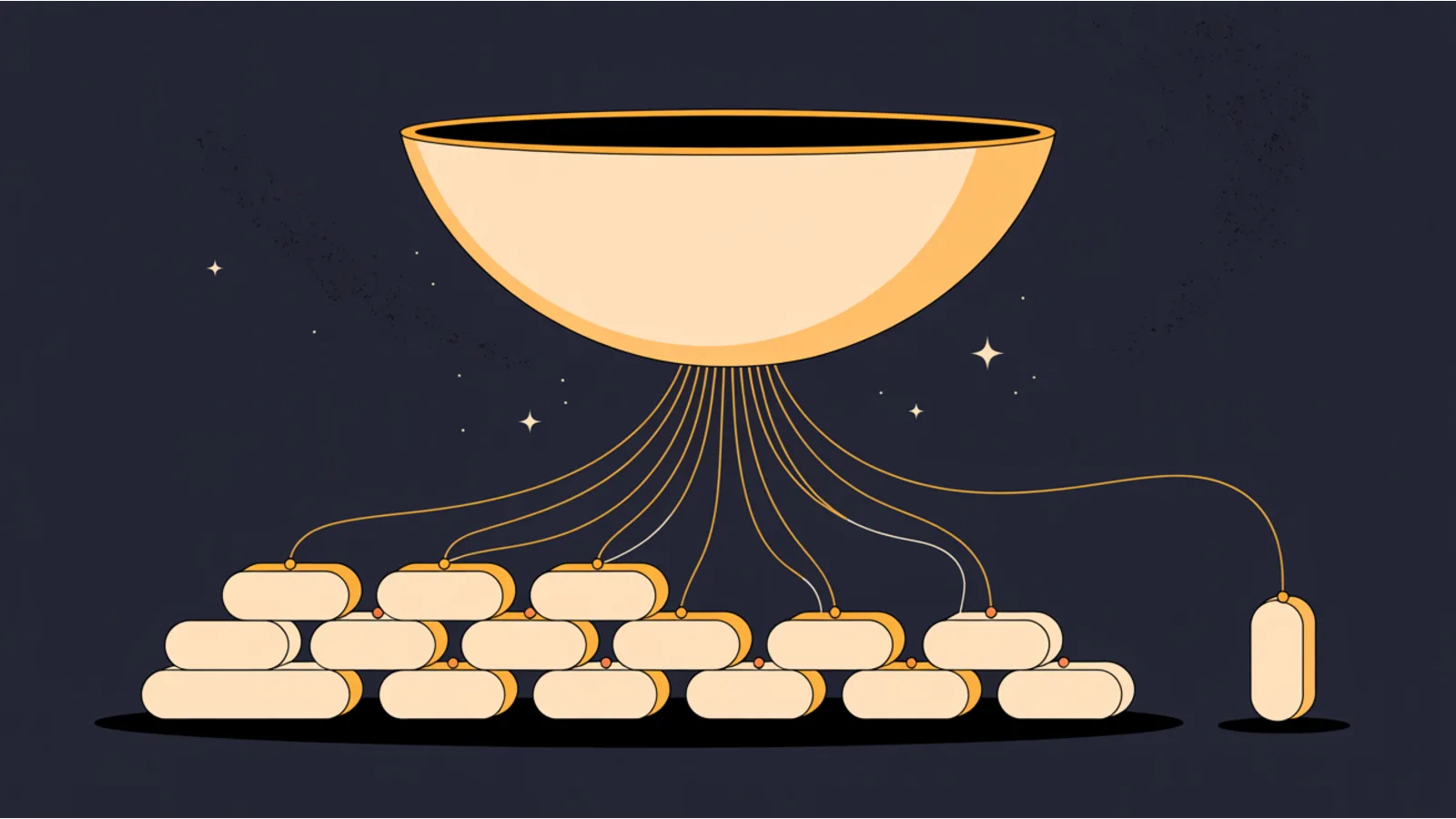
The number everybody prints is 66 percent. Two philanthropic trusts hold roughly two thirds of Tata Sons, the unlisted holding company atop India's largest industrial group, and that is offered as the explanation of who runs Tata. It is the wrong number.
The right number is 40, and it sits in Tata Sons' own Articles of Association. Three articles switch on at that threshold, and the Supreme Court of India reproduced all three when it decided Tata Consultancy Services Limited v. Cyrus Investments Pvt Ltd on 26 March 2021.
The forty percent switch
Article 104B allocates the seats:
So long as the Tata Trusts own and hold in the aggregate at least 40% of the paid up Ordinary share capital, for the time being, of the company, the Sir Dorabji Tata Trust and Sir Ratan Tata Trust, acting jointly, shall have the right to nominate one third of the prevailing number of Directors on the Board and in like manner to remove any such person so appointed and in place of the person so removed, appoint another person as Director.
A third of a board is not control on its own. Article 121 converts it: board business decided by majority needs the affirmative vote of a majority of the Article 104B directors present at the meeting. A third of the seats with a blocking vote welded on.
Article 118 handles the top job, on the same 40 percent condition. A five-member Selection Committee recommends the Chairman: three of the five are trust nominees, the committee's own chairman comes from among them, and quorum needs a majority of them. The same process governs removing an incumbent Chairman, which is the sentence to hold onto if you are trying to understand October 2016. Article 86, on that condition too, requires that quorum at any general meeting include a trust nominee.
So: a third of the board, a veto inside it, three of five seats on the committee that names and unnames the chairman, and a veto over whether a meeting can lawfully begin. None of that is priced at 65. The trusts could sell a quarter of the company and still sit above 40, and every one of those rights stays on. Everything above 40 is philanthropy funding. Control stops at 40.
The article that points the other way
Then the Articles deal with everybody else. Article 75, unchanged since a September 2000 amendment that Cyrus Mistry was a party to, carried unanimously in his presence and with his consent, lets the company "at any time by Special Resolution resolve that any holder of Ordinary shares do transfer his Ordinary shares." The Supreme Court called it "nothing but a provision for an exit option (though one may think of it as an expulsion option)," and declined to strike it down.
So the document that guarantees two charities a permanent third of the board also lets the company vote a minority holder off the register. Not a supervoting class like the Fords', not a loyalty share like the Agnellis', just nomination rights on one side and a forced-sale clause on the other.
The case, and what the court actually decided
The Shapoorji Pallonji group's 18.37 percent is one of the most quoted numbers in Indian business, and for the purpose that mattered it was close to irrelevant. Section 244(1)(a) of the Companies Act 2013 lets an oppression petition be brought by a hundred members, or by a tenth of the members, or by holders of a tenth of the issued share capital. Measured against the issued capital, the two petitioning SP Group companies "together had only around 2% of the total issued share capital of Tata Sons." The judgment states that figure without explaining the gap between it and the 18.37 percent everyone quotes. The tribunal held the petition not maintainable in March 2017 and refused a waiver in April; the appellate tribunal reversed that September, unchallenged. More than four years of litigation rested on that discretion.
Then the part most summaries get backwards. The order reinstating Mistry came from the appellate tribunal in December 2019, not the Supreme Court. On 26 March 2021 the Supreme Court set it aside in full and dismissed the company petition, the SP Group's own appeal, and its application for a separation of ownership. On price it refused to rule: "We will leave it to the parties to take the Article 75 route or any other legally available route in this regard." The clause it had just called an expulsion option is the exit it pointed the minority towards.
The companion claim, that Tata Sons made itself private in 2017 to trap the minority, fails too. The company was incorporated private in 1917, became public only by a statutory fiction imposed in 1975, and lost that status when Parliament deleted the fiction in 2000. The court answered that question in Tata Sons' favour as well.
What sits below the holding company
Tata Sons is usually described as owning the Tata companies. Mostly it does not. At 31 March 2023 it held, with its subsidiaries and joint ventures, 46.32 percent of Tata Motors' Ordinary shares and 7.66 percent of its A Ordinary shares, being 45.74 percent of total voting rights. Under half either way. And apart from one board seat held by Tata Steel, the company told the SEC, "neither Tata Sons nor its subsidiaries have any special contractual or other power to appoint our Directors or management."
What runs alongside the votes is a licence. Under the Tata Brand Equity and Business Promotion Agreement of 18 December 1998, Tata Motors and certain of its subsidiaries pay 0.15 to 0.25 percent of annual net income, capped at 5 percent of profit before tax, for the TATA name and marks. Tata Motors owed Rs 624 million for fiscal 2023. Strip the shareholding away and the group still holds a contract every company in it needs.
Where the pressure is now
Being unlisted is not the same as being exempt. On 30 September 2022 the Reserve Bank of India named Tata Sons Private Limited in its first Upper Layer list under Scale Based Regulation. The 2021 framework was plain: an Upper Layer entity "shall be mandatorily listed within 3 years of identification." That framework has since been replaced by the 2025 Directions, which restate the Rs 1,00,000 crore threshold but carry no equivalent sentence, and the RBI skipped the 2025-26 list entirely while it reviewed the identification criteria. So the clock's position is genuinely unclear, which is the point.
On 6 August 2026 the RBI published a fresh list still naming Tata Sons, footnoted as "without prejudice to the outcome of its application for de-registration, which is under examination." Tata Sons applied to the RBI in the 2023-24 financial year to give up its Core Investment Company registration and continue as an unregistered one, and its own 2025-26 annual report says the application is still under consideration. Business Today puts the company's standalone assets above Rs 2 lakh crore as of March 2026, comfortably past the threshold either way.
Trust law is moving too. The Maharashtra Public Trusts (Amendment) Ordinance of 1 September 2025 defines a perpetual trustee, one appointed for life, and provides that where the deed is silent "the number of perpetual trustees at any point of time in the trust shall not exceed one-fourth of the total number of trustees." It also redirects to the Charity Commissioner every reference to a civil court appearing in a trust deed, scheme, order or decree, including the power to appoint trustees, though that section commences only on a date the state notifies, which I did not find. If the two trusts named in Articles 86, 104B and 118 are registered public trusts in Maharashtra, as their charitable status in the state implies, their supervisor is that commissioner and not a securities board.
And the minority is still trying to leave. Business Today reported in July 2026 that the SP Group carries roughly Rs 60,000 crore of debt and is weighing a swap of about 7 percent of Tata Sons for shares in listed group companies, valuing the whole stake near Rs 3 lakh crore. In December 2020, ThePrint reported the sides arguing Rs 70,000 to 80,000 crore against Rs 1.75 lakh crore. Press estimates, every one.
What the record actually says
Tata Sons is unlisted, but it is not silent. Its annual report is posted publicly, and the 2025-26 edition, the company's 108th, prints a promoter table: Sir Dorabji Tata Trust 27.98 percent, Sir Ratan Tata Trust 23.56, JRD Tata Trust 4.01, Tata Education Trust 3.73, Tata Social Welfare Trust 3.73, RD Tata Trust 2.19, Sarvajanik Seva Trust 0.10, all measured against 4,04,146 ordinary shares. Seven trusts, 65.30 percent. That is the number the two-trust shorthand is standing in for.
Which settles the first of three widely repeated claims. The two flagship trusts do not hold 66 percent between them. Sir Dorabji at 27.98 and Sir Ratan at 23.56 comes to 51.54. The court's 2016-era table says two Tata Trusts, 65.89 percent, and that reconciles only if the five smaller trusts are being counted inside the two flagship names. Any clean two-line ownership table for Tata Sons is flattening seven trusts into two. The company's own promoter table names all seven, and they sum to 65.30 percent.
The share count does the rest of the work. Against 4,04,146 ordinary shares, the SP Group's 74,244 is 18.37 percent, which is exactly the figure the court used, and Ratan Tata's 3,368 shares are 0.83 percent. The same report carries the year's results: revenue of Rs 42,367 crore, profit after tax of Rs 31,961 crore, and a recommended dividend of Rs 1,10,717 per ordinary share.
No Tata individual owns the group either. In the court's table the trusts, the SP Group and the operating companies account for 97.13 percent, the balance held by Ratan Tata and a few others. His own holding was reported at 3,368 shares, left by will to two charitable vehicles he set up rather than to family.
And Mistry was not the second outsider to chair Tata. The judgment counts six chairmen since 1868 and says five of them, Jamshedji Tata, Sir Dorab Tata, Nowroji Saklatwala, JRD Tata and Ratan Tata, "belonged to the same family." That makes Mistry the first outsider in 144 years.
The ledger reading
An earlier piece in this series, Three Empires, No Owners, described Tata the way almost everyone does: charitable trusts own two thirds of the holding company, therefore they control it. The shareholding is right. The causation is not.
This is the Hershey and Wallenberg pattern with a sharper edge. Those rely on a supervoting class. Tata's relies on nomination rights that never dilute, a blocking vote in the boardroom, ownership of the chairman-selection process, and a clause that can vote an unwanted shareholder out. The trusts do not need a majority. They need 40 percent and the drafting.
Which is why the open questions matter. If the RBI holds Tata Sons to a listing requirement, the charity's holding company opens its register to a market that will price those Articles. If Maharashtra's ordinance is fully notified, a state charity regulator gains a hand in appointing the trustees who exercise them. Neither touches the 40 percent line. Both change who stands behind it.
Related reading
- Three Empires, No Owners: the earlier survey this post corrects on the mechanism.
- The Agnelli Chain: the loyalty-share answer to the same problem.
- Two Percent of the Company, Forty Percent of the Vote: a supervoting class doing it with one share class.
- The Candy Fortune That Raises Two Thousand Children: a charitable trust holding a public company.
- The Working Ledgers: the market and the money underneath these structures.
Fact-check notes and sources
- Everything attributed to the judgment: Articles 75, 86, 104B, 118 and 121 as quoted, the 65.89 / 18.37 / 12.87 shareholding table, the Section 244(1)(a) and waiver history, the operative order, the conversion history and the six-chairmen passage, all from the Supreme Court's signed file in TCS v. Cyrus Investments, 26 March 2021, official PDF, also on Indian Kanoon. It also records the SP Group stake as bought in 1965 and worth around Rs 58,441 crore in March 2016 against Rs 69 crore paid.
- Two cautions on it. Article 118 cross-refers to Article 121 as requiring the affirmative vote of all Article 104B directors, while Article 121 as quoted requires a majority of those present; this post follows Article 121's own text. And one oddity worth naming: the judgment gives the date of Mistry's removal as a director as 16.02.2017 in paragraph 2.11 and as 06.02.2017 in nine other places, and paragraph 19.22 misspells Sir Ratan Tata Trust. Both appear in the court's own signed file, not in a database transcription of it, so read paragraph 2.11 with that in mind.
- Tata Sons' own disclosure (the seven-trust promoter table and its percentages, the 4,04,146 ordinary shares, the FY2026 revenue, profit and dividend, and the Core Investment Company surrender application): Tata Sons Private Limited, 108th Annual Report 2025-26. The same tables appear in the 106th Annual Report 2023-24, which is where the surrender application is first recorded.
- The RBI position (the 2022 Upper Layer listing as a Core Investment Company, the three-year listing requirement, the 6 August 2026 list and its footnote, and the Rs 1,00,000 crore threshold): the 2022 press release, the Scale Based Regulation framework, the 2026-27 press release and the 2025 Directions. The three-year sentence belongs to the 2021 framework; the 2025 Directions that replaced it carry no equivalent, and no Upper Layer list was published for 2025-26 while the criteria were under review.
- The operating-company layer (the 46.32, 7.66 and 45.74 percent figures, Tata Steel's seat, and the 1998 brand agreement): Tata Motors, Form 20-F for the year ended 31 March 2023, its last full annual report. The subscription rate quoted is the rate under Tata Motors' own agreement, not a published group-wide schedule. Tata Sons' holding in TCS is not quantified above, since that filing does not cover it.
- The Maharashtra ordinance: Mah. Ord. VII of 2025. Every section except section 5 came into force at once; section 5, which inserts the Charity Commissioner provision, waits on a state notification I could not find. Whether the two flagship trusts are registered under that Act is an inference from their charitable status in the state, not something any source here establishes.
- Reported, not confirmed. Tata Sons' asset size, and the SP Group's debt and proposed swap: Business Today, 6 August 2026 and 17 July 2026. The 2020 valuations: ThePrint. Ratan Tata's 3,368 shares and their bequest under a February 2022 will: Outlook Business, which also records that other parts of the estate go to roughly two dozen individuals, so the point above is about the Tata Sons shares only. Trustee rosters as at August 2026 are unverified. And the founding year of Sir Dorabji Tata Trust is unresolved: the usual date is 1932, the judgment says 1952 in the sentence that correctly dates Sir Ratan Tata Trust to 1919, so neither appears above.
This post is informational and journalistic, describing court records, regulatory publications and public filings. It is not investment, tax, or legal advice, and no affiliation with Tata Sons Private Limited, Tata Trusts, the Shapoorji Pallonji group or any company named is implied. Details are current as of 6 August 2026 and change.
