
Stand in the National Archives Rotunda and look toward the far left of Barry Faulkner's The Declaration. The National Archives dates the mural to 1936 and gives its dimensions as about 14 by 37.5 feet. Its numbered key places 28 men across the canvas. Find No. 2 in the front row, between Robert Morris and Charles Carroll: Samuel Chase. National Archives mural key.
Morris has the financier's story. Carroll has the great fortune and the long life. Chase has a different distinction: the Capitol Visitor Center identifies him as the only Supreme Court justice ever impeached. He was acquitted, not removed. Congress's exhibition.
The painted company makes the founding look settled. Chase's life was not. Before independence, he sold a house he could not finish. After it, accusations about flour trading followed him. On the bench, his political combativeness became a constitutional confrontation.
Even his place in this scene needs explanation. One of Maryland's most forceful advocates for independence was in Annapolis when Congress voted on 2 July 1776 and adopted the Declaration on 4 July. He signed later. The Maryland State Archives makes that distinction explicit. Maryland's account.
The signature survived. So did the bills.
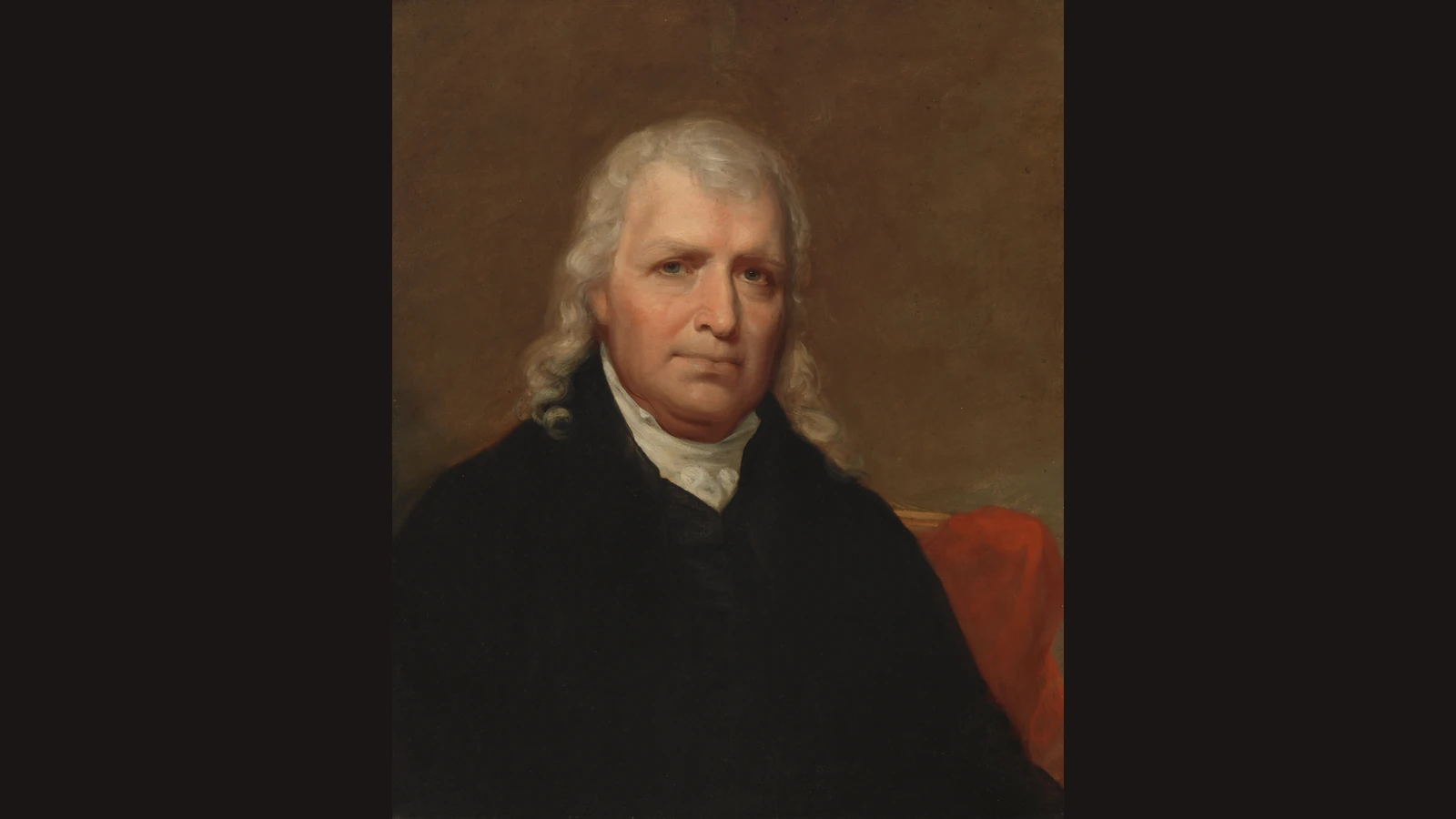
No. 2 in The Rotunda Twenty-Eight. Portrait above: John Wesley Jarvis, Samuel Chase, 1811, oil on wood. National Portrait Gallery, Smithsonian Institution, NPG.67.2, CC0. The full portrait is reproduced against a neutral background, not reconstructed with AI.
A minister's son learns the argument
Chase was born on 17 April 1741, near Princess Anne in Somerset County, Maryland. His father, Thomas, was an Anglican minister. He was educated at home and studied law with John Hall in Annapolis. The State Archives gives his admission to the bar as 1761; the Federal Judicial Center records legal study in 1763. The safe description is that his legal career began in the early 1760s. Biographical profile and judicial record.
Law gave him a profession built on words, clients and judgment. Politics offered a much larger audience. Those two forms of persuasion would become difficult to separate in his career.
He entered Maryland's colonial legislature in 1764, according to the Federal Judicial Center. During the Stamp Act protests of 1765, he became associated with the Sons of Liberty and resistance in Annapolis. The National Park Service's historical biography describes officials denouncing his participation in violent demonstrations. The revolution did not begin for him as a quiet disagreement over paperwork. National Park Service biography.
The house was bigger than the plan
In 1769, Chase began a substantial townhouse in Annapolis. He sold it unfinished to Edward Lloyd IV in 1771. The National Park Service records that he never lived there. Lloyd hired William Buckland to continue the work, which was completed in 1774 with William Noke's assistance. The Park Service's house history.
The name survives as the Chase Lloyd House. But the name compresses two very different roles: the person who started it and the person who could finish it. The present building cannot be read as proof that Chase successfully financed the life it represented.
The Maryland State Archives' longer biography connects the sale to mounting construction costs. That is the useful mechanism, rather than a picturesque story about colonial extravagance. A project can be desirable, well situated and beautifully designed while still exceeding the owner's capacity to carry it. Archives financial biography.
This happened before the Declaration. It cannot be charged to British punishment for signing it. The distinction matters in a series about what independence cost: not every later problem began with the signature, and not every financial wound was inflicted by an enemy.
Selling an unfinished project is also not the same as losing every asset. It can be a painful decision that prevents a larger loss. The record establishes a sale, an uncompleted ambition and a house Chase never occupied. It does not supply a modern construction budget, an inflation adjusted loss or permission to invent either.
The parallel with Morris's unfinished mansion is useful without making the two failures identical. In both stories, the building that outlived the plan became easier to remember than the arithmetic behind it.
Independence reached him by letter
Congress sent Chase to Canada in 1776 with Benjamin Franklin and Charles Carroll; Father John Carroll accompanied them. The effort to draw Canada into the revolutionary cause failed. After returning, Chase worked in Maryland to change instructions that restrained its delegates from supporting independence. Congressional biography and Maryland's account.
Maryland lifted that restriction on 28 June 1776. In his letter to Chase on 1 July 1776, John Adams reported that the convention's favorable vote had arrived by post that morning as Congress entered the debate. That establishes the arrival of the instructions. It does not establish a dramatic horseback delivery by Chase himself. His precise location that day is not settled by the correspondence checked for this article. Adams's letter in Harvard's documentary selection.
For the next two milestones, the record is clearer. The State Archives places Chase in Annapolis on 2 July 1776 and 4 July 1776. The first was the vote for independence; the second was adoption of the Declaration's text. Neither date should be substituted for the later signing of the engrossed parchment. National Archives timeline.
On 5 July 1776, Chase wrote to Adams: "I envy You! How shall I transmit to posterity that I gave my assent?" Harvard's Declaration Resources Project reproduces the passage from their correspondence. His frustration was not opposition. He wanted a visible record of his agreement.
Adams answered on 9 July 1776, reporting the Philadelphia celebration and expecting a later opportunity to subscribe the document. His image of the decision was decisive: "the River is past and the Bridge cutt away." Massachusetts Historical Society transcription.
Chase was in Philadelphia and signed on 2 August 1776, according to the State Archives. The familiar version in which the men in a patriotic painting gather to sign on the Fourth mistakes commemoration for a dated attendance record. Faulkner painted an allegory, not a photograph. Chase helped make the decision possible without being present for its two July milestones.
The risk was still real. Adding his name publicly identified him with the new states. His own letter is revealing: he was worried about leaving his assent outside the record.
The flour did not stay in the warehouse
Chase's business activities extended beyond legal fees. The State Archives lists a West River saltworks, a partnership in John Dorsey and Company, an interest in Nottingham Ironworks, and a Baltimore wharf and lumberyard. These were operating ventures, not simply titles on a memorial. Occupational record.
The dangerous intersection came in August and September 1778. The Archives' financial biography records heavy wheat and flour purchases by his firm while Congress dealt with a shortage in New England. Critics alleged that he had used congressional information for private advantage. Chase maintained that the shortage was common knowledge. His reputation suffered, and he lost his congressional seat in November. Financial biography.
Allegation is the necessary word. A documented purchase and a damaging accusation do not, by themselves, establish a criminal conviction. The evidence checked here also does not justify erasing the accusation as though no genuine conflict existed.
It lasted. The Morgan Library holds John Cadwalader's letter of 1 March 1782, which again discusses the flour charge and opposition to Chase's congressional appointment. The catalogue describes the accusation, not a judicial finding that proved it. That later letter establishes a reputational cost a purchase record alone could not show. Morgan manuscript MA 558.6.
The accounting needs another distinction. On 19 February 1780, Maryland's council ordered £25,000 paid to Chase for John Dorsey and Company on account. That is a contemporary payment authorization, not evidence that Chase personally pocketed £25,000 in profit. The recipient's name, the firm's account and the kind of money involved cannot be collapsed into one sensational number. Council journal.
The uncomfortable entry is not limited to flour. The Archives' estate worksheet records fifteen enslaved people among Chase's personal property at his death in 1811. His insistence on political liberty coexisted with ownership of human beings. Financial difficulty did not make him powerless in relation to the people he enslaved. Both facts belong in his ledger, without turning the inventory's treatment of them as assets into the narrator's own judgment of their worth.
Public influence and private business had become entangled. The damage was not only whether a transaction made money. It was whether colleagues and constituents could trust the boundary between the office and its holder.
The robe did not end the argument
Chase opposed ratification of the federal Constitution in 1788, then became a Federalist. His state criminal and general court appointments preceded his federal service. Washington nominated him to the Supreme Court on 26 January 1796. The Senate confirmed him the following day. A lawyer who had fought the new framework now held office within it. Maryland's portrait history and Federal Judicial Center.
Judicial office did not mean remaining in Washington. The Judicial Center records his circuit assignments as well as his Supreme Court service. That matters because the conduct challenged in his impeachment arose largely while he was presiding over trials and addressing grand juries away from the Supreme Court itself.
The disputes included his handling of the John Fries and James Callender proceedings in 1800 and a later Maryland grand jury address. They had nothing to do with his absence from the July independence votes. They concerned the way he exercised judicial authority decades afterward. Congressional account.
The House impeached him on 12 March 1804. Its accusations included limiting defense witnesses and refusing to dismiss biased jurors. The final article attacked his use of the bench for partisan politics. Chase argued that his political convictions, rather than an impeachable offense, were on trial. Senate history.
The trial began in earnest on 4 February 1805. On 1 March 1805, the Senate acquitted him on all eight articles. Its history notes that three attracted guilty votes from a majority, but none reached the required two thirds. Acquittal did not mean unanimous approval of his behavior.
The limit of the verdict matters. The outcome became a landmark against using impeachment simply to displace an objectionable judge. It did not confer permission to behave without restraint. Nor was a Senate verdict a Supreme Court opinion granting every later justice immunity from impeachment. Federal Judicial Center's discussion.
The institution survived a test that its participant had helped provoke. That is different from saying his temperament was the model the institution needed.
The cost was not one British bill
Chase's losses do not fit the familiar account in which signing the Declaration directly causes every misfortune that follows. His unfinished house preceded independence. The flour controversy arose from his own commercial involvement. The impeachment concerned his judicial conduct. Each deserves its own date and cause.
The cost of the courtroom conflict was also different from removal. He faced a public trial at sixty three, but retained his office. The Senate's acquittal preserved his place on the Court; it could not turn the disputed conduct into an uncontested reputation. Senate trial history.
His Supreme Court service continued until his death. It is misleading to end the life at the moment an accusation makes the best anecdote. The service record shows continued public responsibility, rather than a simple descent from patriot to outcast.
He died on 19 June 1811, in Baltimore according to the Judicial Center, and was buried in Old St. Paul's cemetery there. Other institutional biographies give Washington as his place of death. That disagreement is recorded below rather than silently harmonized. The date and Baltimore burial are consistent across the accounts checked. Judicial record and State Archives profile.
The Archives' worksheet values his personal property, including its appraised value for enslaved people, at $14,866.01. About 2,500 acres and Baltimore lots are listed separately. Its narrative says debts exceeded personal property; the worksheet uses the broader word estate. Those are not interchangeable totals. Without reconciling the underlying probate accounts, the defensible conclusion is serious debt at death, not a precise negative net worth. Estate record and its internal discrepancy.
The dollar figure is historical, not a modern valuation. The acres are not cash. A career's prestige is neither. That is why an honest ending needs more than either died rich or died broke.
Where the record still has his name
Back at the mural, Chase stands within the far left group. Lester Gorelic's study for the National Archives interprets Morris, Chase and Carroll as men associated with work for independence behind the scenes. The Canada mission helps explain the Maryland pair. That is an interpretation of Faulkner's arrangement, not evidence that the three shared every committee assignment. No distinctive Chase prop or costume symbolism is established in the checked key. Gorelic's mural study.
He also appears in John Trumbull's Declaration of Independence in the Capitol, according to the Smithsonian's portrait catalogue. That is a separate painting in a different Rotunda. The Architect of the Capitol explains that Trumbull represented presentation of the draft, not the August signing, and deliberately included some men absent from the depicted event. Smithsonian catalogue and Architect of the Capitol.
Annapolis preserves the house bearing Chase's name, though its completion belonged to another owner. Baltimore holds his grave. The National Portrait Gallery holds Jarvis's 1811 portrait, reproduced here; display arrangements can change, so check its catalogue before visiting. A collection record is not a promise that a visitor will find it hanging that day. Portrait record.
The second of the seven ledger laws gives this life its practical ending: Carrying costs are senior to your plans. The unfinished house is the clearest example. An owner's ambitions cannot order construction expenses to wait for a better year.
That does not reduce his public service to a failed property investment. It keeps the two ledgers visible. Winning an argument, keeping an office and meeting a financial obligation are different outcomes. Success at one is not payment for the others.
I wrote about that mismatch between a custom building and the owner's capacity to finish it in The Resale Trap. Chase's example adds a warning about the prestige surrounding the project: a name can survive on a building even when its original plan did not.
Look again at No. 2. His place on Faulkner's wall is secure. The painting does not have to pay for the life it commemorates.
Reputation can wait for a portrait. Creditors cannot.
Related reading
- Robert Morris: The Founding Father in the Capitol Dome Nobody Can Name: the neighboring figure whose financial collapse started this investigation.
- The Rotunda Twenty-Eight: the numbered series directory, with unpublished lives clearly marked.
- James Wilson Drafted the Constitution and Died Hiding From His Creditors: another founding justice with a damaged personal balance sheet.
- Henry Knox: a different grand building and a different set of obligations.
- The Ledger Lessons: the seven principles used to compare these lives without pretending their endings were identical.
Download the finished article as Markdown or the source and uncertainty ledger.
Fact-check notes and sources
- Mural and other portraits: National Archives numbered key, Gorelic in Prologue, Trumbull catalogue, and Jarvis portrait, NPG.67.2. The Smithsonian designates the portrait CC0; the reproduction was obtained from its public domain Commons copy. No AI portrait or invented mural detail was used.
- Early life, house and occupations: Maryland profile, financial biography, and the National Park Service's 1973 Signers of the Declaration. Maryland dates admission to 1761; the Judicial Center's education entry says legal study in 1763. These are not identical descriptions, and no exact admission day is invented.
- 1776 whereabouts and quotations: Maryland's signing account, Harvard's selection of delegates' letters, and Adams to Chase, 9 July 1776. The July 1 horseback delivery was not established. July 2 and July 4 were not his signing date.
- Flour and finance: Cadwalader's 1782 letter, Council journal, 19 February 1780, and the Archives' estate worksheet. The £25,000 order, fifteen enslaved people, $14,866.01 valuation and acreage each rest on the specific cited record, not an independent reconstruction. Payment, profit, personal property and total estate are kept separate.
- Court, acquittal and death: Federal Judicial Center, Senate trial history, Capitol Visitor Center, and Congressional biography. The last gives Washington, rather than Baltimore, as the death location. The narrative attributes Baltimore to the Judicial Center instead of concealing that conflict.
- Claims declined: no criminal flour conviction, audited negative net worth, verified bankruptcy filing in 1788, or documented July 1 ride is asserted. The proposed 16 January 1782 legislative clearance was not independently established in this pass and is neither repeated nor declared false. The judicial acquittal is not described as unanimous approval or permanent immunity.
This post is informational, not financial advice. Historical claims are cited above; institutions and publications are mentioned as nominative fair use with no affiliation implied.

