There are four realistic paths. An existing chain's token fits an application that needs a transferable asset. A launchpad such as pump.fun fits a speculative collectible. An app chain or rollup fits a team that needs control over execution and fees. A true client fork fits protocol engineers prepared to operate a new network. The legal reality is that publishing code, selling an asset, transmitting customers' money and operating a derivatives market are different activities with different rules.
“That the chance of gain is naturally overvalued, we may learn from the universal success of lotteries.”
Adam Smith, The Wealth of Nations, Book I, Chapter X, public domain text.
This is informational, not legal, tax or investment advice. Sources were checked on November 1, 2026. A price is a published component price, before US sales tax where applicable, unless stated otherwise. It is never a promise that the whole venture can be built for that amount.
The old printing press made banknotes cheap to reproduce. It could not make the issuing bank sound. During America's free banking era, merchants had to establish which private notes their bank would accept and at what discount. A Federal Reserve historical study describes that extra cost of doing business. A new blockchain inherits a similar problem: strangers must decide whether its promises, redemption arrangements and trading markets deserve their money.
First, decide what you are actually building
Terms. A blockchain is a shared transaction record whose participating computers agree on updates. A coin is native to its chain; a token is an asset recorded on an existing chain. A validator helps agree on valid transactions. Consensus is that agreement procedure. Proof of work uses computational work; proof of stake uses validators' committed assets. A smart contract is a program executed by the network. An app chain has rules chosen for an application. A rollup executes transactions separately and settles results on another chain. Its sequencer orders transactions. A bridge moves assets or messages between networks, introducing another security dependency.
Creating a token leaves consensus to the host network. Creating a rollup adds infrastructure and bridge responsibilities. Forking a client means maintaining your own version of the software that network participants run. Copying a repository does not copy its users, miners, validators, exchange connections or credibility. A code fork also differs from a contested split of an existing chain's transaction history.
The upside is concrete when a product needs it: application access rights, control over transaction rules, or fee income from real usage. The treasury's ability to sell depends on buyers and available liquidity.
The invoice starts after the download
OpenZeppelin's ERC20 example creates balances and transfer rules inside an existing chain. Your team needs contract and key management skills. You do not recruit a validator network. There is no universal dollar deployment price: gas varies, and liquidity, legal work and security review are separate bills.
Scroll to compare columns and rows when the table extends beyond the box.
| Framework | What the operator takes on | Published cost boundary |
|---|---|---|
| OP Stack | Execution and consensus clients, batcher, proposer and challenger; intermediate Ethereum tooling and Docker knowledge | MIT licensed core; no complete production budget |
| Arbitrum Orbit | Dedicated chain, gas token and data availability choices | Expansion Program charges 10% of net protocol revenue, defined as gross revenue less settlement costs |
| ZK Stack | Rust and Foundry tooling; additional production operations beyond the local example | No complete price; the example's history disappears when stopped |
| Avalanche L1 | Your validator arrangements and servers | About 1.33 AVAX per validator per month at the documented baseline; dynamic, plus hosting |
| Cosmos SDK | Modules, consensus integration and Go development | Core is Apache licensed; enterprise modules have separate production licensing |
| Polygon CDK | Bespoke institutional chain and Agglayer connection | Contact provider; current documentation describes a bespoke product |
The Avalanche baseline assumes fewer than the documented target of 10,000 L1 validators; fees can increase. Arbitrum's revenue definition does not deduct every staffing or hosting expense.
Conduit publishes a $250 monthly Trial Testnet and advertises deployment in 15 minutes. Mainnet Growth and Pro prices require a quote, plus 5% of sequencer profit. Production still needs a separate budget. Provider and applicable framework revenue shares can both apply, alongside settlement, data availability, proving, RPC access, indexing and staff costs. Caldera and Gelato describe managed rollups without publishing a numeric mainnet price on those pages. Their deployment claims describe provisioning. Production readiness requires additional work.
For a concrete hosting reference, DigitalOcean lists a Basic Regular server with 16 GiB memory, eight shared virtual CPUs and 320 GiB storage at $96 per month before tax. Size the server for the chosen chain. Redundancy, disk growth, monitoring and operators still need sizing. Most specialist audits require quotes; OpenZeppelin and Trail of Bits publish no fixed audit price on these service pages.
A true fork changes a blockchain client's code and maintains the resulting network. Bitcoin Core permits reuse under MIT, but explicitly calls testing and review its development bottleneck. Its build requirements include C++ tools. The download provides neither miners nor customers. No cited project promises a complete public fork in a specified number of days.
The US rules on November 1, 2026
The SEC's starting point remains Howey: an investment of money in a common enterprise with an expectation of profits from other people's essential managerial efforts. Its March 17, 2026 interpretation, effective March 23, separates the asset from the investment contract around its sale. Digital commodities, collectibles and tools can be nonsecurity assets while their fundraising transactions involve securities. Stablecoins and digital securities receive separate treatment. SEC interpretation.
The February 27, 2025 meme coin statement was a nonbinding staff view. The later Commission interpretation expressly supersedes earlier statements on these topics and describes ordinary meme coins as collectibles driven by entertainment, culture and supply and demand. A sale financing promised development requires a different analysis of buyers' reliance on the promoter. Calling it a meme does not settle that question. The interpretation also discusses mining, staking, airdrops and wrapping; those fact specific treatments are no general fundraising exemption. Interpretation and its account of the earlier statement.
The SEC's August 18, 2026 Regulation Crypto Assets remains a proposal in the current official docket checked for this article. Its proposed issuance exemptions cannot be used as enacted permission. An actual September 17 innovation exemption concerns certain venues and liquidity providers trading tokenized NMS stocks, meaning stocks in the national market system. Its scope does not cover an ordinary new coin offering. Proposal, adopted order.
The CFTC regulates commodity derivatives and certain financed retail commodity transactions, and enforces fraud and manipulation prohibitions in commodity cash markets. A derivative is a contract whose value depends on another asset or outcome. In December 2025, the agency announced listed spot crypto trading on registered futures exchanges under existing authority. Its October 13, 2026 notice seeks comment on additional rules; that notice itself creates no blanket licensing regime. There is no general CFTC approval to obtain simply to launch a token. CFTC announcement, October notice.
CLARITY, H.R. 3633 in the 119th Congress, remains pending in the Senate. The official bill record read today shows a Senate committee substitute reported June 1, 2026, then a failed September 15 cloture vote on proceeding, 49 to 50. Its latest action is reconsideration of that vote; the bill remains unenacted. We found no verified enacted successor that would justify treating its proposed digital commodity regime as operative. Library of Congress bill record, Congressional Record.
GENIUS is enacted. S. 1582 became Public Law 119-27 on July 18, 2025. It establishes a permitted payment stablecoin issuer regime with reserves, redemption, disclosure and supervision requirements. The OCC's October 21, 2026 final-rule bulletin states that the Act and its rule take effect January 18, 2027. A dollar peg alone supplies none of these permissions. Statute, OCC bulletin.
Other obligations survive a nonsecurity classification:
- FinCEN: FIN-2019-G001, May 9, 2019, distinguishes creating software from accepting and transmitting value through it. Operating an exchange, administering convertible currency or transmitting customer funds can trigger money transmitter and Bank Secrecy Act obligations. Guidance.
- State licensing: check each relevant state's rules independently. New York's virtual currency business regime is 23 NYCRR Part 200, known as BitLicense. The state's own oversight report describes the licensing requirement. Do not assume federal treatment eliminates it. New York State Comptroller.
- OFAC: sanctions obligations apply to virtual and ordinary currency alike. Screening wallet addresses is only part of a risk based program; prohibited persons and transactions still matter. Treasury guidance.
- IRS: covered brokers report 2025 transactions on Form 1099-DA in 2026. Basis reporting starts with specified covered assets acquired from 2026, rather than every transferred asset. Public Law 119-5, approved April 10, 2025, repealed the separate DeFi broker rule; taxes and custodial broker reporting survive. IRS timing, instructions, repeal.
Manipulative wash trading and pump and dump schemes are illegal. Fraudulently concealing insider allocations while misleading public buyers is illegal. So is offering securities without required registration or a valid exemption. “Unregistered” alone does not mean unlawful, because lawful exemptions exist. Market making cannot excuse fabricated trading. Commodity Exchange Act, Securities Act, CFTC warning.
Getting a market open
The practical order is permissionless markets first, exchange review afterward. Uniswap allows new pools without a listing committee. Raydium says a pool is live once its creation transaction confirms; indexing can lag. Its guide suggests about 0.2 SOL for creation related costs, with liquidity additional. A wholly new native chain still needs compatible exchange infrastructure or a supported bridge. Copying a client does not make its coin appear in Ethereum pools.
Kraken charges no evaluation or listing fee, but optional integration and promotional services are separate. It aims to respond within two weeks and says listing generally takes 2 to 6 weeks after provisional acceptance. Neither is a guarantee. Unsupported chains can take longer because gateways and nodes must be built. Binance.US requires due diligence and publishes no standard fee or completion deadline on its listing page. No comparable published guarantees establish which centralized exchange is fastest.
Liquidity means enough assets or orders to absorb a trade. Thin pools move sharply when somebody sells. Market makers quote both sides while managing inventory risk; their presence cannot manufacture honest demand.
What pump.fun changes
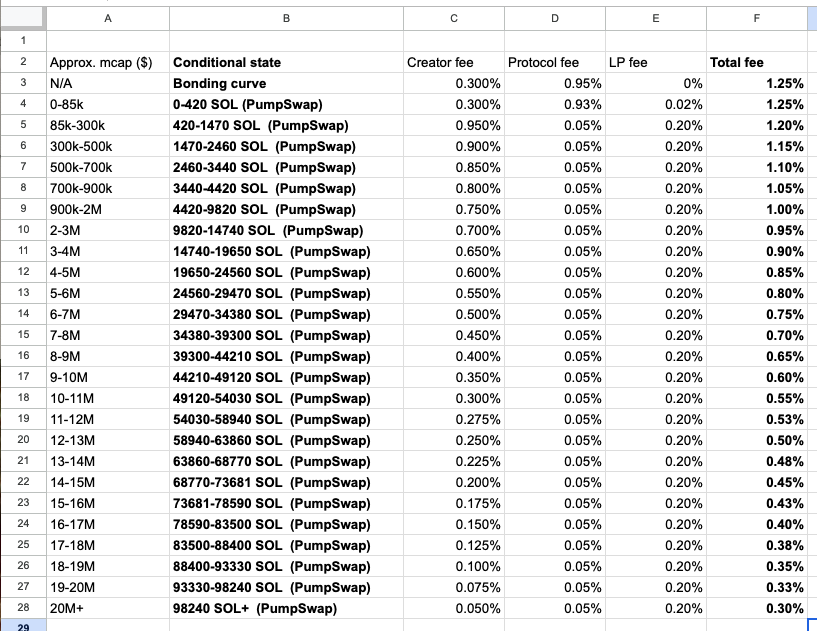
Pump's program documentation describes immediate Solana token trading against a bonding curve, a formula relating reserves to price, without creator liquidity seeding. When the curve's sale inventory is exhausted, graduation moves liquidity to PumpSwap and burns the resulting liquidity ownership tokens. Its published schedule shows 1.25% on curve trades, split into 0.30% creator and 0.95% protocol fees. Canonical PumpSwap rates vary by market capitalization, from 1.25% in the lowest band to 0.30% in the highest published band. Fee documentation says the onchain configuration determines tiers. Current creation and migration fees, retail terms and US eligibility remain unverified here; check them before using the service.
Solidus Labs studied more than 7 million Pump tokens with at least five trades from January 2024 through March 2025. Its method classified 98.6% below $1,000 of SOL valued liquidity after excluding tokens migrated to Raydium. That historical liquidity measure is neither your probability of losing money nor proof that every unsuccessful coin was criminal. It does show why making a coin tradeable is a very different achievement from sustaining a market. Smith's lottery passage makes a narrower, still useful point: enthusiasm for a possible prize can overwhelm attention to its cost. The analogy concerns buyer psychology; it does not establish the legal classification of a token.
Polymarket shows what CFTC involvement buys
A prediction market trades positions on outcomes. Polymarket's international platform settles on Polygon. Its American exchange is a separate regulated business with its own clearing arrangements; the international platform still prohibits US trading. Do not assume both systems use the same settlement machinery. Official status, company disclosure.
The relevant sequence is more demanding than obtaining a token listing:
Scroll to compare columns and rows when the table extends beyond the box.
| Date | Verified step and its meaning |
|---|---|
| January 3, 2022 | The CFTC imposed a $1.4 million penalty for offering event based binary options without required DCM designation or SEF registration. Its order required noncompliant markets and access to end by January 14, with funds available for redemption. The order allowed future activity complying with the law. Release, order |
| December 16, 2024 and July 9, 2025 | QC Clearing obtained clearinghouse registration, then QCX obtained designated contract market status. A DCM is a federally regulated derivatives exchange; a clearinghouse manages settlement and contractual obligations. Clearing registry, designation |
| July 21, 2025 | Polymarket announced acquiring their parent, QCEX, for $112 million. That figure is an acquisition price, not a government application charge. Company announcement |
| September 2, 2025 | Staff Letter 25-28 gave conditional relief from specified reporting requirements. A staff promise not to recommend enforcement under stated conditions is narrower than blanket Commission approval. Letter |
| November 24, 2025 | An amended designation allowed futures commission merchant intermediation, meaning customers could access the exchange through regulated brokers. Amended order |
| December 3 and 11, 2025 | The company announced its US app rollout to waitlisted customers on December 3, initially for sports. December 11 Letter 25-48 revised the earlier reporting relief for intermediated clearing. Launch announcement, letter |
| November 1, 2026 observation | The US service displays sports and political markets and identifies QCX as its regulated exchange. Its continuing obligations and separate international restrictions remain. US service, exchange |
The time cost is visible in the records. QCX's application submissions ran from June 2022 through June 2025 before designation in July. Kalshi's submissions ran from December 2019 through September 2020; designation followed on November 3, 2020. These case histories establish no promised turnaround time. Neither provides a published standard budget for launching your own regulated exchange. QCX order, Kalshi order.
Kalshi still had to litigate election contracts. A federal district court overturned the CFTC's congressional control contract prohibition in September 2024; the appeal was dismissed May 7, 2025. The CFTC recounts that history in its June 2026 prediction-market proposal. That decision concerns those contracts; the current rulemaking record still identifies a proposal. Registration supplies a regulated venue with surveillance and operating duties. It does not approve every future contract, guarantee returns or grant an ordinary token issuer permission to raise money. CFTC account of the case.
A separate interim final rule effective October 19, 2026 excludes qualifying state or tribal licensed sportsbook and casino wagers from the swap definition. It requires, among other conditions, licensed activity within scope and no multilateral trading or individual negotiation. It does not authorize an unlicensed blockchain bookmaker. The rule also discusses continuing state and tribal disputes over sports event contracts. CFTC rule.
Why earlier ideas did not become the next large market
Wagerr: separate the token launch from the betting launch. Token data dates WGR to 2017; the company announced live blockchain betting on September 15, 2018. Token history supplies the earlier date. Its design burned wagers and minted payouts. The company reported more than 400,000 WGR wagered during its first weekend, an unaudited company figure. Company release.
CoinCodex records a $1.03 high on January 10, 2018. Its October 31 to November 1, 2026 row shows a $0.001614 close and $21.73 exchange volume. Exchange turnover measures something different from sports wagers or people. We could not verify current betting participation or a reliable causal postmortem. Attributing Wagerr's trajectory to a specific regulator, competitor or abandoned feature would invent the missing chapter. Token history, dated trading data.
Augur: launched on Ethereum in 2018, with v2 in July 2020. The project's release notes document gas fee confusion, orderbook fixes and interface problems. Its 2026 fork record reports about 6.398 million REP migrated to the winning branch, expressly warning that token totals cannot count people. It also documents wallet discovery and exchange support problems. Project history, v2 record, release notes, fork record.
Augur's Lituus oracle work remains under development. An oracle supplies outside information to a contract, such as a match result. Its dispute process must handle ambiguity and dishonest reporting. The project's own current discussion treats these as engineering problems. Calling Augur dead would erase the work visible in its records.
Gnosis: its own history says prediction markets needed infrastructure that did not yet exist, leading it to build that infrastructure. Its 2024 account identifies limited liquidity and too few informed participants as obstacles. This is a documented change of business direction, rather than disappearance. Project history, liquidity discussion.
Our inference from these cases is modest: useful trading needs counterparties, understandable interfaces and credible resolution of disputes. Running a ledger addresses only part of that work. We have no comparable dataset establishing a single cause of failure across these projects.
The established chains already have the difficult part
These are established large networks and major Ethereum rollups, selected for comparison rather than presented as a complete ranking. Launch year means initial production operation. Purposes describe common applications; their activity shares were not measured.
TVL, total value locked, estimates the dollar value deposited in the DeFi protocols the provider tracks. Stablecoin supply measures the dollar value of circulating dollar pegged tokens on a chain. These can overlap, so never add the columns. Native staking is excluded from DefiLlama's chain TVL; coverage and token prices affect the totals. Bitcoin's second figure is instead BTC market capitalization, price multiplied by circulating supply, because that stablecoin dataset supplied no Bitcoin row. Definitions.
Dollar values below were read November 1, 2026 at 21:18 UTC from DefiLlama chain TVL and stablecoin supply, rounded here. Bitcoin capitalization was read at 21:19 UTC from CoinGecko. These provider snapshots carry no independent audit assurance.
Scroll to compare columns and rows when the table extends beyond the box.
| Network and launch | Consensus or settlement model | Common purpose | DeFi TVL | Dollar stablecoin supply, except BTC cap |
|---|---|---|---|---|
| Bitcoin, 2009 | Proof of work | Monetary transfer and holding | $6.15 billion | BTC cap: $1.565 trillion |
| Ethereum, 2015 | Proof of stake | Contracts, DeFi and rollup settlement | $44.00 billion | $139.65 billion |
| Solana, 2020 | Stake based; Alpenglow consensus | Trading, payments and applications | $5.39 billion | $15.05 billion |
| BNB Smart Chain, 2020 | Proof of staked authority | Contracts and DeFi | $5.25 billion | $13.08 billion |
| XRP Ledger, 2012 | Trusted validator consensus, without mining | Payments and issued assets | $318.56 million | $790.67 million |
| Tron, 2018 | Delegated proof of stake | Stablecoin transfers and contracts | $5.37 billion | $93.80 billion |
| Cardano, 2017 | Ouroboros proof of stake | Contracts and native assets | $53.83 million | $63.36 million |
| Avalanche, 2020 | Stake based Snowman consensus | Contracts and dedicated chains | $583.83 million | $1.28 billion |
| Base, 2023 | Sequencer and proofs settling on Ethereum | Payments and applications | $5.96 billion | $5.13 billion |
| Arbitrum One, 2021 | Rollup settling on Ethereum | DeFi and applications | $1.44 billion | $3.59 billion |
| OP Mainnet, 2021 | Optimistic rollup settling on Ethereum | Contracts and applications | $411.08 million | $437.91 million |
A rollup's sequencer orders transactions; the settlement and proof systems supply other parts of its security. Calling every row simply proof of stake would hide that difference. Likewise, BNB Smart Chain's launch date does not date every chain or asset ever bearing the BNB name.
Neither TVL nor stablecoin supply counts customers, measures revenue or proves decentralization. A large market capitalization is no promise that holders could collectively sell for that amount. These figures show the scale of infrastructure and capital a newcomer faces. They provide no forecast that another chain will win a fraction of it.
Adjusted exposure: what can you lose, owe or have to repair?
Here, exposure means the money, operating obligations and possible legal liability you take on. The comparisons are qualitative. No defensible common dataset lets us turn them into a risk adjusted return forecast.
Scroll to compare columns and rows when the table extends beyond the box.
| Path | Up front cost | Time to first trade | Technical risk | Legal and regulatory exposure | Buyer financial exposure | What can go wrong |
|---|---|---|---|---|---|---|
| Token on an existing chain | Variable network fees; engineering, audit and liquidity total not published | After deployment and a funded pool; no universal promised time | Contract permissions, bugs and host chain dependencies | Offering structure, marketing, custody and transmission determine duties | Price collapse, concentrated ownership, limited exits | Administrator compromise or liquidity withdrawal |
| Launchpad memecoin | Creation charge unverified; later graduation charge conditional; trading fees above | Curve trading after launch if available to the user; no guaranteed sale | Platform contracts, wallet security and platform changes | Meme label gives no immunity from fraud or disguised securities offerings | Speculation, fees, slippage and loss of the entire purchase | Attention disappears before a seller can exit |
| App chain or rollup | Production service quote; infrastructure, settlement and security costs extra | Network, bridge and trading application must work first; no published production schedule | Sequencer, proofs, bridge and upgrade keys | All relevant token rules plus operating activities | Token loss plus bridge or withdrawal failure | Operators stop, keys fail or bridge funds are lost |
| True client fork | Software licence may permit copying; complete production cost not published | Network security and exchange integration first; no published schedule | Consensus changes, weak security participation and maintenance divergence | A new ledger changes none of the offering or business obligations | Thin markets and network attacks | No independent operators or usable exchange route |
Four illustrations for ordinary decisions
Illustration: a hobbyist with a joke coin. A launchpad or a simple existing chain token fits the experiment better than operating a chain. Check availability, platform terms, truthful allocation disclosures and the securities analysis if money funds promised development. Set an amount you can afford to lose. The honest downside is that even an honest joke may leave buyers unable to sell.
Illustration: a small business with loyalty points. Start by asking why points need public trading. A conventional customer database may satisfy the entire need. If transferability earns its keep, an existing chain token avoids operating consensus. Check consumer promises, redemption, privacy, tax and any money transmission activity. A customer should not need to understand a bridge to redeem a sandwich.
Illustration: a game studio. Prototype on an existing network. Consider an app chain only when control over execution or fees solves a measured problem. Budget for the operational components in the framework documentation, then obtain security and legal quotes. The downside is an additional live service whose outage can strand a player's assets even when the game server works.
Illustration: a nonprofit taking donations. Receiving established crypto assets ordinarily does not require issuing a new token. Establish wallet controls, sanctions procedures, valuation records and a conversion policy. Review charitable receipt and tax requirements with a qualified adviser. The downside is custody and price risk; a new charity coin adds liquidity and offering questions without making the donation more charitable.
The discipline behind The $97 Launch applies here: establish what a customer needs before paying to build the machinery around it. A working service gives a chain a reason to exist.
Related reading
Our Crypto Wars history follows the dispute over publishing encryption. Freedom to publish software does not resolve the rules for selling financial products. The Blockchain Stack Generator article and Blockchain Visualizer article introduce the separate infrastructure layers. The Crypto Wallet Quantum Risk Audit article is related wallet reading. Our stablecoin business article provides another perspective on issuers. Use the older posts for background and the current primary sources below for legal and pricing claims.
Fact-check notes and sources
All sources below were read November 1, 2026. Times are UTC. Product claims are attributed to their publishers; hypothetical examples and comparative judgments are ours.
-
public domain text, 21:19.
-
Federal Reserve historical study, 21:19.
-
ERC20 example, 21:19.
-
OP Stack, 21:19.
-
MIT licensed core, 21:20.
-
Arbitrum Orbit, 21:20.
-
Expansion Program, 21:19.
-
ZK Stack, 21:19.
-
Avalanche L1, 21:18.
-
Cosmos SDK, 21:19.
-
Go development, 21:19.
-
Apache licensed, 21:20.
-
Polygon CDK, 21:19.
-
Conduit, 21:18.
-
Caldera, 21:19.
-
Gelato, 21:19.
-
DigitalOcean, 21:18.
-
OpenZeppelin, 21:19.
-
Trail of Bits, 21:20.
-
Bitcoin Core, 21:19.
-
build requirements, 21:19.
-
SEC interpretation, 21:17.
-
Proposal, 21:17.
-
adopted order, 21:19.
-
CFTC announcement, 21:16.
-
October notice, 21:17.
-
Library of Congress bill record, 21:22.
-
Congressional Record, 21:20.
-
Statute, 21:16.
-
OCC bulletin, 21:19.
-
Guidance, 21:19.
-
New York State Comptroller, 21:23.
-
Treasury guidance, 21:16.
-
IRS timing, 21:16.
-
instructions, 21:16.
-
repeal, 21:20.
-
Commodity Exchange Act, 21:19.
-
Securities Act, 21:19.
-
CFTC warning, 21:16.
-
Uniswap, 21:19.
-
Raydium, 21:19.
-
Kraken, 21:18.
-
Binance.US, 21:18.
-
program documentation, 21:18.
-
published schedule, 21:19.
-
Fee documentation, 21:18.
-
Solidus Labs, 21:18.
-
Official status, 21:19.
-
company disclosure, 21:21.
-
Release, 21:19.
-
order, 21:20.
-
Clearing registry, 21:21.
-
designation, 21:21.
-
Company announcement, 21:19.
-
Letter, 21:19.
-
Amended order, 21:19.
-
Launch announcement, 21:20.
-
letter, 21:19.
-
US service, 21:19.
-
exchange, 21:20.
-
Kalshi order, 21:21.
-
CFTC account of the case, 21:20.
-
CFTC rule, 21:25.
-
Company release, 21:19.
-
Token history, 21:19.
-
dated trading data, 21:19.
-
Project history, 21:19.
-
v2 record, 21:20.
-
release notes, 21:20.
-
fork record, 21:20.
-
Project history, 21:20.
-
liquidity discussion, 21:19.
-
Definitions, 21:19.
-
DefiLlama chain TVL, 21:18.
-
stablecoin supply, 21:18.
-
CoinGecko, 21:19.
-
Bitcoin, 2009, 21:19.
-
Ethereum, 2015, 21:19.
-
Proof of stake, 21:19.
-
Solana, 2020, 21:25.
-
Alpenglow consensus, 21:25.
-
BNB Smart Chain, 2020, 21:19.
-
Proof of staked authority, 21:19.
-
XRP Ledger, 2012, 21:19.
-
Trusted validator consensus, 21:19.
-
Tron, 2018, 21:22.
-
Delegated proof of stake, 21:19.
-
Cardano, 2017, 21:19.
-
Avalanche, 2020, 21:19.
-
Stake based Snowman consensus, 21:19.
-
Base, 2023, 21:20.
-
Arbitrum One, 2021, 21:20.
-
OP Mainnet, 2021, 21:19.
-
The $97 Launch, 21:27.
-
Crypto Wars history, 21:27.
-
Blockchain Visualizer article, 21:27.
-
stablecoin business article, 21:27.
-
Current SEC docket, 21:23.
-
Current CFTC docket, 21:25.
This post is informational, not legal, tax or financial advice. Mentions of third parties are nominative fair use. No affiliation or endorsement is implied.