
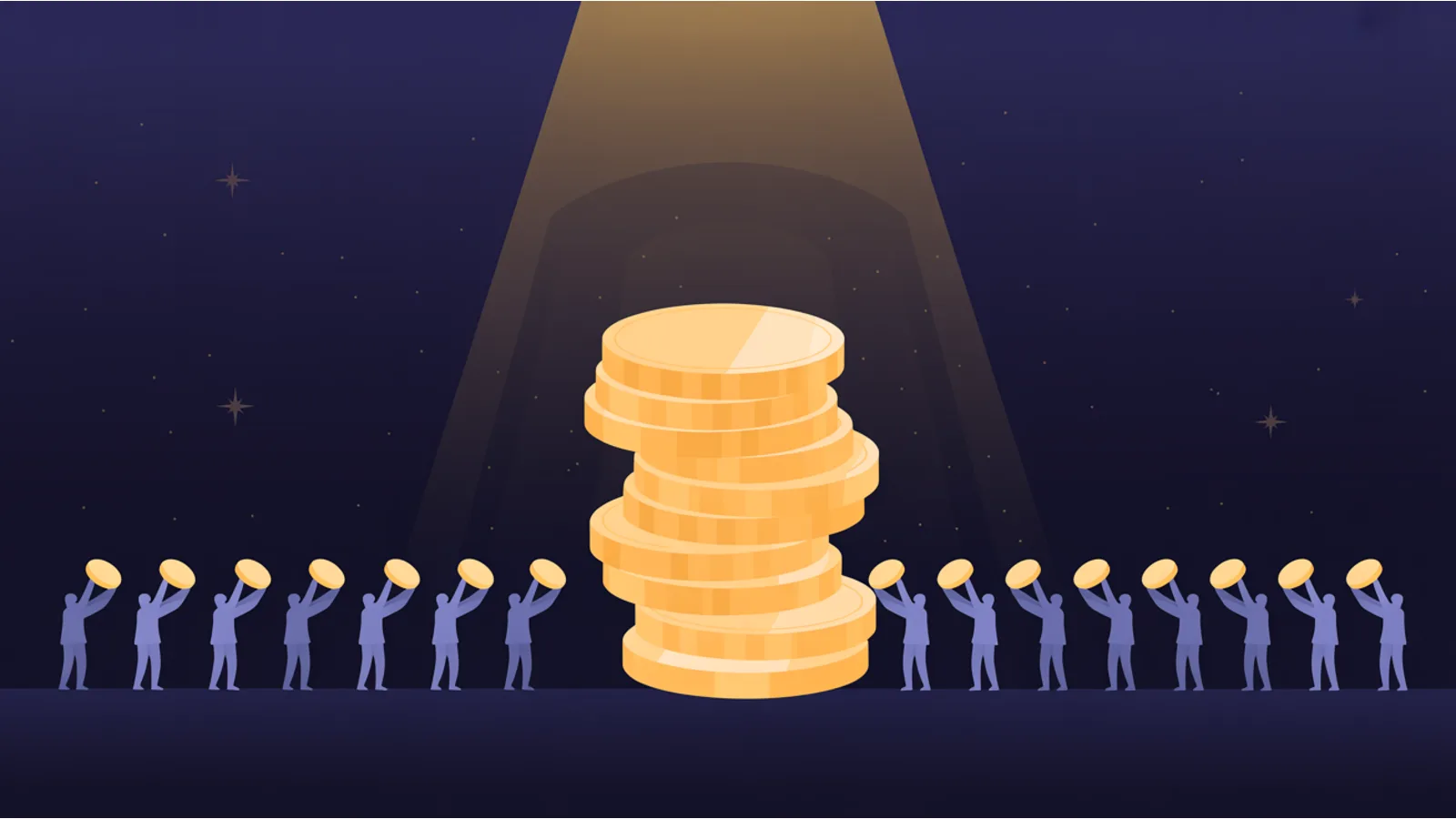
A stablecoin is a digital token that is supposed to always be worth one US dollar. You buy one with a dollar, you can sell it back for a dollar, and in between it does not swing around like other crypto. That much is on the label. What is not on the label is the business underneath, and the business is almost comically simple.
You hand the issuer a dollar. The issuer takes your dollar and buys a short-term US Treasury bill paying around four percent. You get a token worth a dollar. The issuer keeps the interest. You get nothing.
That is the entire model for the fiat-backed stablecoins that make up the vast majority of the market. It is a money-market fund that keeps the yield instead of passing it to you. Everything else, the corporate structures in the British Virgin Islands, the audits that are not audits, the deal that sends half of one issuer's income to a crypto exchange, is detail about who runs the machine and who pockets the float. This post is that detail, documented and sourced, because the ownership of the two biggest issuers in particular is a lot stranger than the "just a digital dollar" framing suggests.
The float is the whole business
Start with the size of the thing. As of mid-2026 the total stablecoin market was about $315 billion across hundreds of tokens, essentially all of it pegged to the US dollar, with Tether's USDT at roughly $186 billion (about 59 percent of the market) and Circle's USDC at roughly $75 billion (about 24 percent) (DefiLlama data via CoinLaw). Those two coins alone are backed by somewhere north of $250 billion in reserves.
Park a quarter-trillion dollars in Treasury bills yielding around four percent and you get roughly ten billion dollars a year in interest. Under the current rules, close to all of that stays with the issuers. You can see the model with total clarity in Circle's own financial filings, because Circle is now a public company and has to show its books: reserve income, the interest earned on the assets backing USDC, was 99.1 percent of Circle's total revenue in 2024, 98.6 percent in 2023, and 95.3 percent in 2022 (Circle S-1, SEC). The stablecoin is not the product. The stablecoin is how they gather the deposits. The interest is the product.
Now the two companies that run most of it.
USDT: the ten-billion-dollar company almost nobody can see inside
Tether issues USDT, the largest stablecoin in the world, and it is one of the most profitable companies per head on the planet. It is also one of the most opaque.
Who owns it. The token USDT is issued by Tether, which sits inside a corporate stack registered in the British Virgin Islands. Tether Limited is owned by iFinex, the same BVI company that operates the Bitfinex crypto exchange, and it rolls up into Tether Holdings Limited (Wikipedia summary of the corporate structure). Tether and Bitfinex being run by the same people is not gossip. It is a finding of the New York Attorney General, whose 2021 settlement stated that iFinex, the operator of Bitfinex, and Tether "are owned and controlled by the same small group of individuals" (NY AG press release). In January 2025 the company moved its global headquarters to El Salvador.
The individuals are a short list. Paolo Ardoino, long the chief technology officer, became CEO in late 2023 and is the public face. In March 2025 Giancarlo Devasini, a former plastic surgeon who had been the finance chief, was made chairman. Devasini and Jan Ludovicus van der Velde founded Bitfinex in 2012 and Tether in 2014 (Wikipedia). Beyond that, the exact ownership split is not officially disclosed. The figures that circulate, that Devasini holds around 47 percent, Ardoino around 20 percent, with van der Velde and former general counsel Stuart Hoegner and a couple of others holding most of the rest, trace back to leaked 2018 documents rather than any confirmed filing (PANews summary). Treat those percentages as widely-repeated estimates, not verified fact. The verifiable part is the shape: fewer than ten people control a company backing over $186 billion in tokens.
One more owner joined recently and is worth naming, because of who he became. In November 2024 the Wall Street firm Cantor Fitzgerald negotiated a roughly 5 percent stake in Tether valued at as much as $600 million, and Cantor also custodies most of Tether's reserves for tens of millions of dollars in fees a year (The Block, Forbes). Cantor's chief executive and majority owner, Howard Lutnick, went on to become US Commerce Secretary, having said he intended to divest to comply with ethics rules. The custodian of the largest stablecoin's reserves and a senior member of the US cabinet were, until recently, the same man's firm.
How it makes money. Interest on the reserves, at enormous scale. Tether reported net profits exceeding $10 billion for 2025, following a record of about $13 billion for 2024, driven mostly by interest on its US Treasury holdings (Tether, CoinDesk). As of the end of 2025 it reported total assets of about $192.9 billion against $186.5 billion in liabilities, with direct and indirect US Treasury exposure above $141 billion, plus $17.4 billion in gold and $8.4 billion in bitcoin (Tether). Two caveats matter here and I want them stated plainly. First, that profit is self-reported. Second, it includes unrealized paper gains on the gold and bitcoin, so it is not all interest income.
The audit that is not an audit. Tether has never completed a full independent audit. What it publishes instead are quarterly attestations, currently from the accounting firm BDO (Tether Q3 2025 report). An attestation is a narrower thing than an audit. It is a firm agreeing that a snapshot of figures management gave it is fairly stated on a given day. An audit is a broad annual opinion on the financial statements themselves, done to stricter standards (Forvis Mazars explainer). For the largest dollar-token in existence, the difference is not academic.
The rap sheet. This matters because Tether has been penalized for lying about exactly this. In February 2021 Bitfinex and Tether paid $18.5 million to settle with the New York Attorney General, who found that Tether had claimed USDT was fully backed one-to-one by dollars when, starting in mid-2017, it "had no access to banking, anywhere in the world" and held no reserves to back the tokens at a dollar each (NY AG). In October 2021 the US Commodity Futures Trading Commission fined Tether $41 million (and Bitfinex $1.5 million), finding that across a 26-month sample from 2016 to 2018, Tether actually held enough fiat reserves to fully back USDT on only 27.6 percent of the days (CFTC). The reserves today look genuinely different and genuinely Treasury-heavy. But the company asking you to trust its attestations is the same company that was fined for misrepresenting its reserves, which is precisely why the attestation-versus-audit gap gets attention.
USDC: the transparent one that gives half of it away
Circle issues USDC, the number-two stablecoin, and it is the near-total opposite of Tether on transparency. It is a US public company that has to open its books, and the books reveal a fascinating quirk: Circle only keeps about half of the money the model generates.
Who owns it. Circle Internet Group went public on the New York Stock Exchange under the ticker CRCL in June 2025, pricing at $31 a share, then closing its first day at $83.23 and later trading well past $250, briefly giving Circle a market value larger than all the USDC in circulation (Circle prospectus, SEC, DL News summary via CoinMetrics). One notable shareholder is BlackRock, the asset manager, which held roughly a 10 percent stake at the IPO and also manages the USDC reserves, a dual role covered below (Circle S-1 breakdown).
Where the reserves sit. This is the part Tether will not show you. About 90 percent of USDC's reserves are held in the Circle Reserve Fund, a government money-market fund regulated under Rule 2a-7, managed by BlackRock and custodied at the Bank of New York Mellon, that invests at least 99.5 percent of its assets in cash, US Treasuries, and Treasury-secured repurchase agreements (SEC filing for the fund, Circle S-1). The rest is cash at large banks. Only Circle can buy shares of that fund. It is, in effect, a dedicated regulated pipe from your dollars into Treasury bills.
How it makes money, and who it shares with. The same float model as Tether, but Circle gives away an enormous slice of it to Coinbase. Under a 2023 agreement, Coinbase earns 100 percent of the reserve interest on USDC held on Coinbase's own platform, plus 50 percent of the interest on the remaining reserve income everywhere else (Circle S-1, Decrypt). In 2024 that sent Coinbase about $908 million of Circle's roughly $1.7 billion in revenue, which works out to Coinbase capturing more than half of USDC's reserve income that year (Circle S-1). The reason is history: Circle and Coinbase launched USDC together in 2018 through a joint venture called Centre, and when Circle bought out Coinbase's half of Centre in 2023 for about $210 million and took sole control of issuance, the price of that control was this permanent revenue split (Circle S-1).
So Circle earned about $1.6 billion in reserve income in 2024 at an effective yield near 3.6 percent, reported net income of about $157 million for the year, and then posted a net loss in the first half of 2025 largely on IPO-related costs (DL News via CoinMetrics, Circle S-1). The transparency is real and welcome. It also reveals that the model's margins get thinner the more you have to pay distributors to hold your token.
The law now says the holder gets nothing
In July 2025 the model became federal law. President Trump signed the GENIUS Act on July 18, 2025, the first US framework for payment stablecoins (White House fact sheet). Its core requirements are what you would want: issuers must hold 100 percent reserves in cash and short-term Treasuries, publish monthly disclosures of reserve composition with the reserves attested by a registered accounting firm, and, for issuers above $50 billion, produce annual audited financial statements. In a bankruptcy, token holders get paid before other creditors (Richmond Fed, Paul Hastings guide).
One clause is the whole story of this post. The GENIUS Act explicitly prohibits payment-stablecoin issuers from paying any interest or yield to the people who hold the tokens (Richmond Fed). Read that again. The interest on the reserves is not merely something issuers happen to keep. Passing it to you is now against the law. The float belongs to the issuer by statute.
That single prohibition explains the entire next section. If the compliant stablecoin is legally forbidden from paying you the yield, then the only way to get the yield is to hold something that is deliberately not a compliant stablecoin.
The rest of the field, and the yield workarounds
The two giants are 83 percent of the market. The remaining sliver is where the more interesting structures live, including the ones built specifically to route the interest back to holders. Here is the field, with who controls each and how it earns.
Scroll to compare columns and rows when the table extends beyond the box.
| Stablecoin | Issuer / who controls it | Where | What backs it | How it makes money | Approx market cap (mid-2026) |
|---|---|---|---|---|---|
| USDT | Tether / iFinex; fewer than 10 individuals | BVI, HQ El Salvador | US Treasuries, gold, bitcoin, secured loans | Keeps interest on reserves | ~$186B |
| USDC | Circle (public, NYSE: CRCL) | US | BlackRock-managed Treasury fund + bank cash | Keeps interest, shares ~half with Coinbase | ~$75B |
| USDS / DAI | Sky (a DAO), founder Rune Christensen | Onchain / DAO | Crypto collateral + tokenized Treasuries | Borrowing "stability fees" + reserve yield | ~$9.9B / ~$4.6B |
| PYUSD | Paxos Trust (PayPal is the brand) | US, moving to OCC charter | Dollar deposits + Treasuries + cash | Paxos keeps interest, shares with PayPal | ~$2.8B |
| USDe | Ethena Labs | Onchain | Hedged crypto (a derivatives trade), not fiat | Perpetual-futures funding-rate yield | ~$5.9B |
| FDUSD | FD121 / First Digital, founder Vincent Chok | Hong Kong, issuer moved to BVI | Short-term Treasuries + repos + cash | Keeps interest on reserves | ~$346M |
| OUSD (Origin Dollar) | Origin Protocol | Onchain | 100% USDC, deployed into DeFi | Deploys backing for yield, takes a 20% cut | (small) |
| openUSDT | Hyperlane / Chainlink / Velodrome multisigs | Onchain (Optimism Superchain) | Locked USDT (a wrapper, not a new issuer) | No documented revenue model | ~$1M |
| Open USD | Open Standard, LLC (Bridge co-founder Zach Abrams); board of partners | Onchain (Solana, Base, Stellar, Polygon, more) | Not disclosed, "major US institutions" | Routes reserve yield to partner businesses, keeps a small fee | Not live (announced Jun 2026) |
USDS and DAI (Sky). MakerDAO, the original decentralized stablecoin project, rebranded to Sky in 2024, launching the USDS token and the SKY governance token as the capstone of founder Rune Christensen's "Endgame" plan (CoinDesk, The Block). In theory it is controlled by no company at all: the original Maker Foundation dissolved in 2021 and handed the keys to token-holder governance. In practice, "decentralized" comes with asterisks. In February 2025 Christensen, whom trade press has started calling Sky's CEO, pushed through an emergency governance change and, critics alleged, banned opposing accounts from the project's Discord mid-vote, which they said delegitimized the process (The Defiant). It earns money the way a bank does, charging "stability fees" (interest) to people who mint USDS or DAI against collateral, plus yield on its collateral, increasingly tokenized US Treasuries. One arm, Spark, had about $2.4 billion allocated to real-world assets in 2025 (Yellow). Note that DAI is now essentially a wrapper of USDS, so do not add the two market caps together.
PYUSD (PayPal USD). Despite the name, PayPal does not issue it. It is issued and custodied by Paxos Trust Company, with PayPal as the brand and the distribution rail (PayPal 10-K, SEC, Paxos). Its regulation is shifting: it launched under New York's NYDFS, and in December 2025 the OCC approved Paxos's conversion to a national trust charter, moving supervision to the federal level (Paxos newsroom). Paxos holds the reserves and earns the interest, and shares an undisclosed portion with PayPal. Interestingly, PayPal does something the giants do not: it currently advertises a 4 percent reward for holding PYUSD in the PayPal app, paid monthly and opt-in (PayPal). That is a reward program layered on top by the distributor, not interest paid by the token itself, which keeps it on the right side of the yield prohibition.
USDe (Ethena). This one is genuinely different, and it is the clearest example of the workaround. USDe is not backed by dollars in a bank. It is a synthetic dollar: the protocol holds crypto and opens an offsetting short position in perpetual futures so the combined value stays near a dollar, and it earns the "funding rate" that longs pay shorts in those futures markets, passing roughly 4 percent to holders of the staked version in early 2026 (Forbes). Because its backing is a derivatives trade rather than Treasury reserves, it does not meet the legal definition of a payment stablecoin, which is exactly why it can legally pay yield where USDC and USDT cannot. The catch is that the strategy depends on those funding rates staying positive, and USDe briefly slipped to $0.97 during an October 2025 market crash, after which its supply fell from a 2025 peak above $14 billion to under $6 billion (Forbes).
FDUSD (First Digital USD). Issued by First Digital, founded by Vincent Chok, with reserves custodied by its sister trust company in Hong Kong, though the issuing entity relocated to the British Virgin Islands in August 2025 as Hong Kong's stablecoin licensing regime took effect. It exists mostly because Binance needed a replacement stablecoin after regulators shut down the minting of Binance's earlier BUSD, and Binance promoted FDUSD into its main trading pairs (The Block). It earns the usual reserve interest. It also lived through the sharpest trust event on this list: in April 2025 Tron founder Justin Sun publicly alleged First Digital's trust arm was insolvent, FDUSD briefly depegged toward $0.87 and lower, and First Digital denied it flatly, called the claim a "smear campaign," and processed redemptions to prove liquidity (CoinDesk). The dispute is tangled up in separate litigation over roughly $456 million of a different stablecoin's reserves (Global Trade Review).
The "open" tokens, and why one of them is not what you think. You asked specifically about the open and yield-bearing category, and it splits into a few easily confused things.
Origin Dollar (OUSD) is the honest version of "give the holder the yield." Issued by Origin Protocol, it is backed 100 percent by USDC, and instead of sitting on that USDC it deploys the backing into onchain lending and liquidity strategies on protocols like Morpho and Curve, then passes the yield straight to holders by automatically growing their wallet balance (Origin docs). Origin makes its money by taking a 20 percent performance fee on the yield generated, which flows to buybacks of its OGN governance token. It is a small token, but its structure is transparent and its revenue model is clearly stated, which is more than can be said for some of the giants.
Then there is openUSDT, and here is a correction worth making because the internet routinely gets it wrong, including in the way the question is usually framed. openUSDT (ticker oUSDT) is a permissionless, cross-chain wrapper of Tether's USDT built for the Optimism "Superchain," created as a joint effort by Chainlink, Hyperlane, and Velodrome, using Hyperlane and Chainlink messaging (openUSDT docs). It is not issued or controlled by Tether. It is a third-party wrapper whose control sits in a set of multisig wallets operated by those partners, with no token-holder governance, and it is backed one-to-one by real USDT locked in a vault, meaning its "reserve" is just Tether's token and the actual dollars sit with Tether. It has no documented revenue model and a tiny market cap. The omnichain USDT that is built on LayerZero's OFT standard, which is the description usually attached to "openUSDT," is actually a separate and much larger project called USDT0, run by an entity called Everdawn Labs (USDT0 docs). They are two different tokens. If you are going to hold one, know which one you are holding.
Open USD, the consortium dollar that is not that OUSD. In mid-2026 a third claimant to the OUSD nickname arrived, and it is by far the most ambitious. Open USD is a dollar payment stablecoin announced on June 30, 2026 by a company called Open Standard, and its whole pitch is to invert the model this post is about. Where Circle and Tether keep the interest on the reserves, Open USD says it will hand that yield to the businesses that adopt and distribute the coin. The launch post states it plainly, that "partners receive all of the earnings from Open USD's reserves, less a small management fee to cover Open USD's operational costs," and that businesses can mint and redeem it at no cost and with no volume limits (Open Standard). Read that as a stated design, not a proven fact. Independent outlets soften "all" to "most" or "nearly all," the size of the "small" fee is disclosed nowhere, and the token was not live at the time of writing. The company says only that it will launch later in 2026.
Two things make it worth watching anyway. The first is the muscle behind it. On July 16, 2026 Visa launched a Visa Stablecoin Platform built to support Open USD, and Open Standard says more than 140 companies have joined as launch members, a roster that name-drops Visa, Mastercard, Stripe, BlackRock, BNY, Coinbase, and Alphabet (CoinDesk, The Block). Circle's stock fell about 16 percent on the day the project was revealed, before analysts called the fear overblown (The Block). The second is who is running it. Open Standard is disclosed, on its own privacy policy, as Open Standard, LLC, a for-profit company rather than the neutral nonprofit the "open" branding suggests, and it is led by Zach Abrams, a co-founder of Bridge, the stablecoin infrastructure startup Stripe bought in 2025 for about $1.1 billion (Open Standard privacy policy, Forbes). The neutral-rail pitch has a very interested party at the wheel.
Now the part this post exists to supply, because a consortium announcement is exactly the kind of thing to discount. That "140 partners" figure is self-reported and already fraying. Within days of the reveal, Samsung, Dunamu, and Upbit publicly distanced themselves from any formal role (FinanceFeeds), the "member" language across the coverage means "will use and integrate," not "invested capital," and no named firm has confirmed a binding or financial commitment on its own channel. People who watched Facebook's Libra and Diem collapse, and the failed retail-payment consortiums before them, expect the roster to thin before anything ships. And notice the one thing the inverted model does not change. Under the GENIUS Act, those reserve earnings can legally flow to the partner businesses precisely because they are businesses in the network and not the public holding the token (NYU Compliance and Enforcement). If you hold Open USD, you still get nothing. The float just spreads across a wider set of companies than it does at Tether or Circle, instead of reaching you.
What could not be pinned down
Honesty requires a list of what is soft, because a piece about opaque companies should be clear about its own gaps.
- Tether's exact ownership percentages are estimates from a 2018 leak, not confirmed filings. The number of controllers being small is documented by the NY AG; the specific splits are not.
- Tether's profit and reserves are self-reported through attestations, not a full audit. The 2025 profit figure also folds in unrealized gains on gold and bitcoin, so it overstates pure interest income.
- The PayPal-Paxos and Tether-Cantor revenue and fee arrangements are only partly disclosed. The precise splits are not in public filings.
- Sky's real-world-asset totals shift constantly and the protocol-wide figure is hard to pin to one number; the $2.4 billion cited is one arm's allocation.
- openUSDT's and USDT0's exact reserves and market sizes are lightly documented and, for openUSDT, come from a single tracker that appears to undercount its cross-chain supply.
- Open USD is a promoted announcement, not a shipped product. Open Standard, LLC has not named the legal entity that will issue the token, its regulator, its reserve custodian or composition, the size of its "small" management fee, or any investor or funding. The token was not live at the time of writing.
- Open USD's partner roster is self-reported. The "140-plus" figure is the company's own, several named firms (Samsung, Dunamu, Upbit) distanced themselves within days per FinanceFeeds, and no named partner has confirmed a binding or financial commitment on its own channel.
The bottom line
Strip away the branding and a stablecoin is a deposit you make into a company that invests it in Treasury bills and keeps the interest, and as of 2025 US law says it has to keep the interest. The differences that matter are about who that company is and how much you can see. Circle will show you a public filing and a BlackRock-run fund, and then quietly send half the take to Coinbase. Tether will show you a ten-billion-dollar profit signed off by a handful of people in the British Virgin Islands who have been fined before for saying their reserves were something they were not. The tokens that actually pay you the yield, like Ethena's USDe, do so precisely by being legally not a stablecoin, which means taking on the risk the giants were built to avoid.
None of this makes stablecoins useless. They move dollars around the world fast and cheaply, and that is a real service. It just means the pitch is incomplete. When something offers to hold your dollars and give you a token worth exactly a dollar back, the honest next question is the one this whole post is about: then who is getting the interest? The answer, almost always, is not you.
If watching your own idle money quietly earn a fortune for someone else is a feeling you would like to understand and escape rather than repeat, that is the argument of my book The W-2 Trap (search the title on Amazon Kindle): the systems that profit from your money working for them are worth learning before you feed them.
Related reading
- How Private Equity Funds, LPs, and Holding Companies Really Work: the other great follow-the-ownership puzzle, where the real controllers sit several layers up.
- Who Borrows From the Social Security Trust Fund: another pool of "your" money that quietly earns for someone else.
- Why W-2 Workers Stay Broke: the same asymmetry, applied to a paycheck instead of a token.
- Crypto Wars: Code Is Speech: the older fight over who controls digital money.
- Where the Ledger Balances: reading an organization by following its money rather than its mission statement.
Fact-check notes and sources
Crypto figures, market caps, and reserve numbers move constantly and many are self-reported; treat everything here as a mid-2026 snapshot and confirm against the primary source before relying on it.
- Market structure: total stablecoin market about $315 billion, USDT about 59 percent and USDC about 24 percent, as of mid-2026 per DefiLlama (CoinLaw).
- The float model: Circle's reserve income was 99.1 percent of total revenue in 2024 (98.6 percent in 2023, 95.3 percent in 2022) (Circle S-1, SEC).
- Tether ownership and control: Tether Limited owned by iFinex, which also runs Bitfinex; the same small group controls both per the NY AG; Ardoino CEO, Devasini chairman; HQ moved to El Salvador January 2025 (Wikipedia, NY AG). Ownership percentages are from leaked 2018 documents and unconfirmed (PANews). Cantor Fitzgerald's roughly 5 percent stake and custody role, and Howard Lutnick's Cantor ties (The Block, Forbes).
- Tether finances: net profit above $10 billion for 2025 and about $13 billion for 2024; total assets about $192.9 billion; Treasury exposure above $141 billion; gold $17.4 billion and bitcoin $8.4 billion; figures self-reported via BDO attestation, not a full audit, and including unrealized gains (Tether, CoinDesk, attestation-vs-audit per Forvis Mazars).
- Tether enforcement history: $18.5 million NY AG settlement (2021, no reserves backing one-to-one from mid-2017) and $41 million CFTC fine (2021, fully backed on only 27.6 percent of days in a 2016 to 2018 sample) (NY AG, CFTC).
- Circle / USDC: NYSE IPO as CRCL in June 2025 at $31; reserves about 90 percent in the BlackRock-managed, BNY-Mellon-custodied Circle Reserve Fund; Coinbase earns 100 percent of interest on USDC held on Coinbase and 50 percent of the remaining reserve income, about $908 million of Circle's roughly $1.7 billion 2024 revenue; Circle 2024 net income about $157 million; BlackRock roughly 10 percent stake at IPO (Circle S-1, prospectus, reserve fund filing, Decrypt, CoinMetrics).
- GENIUS Act: signed July 18, 2025; 100 percent reserves in cash and short-term Treasuries; monthly disclosures and attestations; audits for issuers above $50 billion; and a prohibition on paying interest or yield to holders (White House, Richmond Fed, Paul Hastings).
- Survey coins: Sky/USDS (CoinDesk, The Defiant); PYUSD/Paxos (PayPal 10-K, Paxos/OCC); USDe/Ethena (Forbes); FDUSD (The Block, CoinDesk depeg); OUSD (Origin docs); openUSDT versus USDT0 (openUSDT docs, USDT0 docs).
- Open USD (Open Standard): announced June 30, 2026; the "partners receive all of the earnings from Open USD's reserves, less a small management fee" wording is the issuer's own and softened to "most" or "nearly all" by independent outlets; more than 140 self-reported launch members; Visa Stablecoin Platform launched July 16, 2026; operator disclosed as Open Standard, LLC, led by Bridge co-founder Zach Abrams; Samsung, Dunamu, and Upbit distanced themselves per FinanceFeeds; not live at the time of writing (Open Standard, privacy policy, CoinDesk, The Block, FinanceFeeds, Forbes).
This post is informational, not financial or investment advice. It documents publicly reported ownership and business models; several figures are self-reported by the issuers and noted as such. Mentions of Tether, Circle, Coinbase, BlackRock, PayPal, and other third parties are nominative fair use and no wrongdoing is implied beyond the cited regulatory findings. Crypto markets, valuations, and regulation change fast; verify against current sources before acting.
