

MoneyPrinterTurbo assembles short videos from a topic, an AI script, footage, narration, subtitles and music. It can help a small business prepare explainers and announcements, provided someone owns the review. The biggest immediate risk is publishing material you have no right to use, especially its bundled music. Try it as a drafting workstation with posting disabled, your own assets and a human approving the finished video.
Our Trendshift guide recommended replacing that music first. This closer reading adds two details: posting is already disabled in the example configuration, and the optional uploader sends videos through a separate service, Upload-Post. We read the live documentation and relevant source code. We did not install, download a runnable package or run MoneyPrinterTurbo. This is a documented workflow review. We did not measure performance.
What the tool actually does
MoneyPrinterTurbo is software you operate on a computer. Its MIT license permits commercial software use subject to its conditions. That software license cannot establish rights in every song, stock clip or person's voice that passes through it.
The English README describes a browser interface, a command line and an API. The browser interface is a control panel for the program. A command line lets an IT person type instructions. An API is a defined way for one program to ask another to do something, like handing a filled order form to a service counter. An API key identifies the account making those requests and can authorize billable work.
The latest release we read was v1.3.9, published October 21, 2026. The live main branch contains continuing changes. Have IT check the documentation against the version actually installed; a feature in the current source is not proof that an older packaged release includes it.
Here is the basic pipeline documented in the README:
Scroll to compare columns and rows when the table extends beyond the box.
| Stage | What happens | What you supply or pay for |
|---|---|---|
| Topic | You describe the subject and intended audience | Accurate business facts, preferably a reviewed brief |
| Script | A language model drafts narration and search terms; a custom script is also supported | A model account and key, or a configured local model such as Ollama; hosted service charges depend on your selection |
| Footage | The program searches Pexels or Pixabay, or uses your images and clips | Provider keys for online sources; licenses still matter when the download is free |
| Voice | Text to speech turns the script into an audio recording | A selected voice service, uploaded narration or no voice; some services need paid credentials |
| Subtitles | Timing information or local speech transcription produces captions | Review of words, timing, names and accessibility; local transcription also needs a model download |
| Music | A background track is mixed under the voice | Your recording or a license covering this use; disable random bundled music |
| MP4 | The parts are rendered into a playable video file | Computer time, disk space and a complete human review |
| Optional posting | Upload-Post sends the approved output onward | Its own account, key, platform connections and any applicable subscription |
The README calls Edge TTS free and says it needs no API key. TTS means text to speech. Its interface label Azure TTS V1 refers to that Edge route; Azure TTS V2 is a different credentialed service. We could not confirm a Microsoft commercial redistribution grant specifically for the third-party Edge TTS use described here. Microsoft's Read Aloud documentation explains listening to webpages; it does not establish a business voiceover license. Use your own recorded narration or a voice service whose terms cover your planned publication.
Ollama is a way to run a language model on your own computer. Choosing it for scripts removes that particular hosted-model call; it does not make footage searches, cloud voices or posting local. The README also supports uploaded audio and local media. Those options let a business keep much more of the workflow under its control. They still require an asset record and permission from people whose voices or images appear.
The separate editable video project documentation describes a local revision workflow for prepared media. It preserves versions and avoids provider calls and posting, but its first renderer does not implement word-aligned subtitles, overlays or transitions. Do not confuse that narrower renderer with the complete generation pipeline.
Costs and the subscription question
There is no required software license payment under the repository's MIT terms. A working video can still incur model charges, voice charges, media licensing, posting-service fees and staff time. We did not measure generation speed, electricity use or editing time. A claim that this produces a finished business video for a fixed number of cents would be unsupported.
The Pixabay API documentation confirms free API use with an account key. Pexels also lists its API as free; its documentation sets usage conditions. Both services require a configured key in MoneyPrinterTurbo. Anthropic's API pricing, read November 3, lists Claude Sonnet 5.5 base usage at US $2 per million input tokens and $10 per million output tokens, before tax. A token is a small piece of text. This provider price example establishes neither a tested model configuration nor a whole-video estimate. Other model and voice choices have their own rates; we have not verified a complete price list for every supported provider.
For optional posting, Upload-Post's pricing lists Free at US $0 per month with 10 uploads per month, excluding TikTok. Basic is $24 per month on monthly billing, or $192 billed annually, equivalent to $16 per month. These November 3 prices are before applicable tax. Manual publishing avoids that service subscription, though it still takes staff time.
The README's provider list also includes a Claude Code subscription. The integration source invokes a locally installed Claude command line client. Anthropic's consumer terms restrict nonhuman access except through an API key or explicit permission. The consumer terms make an exception: “Except when you are accessing our Services via an Anthropic API Key or where we otherwise explicitly permit it”. Its more specific Claude Code legal documentation distinguishes an end user signing into the unmodified official client with their own subscription from developers routing users' requests through subscription credentials.
The specific permission says: “Nor does it prevent an end user from signing in to the unmodified Claude Code binary with their own Claude subscription”. That distinction matters. We cannot certify an individual deployment's compliance simply because the README lists the option. Keep the official client unmodified, use your own authorized account and ask Anthropic about your intended business workflow if it goes beyond ordinary individual use. An agency should not turn one employee's subscription into a shared client video service. A separately billed API account is the clearer route for that service, subject to its commercial terms.
Five business uses worth considering
These are illustrations. We have no customer results or performance measurements for them. Every card assumes you remove bundled music, select owned or properly licensed footage and narration, review the finished file and set any platform-required AI disclosure. Software license cost is the same across the examples. API use, staff time and any purchased asset rights remain additional and depend on actual choices.
Illustration: a product or service explainer. A repair shop could explain how its inspection appointment works. Supply its own script, actual bench footage and the owner's recorded narration. Replace generic claims about quality or turnaround with promises the shop can keep. Check that the captions do not convert an estimate into a guarantee. With existing owned assets, this design needs no stock purchase or hosted script generation; incremental production cost is still unknown because recording and review take time. A stock technician must not appear to be an employee who worked on a customer's equipment.
Illustration: weekly tips for a local service business. A landscaper could explain watering or tool care using its own demonstrations. Let AI shorten an approved tip, then have the person who does the work verify every instruction. Avoid showing stock plants as examples of work the business completed. Use varied, useful scripts rather than changing a place name in the same video repeatedly. Budget the selected model and voice usage, or record the narration yourself. There is no verified per-video price because the prompt length, revisions and chosen provider vary.
Illustration: an event or sale announcement. A retailer could turn its approved event details into a captioned clip showing the actual venue and merchandise. Have a manager verify dates, stock limits, exclusions and the offer's end time before approving it. Use music licensed for the destination, including paid advertising if the clip will be promoted. A license for an organic post may not cover an advertisement or another platform. The tool's software license adds no fee; the specific music license and staff cost are unknown until selected. A silent clip with readable captions can avoid a music purchase altogether.
Illustration: short answers from a written FAQ. A bookkeeping firm could turn a general appointment FAQ into brief answers about what to bring and how scheduling works. Remove client names and account information before any script reaches a hosted model. Have a staff member check that the edit has preserved qualifications, rather than turning general information into individualized tax advice. Reuse an approved visual style with actual office footage or plainly illustrative stock. To avoid model calls, supply the written script and search terms or use local footage, and keep posting disabled; professional review and any voice license still have to be budgeted.
Illustration: internal training clips. A wholesaler could make a short reminder about its own packing process with footage of the actual work area. Keep faces, shipping labels and customer details out unless their use is authorized. Record the trainer's voice or secure explicit permission for a synthetic version. The supervisor must check the finished sequence against the current procedure. Keep social posting off and distribute through the company's approved internal system. The incremental tool license cost is zero; recording, secure storage and review costs are unknown. Existing prepared footage and narration can use the narrower local revision workflow if its editing limits are acceptable.
Stock footage is useful for an abstract idea such as rain, a calendar or a generic package. It becomes misleading when viewers reasonably take it as evidence of your facilities, staff or results. Showing a stock kitchen under a restaurant's name can imply it is that restaurant's kitchen. Prefer the actual location; where illustration is needed, say so visibly. An AI disclosure tells viewers how media was made. It does not correct a false business claim.
The workflow and its publishing checkpoint
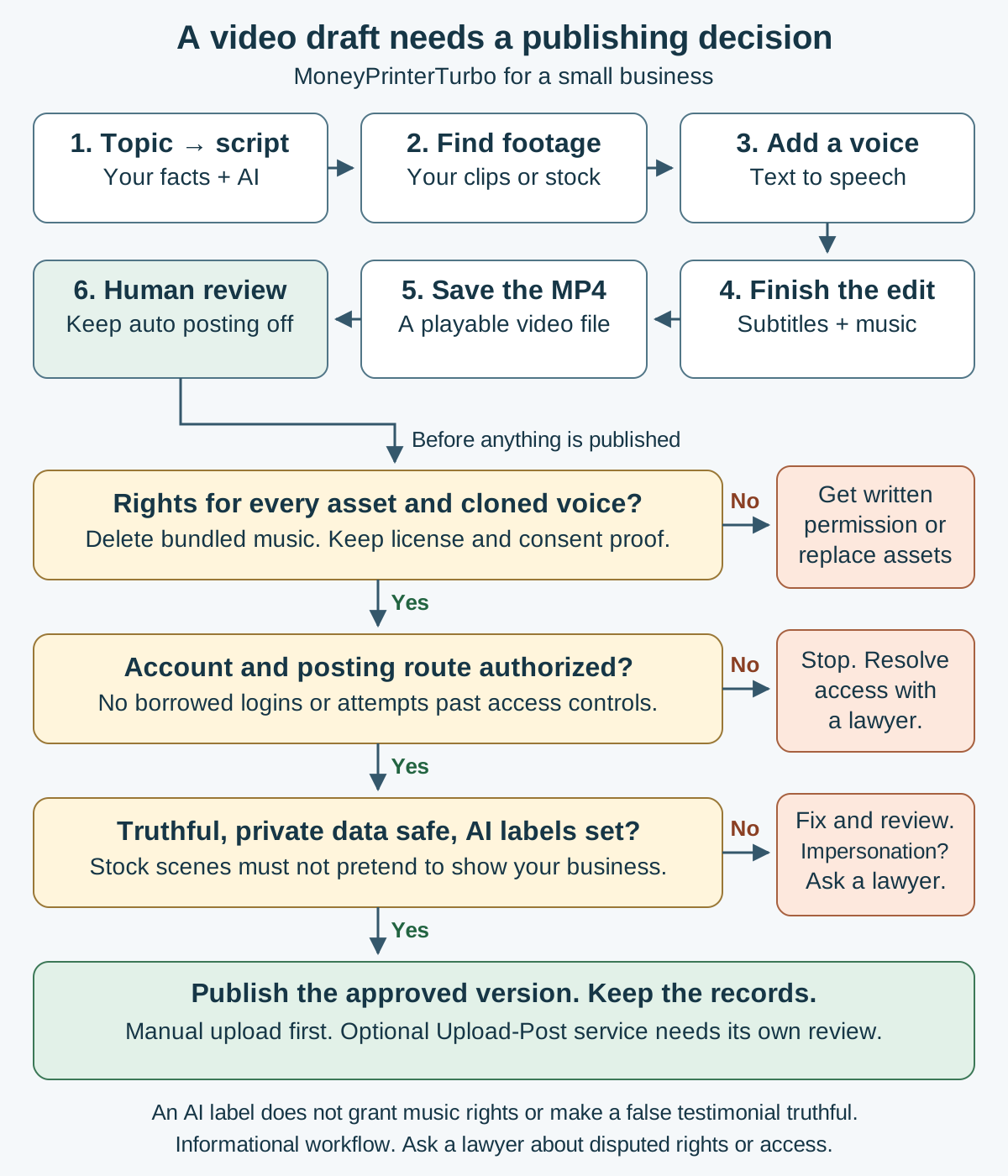
┌─────────────────────────────────────────────────────────────┐
│ Topic → AI script → footage → voice → subtitles → music      │
└────────────────────────────┬────────────────────────────────┘
                             ▼
                    MP4 → human review
                             ▼
        Asset licenses and voice consent complete?
             No → get permission or replace assets
            Yes ▼
        Account and posting route authorized?
             No → stop and resolve access with a lawyer
            Yes ▼
        Truthful claims, safe data and required AI labels?
             No → fix and review; disputed rights → lawyer
            Yes ▼
              Publish approved version → keep records
The Computer Fraud and Abuse Act and other legal risks, and copyright
This section is informational, not legal advice. Ask a lawyer licensed where you operate about disputed permissions, voice rights or access. Most ordinary uses are lawful when the business controls its accounts, clears its assets and follows the service terms. For this tool, copyright and truthful publishing deserve more attention than computer intrusion law.
Account access and the CFAA
The federal Computer Fraud and Abuse Act, 18 U.S.C. § 1030(a)(2), addresses someone who “intentionally accesses a computer without authorization or exceeds authorized access” and obtains specified information. Ordinary video creation on your machine is not the concern. Posting to your own account through an authorized official API with your own keys is not inherently a CFAA problem.
In Van Buren v. United States, the US Supreme Court held in 2021 that improper purpose alone did not make an otherwise authorized database lookup exceed authorized access. The federal interpretation applies nationwide. The Court described a “gates-up-or-down” inquiry, but footnote 8, slip page 13, left open whether the limits can come from contracts or policies as well as technology. It did not decide that every platform rule is irrelevant to the CFAA.
A terms-only restriction on otherwise authorized activity often presents contract and account suspension risks. Entering someone else's account without permission, using stolen credentials or continuing after access is revoked can raise the computer crime issue itself. Shared passwords also create contractual and security problems; use supported account roles for client work. Do not get around logins, paywalls, CAPTCHAs or account blocks. Obtain written authority from the account owner and use a method the platform permits.
States also have their own computer crime statutes. California Penal Code § 502(c)(7) addresses knowing access without permission. Texas Penal Code § 33.02(a) uses the phrase “without the effective consent of the owner.” Other countries differ. Do not assume the federal ruling disposes of a state-law or overseas dispute.
MoneyPrinterTurbo's uploader source sends the video and metadata to Upload-Post through its /api/upload endpoint, using an Upload-Post API key. It does not directly implement TikTok's, Instagram's or YouTube's official publishing API. Upload-Post advertises “Official APIs. OAuth security. No workarounds.” OAuth is an account authorization flow that grants access without giving this video program your social password. That is the provider's claim; we did not audit its internal operations. Review its account permissions and use the platform's own upload screen initially.
The bundled music needs replacing
The live Chinese README, Background Music says: “当前项目里面放了一些默认的音乐,来自于 YouTube 视频,如有侵权,请删除。” [The project includes some default music from YouTube videos; if it infringes, please delete it.] The English README carries the same warning. Our folder listing counted 29 MP3 files and no accompanying license or notes file in that directory. We did not listen to or download them, and we have not established that each track infringes. We also found no basis for telling a commercial publisher those files are cleared.
Delete the bundled music before any commercial use. Disable random music selection and explicitly select an owned or licensed recording, or no music. The resource initialization code copies missing packaged resources into the application's working data. Deleting only a copied track can allow it to reappear. Have IT check both the packaged resources and active music library, then repeat the check after initialization or an upgrade.
17 U.S.C. § 106(2) reserves the right “to prepare derivative works based upon the copyrighted work”. Other clauses cover copying, distribution and relevant performance rights. A commercial music use may require rights in both the recording and the composition. Crediting an artist does not supply those rights. Section 107 makes fair use a contextual inquiry, including “whether such use is of a commercial nature or is for nonprofit educational purposes”. There is no universal safe number of seconds for a promotional soundtrack.
YouTube's Terms, Permissions and Restrictions, item 1, limit downloading and other uses, with an exception for uses “as expressly authorized by the Service” and another for prior written permission from YouTube and applicable rights holders. A song being available in a video does not authorize extracting it for an advertisement. Permission to watch or save something through a platform feature is different from permission to reuse it in another production.
Stock licenses have limits
Pexels permits free use and modification, but says: “Don't imply endorsement of your product by people or brands on the imagery.” It also restricts offensive depictions of identifiable people, resale of unaltered copies and use in trademarks. A stock actor's face is not permission to present that person as your satisfied customer.
Pixabay's license summary says: “You cannot use Content in a misleading or deceptive way.” It permits free use and modification while restricting standalone distribution, certain commercial uses of recognizable trademarks, logos or brands, and immoral or illegal uses, particularly involving recognizable people. The summary says the full Content License is legally binding; we verified the summary, and a business should read the full terms for its particular asset and use. Keep proof of the license and any separate permissions. Our practical recommendation is actual business footage whenever a stock scene could suggest a false facility, result or endorsement.
AI labels and monetization are separate checks
YouTube: its altered or synthetic content guidance says, “We require creators to disclose AI-generated or altered content that seems realistic.” The current page calls the setting AI use under Attributes. Its examples exempt script assistance, caption creation and cloning your own voice for voiceovers. Check the finished media rather than assuming that any AI involvement requires the same label. Realistic invented scenes and another person's synthetic voice need particular attention.
TikTok: its AI content guidance says, “We also require creators to label all AI-generated content that contains realistic images, audio, and video”. It also restricts certain impersonations and private adult likenesses used without permission. A label does not excuse prohibited material or an invented endorsement.
Instagram and Facebook: Meta's disclosure guidance requires disclosure for organic posts containing “photorealistic video or realistic-sounding audio that was digitally created or altered”. Its updated labeling announcement calls the label AI info. Paid advertisements need their own policy review. Do not assume the organic-post rule settles every advertising requirement.
The MoneyPrinterTurbo upload code conditionally sends YouTube's containsSyntheticMedia field when YouTube metadata is supplied. We found no equivalent TikTok or Instagram disclosure field in that method. Upload-Post's API documentation offers those fields, so their existence at the service does not prove this caller sets them. Manually check the disclosure in each destination before publishing.
For monetized YouTube channels, a separate YouTube Partner Program policy addresses inauthentic content, including repetitive or mass-produced work. One current example is “AI-generated content made with generic or unoriginal templates giving the impression of mass production”. A series can use a consistent introduction while delivering substantially different, useful material. A folder of nearly interchangeable stock videos may fail that standard even with licensed assets and accurate AI labels. This monetization rule permits qualifying AI videos while setting conditions for Partner Program eligibility.
Voice cloning and invented customers
The Chinese README describes “还可以上传参考音频复刻说话人音色” [You can also upload reference audio to clone a speaker's voice]. The English version identifies the ModelBest VoxCPM reference-audio feature. Have written consent covering the voice, subject matter, platforms, commercial use, duration and withdrawal process before using it. Possessing a recording does not establish permission to synthesize its speaker.
Tennessee's 2024 ELVIS Act is one state example. Its voice definition, § 47-25-1102, covers an identifiable person's “actual voice or a simulation of the voice of the individual”. Section 47-25-1105 addresses unauthorized advertising use and knowingly making an unauthorized voice or likeness publicly available. Have local counsel assess the specific use and governing law; this state example does not establish a uniform national voice rule.
If someone proposes reusing the narration for outbound calls, the FCC's February 8, 2024 ruling, paragraph 2, says the TCPA's artificial-voice restrictions “encompass current AI technologies that generate human voices.” Paragraphs 7 and 9 explain that consent and other requirements apply. The ruling concerns telephone calls and applies existing requirements to AI voices. Ordinary social publication has separate platform checks. The voice owner's permission does not replace the called party's required consent.
An invented customer creates another problem. 16 C.F.R. § 465.2(a)(1) prohibits material misrepresentations about whether a “reviewer or testimonialist exists”. The FTC's 2024 final rule, effective October 21, 2024, distinguishes nondeceptive artificial narrators and portrayals from fake testimonials. An openly artificial presenter can explain your actual service. It cannot truthfully claim to be a real customer who bought something and loved it if that experience never happened. An AI label does not repair that lie.
Before you install
Give your IT person the official English README installation section, this article and the kit below. The official Python package name is mpt, maintained by harry0703. The README says the similarly named MoneyPrinterTurbo package on PyPI is maintained by a third party. Do not substitute it.
The README requires Python 3.11 or later and recommends Python 3.11. Its minimum table lists four CPU cores and 4 GB RAM; its recommended RAM is 8 GB. A GPU, a processor often used for graphics and AI calculations, is optional for the basic workflow. These requirements come from the project. Leave disk space for source media, finished videos and any downloaded transcription models.
These are the README's package installation commands, reproduced for review. We did not execute them. A virtual environment is a separate folder of Python dependencies for this application, rather than mixing them into other software.
macOS or Linux:
python3 -m venv .venv
source .venv/bin/activate
python -m pip install mpt
mpt webui
Windows PowerShell:
python -m venv .venv
.venv\Scripts\Activate.ps1
python -m pip install mpt
mpt webui
The program creates its configuration on first launch. Enter only the keys for selected services through its settings. Keep them out of shared presets, screenshots and client handoffs. The README supports exporting settings and keys, so treat an export as sensitive unless IT has checked its contents. Store configuration and generated media in a restricted application data location and decide who can delete or retain finished work.
Keep upload_post_enabled = false and upload_post_auto_upload = false, the defaults in the example configuration. If posting is later enabled, check destinations, privacy and audience settings individually. The YouTube defaults include public visibility and a false made-for-kids setting; neither should substitute for a person deciding the right audience.
Data goes to whichever services you choose: script text to a hosted language model, search terms to stock providers, narration text and any reference audio to a cloud voice service, and completed videos and captions to Upload-Post if enabled. Local models can reduce particular transfers, but the whole workflow is not private merely because its control panel opens on your computer. Start with public facts and dummy content. Keep the interface restricted to the intended machine unless IT has designed access controls.
For the first real draft, make the business facts explicit, use owned footage and narration, leave music off and stop at the MP4. Watch the complete video with sound, then watch it with sound muted. Check names, dates, captions, visual implications and the call to action. A person should approve the exact file that gets posted; an earlier approved script does not approve later generated imagery.
Download the publishing kit
- AI short video safe publishing kit (.md): setup commands, an asset license and voice consent log, platform disclosure checks, review records and business use cards.
If you are turning this work into a service for other businesses, The $20 Dollar Agency fits the next question: what defined piece of work will a client buy? Include recording permissions, asset clearance and a client's final approval in that scope. Delivering an MP4 does not settle those responsibilities.
Related reading
- GitHub's top repositories and their small business uses
- REA reverse engineering and legal risks
- Cloudflare's security audit skill for small business
- Scrapling web data and permission
- Firecrawl web data and API use
- Vetting tools found on indie launch boards
Fact-check notes and sources
All source reads below were on November 3, 2026, UTC. The repository review used source text and directory listings. We did not install the program. Policy quotations describe the pages as read. Prices are US dollars before applicable tax; no purchase or end-to-end video cost test was performed.
- Project identity and release: repository, MIT license and v1.3.9 notes, read 21:34 UTC. Release date and software-license scope; no adoption or quality inference from GitHub popularity.
- Pipeline and installation: English README, sections Features, System Requirements, Install the Official Package with pip, Voice Synthesis and Background Music; Chinese README, lines 522 and 560 for voice and music quotations; songs listing, all read 21:34 UTC. Counted files without downloading audio.
- Configuration and behavior: example configuration, read 21:34 UTC; parameter defaults, packaging, diagnostics and local projects, read 21:35 UTC; resource copying, read 21:36 UTC. Support defaults, privacy cautions and possible music replenishment.
- Posting: upload implementation and task caller, read 21:35 UTC; Upload-Post claims and field documentation, read 21:35 UTC; pricing, read 21:35:47 UTC and confirmed in a home browser before 21:47 UTC. We attribute the provider's official-API claim and did not independently audit it.
- Models and voice: Claude adapter, read 21:35 UTC; consumer terms, read 21:35:11 UTC; Claude Code legal terms, read 21:35:13 UTC; API pricing, read 21:35:49 UTC and confirmed in a home browser before 21:44 UTC. Microsoft Read Aloud, read 21:34:51 UTC, explains the feature but did not establish the commercial redistribution permission sought.
- Stock: Pixabay API, read 21:35:02 UTC, for free API usage and key requirements. Pexels license, API, API documentation and Pixabay license summary, read in a home browser before 21:47 UTC. The full Pixabay terms were not verified; the article identifies the summary as such.
- YouTube: Terms, Permissions and Restrictions item 1, read 21:35:03 UTC; AI disclosure requirements and examples, read 21:35:05 UTC; Partner Program, inauthentic content update and Generic or Repetitive Content section, read 21:35:06 UTC.
- Other platform labels: TikTok AI guidance, read in a rendered browser page at 21:36:01 UTC; Meta organic-content disclosure, read 21:35:47 UTC; Meta AI info update, read 21:35:10 UTC.
- Computer access law: 18 U.S.C. § 1030(a)(2), (e)(6) and Van Buren, slip pages 13 and 20, footnote 8, read 21:34:44 UTC. Texas § 33.02(a), read in a rendered browser page at 21:36:17 UTC. California § 502(c)(7), read in a home browser before 21:39 UTC.
- Copyright: 17 U.S.C. § 106, read 21:35:23 UTC, and § 107, read 21:35:24 UTC; exclusive rights and contextual fair-use factors.
- Voice and phone calls: Tennessee signing announcement, § 47-25-1102 and § 47-25-1105(a)(1) and (2), read in a home browser before 21:47 UTC. The enacted PDF and statutory exceptions were not verified here. FCC 24-17, paragraphs 2, 7, 9 and 11, read 21:34:44 UTC, for AI voices within TCPA rules and the ruling's effective date.
- Testimonials: 16 C.F.R. § 465.2(a) and (b), read 21:35:25 UTC; FTC final rule, 89 FR 68034 and 68049, read 21:35:54 UTC, for effective date and nondeceptive portrayal distinctions.
The business examples and review workflow are our illustrations and recommendations. They are not measured customer results. The existing Trendshift and launch-board companions and book catalog were checked for context; the four sibling tool articles are companion links in this publication batch.
This post is informational, not legal advice. Mentions of third parties are nominative fair use. No affiliation or endorsement is implied.
