
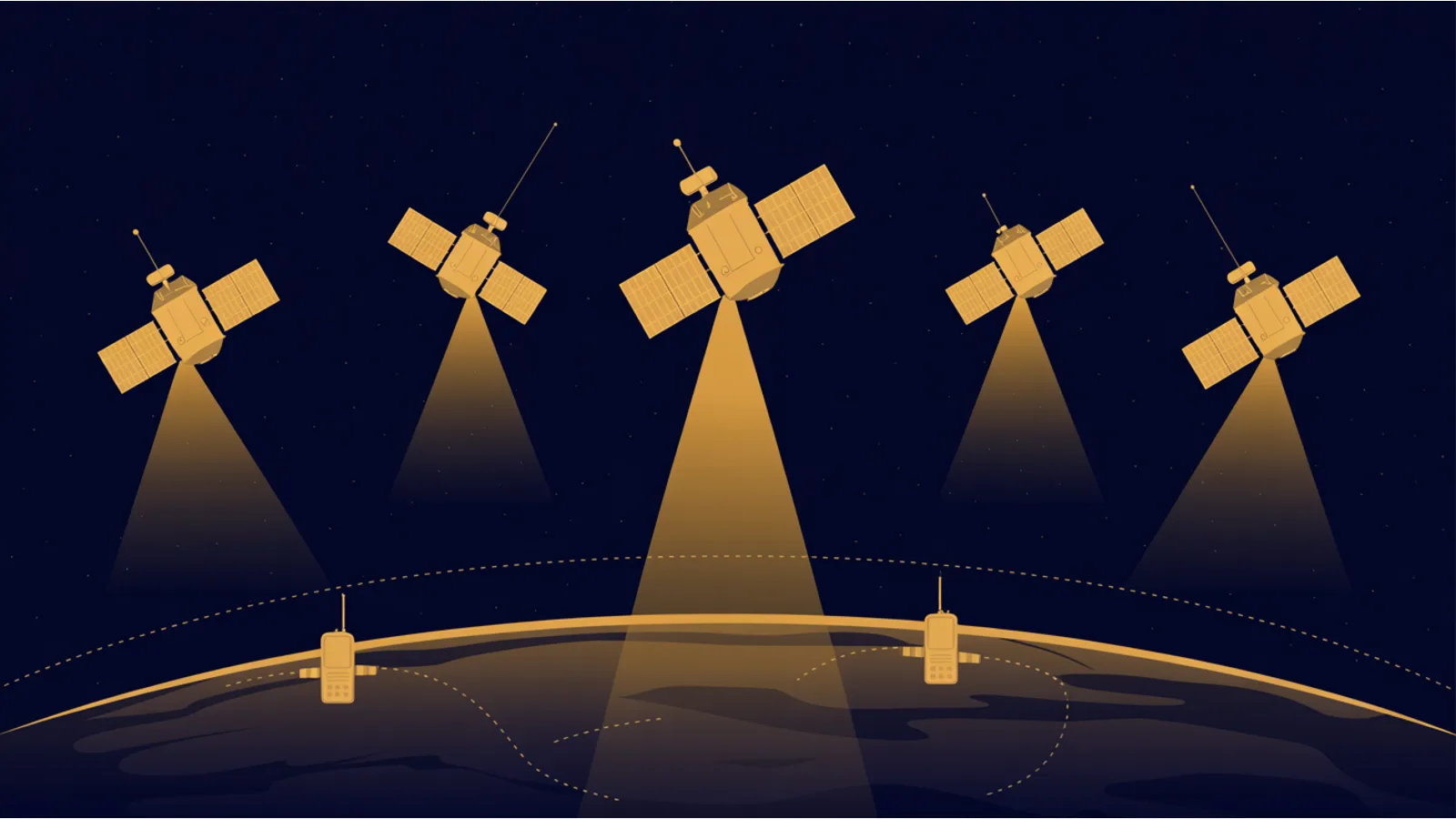
The Mobile User Objective System is one of the more instructive entries in this public-money series precisely because it is not a cancellation. Every satellite the U.S. Navy set out to build was built. Every one reached orbit. The system works today, and the Space Force is buying more of it. And yet the Government Accountability Office spent a 2021 report documenting a problem that cost real capability for years: the satellites arrived on schedule while the radios that could exploit their most advanced feature did not. The expensive new phones in the sky were operational long before enough handsets on the ground could take advantage of them.
That gap, between a fielded space segment and a lagging terminal segment, is the honest critique here. It is a coordination failure, not a broken machine. Keeping those two ideas distinct is the whole point of this post.
What MUOS is
MUOS is a U.S. Navy narrowband satellite communications system operating in the ultra-high-frequency band. It is the successor to the aging UHF Follow-On (UFO) satellites, and its purpose is to give mobile, dispersed forces something close to smartphone-grade secure voice and data: encrypted communications that hold up when users are moving, when weather is bad, and when terrain would otherwise block a signal. Lockheed Martin Space is the prime contractor. The Navy's Communications Satellite Program Office, PMW 146, leads the program. These concept, lineage, prime, and program-office facts are corroborated across the program's public record and the GAO report cited throughout this piece.
The design carries two payloads on each satellite, and that detail matters for the fairness of the story. One is the advanced payload, which uses a Wideband Code Division Multiple Access (WCDMA) waveform, the same family of technology behind 3G mobile phones. The other is a legacy payload compatible with the old UFO system. The legacy payload is what kept existing narrowband users connected during the long transition, so no capability was lost while the new terminals caught up. That dual-payload choice is a large part of why this program reads as a delay rather than a failure.
According to GAO, the WCDMA payload delivers roughly a tenfold increase in communications capacity over the legacy UHF system. Vendor and trade-press descriptions put the throughput advantage as high as sixteenfold, and cite user data rates up to 384 kbit/s. Those two figures come from different sources and should stay attributed to different sources: GAO says about ten times, the vendor side says up to sixteen times. They are not the same claim, and blending them would misstate the record.
The timeline: satellites first, capability later
The build-and-launch record is exact and well documented. Five MUOS satellites were launched between 2012 and 2016:
- MUOS-1: February 24, 2012
- MUOS-2: July 19, 2013
- MUOS-3: January 20, 2015
- MUOS-4: September 2, 2015
- MUOS-5: June 24, 2016
With the fifth launch in June 2016, the full constellation was on orbit. Four satellites operate actively and one serves as an on-orbit spare. That spare is MUOS-5, which suffered an orbit-raising propulsion anomaly shortly after its 2016 launch and then recovered to geostationary orbit. The recovery is worth noting for accuracy, but it does not change the headline fact: all five were launched and all five reached orbit.
The capability timeline runs on a different and slower clock, and this is where the three separate milestones have to be held apart:
- Satellites on orbit (2016). The hardware was in place and the constellation was complete.
- Waveform available (later). MUOS first demonstrated its WCDMA voice and data over the Army's AN/PRC-155 Manpack radio back in 2013, and the operational waveform later became available for installation into compatible terminals, with the system generally described as declared fully operational around 2019. The exact calendar labels for these waveform milestones vary by source, so the safe claim is the ordering, not a precise date: the satellites came first, the usable waveform came later.
- Enough terminals fielded to actually use it (still a gap in 2021). This is the milestone that lagged the furthest, and it is the one GAO put its name on.
Conflating any two of these three is the recurring trap with MUOS. A working waveform is not the same as enough radios in soldiers' hands to use it, and satellites on orbit are not the same as either.
What GAO actually found
The load-bearing citation is GAO report GAO-21-105283, published September 2, 2021. Its finding is blunt and specific: the full MUOS constellation had been on orbit for more than four years, yet the Department of Defense had not been able to use the system's advanced capabilities, including that roughly tenfold jump in capacity. In GAO's words, a key reason was the military services' delayed delivery of compatible radio terminals to users. In the meantime, users kept relying on the legacy pre-MUOS system, which was oversubscribed. GAO also noted that the department had not updated its narrowband requirements since 2010.
Two points of attribution matter here. First, GAO pins the delay on the military services' delivery of compatible radio terminals, not on the satellite contractor. The satellites were delivered. Second, GAO framed this as a longstanding gap between fielding the satellites and fielding the terminals that could use them, which is exactly the space-versus-ground mismatch this post is about.
The compatible manpack radio most often cited is the JTRS HMS AN/PRC-155, built by General Dynamics Mission Systems. It is a survivor of the broader Joint Tactical Radio System (JTRS) program's turbulence and cancellation, and it shipped in low-rate initial production. That JTRS history is part of why terminal fielding was slow. Multiple terminal types exist across the services, and the AN/PRC-155 is the most cited MUOS-capable manpack, but the general picture is consistent: the radio and terminal segment moved much more slowly than the launches.
GAO's report did not stop at diagnosis. It described a DoD plan, funded to accelerate terminal procurement, aiming to transition roughly 70 percent of users from the legacy systems to MUOS terminals by the end of 2026. That 70-percent target is useful because it quantifies how large the remaining gap still was as of 2021. GAO did not publish a precise fielded-terminal count in the public report, so the transition target is the best available measure of the shortfall.
GAO issued two recommendations, and both were later closed as implemented. The closure actions tie to specific later steps: a Joint SATCOM Layer document in 2023 and an Integrated Broadcast Service over MUOS demonstration in 2024. The right way to describe this is closed as implemented through 2023 and 2024 actions, not through any single crisp later date.
The money: what was spent, and what it bought
GAO reported that DoD invested $7.4 billion to develop, build, and begin delivering MUOS, as of that September 2021 report. A separate delivered-cost figure of $7.34 billion, covering five satellites, four ground stations, and a terrestrial transport network, also circulates in the program's public record. Both are program totals. Neither is a per-satellite price, and neither should be presented that way. Rounded and generalized, MUOS is a roughly $7 billion program.
It is worth being careful with these numbers because they are close enough to blur together. The $7.4 billion is GAO's 2021 figure for total invested to develop, build, and begin delivering the system. The $7.34 billion is the delivered-cost accounting for the constellation, ground stations, and transport network. They describe the same program from slightly different angles, and both are totals, not increments. When this post says about $7 billion, that is the honest general figure for the whole program.
Unlike some programs in this series, MUOS did not spend that money and produce nothing. The satellites exist and function. The critique is not that the dollars bought empty air; it is that for a stretch of years the dollars bought a capacity increase that could not be fully drawn down because the ground equipment to draw it down was not yet in enough hands.
The critique and the defense, side by side
The honest critique
Roughly $7 billion bought a five-satellite constellation whose advanced WCDMA capability, GAO's tenfold capacity increase over the legacy UHF system, sat largely unused for years because the compatible ground radios and terminals, and the waveform fielding, lagged far behind the launches. GAO documented that the full constellation had been on orbit for more than four years while the department still could not use those advanced capabilities. This is a textbook mismatch between the space segment and the terminal segment: the new capability in orbit outran the equipment on the ground meant to reach it. During those years, users leaned on the very legacy system MUOS was built to replace, a system GAO described as oversubscribed. And the department had not refreshed its narrowband requirements since 2010, which is a governance gap in its own right. The failure is one of acquisition sequencing and cross-service coordination, and it is real.
The honest mission defense
Secure mobile satellite communications for dispersed, moving forces is a legitimate warfighting need, not a vanity capability. MUOS answers it with far more capacity and better resistance to weather and terrain than the aging UHF Follow-On system it replaces. This was never a cancellation. All five satellites were built, launched, and delivered, and the constellation reached orbit as planned. The legacy UFO-compatible payload on each satellite kept existing narrowband users connected throughout the transition, so the delay in fielding advanced terminals did not strip away a capability that users already had. The advanced waveform eventually came online, the compatible radios such as the AN/PRC-155 reached the field, GAO closed both of its recommendations as implemented through 2023 and 2024 actions, and the program is being extended rather than wound down: the Space Force is procuring two additional satellites, MUOS-6 and MUOS-7, per 2025 reporting. The honest verdict is schedule and segment mismatch, not a broken or useless satellite.
Both of those paragraphs are true at the same time, and the point of this series is to let them sit together rather than collapse one into the other. MUOS belongs on the same shelf as Blue Force Tracking: the capability was delivered and the underlying need was genuine, and the pain was in integration and fielding, not in the core product. It does not belong on the shelf with programs that spent billions and never put working hardware in the field.
Fact-check notes and sources
- MUOS is a U.S. Navy narrowband UHF satellite communications system, successor to the UHF Follow-On (UFO) satellites, with Lockheed Martin Space as prime and the Navy's PMW 146 as program office: GAO-21-105283 and the MUOS program overview.
- DoD invested $7.4 billion to develop, build, and begin delivering MUOS as of the September 2021 report; a delivered-cost figure of $7.34 billion also appears in the public record. Both are program totals, not per-satellite: GAO-21-105283 and the program overview.
- Five satellites were built and launched, with four operational and one (MUOS-5) serving as an on-orbit spare after a recovered post-launch propulsion anomaly: program overview and Gunter's Space Page.
- Launch dates MUOS-1 (Feb 24, 2012), MUOS-2 (Jul 19, 2013), MUOS-3 (Jan 20, 2015), MUOS-4 (Sep 2, 2015), MUOS-5 (Jun 24, 2016), full constellation on orbit in 2016: program overview.
- The load-bearing finding: the full constellation had been on orbit more than four years but DoD could not use its advanced capabilities, a key reason being the military services' delayed delivery of compatible radio terminals, with users leaning on the oversubscribed legacy system: GAO-21-105283, GAO highlights PDF, and independent coverage from USNI News.
- The advanced payload uses WCDMA at up to 384 kbit/s; GAO cites roughly a tenfold capacity increase while vendor and trade sources cite up to sixteenfold, and a separate legacy UFO-compatible payload sustains narrowband comms during transition: GAO-21-105283 and Naval Technology.
- Waveform demonstrated over the AN/PRC-155 in 2013, with the usable waveform arriving after the satellites and the system generally described as fully operational around 2019; exact milestone dates vary by source, so the defensible claim is the ordering (satellites first, waveform later, terminals later still): program overview.
- DoD plan to transition roughly 70 percent of users from legacy systems to MUOS terminals by the end of 2026, and GAO's two recommendations closed as implemented through 2023 and 2024 actions (a 2023 Joint SATCOM Layer document and a 2024 IBS-over-MUOS demonstration), not a single later date: GAO-21-105283.
- The most-cited compatible manpack is the JTRS HMS AN/PRC-155 by General Dynamics Mission Systems, a survivor of JTRS turbulence that shipped in low-rate initial production; the delay belongs to terminal fielding across the services, not to the satellite prime: program overview.
- The Lockheed Martin release confirming the fifth satellite and the prime role, plus continued UHF legacy support: Lockheed Martin.
Related reading
- TSAT: the Transformational Satellite program that never launched: the contrast case, roughly $3 billion spent on a satcom effort cancelled in 2009 with no hardware in orbit.
- GPS OCX: the ground control system that fell behind its satellites: another space-versus-ground-segment mismatch where the control side lagged the spacecraft.
- FBCB2 and Blue Force Tracking: a genuine success story: capability delivered and credited with sharply reducing fratricide, where the hard part was integration and fielding.
- The GAO High-Risk List and improper payments: the oversight lens this whole series borrows from.
- The public-money programs index: the full catalogue of programs examined in this series.
This post is informational and journalistic, not legal or financial advice. It describes public programs and documented events; mentions of third parties are nominative fair use and no affiliation is implied.
