
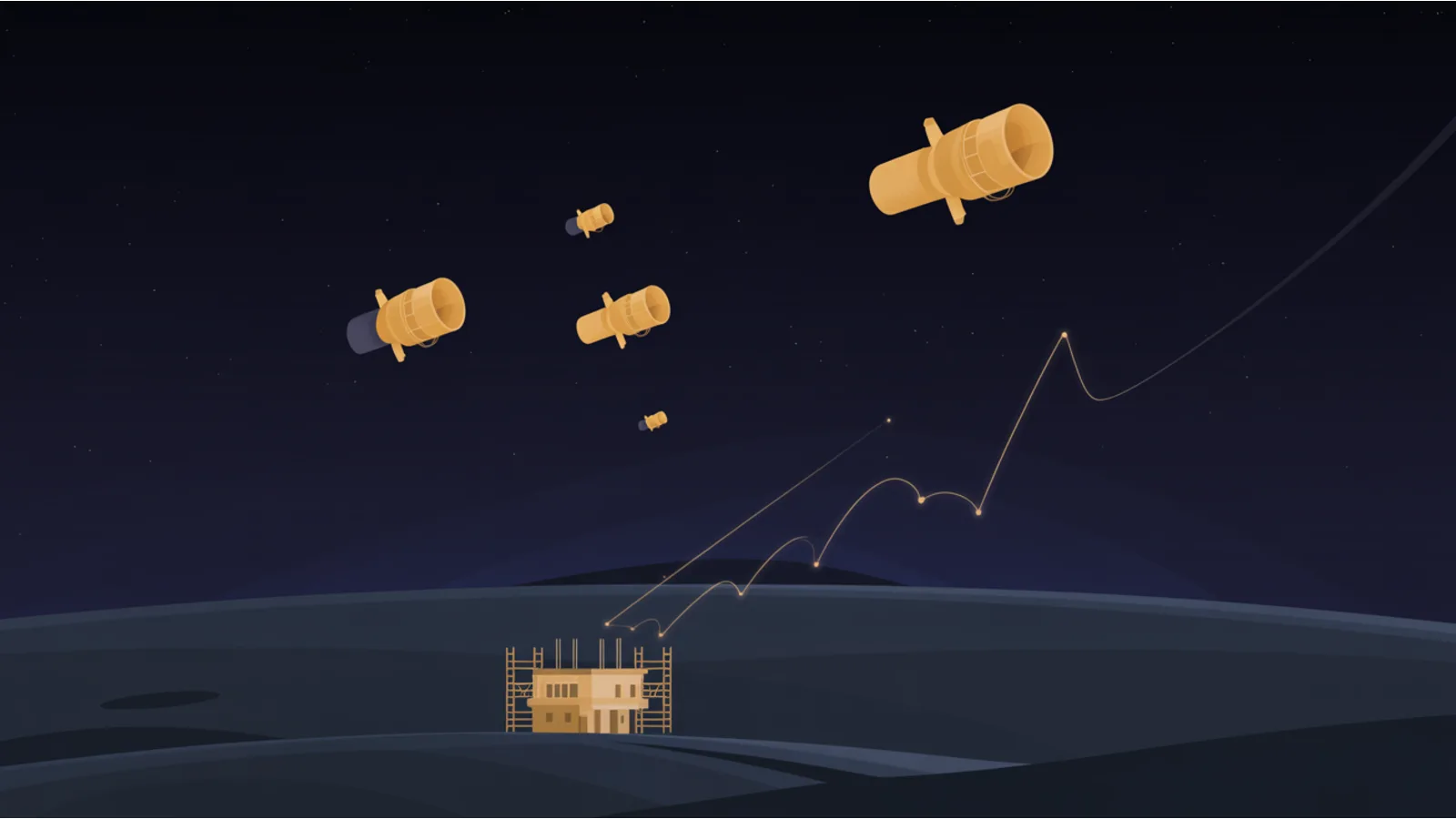
The Global Positioning System is one of the few pieces of public infrastructure that almost everyone touches every day without noticing. It steers aircraft, timestamps financial transactions, synchronises cellular networks, guides farm equipment, and underwrites a long list of military operations. Behind the satellites overhead sits a less visible layer: the ground control system that flies them, uploads their navigation data, and keeps the constellation healthy. For more than a decade, the United States tried to build a modern replacement for that ground brain. It was called OCX. It cost billions, ran roughly eight years late, and in the end the Space Force cancelled it before it ever ran the constellation for real.
This is a case where the mission was legitimate and the failure was still real. Both of those statements are true at once, and the record supports keeping them side by side.
What OCX was, and what it was not
The single most important distinction in this story is also the one that gets garbled most often. OCX, the Next-Generation Operational Control System, is the ground control segment. It is the software and hardware on the ground that commands and controls the modernised GPS III satellites. It is not the satellites themselves.
The satellites are a separate program built by Lockheed Martin. OCX was built by Raytheon, which rebranded to RTX in 2023, so older documents say "Raytheon" and newer ones say "RTX." Same prime contractor, different name. According to Defense News, Raytheon received the OCX development contract in 2012, with prototyping work reaching back to around 2007.
The point of OCX was not merely to replace aging equipment. It was meant to increase GPS accuracy, add automation, broadcast the encrypted, jam-resistant M-code military signal, and provide a cyber-hardened control system built to modern security standards rather than 1990s ones. Those are real capabilities with real national-security value. Keep that in mind, because the honest defence of this program rests on it.
The concrete stakes
The stakes were straightforward. The modernised GPS III satellites were designed to do things the legacy ground system could not fully exploit, above all the secure M-code signal. If the new ground system slipped, either the satellites would launch and fly on the old ground control anyway, or the new capabilities would sit unused in orbit. Both of those things happened.
The money, kept in its lanes
The recurring trap in reporting on OCX is treating several different dollar figures as one number. They are not the same, and the differences matter. Here is the record, each figure tagged with its year and its scope.
- Original estimate, 2012: approximately $3.7 billion, with operations targeted for around June 2017, per Air and Space Forces Magazine reporting on the 2012 Air Force estimate.
- Post-breach estimate, 2016 to 2019: roughly $6.2 billion, about a 68 percent increase over the original baseline, which GAO characterised as about $2.5 billion in cost growth since the 2012 start. This is the figure attached to the Nunn-McCurdy breach and the September 2018 rebaseline.
- As of November 2023: OCX Blocks 0, 1, and 2 totalled about $7.6 billion, which GAO framed as roughly a 73 percent increase over an approximately $4 billion ground-station baseline. Note that the $4 billion to $7.6 billion / 73 percent framing uses a slightly different baseline than the $3.7 billion to $6.2 billion / 68 percent post-breach framing. They are two different comparisons, not one.
- At acceptance, July 2025: the program cost was cited at roughly $7.6 to $7.7 billion. This is the projected, contracted total program figure.
- At termination, January 2026 accounting: the Space Force cited roughly $6.27 billion. This is money actually spent to date, described as Raytheon funding plus other government costs.
The $6.27 billion spent figure and the $7.6 to $7.7 billion projected program figure are not contradictory. They measure different things: money out the door versus total projected program cost across a different accounting scope. Merging them, or averaging them, would misstate the record. Some outlets have loosely rounded to "$8 billion" or referenced a "$10 billion" projection; those are rounded or ceiling-flavoured numbers, not the spent figure, and this piece does not treat them as the cost.
The timeline
- 2007: OCX prototyping work begins.
- 2012: Raytheon receives the OCX development contract; estimate about $3.7 billion, operations targeted around June 2017.
- June 30, 2016: the Department of Defense declares a critical Nunn-McCurdy unit-cost breach, triggered when a program's unit cost grows more than about 25 percent over projections. Air Force Secretary Deborah Lee James declared the critical breach.
- October 12, 2016: Pentagon acquisition chief Frank Kendall certifies the program to continue, finding OCX essential to national security with no cheaper alternative, per Defense News.
- September 2018: a new cost and schedule baseline is approved after the breach.
- December 23, 2018: the first GPS III satellite launches. It used OCX Block 0, delivered in 2017, for launch and early checkout only.
- May 2019: GAO publishes GAO-19-250, finding OCX delayed about five years with at least two more years of work remaining, and identifying the ground system, not GPS III satellite engineering, as the primary cause of delay.
- Mid-2019: Lockheed Martin delivers the Contingency Operations, or COps, upgrade to the legacy ground system, letting the modernised satellites be flown operationally on the old ground control. Lockheed's release announced this in June 2019; final qualification testing completed May 22, 2019.
- September 2024: GAO publishes GAO-24-106841, finding significant risks remained to delivering the capability.
- July 1, 2025: RTX formally delivers OCX via a DD-250 form and the Space Force contractually accepts it, roughly eight years past the original June 2017 target. Acceptance is not the same as operational.
- April 17, 2026: the Space Force terminates OCX after failed integrated testing, having spent about $6.27 billion, and pivots to incremental upgrades of the legacy ground system.
The irony: the satellites flew without it
The center of this story is a reversal. OCX existed to command the modernised GPS III satellites. But when the first GPS III satellite launched on December 23, 2018, OCX was not ready to do that job.
OCX Block 0 handled the launch and early checkout of that first satellite, and nothing more. For actual operational command and control, the Space Force fell back on the legacy ground system, the GPS Architecture Evolution Plan Operational Control Segment, known as AEP OCS, built by Lockheed Martin. Lockheed delivered a Contingency Operations upgrade, COps, to that legacy system in mid-2019 so it could control the more powerful new satellites.
So the modernised birds flew for years on the old ground software, upgraded with a patch, precisely because the new ground system built to fly them was late. That is the interim story in one sentence: the satellites arrived first, and the legacy ground system, not OCX, ran them.
The ending most write-ups get wrong
For years OCX read like a slow-motion recovery story: badly overrun, badly late, but grinding toward eventual delivery. On July 1, 2025, that appeared to arrive. RTX submitted the DD-250 for Blocks 1 and 2, and the Space Force contractually accepted the system.
But acceptance was never the finish line. The system still had to pass integrated testing against the broader GPS enterprise, meaning the satellites, the ground segment, and user equipment working together, before it could transfer to operations. It did not pass.
On April 17, 2026, the Space Force cancelled OCX. According to a primary Space Force release and defense-press reporting, integrated testing revealed extensive system issues across multiple capability areas. Col. Stephen Hobbs, the Mission Delta 31 commander, stated that "extensive system issues arose during the integrated testing of OCX with the broader GPS enterprise" and that "the challenges of onboarding the system in an operationally relevant timeline proved insurmountable." Officials concluded that forcing OCX into operations would put current GPS military and civilian capabilities at risk.
Tom Ainsworth, the acting Space Force acquisition executive, framed the lesson as a shift in strategy: the service needs to "deliver warfighting capability at a faster rate" and prioritise "rapid, incremental capability delivery versus complex all or nothing system deliveries."
Instead of OCX, the Space Force is pursuing incremental upgrades to the proven legacy AEP ground system. Lockheed Martin received a follow-on contract of about $105 million to support that path and to continue controlling the GPS III and upcoming GPS IIIF satellites.
So the honest arc is not "delivered eight years late." It is: accepted about eight years late in July 2025, then cancelled in April 2026 after roughly $6.27 billion spent, never operational at all. The GPS constellation's ground control continues to run on the legacy system it was meant to replace.
GAO had been flagging ground-system problems for a long time, with reporting on GPS ground-system issues dating to 2009 and a string of later reports including GAO-15-657 in 2015, GAO-18-74 in 2018, GAO-19-250 in 2019, and GAO-24-106841 in 2024.
The honest critique and the honest defence
The critique
By the numbers, OCX is a textbook acquisition failure. A ground system estimated near $3.7 billion in 2012 grew to roughly $6.2 billion by the 2016 critical Nunn-McCurdy breach and about $7.6 to $7.7 billion by 2023 to 2025. It slipped roughly eight years past its original target. DoD's own 2016 post-mortem, as reported by Air and Space Forces Magazine, attributed the overrun to an unrealistic original schedule, an underestimate of what cybersecurity would cost, a lack of software expertise inside the government, and poor systems engineering by the contractor. And after all of that, the system was cancelled before it ran the constellation. It was, in Ainsworth's own words, exactly the kind of "complex all or nothing" delivery the service now says it wants to avoid.
The defence
The mission was never the problem. GPS underpins both military operations and vast swaths of civilian infrastructure, and the legacy 1990s-era ground control cannot fully exploit modern capabilities, most importantly the encrypted, jam-resistant M-code signal and hardened cybersecurity. A modern, cyber-hardened GPS control system is a legitimate national need, not gold-plating.
Part of the overrun bought real value rather than pure waste. DoD's own account attributes much of the cost growth to underestimating cybersecurity requirements that were rightly tightened after 2010. Building a genuinely cyber-hardened control system for critical national infrastructure is expensive, and some of that expense was security the public should want.
There is also a defensible reading of the ending. Rather than push a system that had failed integrated testing into live operations, and risk the GPS service that aviation, finance, and the military depend on, the Space Force chose to cancel it and fall back on the proven legacy system with lower-risk incremental upgrades. That is a costly lesson, but the final decision protected the constellation the public relies on instead of gambling with it.
Both verdicts stand. The mission was worth pursuing, the cost and schedule outcome was a failure, and the program never fielded. The record does not require choosing one of those over the others.
Fact-check notes and sources
- OCX is the ground control segment for GPS III, prime contractor Raytheon/RTX, development contract 2012 with prototyping around 2007; adds M-code, automation, and cyber-hardening. Raytheon rebranded to RTX in 2023. Defense News, October 17, 2016
- Original OCX estimate at 2012 program start was approximately $3.7 billion, with operations targeted around June 2017. Air and Space Forces Magazine
- DoD declared a critical Nunn-McCurdy unit-cost breach on June 30, 2016; Frank Kendall certified continuation on October 12, 2016 as essential with no cheaper alternative; a new baseline was approved September 2018. Defense News, October 17, 2016
- Post-breach cost grew from about $3.7 billion to roughly $6.2 billion, about a 68 percent increase and about $2.5 billion of growth since 2012. GAO-19-250 (May 2019)
- DoD's stated root causes in 2016: unrealistic schedule, underestimated cybersecurity cost, weak government software expertise, and poor contractor systems engineering. Air and Space Forces Magazine
- GAO-19-250 found OCX delayed about five years with at least two more years remaining, and named the new ground system, not GPS III satellites, as the primary delay driver. GAO-19-250 (May 2019)
- Cost reached about $7.6 billion as of November 2023, roughly a 73 percent increase over an approximately $4 billion baseline; GAO-24-106841 (September 2024) found significant remaining risk. National Defense Magazine, November 12, 2024 and GAO-24-106841
- The first GPS III satellite launched December 23, 2018; OCX Block 0 handled launch and checkout only, while operational control ran on the legacy AEP OCS upgraded by the COps patch, delivered mid-2019. Lockheed Martin, June 11, 2019
- RTX delivered OCX via DD-250 on July 1, 2025 and the Space Force contractually accepted it, roughly eight years past the June 2017 target and at a cost cited around $7.6 to $7.7 billion; acceptance is not operational. Air and Space Forces Magazine
- The Space Force terminated OCX on April 17, 2026 after failed integrated testing, citing about $6.27 billion spent as of January 2026, and pivoted to legacy AEP upgrades with a roughly $105 million Lockheed follow-on. The $6.27 billion is spent-to-date, distinct in scope from the roughly $7.6 to $7.7 billion projected program cost. Breaking Defense, April 2026
- Termination quotes from Tom Ainsworth and Col. Stephen Hobbs, drawn from the official Space Force statement and reported verbatim in defense press. Inside GNSS
- Post-breach cost figure of $6.2 billion and 68 percent, contractor context. C4ISRNET, May 22, 2019
Related reading
- The NPOESS and JPSS weather-satellite saga: another modernisation program where cost growth and schedule slip forced a restructuring.
- NGA EnhancedView commercial imagery: how the government buys and sustains space-based capability from contractors.
- Army Future Combat Systems: a large, complex all-in-one program that was cancelled before fielding.
- The GAO High-Risk List and improper payments: the oversight lens that flags programs like OCX early and often.
- The public-money programs index: the full set of program cost breakdowns in this series.
This post is informational and journalistic, not legal or financial advice. It describes public programs and documented events; mentions of third parties are nominative fair use and no affiliation is implied.
