
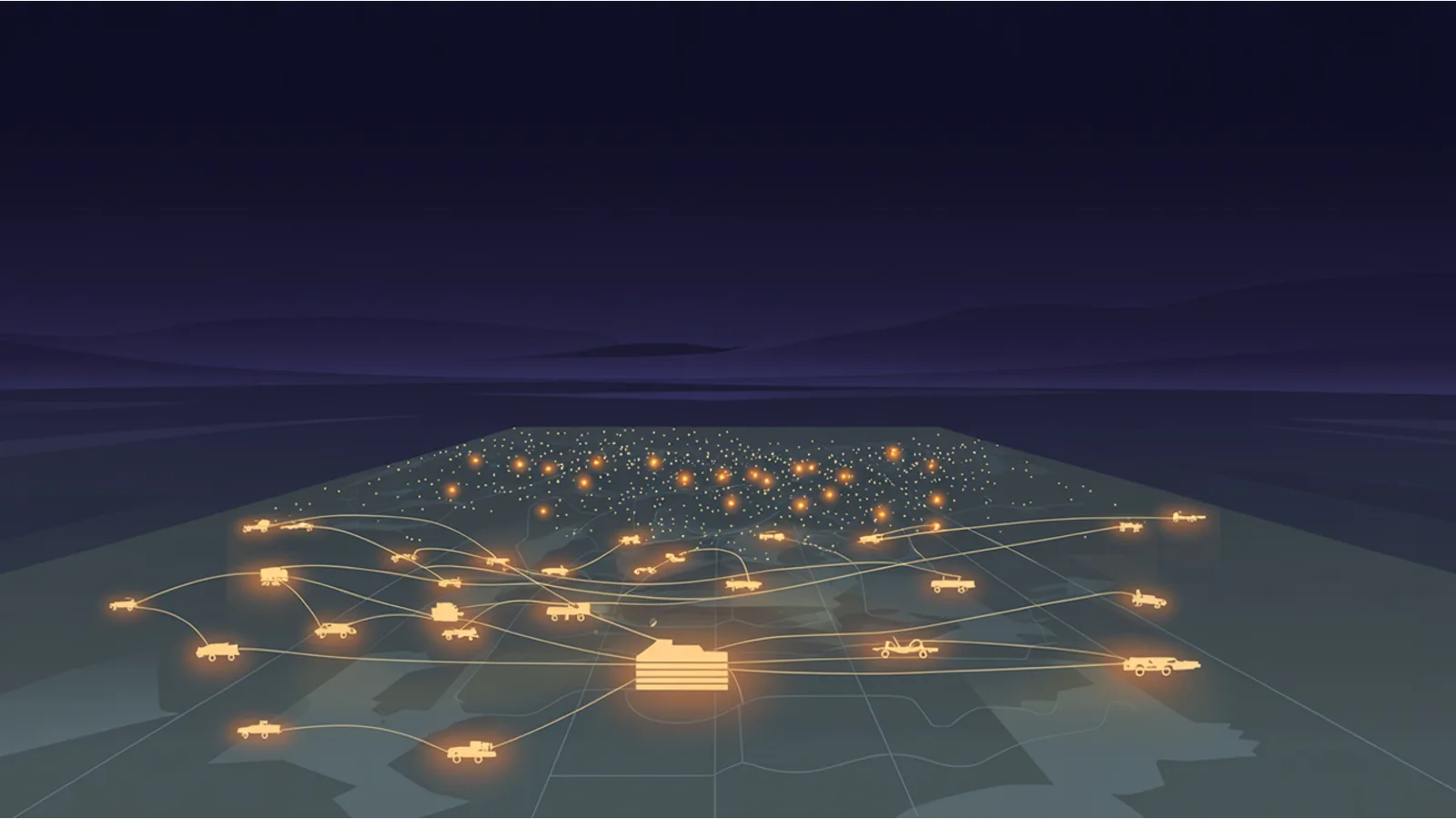
In the 1991 Gulf War, an American tank crew that wanted to know where friendly units were used a map, a compass, and radio calls. There was no live picture of the battlefield inside the vehicle. According to figures reported by Air Force Magazine in June 2004, fratricide was blamed for 35 of 148 U.S. battle deaths in Desert Storm, roughly 24 percent. That number is the reason the U.S. Army spent the next decade building a system to put a moving digital map of friendly and, where available, enemy positions into the crew compartment of a fighting vehicle.
The system was Force XXI Battle Command Brigade and Below, universally abbreviated FBCB2. Its network layer became known as Blue Force Tracking. Unlike most of the programs in this public-money series, this one is not a story about a capability that never arrived. It is a story about a capability that worked, was used hard in combat, and then cost a great deal of money and organisational effort to feed, scale, and reconcile. Both halves of that are true at once, and this post keeps them side by side.
What FBCB2 was, and the three names that get confused
Three terms travel together in this story, and conflating them is the fastest way to get the record wrong.
- FBCB2 is the terminal and system: a vehicle-mounted digital command-and-control device that displays friendly ("blue") and hostile ("red") force locations on a moving map. The U.S. Army awarded the prime development contract to TRW in 1995; TRW was acquired by Northrop Grumman in 2002. Exact contract values varied by increment, so no single dollar figure captures the whole program.
- Blue Force Tracking (BFT) is the transport and capability layer, the network that moves position reports, not the box on the dashboard. The first-generation FBCB2-BFT used L-band satellite communication for beyond-line-of-sight position reporting across wide areas.
- JBC-P, Joint Battle Command-Platform, is the successor generation. More on it below.
A further distinction matters inside the program itself. Alongside the satellite-based FBCB2-BFT, the Army ran a variant called FBCB2-EPLRS, which used the terrestrial Enhanced Position Location Reporting System, a line-of-sight radio, for faster local updates. These were two genuinely different transports riding on the same terminal family: the satellite path reached far but refreshed slowly, and the terrestrial path was fast but local. That parallelism is part of the cost story later on.
FBCB2 saw early operational use in the Balkans, in Bosnia and Kosovo around 1998, before it became famous in Iraq.
The 2003 payoff
FBCB2 was still only partially fielded when the 2003 invasion of Iraq began. That partial fielding is central to how its combat value was later assessed, and it is a detail worth holding onto: only some vehicles in a given unit carried the system. The Association of the U.S. Army records that Task Force 2-7 Infantry received 27 FBCB2 systems, a few of them with Blue Force Tracking, less than two months before the 21-day drive toward Baghdad.
What the system gave those units was concrete. According to the Association of the U.S. Army, FBCB2 let crews navigate during blinding sandstorms, coordinate attacks with greater precision, and exchange text messages on the move. None of that existed at scale in 1991. The wider communications backdrop had changed too: the U.S. Government Accountability Office reported in GAO-04-547 (June 2004) that U.S. forces in Iraq had roughly 42 times the bandwidth available in Desert Storm. That figure is a theater-wide communications number, not an FBCB2-specific measurement, but it describes the environment the system operated in.
The most-cited claim about FBCB2 is that it reduced friendly fire, and this is where careful attribution matters more than a headline. Air Force Magazine, in June 2004, reported that fratricide accounted for about 11 percent of 115 U.S. battle deaths in the major-combat phase of Operation Iraqi Freedom, against about 24 percent (35 of 148) in the 1991 Gulf War, citing Adm. Edmund Giambastiani. The two percentages rest on different denominators, and the comparison is an overall Desert Storm versus Iraqi Freedom figure, not a controlled measurement of what Blue Force Tracking alone caused. The honest way to state it: fratricide fell sharply between the two conflicts, and FBCB2 is widely credited as one contributor, in a period when much else also changed.
An even stronger claim circulates: that among units with even partial FBCB2 deployment, fratricide fell to zero during the Baghdad campaign. That appears in Association of the U.S. Army accounts and in a Naval Postgraduate School case study. It is an observed outcome in specific, partially equipped units over a short campaign, widely repeated but not a controlled statistic. It belongs in the record as something reported and credited, not as a program-wide guarantee.
The program also collected reputational markers. According to secondary summaries of the program history, FBCB2/BFT was recognised in 2001 as one of the five best-managed software programs in the U.S. Government, and picked up innovation and management awards in 2003. Awards are a signal of how the program was regarded, not an independent measure of battlefield performance, but they cut against any lazy assumption that this was a troubled effort.
The bill: bandwidth, satellites, and a scramble of incompatible systems
Now the other half. The oversight critique of Blue Force Tracking is real, and it is about cost, capacity, and fragmentation rather than failure.
Multiple systems that could not talk to each other. GAO-04-547 found that ground forces in Iraq arrived with "several different, non-interoperable Blue Force Tracking systems" and that "there is no joint standard for such tracking systems." Air Force Magazine put a number on the same problem, reporting as many as nine different blue-force-tracking systems in theater that often could not share information with one another, a figure attributed to Marine Lt. Col. Mike Sweeney. GAO used the word "several" without a count, so the roughly nine figure should be attributed to the named officer, not to GAO. Either way, commanders had to invent field workarounds to stitch these systems together.
Bandwidth and satellite limits. Even with 42 times the Desert Storm bandwidth, GAO reported continuing shortages. Air Force Magazine quoted Lt. Gen. William S. Wallace citing "limitations in satellite capability" as the reason FBCB2, which he called "extraordinarily successful," could not be fielded more widely. The first-generation L-band network updated a vehicle's own position within 10 to 15 seconds, but positions for other friendly forces could take several minutes to appear. That refresh gap is a first-generation BFT limitation, later addressed by the second-generation network.
Parallel transports and slow reconciliation. The satellite FBCB2-BFT and the terrestrial FBCB2-EPLRS ran side by side, and separate logistics tracking added more variants. According to a U.S. Army War College strategy paper (DTIC ADA482366), the Joint Requirements Oversight Council issued memoranda, cited in that paper as JROCM 161-03 (2003) and 163-04 (2004), designating FBCB2 as the future battle-command system for joint forces at brigade and below and directing the Army and Marine Corps to converge on a single ground blue-force-tracking capability. Those memorandum numbers come from the War College paper rather than from the public memoranda themselves, so they carry medium confidence, and the paper describes near-term progress on consolidation as limited.
The fair summary of the critique is version proliferation, bandwidth demand, and years of reconciliation cost: the messy price of keeping and scaling a network that worked, not evidence that it did not.
Keeping the money straight
Two number traps are worth flagging explicitly, because they recur across this series.
First, platform counts are cumulative snapshots that rise over time, and each needs its year attached. Army program articles reported more than 95,000 FBCB2 systems deployed by early 2011, more than 100,000 by mid-2011, more than 120,000 platforms by 2013, and more than 130,000 by 2015. Those are not a single total; they are the same fielded base growing.
Second, a separate air-ground capability is sometimes mistaken for FBCB2's own cost. GAO-06-240R documents that U.S. Joint Forces Command's Joint Blue Force Situational Awareness translation project, which moved BFT data from ground command systems to strike aircraft, cost about $3.38 million, and that a follow-on carried a $15.0 million budget ($6.4 million research and development plus $8.6 million procurement). Those are Joint Forces Command project costs for air-ground sharing under Limited Acquisition Authority. They are not FBCB2 program costs, and GAO reported that the translation work reduced the time to determine "red" targets. Keep those small component figures visually and rhetorically apart from the six-figure platform counts and the broader program.
The successor, and an honest test-range caveat
The next generation is Joint Battle Command-Platform (JBC-P). According to the Army and its program office, JBC-P added a faster second-generation satellite network known as BFT-2, a touchscreen interface, and chat-style messaging, and it reached first unit equipped in May 2015.
The successor's early testing was not clean, and the record should say so. The Department of Defense's Director, Operational Test and Evaluation reported in its FY2014 assessment that JBC-P Software Build 6.0 was not operationally effective, because it did not meet user requirements for command-and-control message completion within the required speed of service, and not operationally suitable, because it was not reliable on most hardware versions. The same report noted that it did meet the maintainability requirement for mean time to repair. This is a snapshot of one software build, not a verdict on the whole successor program; later builds were fielded. It belongs here as an oversight finding on a specific increment, the same way the interoperability and bandwidth findings apply to first-generation BFT.
The critique and the defense, side by side
The honest critique. The force went to war in 2003 with multiple non-interoperable blue-force-tracking systems and no joint standard, per GAO-04-547, and commanders had to hand-stitch them together. First-generation FBCB2-BFT was bandwidth-hungry and satellite-constrained; GAO reported continuing shortages even at 42 times the Desert Storm bandwidth, and a corps commander said satellite capacity was the reason the system could not be fielded more widely. The Army ran parallel satellite and terrestrial transports, JROC-directed consolidation moved slowly, and even the successor's Build 6.0 flunked its FY2014 operational test. The cost of this capability was not only dollars; it was bandwidth, fragmentation, and years of reconciliation.
The honest defense. This is one of the clearer "the network worked" stories in modern military acquisition. Blue Force Tracking gave crews a live map of where friendly and sometimes enemy forces were, and it delivered real payoff in combat: navigation through sandstorms, faster and more precise coordination, and text messaging on the move, none of it available at scale in 1991. It is widely credited with improving situational awareness and reducing fratricide, in a period when fratricide fell from roughly 24 percent of U.S. battle deaths in Desert Storm to about 11 percent in the major-combat phase of Operation Iraqi Freedom, and Army case-study accounts report that partially equipped units saw friendly-fire incidents drop to zero during the Baghdad campaign. The program was repeatedly recognised for good management. The criticism is what it cost to build, feed, and reconcile the network, not whether the capability was real.
Both verdicts stand. FBCB2 and Blue Force Tracking earned their reputation, and the reconciliation bill was earned too. In the ledger of where the public money goes, this is what a genuine success with a large maintenance and integration cost looks like, and it is worth being just as precise about the second part as the first.
Fact-check notes and sources
- Fratricide fell from about 24 percent (35 of 148) of U.S. battle deaths in Desert Storm to about 11 percent of 115 in the major-combat phase of Operation Iraqi Freedom, citing Adm. Edmund Giambastiani; the drop is an overall comparison across different denominators, not a controlled measurement of Blue Force Tracking's effect. Also the source for the "as many as nine" incompatible systems, the 10-to-15-second own-position versus several-minutes-for-others refresh, and the satellite-capacity limit on wider fielding: Air & Space Forces Magazine, June 2004.
- Ground forces arrived in Iraq with "several different, non-interoperable Blue Force Tracking systems" and "no joint standard," and theater bandwidth was roughly 42 times that of Desert Storm yet still short: U.S. GAO, GAO-04-547 (June 2004).
- Task Force 2-7 Infantry received 27 FBCB2 systems shortly before the drive on Baghdad; sandstorm navigation, precise coordination, and on-the-move messaging; and the case-study report that fratricide fell to zero in partially equipped units (framed as reported, not measured): Association of the U.S. Army.
- JBC-P Software Build 6.0 found not operationally effective and not operationally suitable in FY2014, though it met the mean-time-to-repair requirement (a single-build snapshot): DoD Director, Operational Test & Evaluation, FY2014 JBC-P report.
- JROCM 161-03 (2003) and 163-04 (2004) designating FBCB2 as the joint brigade-and-below system and directing consolidation, cited via a War College paper rather than the memoranda themselves (medium confidence): U.S. Army War College, DTIC ADA482366.
- Joint Forces Command's air-ground BFT translation project cost about $3.38 million with a $15.0 million follow-on ($6.4 million R&D plus $8.6 million procurement), a component cost distinct from the FBCB2 program: U.S. GAO, GAO-06-240R.
- Program lineage (TRW prime contract 1995, Northrop Grumman acquisition 2002), early Balkans use around 1998, and management-award recognition; exact contract value varies by increment: Force XXI Battle Command Brigade and Below program summary.
- The distinction between FBCB2-BFT (L-band satellite, beyond-line-of-sight, slower) and FBCB2-EPLRS (terrestrial radio, line-of-sight, faster local): Blue Force Tracking summary.
- Cumulative platform growth (more than 95,000 by early 2011, more than 100,000 by mid-2011, more than 120,000 by 2013, more than 130,000 by 2015) and JBC-P/BFT-2 succession with first unit equipped May 2015: U.S. Army program article.
Related reading
- Command Post of the Future (CPOF): the higher-echelon side of digital command and control that BFT fed into.
- WIN-T, the Army's tactical network: the transport backbone that shaped how much bandwidth systems like FBCB2 could claim.
- DCGS-Army versus Palantir: another Army data-and-display program where integration, not the core idea, drove the controversy.
- The GAO High-Risk List and improper payments: the oversight lens this series applies to federal spending.
- The public-money programs index: the full set of program write-ups in this series.
This post is informational and journalistic, not legal or financial advice. It describes public programs and documented events; mentions of third parties are nominative fair use and no affiliation is implied.
