
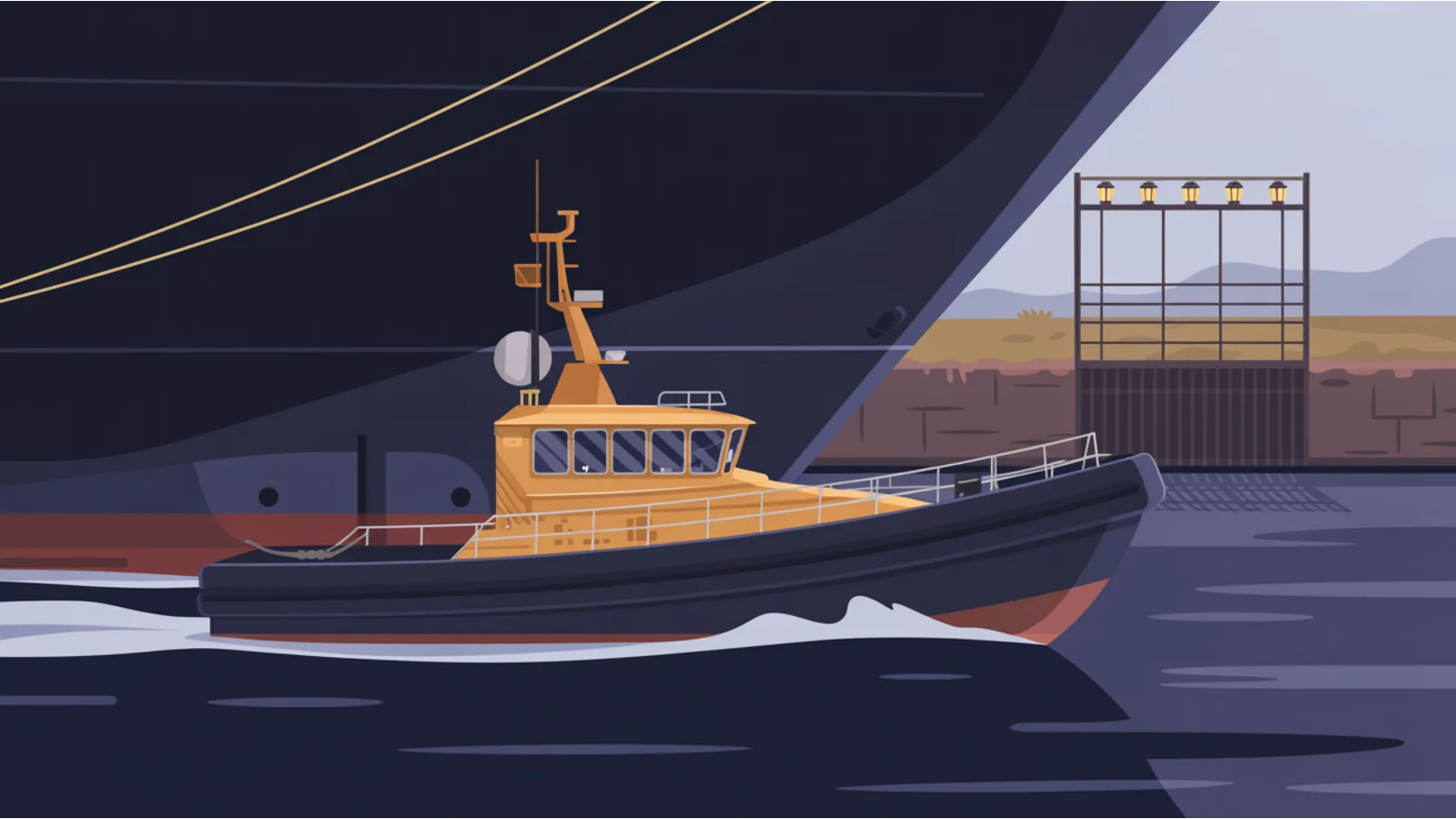
Third in a series on jobs whose pay system is stranger than the salary. The first two were airline pilots and railroad crews, both of whom bargain under a federal statute. Harbor pilots do not bargain at all, which turns out to be the more interesting arrangement. Every figure below is cited to a state agency, a statute, or an audited financial statement, and where a number could not be verified I say so rather than estimating.
There is one occupation in America where a government body meets, on the record, and votes on how many people are permitted to hold the job. Then a second government body sets the price of their labor by published formula.
On May 21, 2026, the Washington State Board of Pilotage Commissioners voted six to three to keep the number of Puget Sound pilots at sixty. A shipping industry association had written in February asking that it be cut to fifty five. The board ran the arithmetic it always runs, forecast vessel assignments divided by a target of 123 assignments per pilot per year, plus one pilot for the association president and one to cover anybody not fit for duty, and declined.
In California the statutory ceiling is sixty and the actual roster is fifty three.
That is the whole story. Everything else is consequence.
What that scarcity is worth
Two states publish real numbers, which is unusual and which is why this article can exist at all.
Washington's board publishes per pilot income annually, drawn from the pilot association's audited financial statements:
| Puget Sound pilots | Per week | Per month | Per year |
|---|---|---|---|
| 2021 | $5,685 | $24,635 | $295,616 |
| 2023 | $6,589 | $28,550 | $342,605 |
| 2024 | $8,646 | $37,466 | $449,591 |
That is a 52 percent increase in three years, and a 31 percent increase in 2024 alone.
California's last published figure comes from audited financials filed in a 2015 rate proceeding, and the income statement carries a line item named, without euphemism, average net income per pilot:
| San Francisco bar pilots | Per week | Per month | Per year |
|---|---|---|---|
| 2013 | $8,253 | $35,763 | $429,155 |
| 2014 | $8,726 | $37,811 | $453,729 |
Now set those against the federal wage statistics for the occupational category that nominally contains this job. In May 2025, captains, mates and pilots of water vessels had a median of 92,460 dollars and a ninetieth percentile of 170,640.
A Puget Sound pilot earns 2.6 times the ninetieth percentile of their own job category, and 4.9 times the median.
The reason is a measurement artifact worth understanding. The federal survey covers wage and salary workers and explicitly excludes "the self-employed, owners and partners in unincorporated firms." State pilots are partners in unincorporated associations. The federal wage statistics structurally cannot see them. The category that carries their job title tops out at 170,640 while the actual practitioners in two documented ports average around 450,000.
Nobody negotiates. A formula decides.
This is the part that makes harbor pilots the opposite of every other job in this series. There is no union bargaining a contract. There is a state tariff, and the pilots get whatever it yields.
California's formula is written into the code, and it is remarkable to read:
Revenue requirement = pilot costs and expenses + (target net income per pilot × number of pilots)
The state sets a target income per pilot as an input, then works backward to the price shippers pay. In setting that target the board must consider the skill required, "the difficulty, risk, and lifestyle commitment," compensation at other state pilotage associations, regional economics, and price indices.
Louisiana goes further. Its statute requires rates to cover "fair average annual compensation for a state ship pilot, in comparison to regulated state ship pilotage in other United States ports." Every port is benchmarked against every other port, which is a ratchet that structurally cannot fall. And if the fee commission fails to decide within twelve months, the pilots' proposed increase takes effect automatically.
Florida writes a floor directly into law: "overall compensation accorded pilots should be equal to or greater than that available to such individuals in comparable maritime employment."
Washington hands the job to its Utilities and Transportation Commission, the same agency that regulates electric and gas utilities. Pilotage is rate-regulated like a power company.
Two findings from California's 2015 rate case deserve quoting because they show the machinery working. The first is an admission that there is no market price at all:
because of lack of transparency and difficulty in obtaining compensation data, neither party presented evidence of income paid to pilots for comparable services in other ports
The second is a shipper association arguing, on the record, that pilot income could be raised by cutting the number of pilots rather than raising rates. The state rejected it on fatigue grounds. But somebody said the quiet part into a microphone.
Who decides how many, and who benefits from the answer
The cap is the asset. So the question of who sets it matters enormously, and the answer varies by state in ways that range from arm's length to frankly astonishing.
Washington is the clean version. A nine member board, a published formula, a public vote, and shippers who show up to argue for fewer pilots and lose.
Texas hands the appointment to the governor, but with a mechanism worth noticing. Each branch pilot may appoint two deputy branch pilots, subject to board approval. Once the board qualifies an applicant, the application goes to the pilots' own association, which places it in a pool. After five years without appointment, the applicant must start over.
The chairman of the Houston board wrote the conflict down himself, in a board presentation, which is the single most candid sentence in this entire research file:
Does the Houston Pilots Association business model have an inherent conflict in insuring there are sufficient Pilots to provide Adequate Pilot services? More Deputy Pilots means less of a share for Full Pilots.
Louisiana dispenses with the arm's length entirely, on the face of the statute. The Board of Examiners of Bar Pilots consists of three examiners, all of whom must themselves be bar pilots. The river port commissioners must all hold river port pilot commissions. The statute says examinations are held "whenever there exists a necessity for more pilots as determined by the river port pilots." And if the examiners displease the people they regulate, a majority of the commissioned pilots can sign a statement and have them removed by the governor.
Incumbents staff the board, incumbents decide when vacancies exist, and incumbents can fire the examiners.
I could not verify any official finding quantifying family relationships in pilot appointments, so I am not putting a number on it. But there is a telling artifact in Texas law: the legislature wrote an anti-nepotism clause for exactly one port. In Brazoria County, a board may not approve a deputy appointment if the appointee is closely related to the appointing pilot, unless every member of the association recommends it in writing. No comparable provision exists for Houston, Galveston, Sabine, Corpus Christi, or anywhere in Louisiana.
How the money actually reaches a person
Pilots are not employees. They are partners, and the association exists to bill, dispatch, run the boats, and train.
Washington publishes the full waterfall for 2024:
- Gross pilotage revenue 43,650,014 dollars
- Less operating expenses of 17,985,325, covering the Seattle office, the Port Angeles station, and the pilot boats
- Leaving a revenue pool of 25,664,689
- Less disability insurance reimbursements
- 25,419,096 distributed among the pilots, or 449,591 each
The expense line is where things a normal job would call benefits already sit: 6,509,769 dollars of pilot training, 1,740,783 of pilot medical insurance, and 377,000 of state license fees, all paid before anyone takes a distribution. The association also owns two pilot boats and a station outright.
San Francisco's structure adds a detail I have not seen anywhere else. Membership in the association is redeemed, not sold. On resignation, death or expulsion, a member's certificate is bought back within sixty days at a price equal to the average of the prior three years' average net income per pilot, which at the end of 2014 was approximately 429,000 dollars. You buy in by being appointed and you cash out at roughly one year's income. They have filed partnership tax returns since 1979.
And there is one more structural protection worth knowing: under a 1906 Supreme Court decision, a pilot association cannot be held liable for the negligence of one of its members during pilotage. Several states also cap individual liability by statute. In Houston, a pilot's liability for error or neglect is one thousand dollars, absent willful misconduct or gross negligence.
The pension, funded by a tax on shipping
California created a pension for its bar pilots by statute in 1975. The benefit is 46 percent of the average of the highest three of the last five years of audited average net income per pilot, divided by twelve, multiplied by years of service beyond twenty five. Eligibility begins at age sixty with ten years. It is funded by a surcharge levied on shipping, expressed in mills per gross registered ton.
As of the fourth quarter of 2025, across 85 participants:
| California pilot pension | Per week | Per month | Per year |
|---|---|---|---|
| Average target benefit | $3,327 | $14,419 | $173,028 |
| Highest individual target benefit | $6,156 | $26,678 | $320,136 |
Participants received 122.3 million dollars over the ten years from 2016 to 2025.
Compare that to the pattern in the rest of this series. Airline pilots get an 18 percent employer contribution. Railroaders get a 13.1 percent employer surtax into a separate federal system. Harbor pilots get a retirement benefit created by state law and funded by a levy on the ships they guide. In each case the money arrives because a rule requires somebody other than the worker to put it there.
What it costs to get in
The published incomes are extraordinary. The path is brutal, and it is the reason the incomes survive scrutiny.
The federal floor requires at least 36 months of deck service on self propelled vessels, of which 18 months must be bridge watchkeeping, and at least 12 of those on the specific class of waters. Route familiarization requires 12 to 20 round trips, and at least a quarter of them must be made in darkness.
The state gate is far higher. The pilots' own national association describes formal apprenticeships running one to three years for a mariner with an advanced credential and up to seven years for someone with less experience, with trip requirements ranging "from hundreds to thousands." On the entrance exam, it notes that "some selectees indicate they studied at least 1,000 hours," and that many candidates go through the selection process more than once.
Washington's process is the best documented. Candidates need a master's license held for at least two years, must be over 25 and under 70, pay a 400 dollar application fee, pass a written exam and a simulator evaluation, and then sit on a ranked waiting list until a training slot opens. Trainees must resign their current employment. The stipend is now 9,500 dollars a month. The program must finish within 36 months. Along the way a trainee must reproduce the navigational chart from memory and write a route description for each of the 24 separate areas of Puget Sound. After licensing, the first license is restricted, and the restrictions come off only after five years.
Houston requires three years as a deputy branch pilot, and a deputy certificate expires on its third anniversary and cannot be renewed. Applicants need roughly 1,080 eight hour days of sea service, a 25,000 dollar bond, and either two years on the ship channel or a hand drawn chart of it from memory.
| The junior years | Per week | Per month | Per year |
|---|---|---|---|
| California trainee stipend | $1,962 | $8,500 | $102,000 |
| Washington trainee stipend | $2,192 | $9,500 | $114,000 |
So the junior figure is roughly six figures, which sounds generous until you notice it is preceded by a decade at sea and followed by five years of restricted licensure. Washington's board states the timeline plainly: the pathway to pilotage averages 25 years from high school graduation, and the average age of a newly licensed pilot in the state is 43.
There is no tuition. There is just your thirties.
The cost column
Boarding a moving ship is the actual job hazard, and the states treat a fall from a pilot ladder as a reportable marine casualty whether or not anyone is hurt.
The scale of it is documented. In 2024, Washington's pilots filed 140 reports of unsafe transfer arrangements, an average of twelve a month, from a corps of 59. The recurring defects were retrieval lines rigged where the pilot boat can snag them, ladders that are old or counterfeit, and accommodation ladders not properly secured. The board's own language from 2022:
2022 was a dangerous year for pilots with multiple fatalities internationally during transfers.
Noncompliant ladders have caused serious injury and death.
I could not obtain a national count of US pilot boarding fatalities, so I am not publishing one.
Two tariff line items tell you what else the states expect to go wrong. California charges 5,000 dollars plus expenses if a pilot is carried away to sea, meaning the ship left with them still aboard. Washington authorizes extra compensation for "being carried to sea on vessels against the will of the pilot."
Fatigue is structural. Pilots may be on call for up to 15 consecutive days, though most work seven on and seven off. Sandy Hook pilots were recorded working four weeks on and two weeks off. In Puget Sound the workload runs about 11.5 assignments per pilot per month, and 11.7 percent of assignments were completed by pilots called back from respite.
And the career can end in a courtroom. California's rate findings note that after the 2007 COSCO BUSAN allision with the Bay Bridge, the responsible pilot was convicted of a crime and imprisoned, which the state called a "sea change in the range of possible consequences to a pilot." Medical fitness rules were also tightened, and the state's own 2025 roster shows four separate pilots spending months listed as licensed but not fit for duty, one for nearly five months.
Mandatory retirement varies. Washington terminates a license at 70. Houston, Brazoria and Sabine cut off at 68. California, Florida, Virginia and Louisiana impose no age limit at all.
What a salaried reader should take from this
I am not suggesting anyone can become a harbor pilot. Roughly 1,250 of them exist nationally, which is my arithmetic from a state board's remark that about fifty women pilots represent four percent of the corps, not a published figure. The lessons are structural.
Scarcity that somebody enforces is worth more than skill that nobody counts. A harbor pilot's income does not come from being better at ship handling than the ship's master. It comes from a state statute saying only sixty people may do it in that water. Every high paying job in this series has a scarcity mechanism behind it, whether it is a 1,500 hour rule, a seniority list, or a board vote.
Watch who sits on the body that sets the number. In Washington that body is public, formula driven, and votes against the shipping lobby. In Louisiana the examiners are required by law to be incumbent pilots who can be removed by a majority of incumbent pilots. Same occupation, opposite governance, and it is entirely reasonable to think differently about the two.
Benchmarking clauses compound in one direction. Louisiana ties its rates to what pilots earn in other ports, and Florida requires compensation at least equal to comparable maritime work. When every port is indexed to every other port, the floor only ratchets up. That is precisely the mechanism ordinary wages lack, which is the whole argument of the COLA piece.
And the federal statistics may simply not describe you. The wage survey that says this job tops out at 170,640 excludes partners in unincorporated firms, so it misses the people actually doing it by a factor of three. Anyone comparing offers using published averages should first ask whether the average is even measuring the thing they are looking at.
Related reading
- The Toll Booth: the full index: where this piece sits in the series on who collects rent on the things you cannot avoid, and every other toll alongside it.
- How airline pilots are paid: credit hours, rigs, and a snap-up clause that synchronized three airlines.
- How railroad workers are paid: paid by the mile, and a separate federal pension system.
- How longshoremen are paid: the other job on the same dock, where a closed register and a cargo royalty do what the wage does not.
- How Saltchuk was built: the private maritime empire that operates in this water, and where its money really comes from.
- The raise written into the contract: the wider set of workers whose raise is a document.
- COLA versus the merit raise: why an indexed number pulls away from a discretionary one.
Fact-check notes and sources
Compensation figures come from state agencies and audited financial statements. Several important figures could not be verified and are identified as such rather than estimated.
- Puget Sound per pilot income for 2023 and 2024, the revenue waterfall, the expense detail, the 140 unsafe transfer reports, the workload and respite callback figures, the pathway timeline and average age of a new pilot, and the trainee stipend spend are all from the Washington State Board of Pilotage Commissioners 2024 annual report, which states the income figures are drawn from the pilot association's audited financials. The 2021 and 2022 figures and the quoted safety language are from the 2022 annual report.
- The 2026 vote to keep the number at sixty, the shipping association's request to cut it to fifty five, and the assignment-based formula are in the board's 2026 number of pilots determination. The board's authority to set the number is WAC 363-116-065.
- San Francisco per pilot income, the partnership structure, the certificate redemption price, and the 1979 partnership filing date are from the 2014 audited financial statements filed with the California Board of Pilot Commissioners. This is the most recent published California per pilot figure I could find; the Board has not published association financials since the 2015 rate proceeding, so do not treat 453,729 dollars as a current number.
- California roster size, vessel movements, trainee outcomes and the 2025 incident record are from the Board's 2025 legislative report. The count of 53 licensed pilots is derived by enumerating the published roster; the report does not state a total.
- The rate formula setting a revenue requirement from a target net income per pilot, and the factors the board must weigh, are at California Harbors and Navigation Code division 5, chapter 6. The tariff itself, including the 5,000 dollar carried-away charge, is in chapter 5. The quoted findings about absent comparable data, the proposal to reduce pilot numbers, and the COSCO BUSAN consequences are in the Board's 2015 rate findings.
- The California pension formula, eligibility and funding mechanism are at Harbors and Navigation Code division 5, chapter 3. Participant counts and target payment figures are from the Board's February 2026 pension staff report.
- Washington rate regulation by the Utilities and Transportation Commission is RCW 81.116.020 and RCW 88.16.055. Licensing requirements are RCW 88.16.090, the age 70 termination is RCW 88.16.102, and the trainee process and stipend are published at pilotage.wa.gov.
- Texas: the deputy appointment mechanism, the governor's commission, the three year deputy requirement and the age 68 limit are in Transportation Code chapter 66. The anti-nepotism provision that exists for only one port is chapter 68, section 68.038(c). The board chairman's quoted remark about deputy pilots reducing full pilots' shares, and the 2022 headcount, are from a board presentation. The five year pool expiry is at the board's application procedure page. Houston pilot compensation is unverified: state law requires a pilot financial report at every rate hearing, but it is not published, and neither the 2021 nor the 2025 rate order states a per pilot figure.
- Louisiana: the requirement that examiners be bar pilots is R.S. 34:942, that commissioners hold river port commissions is R.S. 34:991, that examinations are held when the pilots determine a necessity exists is R.S. 34:993, and that a majority of pilots can have examiners removed is R.S. 34:946. The rate standard benchmarking to other US ports and the twelve month automatic increase are at R.S. 34:1122. Louisiana pilot compensation is unverified and is affirmatively absent from the state auditor's record: a full enumeration of the Legislative Auditor's public report index found only four pilot related reports, all routine audits of the fee commission, none containing compensation or headcount data.
- Florida's compensation floor is Florida Statutes 310.151. Virginia's utility style ratemaking is Virginia Code 54.1-918.
- Federal sea service and route familiarization requirements are 46 CFR 11.703 and 46 CFR 11.705. The description of state apprenticeships, the study hours remark, the self employed partnership structure, the 1906 liability decision, and the observation that the federal license is a much lower bar than a state license are from the American Pilots' Association, a trade body for the pilots themselves and therefore an interested source.
- Wage comparison figures for captains, mates and pilots of water vessels are May 2025 Occupational Employment and Wage Statistics. The exclusion of self employed workers and partners in unincorporated firms is stated in the program's technical notes, and it is the reason those figures do not describe state licensed pilots.
- The fatigue and schedule figures are from a NASA study of San Francisco bar pilot fatigue hosted by the California board.
- The estimate of roughly 1,250 state pilots nationally is my own arithmetic from the Washington board's statement that approximately fifty women pilots represent about four percent of the corps. It is not a published figure and should be treated as an approximation. A national count of pilot boarding fatalities could not be obtained and is not asserted.
This post is informational and journalistic, not career, legal or financial advice. It describes published state agency reports, statutes, tariffs and audited financial statements. Rates and rosters change, and several figures are as of 2024 to 2026 as noted, so verify current status before relying on any of them. Mentions of specific pilot associations, states and industry groups are nominative fair use, and no affiliation is implied.
