
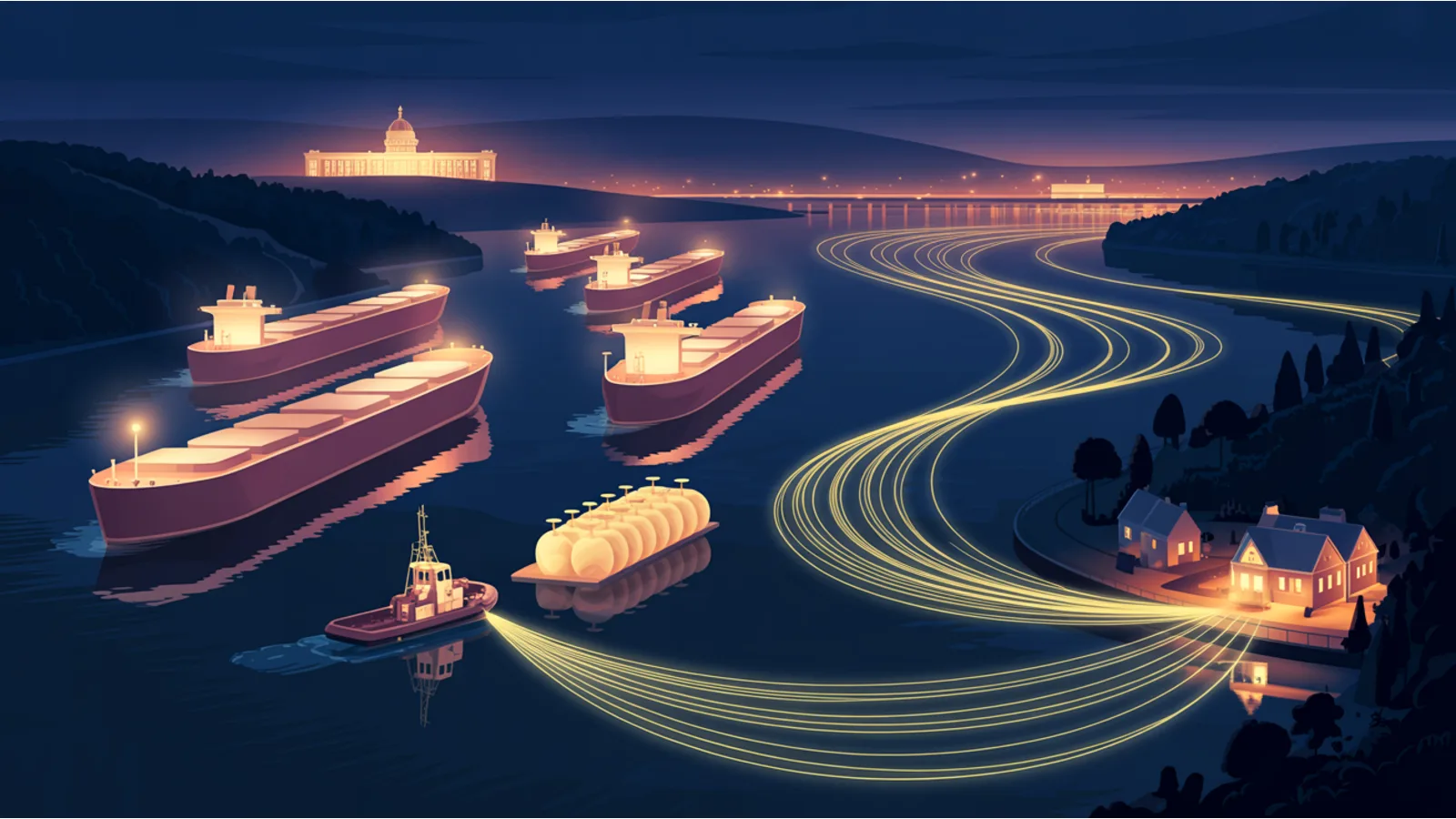
Saltchuk is one of the largest private companies in America that almost nobody outside the maritime world can name. It is worth understanding because it is a clean case study in how a quiet family holding company builds a durable fortune out of federal law rather than out of any product you would recognize. A note on the framing before we start. This piece was prompted by a question about a "Saltchuk 8(a) funding element," and the honest answer is that there is no such thing. Saltchuk is the largest family-owned company headquartered in Washington State, so it is structurally barred from the Small Business Administration's 8(a) program for small disadvantaged firms. That is not where its government money comes from. The real channels are more interesting, and I will walk through each one with a source attached. Because Saltchuk is private and publishes no audited financials, every company-wide revenue and profit figure here is an estimate, and I say so each time.
Start with the ownership, because it explains everything that follows. Saltchuk Resources is a privately held Seattle holding company, headquartered at 450 Alaskan Way South, that was founded in 1982 when a group of eight investors led by a Seattle attorney named Michael Garvey formed a partnership to buy an Alaska shipping line called Totem Ocean Trailer Express. The name is Chinook jargon for saltwater. Ownership consolidated to Mike and Lynn Garvey in the mid-1990s, and in 2009 their three daughters, Denise Tabbutt, Nicole Engle, and Michele Seaver, took over the family's majority stake (Wikipedia, Davis Wright Tremaine). There is no employee stock ownership plan and no public shareholder. Three sisters and a handful of remaining founding families own one of the biggest transportation companies in the country, and they do it through a corporate home office of only about 65 people that sets strategy while each operating company runs itself (Wikipedia, MarineLink).
How big it actually is
This is where the honesty has to start, because Saltchuk files nothing. The number the company puts in its own press releases is approximately 5.5 to 5.6 billion dollars in consolidated annual revenue and roughly 8,500 to 8,800 employees (Maritime Executive, quoting Saltchuk's own boilerplate). That figure originates on Saltchuk's own corporate page and is copied into filings and trade press from there, so treat it as company-provided and unaudited rather than independently verified. The Puget Sound Business Journal, ranking the largest family-owned companies in Washington, put 2023 revenue at 4.85 billion dollars with about 7,600 employees (via Wikipedia). Forbes lists 5.5 billion dollars and 8,900 employees as of May 2026, sourced to FactSet (Forbes). So the honest range is somewhere between 4.8 and 5.6 billion dollars, growing, with no public profit figure at all. Anyone who quotes you a precise Saltchuk revenue or a net income is quoting an estimate.
Structurally it is a holding company sitting on roughly 34 operating companies grouped into about seven business units (Wikipedia). The easiest way to hold it in your head is by what the companies move: ships, planes, trucks, and fuel.
What Saltchuk owns
The ships are the core. Saltchuk Marine holds Foss Maritime, a tugboat company founded in 1889 that runs harbor towing, ocean towing, and a Pacific Northwest shipyard, along with a fleet of tractor tugs and barges (Saltchuk Marine, Foss). Under Foss sits Young Brothers, the company that has moved cargo between the Hawaiian islands since 1900 and which matters more than its size suggests, for reasons I will come back to (Saltchuk Marine). The marine group also includes AmNav on the West Coast, Cook Inlet Tug and Barge at the Port of Anchorage, and Foss Offshore Wind.
The TOTE Group is the original business. TOTE Maritime Alaska runs two roll-on roll-off ships, the Midnight Sun and the North Star, between Tacoma and Anchorage, both converted to run on liquefied natural gas in 2023. TOTE Maritime Puerto Rico runs two Marlin-class ships, the Isla Bella and the Perla del Caribe, between Jacksonville and San Juan, and they were the first LNG-powered container ships in the world (TOTE Maritime, TOTE Group). A third piece, TOTE Services, does not carry Saltchuk's own cargo at all. It manages ships for the federal government, and it is the single most important company in this whole story for understanding where the money comes from.
Then there are the two public companies it swallowed. In 2024 Saltchuk bought Overseas Shipholding Group, a Jones Act tanker operator with about 21 US-flag vessels, and in 2026 it agreed to buy Great Lakes Dredge and Dock, the largest dredging contractor in the United States (OSG press release, Maritime Executive). Both deals are the clearest window we have into Saltchuk's real scale, and I will size them precisely in a moment, because unlike Saltchuk itself, these two were public and their numbers are on file.
The planes. Saltchuk Aviation runs Northern Air Cargo, an Alaska freight airline flying Boeing 737 freighters, Aloha Air Cargo in Hawaii, which Saltchuk built out of the assets of the bankrupt Aloha Airlines in 2008, and StratAir out of Miami. In July 2025 the group restructured, dropping its 767 widebodies and closing its Miami base (FreightWaves, Wikipedia).
The fuel. NorthStar Energy, formed in 2006, holds Aloha Petroleum, one of the largest gasoline marketers in Hawaii with roughly 100 stations under the Aloha, Shell, and Mahalo brands, plus Hawaii Petroleum and Delta Western, the largest independent fuel distributor in Alaska, which moves more than 200 million gallons a year through 13 terminals (Wikipedia, NorthStar Energy, Delta Western). Add the Alaska trucking company Carlile and a handful of logistics firms, and you have the whole map.
Notice the pattern in that map. Alaska, Hawaii, and Puerto Rico appear over and over. That is not an accident. It is the business model.
The two acquisitions, sized from the filings
Because Saltchuk is private, the surest way to see how much money it commands is to watch it buy companies that were public, since those transactions leave a paper trail at the Securities and Exchange Commission. It filed as the acquirer under the name Saltchuk Resources, Inc., and the tender offer documents state the terms exactly.
For Overseas Shipholding Group, Saltchuk's tender offer was 8.50 dollars a share in cash (SEC tender offer, SC TO-T). That was a 61 percent premium to the prior 30-day average price, and it valued OSG at roughly 653 million dollars in equity and about 950 million dollars including debt. The deal was announced on May 20, 2024 and closed on July 10, 2024 (Maritime Executive). OSG had about 72 million shares outstanding at the time (SEC XBRL).
For Great Lakes Dredge and Dock, the offer filed in March 2026 was 17.00 dollars a share in cash (SEC tender offer, SC TO-T). Against roughly 66.8 million shares that is about 1.14 billion dollars in equity, and the reported total transaction value was about 1.5 billion dollars (Maritime Executive). It was announced on February 11, 2026 with an expected close in the second quarter of that year.
Put those together. In under two years a private family company committed on the order of 2.5 billion dollars of enterprise value to two acquisitions, in cash, without a single outside shareholder to answer to. That is the real measure of Saltchuk's financial weight, and it is far more telling than any rounded revenue headline.
The OSG purchase also handed us the only clean profit-and-loss window into any part of Saltchuk, because OSG had to report as a public company right up to the close. In 2023, its last full year on its own, OSG posted 451.9 million dollars in shipping revenue, 96.9 million dollars in operating income, and 62.5 million dollars in net income (SEC XBRL revenue, net income). Worth knowing, that was a recovery. The same filings show OSG lost money in most years from 2010 through 2016, including a 638 million dollar loss in 2013. Jones Act shipping is protected, but it is not a straight line to profit, and Saltchuk bought OSG at the good part of that cycle. Great Lakes, for its part, did 888 million dollars of revenue in 2025 (SEC XBRL).
Where the money really comes from
Here is the part the "8(a)" question was reaching for, and the answer has four parts, none of them a small-business set-aside.
One. The Jones Act is the whole foundation. The Merchant Marine Act of 1920, universally called the Jones Act, reserves cargo moving between two US points to ships that are US-built, US-flagged, and US-crewed (MARAD). Foreign competitors are simply not allowed on those routes. That is why Alaska, Hawaii, and Puerto Rico keep showing up in Saltchuk's map. Those are islands and near-islands that must be supplied by sea, and the Jones Act fences off that sea for domestic carriers. Saltchuk's TOTE, Young Brothers, Foss, Tropical Shipping, and now OSG all operate inside that fence. It is not a check from the government. It is something more valuable, a permanent barrier that keeps cheaper foreign ships out of your market forever.
What that protection costs the people on the islands is fiercely disputed and worth presenting honestly. The Government Accountability Office studied Puerto Rico in 2013 and concluded the effect on consumer prices there was "difficult, if not impossible, to determine with precision" (summary of GAO-13-260). An older GAO study estimated the Alaska trade paid about 163 million dollars a year in extra shipping costs (cited by CEI). Critics like the Grassroot Institute of Hawaii put the cost at around 1,800 dollars a year per resident (Grassroot Institute). The industry group Saltchuk belongs to, the American Maritime Partnership, calls those numbers "myth and conjecture" (American Maritime Partnership). I am not going to pretend to settle that here. The point for this article is narrower and not in dispute. The protection exists, it is worth a great deal to whoever operates inside it, and Saltchuk has spent 40 years buying up the companies that do.
Two. TOTE Services is a major federal contractor. This is the part most people miss, because it looks like a shipping company but it is really a government services company. TOTE Services manages and oversees the construction of ships for the government. It holds MARAD's National Security Multi-Mission Vessel program to manage construction of five new training ships for the maritime academies, a program worth about 1.5 billion dollars (TOTE Services). In July 2026 the Navy awarded it a Vessel Construction Manager contract for the Medium Landing Ship worth about 2.2 billion dollars, with options that could bring it to roughly 2.6 billion dollars for as many as eight ships, the first due in 2029 (USNI News). It holds a contract worth up to 311 million dollars to support the Sea-Based X-Band Radar ship (GovConWire), and it is one of a handful of contractors managing the Ready Reserve Force, the government's fleet of standby sealift ships (National Defense Magazine via TOTE Services). These are competed, full-and-open federal contracts, not set-asides. You can see individual awards in the public spending data, such as a MARAD obligation to TOTE Services for support of the missile-tracking ship Pacific Tracker (USAspending.gov).
Three. OSG came with federal stipends attached. When Saltchuk bought OSG it also bought OSG's place in the Maritime Security Program and the newer Tanker Security Program, which pay US-flag operators an annual stipend to keep militarily useful ships available to the government. OSG has enrolled three tankers, each drawing a stipend of up to about 6 million dollars a year (gCaptain). The per-ship stipend across these programs runs about 5.3 million dollars a year now and is scheduled to rise toward 6.8 million by the early 2030s (CRS R46654). One OSG tanker chartered to the Military Sealift Command was reported to earn more than 20 million dollars in time-charter equivalent in its first contract year (BusinessWire). Northern Air Cargo adds another federal thread, carrying US Postal Service bypass mail in Alaska and holding military charter work (Wikipedia).
Four. Young Brothers is a regulated monopoly, and the story there is remarkable. Interisland cargo in Hawaii is a regulated business, and Young Brothers is the dominant carrier, with its rates set by the Hawaii Public Utilities Commission. That means it does not compete on price. It petitions a regulator, and the regulator grants an increase. During the pandemic the PUC granted Young Brothers a 46 percent emergency rate increase in August 2020 (Hawaii PUC). In November 2025 it granted a further 25.75 percent permanent increase worth about 26 million dollars a year (Honolulu Civil Beat). Young Brothers had also asked the state for 25 million dollars of federal pandemic relief in 2020, though that particular bill stalled in the legislature and the rate increases substituted for it (Star-Advertiser, request, Star-Advertiser, stall).
The sharpest detail comes from a 2026 investigation by Honolulu Civil Beat, which reported that Young Brothers held onto roughly 26 million dollars in state wharfage fees during the pandemic to cover its own costs and now owes the state around 30 million dollars including penalties and interest, all while continuing to pay dividends up to its parent, Foss Maritime, and thus to Saltchuk (Honolulu Civil Beat). Read that sentence again. A regulated monopoly used money owed to the state to fund itself, and sent profit up to its private owners at the same time. Whatever you think of it, that is a very specific picture of where the money goes.
Why the "8(a)" framing does not fit, and what to look at instead
It is worth being direct about the premise, because correcting it is more useful than humoring it. The SBA's 8(a) program is a nine-year development program restricted to small businesses that are at least 51 percent owned and controlled by socially and economically disadvantaged individuals (CRS R48190). Saltchuk is the opposite of a small disadvantaged business. It is the largest family-owned company in its state, with billions in revenue, owned by an established family. It cannot participate in 8(a) and there is no evidence it tries to.
The reason this matters is that "8(a)" points you at the wrong door. If you want to understand how a company like this draws on the public, the doors that actually open are the four above, and each one has a public paper trail you can pull yourself. Tender offers and annual reports for its acquisitions are on SEC EDGAR. Its federal contracts are on USAspending.gov. Its regulated rates are in Hawaii PUC dockets. Its statutory protection is the Jones Act, written into federal law. None of it requires an inside source. It just requires knowing which filing cabinet to open, which is the real skill in tracing where a private empire's money comes from.
Where the money goes
Follow it to the end and the destinations are simple. Some is reinvested, and aggressively so, which is what the OSG and Great Lakes deals are. Saltchuk describes its own strategy as reinvesting in its companies and letting its values drive acquisitions, and the roughly 2.5 billion dollars of recent deals is that strategy in action. A small, visible slice goes to communities, an average of about 5 million dollars a year in cash and in-kind giving over the last five years, by the company's own account (saltchuk.com, via proxy fetch). And the rest, the actual profit, is not disclosed, because it flows to a private family through a company that answers to no public shareholder. That is the whole point of the structure. The Jones Act protects the markets, federal contracts and stipends and regulated rates feed the revenue, and private ownership keeps the result off the public record.
What a reader should take from this
A legal moat beats a good product. Saltchuk did not win by building something you would recognize. It won by owning the companies that sit inside a protected market, and by keeping them there for 40 years. The most durable business advantage is often a rule that keeps competitors out, not a feature that pulls customers in. When you evaluate any company, the question under the revenue is always what protects it, and here the answer is a 1920 statute.
Private plus protected plus federal is an unusually stable combination. Each leg supports the others. The Jones Act guarantees the market, government contracts and stipends and regulated rates smooth the revenue, and private ownership means no quarterly pressure and no disclosure. It is a structure built to last across generations, which is exactly what it has done, passing from founders to a second generation of three sisters.
You can trace a private empire without inside information. The lesson that generalizes best is the method. A company that files nothing still leaves a trail when it touches the public: SEC filings when it buys a public company, federal award records when it takes a government contract, regulator dockets when it sets a monopoly rate. Saltchuk is opaque by design, and yet almost every number in this article came from a public filing. If you want to know where any big private company's money comes from, stop looking for the company's own disclosure and start looking for the places the public system forces a disclosure out of it.
Related reading
- The Toll Booth: the full index: where this piece sits in the series on who collects rent on the things you cannot avoid, and every other toll alongside it.
- How Saltchuk was built: the origin story, how a Seattle lawyer and a failing Alaska shipping line became this empire.
- How harbor pilots are paid: another maritime business where a government rule, not a market, sets the price and the profit.
- The raise written into the contract: the same idea from the labor side, where the advantage is a document rather than a negotiation.
- COLA versus the merit raise: why an advantage written into a rule pulls away from one that depends on a decision.
Fact-check notes and sources
Saltchuk is a private company that publishes no audited financials, so every company-wide revenue and profit figure here is a self-reported or third-party estimate and is labeled as such. The acquisition terms, the OSG financials, and several federal and regulatory facts are drawn from primary filings and agency records.
- Ownership, founding, structure: founded 1982 by eight investors led by Michael Garvey to acquire Totem Ocean Trailer Express; majority ownership passed in 2009 to Denise Tabbutt, Nicole Engle, and Michele Seaver; chaired by Mark Tabbutt with Tim Engle as president; about 34 operating companies in seven business units; corporate home office of about 65 people; largest family-owned company in Washington. Sources: Wikipedia, MarineLink, Seattle Business magazine, and TOTE Maritime.
- Revenue and employee estimates: self-reported approximately 5.5 to 5.6 billion dollars and 8,500 to 8,800 employees (Maritime Executive); 4.85 billion dollars and about 7,600 employees for 2023 per the Puget Sound Business Journal (via Wikipedia); 5.5 billion dollars and 8,900 employees per Forbes. No parent profit figure is published anywhere.
- OSG acquisition: 8.50 dollars per share in cash, a 61 percent premium, about 653 million dollars equity and roughly 950 million dollars total; announced May 20, 2024, closed July 10, 2024. Per-share price from the SEC tender offer (SC TO-T); share count from SEC XBRL; deal framing from Maritime Executive and the OSG press release.
- OSG financials: 2023 revenue 451.9 million dollars, operating income 96.9 million dollars, net income 62.5 million dollars, with losses in most years from 2010 to 2016 including a 638 million dollar loss in 2013. From SEC XBRL company facts: revenue, net income, operating income.
- Great Lakes Dredge and Dock acquisition: 17.00 dollars per share, about 1.14 billion dollars equity and roughly 1.5 billion dollars total; announced February 11, 2026. Per-share price from the SEC tender offer (SC TO-T); share count and 2025 revenue of 888.3 million dollars from SEC XBRL; total value from Maritime Executive.
- Operating companies: rosters and descriptions for Foss, Young Brothers, AmNav, Cook Inlet Tug and Barge, TOTE Maritime Alaska and Puerto Rico, Tropical Shipping, Northern Air Cargo, Aloha Air Cargo, StratAir, Aloha Petroleum, Hawaii Petroleum, Delta Western, and Carlile from Saltchuk Marine, TOTE Group, NorthStar Energy, Delta Western, Aloha Petroleum (Wikipedia), and Northern Air Cargo (Wikipedia).
- The Jones Act: cabotage reservation of domestic waterborne cargo to US-built, US-flagged, US-crewed ships, from MARAD. The contested cost estimates are from GAO-13-260 as summarized, the 1988 GAO Alaska figure via CEI, the Grassroot Institute of Hawaii, and the industry rebuttal from the American Maritime Partnership.
- TOTE Services federal contracts: the roughly 1.5 billion dollar NSMV program and Ready Reserve Force role from TOTE Services; the roughly 2.2 to 2.6 billion dollar Navy Landing Ship Medium award from USNI News; the Sea-Based X-Band Radar support contract from GovConWire; a sample award from USAspending.gov. Aggregate federal totals across all Saltchuk subsidiaries were not fully summed and I do not assert a single number.
- OSG stipends: three tankers in the Tanker Security Program at up to about 6 million dollars a year each (gCaptain); per-ship stipend schedule from CRS R46654; the Military Sealift Command charter earnings from BusinessWire.
- Young Brothers: the 46 percent emergency increase (Docket 2019-0117) from the Hawaii PUC; the 25.75 percent permanent increase (Docket 2024-0255) and the wharfage-fee investigation from Honolulu Civil Beat and Civil Beat again; the 2020 relief request and its legislative stall from the Honolulu Star-Advertiser and again.
- The 8(a) program: eligibility limited to small businesses at least 51 percent owned by socially and economically disadvantaged individuals, from CRS R48190. Saltchuk does not and cannot qualify. Community giving of about 5 million dollars a year is Saltchuk's own figure from its website, retrieved through a proxy because the site does not render for a plain fetch.
This post is informational and journalistic, not investment or financial advice. It describes a private company using public filings, agency records, regulator dockets, and press reporting. Company-wide revenue and profit figures are estimates because Saltchuk publishes no audited financials, and figures attributed to trade press are presented as reported. Mentions of Saltchuk, its subsidiaries, and other third parties are nominative fair use, and no affiliation is implied. Figures are as of mid-2026 and change over time, so verify current status before relying on any of them.
