
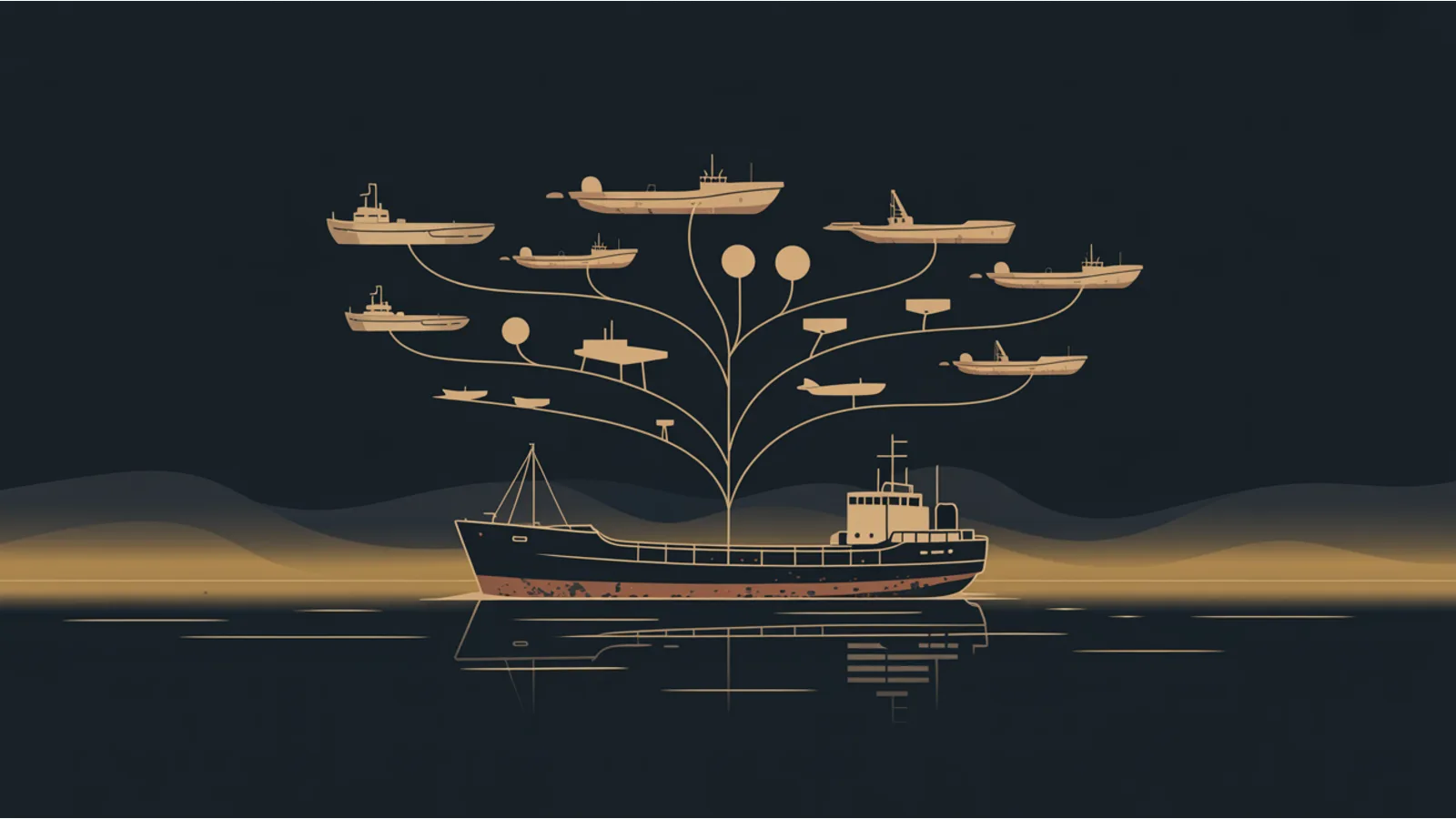
This is the origin story behind the deep dive on where Saltchuk's money comes from. That piece follows the money through the Jones Act, the Navy contracts, and a Hawaii monopoly. This one answers the question underneath it: how did a company that now runs billions of dollars of ships, planes, and fuel come to exist at all? The answer is stranger and more human than the size suggests. It started with a lawyer who was not in the shipping business buying a shipping company that was losing money. Every fact below is cited, and where a detail comes from the company's own telling rather than an independent record, I say so.
In November 1975 a container ship called the SS Great Land left Seattle on her maiden voyage to Anchorage. She belonged to an up-and-coming domestic carrier called Totem Ocean Trailer Express, known by everyone as TOTE (TOTE Maritime). Seven years later that carrier was losing money and looking for a buyer. The buyer that showed up was not a shipping conglomerate. It was a group of investors led by a Seattle attorney, and the company they built out of that one failing ship line is now one of the largest private companies in the country.
The name, and the deal that started it
In 1982 a group of investors formed a partnership to acquire TOTE and its ocean liner service to Alaska. They named the partnership Saltchuk, which is Chinook jargon for saltwater (TOTE Maritime). That is the whole founding act. There was no product invented, no technology, no patent. A group of people bought a company that carried freight to Alaska, and they bought it precisely because it was cheap, because TOTE had lost money in the years before the purchase.
The partners were a mix of insiders and outsiders. Bob McMillen, Ev Trout, and Len Shapiro were working at TOTE in 1982. Stan Barer, Michael Garvey, and Fred Goldberg were outside investors (TOTE Maritime). The group is usually described as eight founders, four of whose families are still partners today (Wikipedia). What matters about the mix is that the people who ran the ships stayed, and the people who put up the capital did not try to run the ships. That division, operators who operate and owners who let them, turned out to be the whole management philosophy, and I will come back to it.
The lawyer who was not a shipping man
The lead figure was Michael Garvey, and his path into the business is the part that makes the origin story worth telling, because he did not come from freight at all.
Garvey grew up spending his summers in Alaska, where an aunt and uncle lived. In 1956, as a teenager, he skipped his own high school prom and graduation, drove from Seattle to Fairbanks, and caught a bush plane to Nome to take a job with a gold mining company (TOTE Maritime). The Alaska connection was personal before it was ever commercial. He went back south, went to the University of Washington, and in 1966, two years out of its law school, co-founded a law firm with two classmates (TOTE Maritime). That firm became Garvey Schubert Barer, a well known Seattle practice, and the Barer in the name, Stan Barer, was one of the outside investors who bought TOTE alongside him.
Here is the sentence that captures the whole thing. By his own account Garvey spent 25 years of his professional life as a lawyer who invested on the side, and that sideline grew into today's collection of maritime, air cargo, and logistics companies (Seattle Business magazine). He did not come to the business with a maritime or freight background. He and his partners built the thing from a lawyer's side investments, which is not how anyone draws up a plan to create a multibillion dollar transportation empire, and is exactly how this one happened.
The strategy was simply to keep buying
Once Saltchuk owned TOTE, the pattern that would define it for the next 40 years set in almost immediately. The company did not grow by inventing new lines of business. It grew by acquiring companies that already ran them, one after another, and then leaving them largely alone.
The purchase of TOTE in 1982 was followed by a long series of acquisitions that added a new capability each time (TOTE Maritime). The tugboat company Foss Maritime, founded in 1889, joined in 1987 and gave Saltchuk deep marine services (Saltchuk Marine). Young Brothers, the interisland cargo carrier that had served Hawaii since 1900, came in 1999 (Saltchuk Marine). Delta Western, an Alaska fuel distributor, joined in 2000 and became Saltchuk's first step into the petroleum business (Delta Western). In 2008 Saltchuk built Aloha Air Cargo out of the assets of the bankrupt Aloha Airlines (Wikipedia). The Alaska trucking company Carlile Transportation came in 2013, the Caribbean container carrier Tropical Shipping was bought in 2014 for about 220 million dollars (gCaptain), and the bush freight carrier Ryan Air, with its hubs across rural Alaska, joined in 2022 (TOTE Maritime).
Then the acquisitions got much bigger. In 2024 Saltchuk bought a public company, the Jones Act tanker operator Overseas Shipholding Group, for about 950 million dollars (Maritime Executive). In 2026 it agreed to buy another public company, Great Lakes Dredge and Dock, the largest dredging contractor in the country, in a deal valued around 1.5 billion dollars (Maritime Executive). The same instinct that bought a money-losing ferry line in 1982 was now buying public companies for ten figures, in cash, four decades later.
Stack it all up and the result is a company that describes itself as roughly 5.5 billion dollars in annual revenue with about 8,500 employees, organized into about 34 operating companies (Maritime Executive, quoting Saltchuk, Wikipedia). Because it is private, that revenue figure is the company's own and is not audited, so treat it as a self-reported estimate. But the shape of the growth is not in dispute. It is a 40 year roll-up that started with one ship line.
The philosophy: buy it, then leave it alone
The strategy was not only to acquire. It was to acquire and then decentralize, which is rarer than it sounds and is the reason the collection held together.
Saltchuk runs its companies with deliberately decentralized decision making, which the company itself calls somewhat unusual in the transportation and logistics sector (TOTE Maritime). Each operating company keeps its own name, its own leadership, and its own local decisions, while a small corporate home office of only about 65 people provides capital and strategy rather than running the operations (Wikipedia). A company that has bought dozens of businesses could easily have merged them into one bland brand. Saltchuk did the opposite. It kept Foss called Foss and Young Brothers called Young Brothers, and let the people who already knew how to run each one keep running it.
That goes straight back to the founding split, the TOTE operators who stayed and the outside investors who did not try to fly the planes or pilot the tugs. The founding structure became the operating philosophy. Buy the company, keep the operators, supply the capital, and stay out of the way.
The handoff that kept it in the family
The last piece of the origin story is the part most family companies get wrong, which is the succession.
Michael Garvey retired from Saltchuk in 2007 (Seattle Business magazine). Ownership of the company passed, in 2009, to his three daughters, Denise Tabbutt, Nicole Engle, and Michele Seaver, who took the family's majority position (Wikipedia). Leadership went to Mark Tabbutt, who served as president from 1999 to 2007 and has been chairman since (MarineLink). Garvey's own achievement was recognized later with a lifetime achievement award from Seattle Business magazine in 2019 (Seattle Business magazine).
The company never went public and never sold to a bigger fish. It stayed private, stayed with the family, and passed from a founder to a second generation intact. That is why the where-the-money-goes questions in the companion piece are so hard to answer from public records. The whole point of how Saltchuk was built is that it was built to stay closed.
What a reader should take from this
The best businesses are often bought cheap, not invented. Saltchuk did not start with a breakthrough. It started with a money-losing shipping line that a group of investors bought because it was available and undervalued. Forty years of patient acquisition turned that into an empire. The founding lesson is that a distressed asset in a business that has to keep running, freight to Alaska will always need to move, can be a better starting point than a brilliant new idea.
A roll-up compounds when you leave the parts alone. The reason Saltchuk's dozens of acquisitions did not collapse into a mess is that it kept each one decentralized, with its own name and its own operators. Most acquirers destroy what they buy by absorbing it. Saltchuk's founding insight, born from a lawyer who knew he was not a shipping man, was to let the people who understood the business keep running it and to supply only capital and patience.
Private and family-held is a strategy, not an accident. Garvey could have taken the company public or sold it many times over. He did neither, and the handoff to his daughters kept it closed for a second generation. Staying private meant no quarterly pressure, no forced disclosure, and no obligation to sell in a downturn. It is the same durability the companion deep dive describes from the money side, and it began as a decision at the founding to build something meant to be held, not flipped.
If you want the wider argument that the smartest way to build is to start with the smallest real thing and compound patiently rather than swing for a moonshot, that is the whole thesis of my book The $20 Dollar Agency (search the title on Amazon Kindle). Saltchuk is that thesis at industrial scale: one modest, unglamorous purchase, held and added to for 40 years.
Related reading
- Saltchuk: where the money really comes from: the companion deep dive on the Jones Act, the Navy contracts, and the Hawaii monopoly that feed the empire this article describes.
- How harbor pilots are paid: another maritime story where a government rule, not a market, sets the economics.
- The raise written into the contract: the same theme from the labor side, where the durable advantage is a structure rather than a hustle.
Fact-check notes and sources
Founding details come from the company's own historical account and an independent magazine profile of the founder. Because Saltchuk is private, revenue and structural figures are self-reported estimates and are labeled as such.
- The founding: the SS Great Land's 1975 maiden voyage, the 1982 formation of the Saltchuk partnership to buy TOTE, the meaning of the name as Chinook jargon for saltwater, TOTE's money-losing condition before the purchase, the named partners (Bob McMillen, Ev Trout, and Len Shapiro from inside TOTE; Stan Barer, Michael Garvey, and Fred Goldberg as outside investors), Garvey's 1956 teenage trip to Nome, his 1966 co-founding of a Seattle law firm, and the acquisition timeline including Ryan Air in 2022, are from the TOTE Maritime / Alaska Business feature "Land, Sea and Air Family". This is the company's own historical telling.
- Michael Garvey: the description of him as a lawyer who invested on the side for 25 years, that he did not come from a maritime or freight background, his retirement from Saltchuk in 2007, the fact that the company is now owned by his three daughters, and the 2019 lifetime achievement award are from Seattle Business magazine.
- Structure, succession, and scale: the eight founders with four founding families remaining, the 2009 transfer of majority ownership to Denise Tabbutt, Nicole Engle, and Michele Seaver, the roughly 34 operating companies, the corporate home office of about 65 people, and the self-reported revenue of about 5.5 billion dollars with about 8,500 employees are from Wikipedia (citing the Puget Sound Business Journal) and Maritime Executive. Mark Tabbutt's tenure as president and chairman is from MarineLink. As a private company Saltchuk publishes no audited financials, so the revenue and employee figures are self-reported estimates.
- The acquisitions: Foss Maritime (founded 1889, joined 1987) and Young Brothers (founded 1900, joined 1999) from Saltchuk Marine; Delta Western (joined 2000, Saltchuk's first petroleum business) from Delta Western; Aloha Air Cargo (built from bankrupt Aloha Airlines in 2008) from Wikipedia; Tropical Shipping (2014, about 220 million dollars) from gCaptain; Overseas Shipholding Group (2024, about 950 million dollars) from Maritime Executive; and Great Lakes Dredge and Dock (2026, about 1.5 billion dollars) from Maritime Executive. The OSG and Great Lakes deals are also documented in Saltchuk's tender-offer filings with the Securities and Exchange Commission, discussed with figures in the companion deep dive.
This post is informational and journalistic, not investment or business advice. It describes a private company using its own historical account, an independent magazine profile, trade press, and public filings. Company-wide revenue and structural figures are self-reported because Saltchuk publishes no audited financials. Mentions of Saltchuk, its subsidiaries, its founders, and other third parties are nominative fair use, and no affiliation or endorsement is implied. Dates and figures are as of mid-2026 and change over time, so verify current status before relying on any of them.
