
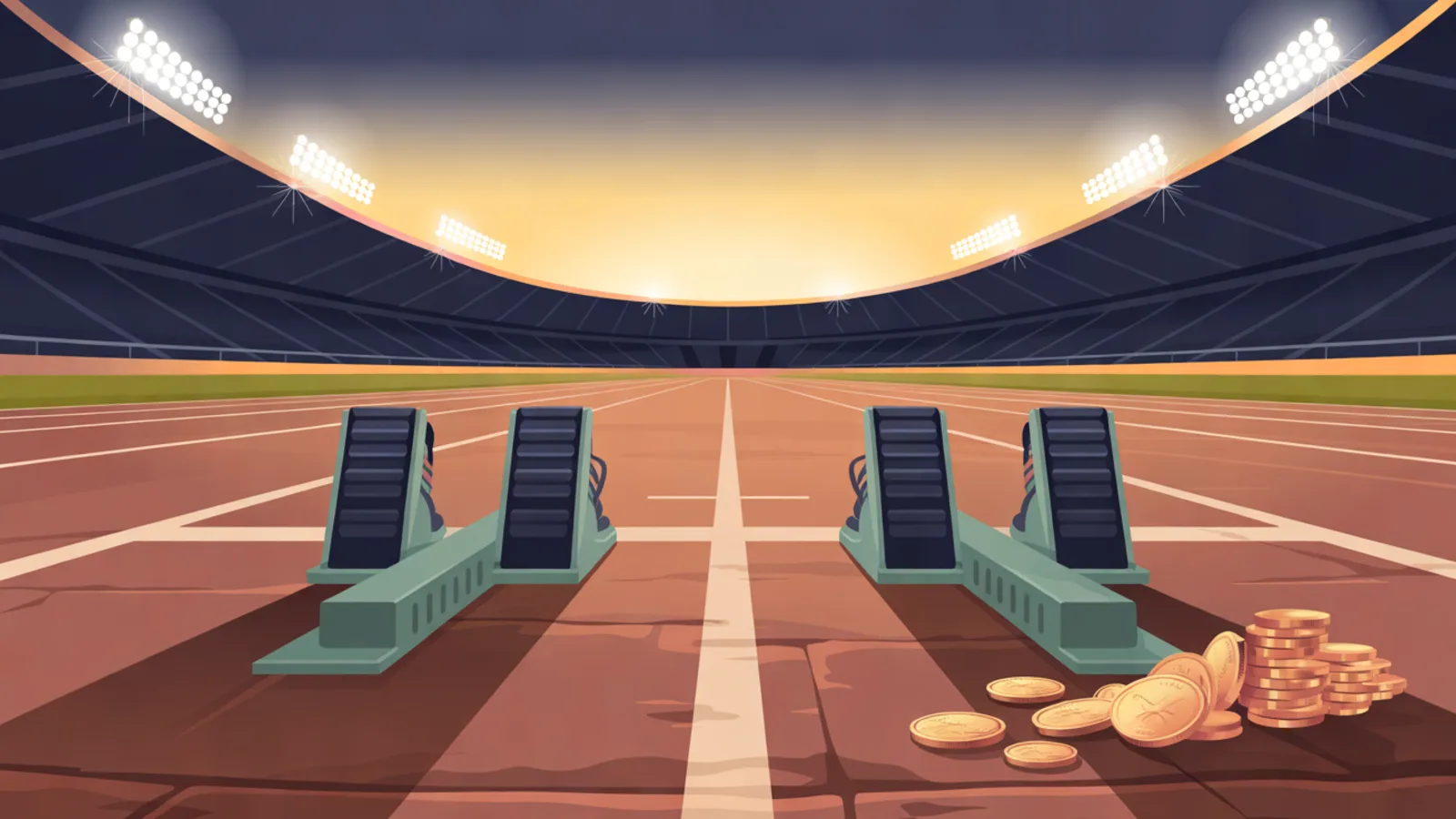
Sports hold attention through skill, suspense and belonging. Their extraordinary pay comes from selling that attention, then bargaining over who receives the proceeds. College athletes are finally inside more of that bargain. Taxpayers often sit outside it while helping finance the buildings. New leagues can change the terms, but a memorable opening night and a durable business are different achievements.
“In every affair consider what precedes and what follows, and then undertake it.”
Epictetus, Enchiridion, XXIX, Elizabeth Carter translation.
Epictetus follows that advice with an aspiring Olympic winner. First come the diet, training and discomfort; even after all that, the athlete can lose. The account is addressed to the competitor. Our modern business model invites everyone else to watch the uncertainty, buy a shirt and occasionally vote on the building.
Old leagues, younger machinery
The intuition that today's arrangement could change is sound. The NFL, NHL and baseball’s constituent leagues are older than eighty years; the NBA reaches that age in 2026. Their own histories distinguish formation from the first season and later changes of name.
Scroll to compare columns and rows when the table extends beyond the box.
| League | Beginning recorded in its official history |
|---|---|
| NFL | 1920, as the American Professional Football Association. |
| NHL | 1917. |
| MLB's constituent leagues | National League, 1876; American League, 1901, documented in official club history guides. |
| NBA | 1946 as the Basketball Association of America; NBA name from 1949. |
| MLS | Formation announced in 1993; first season in 1996. |
| WNBA | Approved in 1996; play began in 1997. |
| NWSL | Founded in 2012; first match in 2013. |
The NFL salary cap began in 1994. The NBA's current labor agreement took effect in 2023. Tradition supplies continuity; contracts keep changing the plumbing.
Why we keep coming back
The uncertainty of outcome hypothesis says that a contest attracts more interest when its result is harder to predict. It sounds obvious until your team is the favorite. You might prefer a comfortable victory to an excellent advertisement for competitive balance.
The evidence depends on the audience and competition. A 2023 PLOS ONE study of 1,234 UEFA Champions League matches found no significant attendance association with outcome uncertainty; team quality mattered. A 2021 Serie A study found different preferences among supporters of stronger and weaker clubs, with a shared appetite for quality opponents. These measure stadium attendance, so they cannot settle every question about television viewers.
Belonging supplies another reason to return. A Frontiers in Psychology review describes emotional connection and community identity in fandom. A peer reviewed comparison of sports and theme park supporters found stronger favorable feelings toward the preferred brand and stronger hostility toward rivals among the sports respondents. A survey of selected fans is evidence about those respondents, rather than a universal diagnosis. A qualitative study of two Chinese football clubs found that local symbolism shaped established residents’ attachment, while newcomers used fandom to seek local belonging.
Pliny the Younger noticed something familiar about Roman racing spectators: their attachment followed the team's colors, even imagining that it would switch drivers if the colors changed during a race. His letter 9.6 and Dickinson College's commentary describe allegiance that exceeds admiration for an individual's skill. The jersey had a business model long before it had a sponsor.
Media packages make those relationships available at home and on a phone. The NBA agreements cover television and streaming from 2025 to 2026 through 2035 to 2036. For fans, access becomes a practical part of attachment: which game is on which service, and can the household watch it together? For the seller, the same loyalty supports another subscription or advertising slot. That is our interpretation of the arrangement; the contracts alone cannot establish its causal effect on fandom.
Betting adds a separate financial stake. In Murphy v. NCAA, decided May 14, 2018, the Supreme Court removed the federal prohibition on states authorizing sports betting; state legalization still mattered. The American Gaming Association's 2026 annual report puts commercial sportsbook revenue in 2025 at $16.89 billion, up 22.6% from the previous year, excluding tribal operations. This is the industry's retained gaming revenue. Handle means the total amount wagered, a much larger and different measure. Neither figure proves that betting improves enjoyment or expands the total sports audience.
College pay: several different money streams
Jim Thorpe's Olympic titles were stripped in 1913 after his earlier paid baseball became public, according to World Athletics' account of his eventual recognition. The performance had not changed. The governing body's classification of the performer had. That history helps explain why arguments about amateurism can turn so sharply on permission to earn.
Name, image and likeness, or NIL, means an athlete's commercial identity: for example, permission to use their face in an advertisement. The NCAA interim policy took effect July 1, 2021. It permitted NIL activity while retaining restrictions on pay for playing and improper recruiting inducements.
The House settlement received final court approval on June 6, 2025, allowing participating schools to begin direct payments that July. The overall settlement package includes approximately $2.8 billion in back damages over ten years. Those damages compensate past restrictions; future school payments and outside sponsorships are separate streams.
The implementation rules set the initial 2025 to 2026 school benefits cap at $20.5 million. Its basis is 22% of average specified revenue at schools in the defendant conferences and Notre Dame. The revenue base includes defined categories such as media, tickets, conference distributions and sponsorship. It is not 22% of each individual school's budget. The rules provide recalculation every three years and 4% increases in the intervening years.
For 2026 to 2027, use the commission's newer first-year report: $21.58 million. That supersedes its earlier $21.3 million estimate; the materials reviewed here do not explain the adjustment. A cap is permission to spend. It guarantees neither an equal share for each athlete nor that every school spends the maximum.
The College Sports Commission, or CSC, administers settlement rules. Its NIL Go process requires reporting outside deals aggregating at least $600, normally within five business days. Deals involving school associated sponsors face valid business purpose and compensation tests. Under current rules, deals of $600 to $15,000 avoid valuation review until associated deals reach $50,000 in an academic year. An adverse decision can lead to revision, cancellation or neutral arbitration. An attractive offer still needs a genuine commercial purpose and a workable contract.
Title IX, the federal prohibition on sex discrimination in federally funded education, remains a contested part of the distribution question. The Education Department withdrew its NIL guidance in February 2025, a change documented by Representative Lori Trahan's contemporaneous statement. That statement criticizes the decision. Legal scholar Erin Buzuvis reviews the settlement objections and appeals and argues that school compensation must satisfy Title IX. She explains that the judge rejected settlement objections while preserving athletes’ ability to challenge future distributions. Her argument for equitable future pay is legal analysis, rather than a final judicial ruling on every allocation.
Federal legislation has advanced without becoming enacted law in the official record reviewed here. The Protect College Sports Act's bill history, checked November 1, records Senate passage on September 28, 2026 and the bill held at the House desk on October 5. The Senate text's section 127 expressly preserves Title IX's applicability. A proposed national framework and an enacted rule are different things.
Why schools bid so much
Conference contracts help explain the available money. Publicly reported values need attribution because the complete contracts are often unavailable.
Scroll to compare columns and rows when the table extends beyond the box.
| Conference | Published amount and term |
|---|---|
| Big Ten | Front Office Sports reports at least $7 billion over seven years, starting July 2023. |
| SEC | Official term: 2024 to 2025 through 2033 to 2034. Sports Business Journal reports more than $300 million annually for the additional premium package, rather than all SEC media income. |
| Big 12 | Front Office Sports reports $2.28 billion over six years, starting in 2025. |
| ACC | ESPN's renewed commitment runs through 2035 to 2036. The announcement gives no comparable dollar total. |
Revenue is money coming in; profit is what remains after expenses. The Knight Newhouse database's FY2025 summary covers 110 public Football Bowl Subdivision programs. It reports rounded totals of $12.8 billion in revenue and $12.8 billion in spending. Revenue included $2.5 billion of institutional or government support and student fees. Coach compensation totaled $2.5 billion. This describes those public programs and that fiscal year, before a full year of settlement payments.
An individual example is Georgia's 2024 announcement of Kirby Smart's contract: $13 million annually, through 2033, before possible bonuses. It is a documented contract example, rather than a claim about every coach's current pay.
Our interpretation is that schools are bidding for perceived competitive advantage inside a valuable entertainment business. A wealthy conference changes what a school can afford. Rival bids change what it believes it must offer. Neither establishes that the next coaching dollar produces its advertised return, or that a school funded partly by fees has earned every dollar commercially.
Professional pay follows a negotiated formula
A collective bargaining agreement, or CBA, is the contract between a league and its players' union. It decides which revenue counts, the players' share, minimum pay and restrictions on team spending. A cap limits the payroll counted under those rules. Social usefulness is a separate question.
The NFLPA's account of its agreement describes a player revenue share of 48%, potentially rising to 48.8% with qualifying media growth. The player cost pool includes benefits as well as cash salaries. The 2026 NFL cap is $301.2 million per club.
The NBA CBA, Article VII, section 12, puts the players' designated share between 49% and 51% of basketball related income, or BRI: the revenue categories the parties agree to include. Its 2026 to 2027 cap is $164.961 million. Unlike an absolute ceiling, the NBA system permits specified exceptions, with additional tax and transaction restrictions at higher spending levels.
The audience supplies the money underneath. Sports Business Journal reported $76 billion over eleven years for the NBA's approved media packages. For football, TV Tech reports Kagan's estimate of nearly $110 billion over eleven years; the NFL's announcement specifies a term through 2033. These published values span entire contract terms. Annual profit requires a separate calculation of revenue and expenses.
An athlete's salary consequently reflects scarce ability, an audience that can be sold repeatedly, and the rules governing bargaining. It is a market price with institutional rules, rather than a national ranking of whose work matters most.
When the public helps pay
The median is the midpoint, with half above and half below. Census reports 2025 median household income of $87,460 and median earnings of $66,620 for full time, year round workers. Households can contain several earners, so the two measures should stay separate.
Now put public construction commitments beside those annual incomes. Nashville's approved stadium ordinance assigns $760 million to its Sports Authority and $500 million to Tennessee: $1.26 billion, by addition. Erie County's 2023 approval announcement records $600 million from New York and $250 million from the county for the Bills stadium: $850 million. These are construction funding commitments. Lifetime financing costs require additional accounting. Comparing them with income illustrates scale; it does not calculate anyone's personal tax bill.
Bradbury, Coates and Humphreys' peer reviewed stadium policy review finds little support for stadiums as engines of broad economic development and concludes that justified public support is substantially below typical subsidies. Their full earlier manuscript explains the accounting trap: spending near a venue can replace spending elsewhere in the region. A busy restaurant beside the stadium does not establish a net citywide gain. Land and tax money also have alternative uses.
The benefit side deserves an honest hearing. Carlino and Coulson's Federal Reserve account of their research finds that quality of life benefits can support a favorable assessment of an NFL franchise. Pride, conversation and enjoyment have value even without an extra paycheck. The later review examines such findings and their limitations. A city can knowingly purchase an amenity; the evidence does not require calling that purchase an economic growth machine.
There is also a federal contribution. Brookings' bond research explains how tax exempt municipal financing reduces federal revenue, extending support beyond the host community. IRS guidance shows why the details matter: private business use and private payment or security tests operate together. Private use alone does not settle a bond's tax treatment.
Our distributional judgment follows from that structure. Owners and well paid athletes capture concentrated financial benefits; fans receive entertainment and sometimes civic pride. Residents who rarely watch can still share financing costs. The fair comparison asks who gets the cash, who gets the enjoyment, who carries the debt and what else the public could have bought.
What the challengers actually change
A challenger can alter the playing format, the ownership arrangement, the schedule or the route to an audience. It still has to finance the next season.
Scroll to compare columns and rows when the table extends beyond the box.
| Competition | Origin and verified position as of this reading |
|---|---|
| UFL | Announced in 2023, began play in 2024, combining the XFL and USFL. Its current announcements market the 2027 season. Consolidation reduced competing spring football organizations. |
| PWHL | Established in 2023, with unified financial backing and standard player agreements. Its 2026 expansion process prepares a twelve team league for 2026 to 2027. |
| Unrivaled | Founded in 2023; first season in 2025. The basketball league combines salaries with player equity and reports a completed second season, with a third planned for January 2027 on TNT Sports. Equity means an ownership interest. |
| TGL | Announced in 2022 for competition beginning in 2025. Simulator shots, a physical green and microphones make team golf fit a television window. Los Angeles GC reports winning the 2026 championship. |
| LIV Golf | Founded in 2021; first season in 2022. Team and individual competition continues, but its 2026 format expanded to 72 holes. Describing current LIV simply as 54 hole golf misses that change. |
| Athletes Unlimited | Launched in 2020. Its formats emphasize individual points and athlete participation in governance. The public benefit corporation currently operates across softball, basketball and volleyball; its properties do not all have identical formats. |
| League One Volleyball | Organization founded in 2020; professional play began in 2025. It connects junior clubs with professional teams and lists ten teams for the forthcoming season beginning in December 2026. |
| Grand Slam Track | Incorporated in 2023, announced in 2024 and raced in 2025. Contracted stars and repeated meetings could concentrate attention. Financial distress led to Chapter 11; a June 2026 statement from its lawyers reports emergence. Reorganization does not itself prove competition has resumed. |
Enhanced Games: an event, then the harder questions
Founded in 2023, the organization held its first Enhanced Games on May 24, 2026, according to the organizer's subsequent release. Its announced model permits performance enhancing substances under medical supervision while allowing unenhanced participation. The original advertised purse was $500,000 per event, including $250,000 for first place. Those were announced terms; an October release supplies a concrete result: the organizer says Hunter Armstrong earned $375,000 while competing without its enhancement protocol.
Health supervision is an organizer's claimed safeguard. UK Anti-Doping warns of short and long term physiological and psychological harm. WADA's public condemnation is recorded in the federal opinion concerning the Games' antitrust lawsuit. That litigation record documents the position. Medical safety requires different evidence.
A September 2026 peer reviewed analysis examined public results for 42 athletes. It found mixed performances and one result faster than the listed world benchmark. The researchers could not independently verify substance use or dosing and lacked an appropriate untreated comparison group. Some equipment also differed from ordinary federation rules. The event therefore supplies neither a controlled test of enhancement nor evidence of long term safety. A faster time and a recognized record are separate claims.
Survival takes more than novelty
The original XFL closed in 2001 after its owners rejected further investment on expected return and risk grounds. The 2020 revival entered bankruptcy after pandemic disruption. A federal bankruptcy opinion records the AAF's 2019 collapse before completing its first schedule. These cases had different causes; each shows why staging games and sustaining a league are separate tests.
Grand Slam Track's reorganization disclosure describes substantial production, travel and athlete costs against insufficient revenue and financing. These cases support a concrete lesson about cash arriving before obligations fall due. They cannot supply a reliable failure percentage for every future league.
What to watch over the next decade
The next decade's competing visions should stay attached to their authors. TGL founder Rory McIlroy expects the format to reach a younger audience. Unrivaled's founders describe athlete ownership as a route to lasting value. Grand Slam Track's court disclosure makes a planned 2027 return conditional on raising capital. These parties have financial interests in the outcomes, and their ambitions remain unproved.
For a fan, watch completed seasons, renewed broadcast agreements and repeat attendance. Check the full viewing cost for your own teams. A financing announcement establishes that someone invested; it leaves audience retention and operating profit to be demonstrated.
For a parent of a college athlete, distinguish school benefits from outside NIL contracts. Ask which payments are guaranteed, what happens after injury or transfer, what services are owed and who controls the athlete's image afterward. The CSC compensation reports now offer useful context, but their outside NIL figures represent full contract values and omit athletes without cleared deals. Treating those medians as everyone's annual wage would mislead.
For a taxpayer, read the lease and bond documents. Look for construction contributions, interest, maintenance, tax diversions, cost overruns and exit provisions. Ask who receives surrounding land value gains and whether the promised spending would otherwise have occurred nearby. A claim about civic enjoyment deserves a public debate. A claim about fiscal return deserves a calculation.
The question running through The W-2 Trap fits this subject: how much of the money your work helps create are you allowed to keep? In sports, we can also ask who wrote that rule and whose money paid for the place where the work happens.
Related reading
- How professional athletes are paid, for the contract mechanisms beneath the headline salary.
- The PGA Tour ledger, for organizational structure and the business of golf.
- The Crown and Kroenke families, for the ownership side of sports and property.
- Netflix's live sports infrastructure, for what it takes to deliver a simultaneous audience.
- Streaming and platform engineering, for the systems behind live information, including our Apprised work.
Fact-check notes and sources
All sources below were read November 1, 2026; individual read times are UTC. League announcements establish their stated plans and claims. Reported media values are attributed to the reporting outlet. Research findings retain their study populations and limitations. Dollar figures are US dollars; prize announcements, contract commitments, income and revenue are distinct measures.
- Epictetus, Enchiridion XXIX. Read 2026-11-01, 21:17 UTC.
- 1920, as the American Professional Football Association. Read 2026-11-01, 21:17 UTC.
- 1917. Read 2026-11-01, 21:17 UTC.
- Chicago Cubs official history, page 40. Read 2026-11-01, 21:29 UTC.
- Washington Nationals official history, page 260. Read 2026-11-01, 21:28 UTC.
- 1946 as the Basketball Association of America; NBA name from 1949. Read 2026-11-01, 21:17 UTC.
- Formation announced in 1993. Read 2026-11-01, 21:18 UTC.
- first season in 1996. Read 2026-11-01, 21:17 UTC.
- Approved in 1996; play began in 1997. Read 2026-11-01, 21:17 UTC.
- Founded in 2012; first match in 2013. Read 2026-11-01, 21:17 UTC.
- NFL salary cap began in 1994. Read 2026-11-01, 21:17 UTC.
- NBA's current labor agreement took effect in 2023. Read 2026-11-01, 21:17 UTC.
- 2023 PLOS ONE study of 1,234 UEFA Champions League matches. Read 2026-11-01, 21:17 UTC.
- 2021 Serie A study. Read 2026-11-01, 21:17 UTC.
- Frontiers in Psychology review. Read 2026-11-01, 21:17 UTC.
- peer reviewed comparison of sports and theme park supporters. Read 2026-11-01, 21:17 UTC.
- Jiang and Bairner on local identity. Read 2026-11-01, 21:24 UTC.
- His letter 9.6 and Dickinson College's commentary. Read 2026-11-01, 21:17 UTC.
- NBA media agreements. Read 2026-11-01, 21:17 UTC.
- Murphy v. NCAA opinion. Read 2026-11-01, 21:17 UTC.
- 2026 annual report. Read 2026-11-01, 21:18 UTC.
- World Athletics' account of his eventual recognition. Read 2026-11-01, 21:18 UTC.
- NCAA interim NIL policy. Read 2026-11-01, 21:17 UTC.
- House settlement received final court approval on June 6, 2025. Read 2026-11-01, 21:16 UTC.
- North Dakota settlement explanation. Read 2026-11-01, 21:17 UTC.
- implementation rules. Read 2026-11-01, 21:16 UTC.
- CSC annual payments and current cap. Read 2026-11-01, 21:16 UTC.
- earlier $21.3 million estimate. Read 2026-11-01, 21:16 UTC.
- NIL Go process. Read 2026-11-01, 21:16 UTC.
- Representative Lori Trahan's contemporaneous statement. Read 2026-11-01, 21:17 UTC.
- reviews the settlement objections and appeals. Read 2026-11-01, 21:18 UTC.
- Official Protect College Sports Act history. Read 2026-11-01, 21:21 UTC.
- Senate passed Protect College Sports Act. Read 2026-11-01, 21:21 UTC.
- Front Office Sports reports at least $7 billion over seven years. Read 2026-11-01, 21:17 UTC.
- Official term: 2024 to 2025 through 2033 to 2034. Read 2026-11-01, 21:16 UTC.
- Sports Business Journal reports more than $300 million annually. Read 2026-11-01, 21:17 UTC.
- Front Office Sports reports $2.28 billion over six years. Read 2026-11-01, 21:17 UTC.
- ESPN's renewed commitment runs through 2035 to 2036. Read 2026-11-01, 21:18 UTC.
- Knight Newhouse FY2025 financial summary. Read 2026-11-01, 21:17 UTC.
- Georgia's 2024 announcement of Kirby Smart's contract. Read 2026-11-01, 21:17 UTC.
- NFLPA labor history. Read 2026-11-01, 21:17 UTC.
- player cost pool includes benefits. Read 2026-11-01, 21:17 UTC.
- NBA CBA, Article VII, section 12. Read 2026-11-01, 21:18 UTC.
- 2026 to 2027 cap is $164.961 million. Read 2026-11-01, 21:17 UTC.
- NBA system permits specified exceptions. Read 2026-11-01, 21:17 UTC.
- reported $76 billion over eleven years. Read 2026-11-01, 21:17 UTC.
- reports Kagan's estimate of nearly $110 billion over eleven years. Read 2026-11-01, 21:17 UTC.
- NFL's announcement specifies a term through 2033. Read 2026-11-01, 21:17 UTC.
- 2025 median household income of $87,460. Read 2026-11-01, 21:16 UTC.
- median earnings of $66,620 for full time, year round workers. Read 2026-11-01, 21:17 UTC.
- approved stadium ordinance. Read 2026-11-01, 21:17 UTC.
- 2023 approval announcement. Read 2026-11-01, 21:18 UTC.
- peer reviewed stadium policy review. Read 2026-11-01, 21:19 UTC.
- full earlier manuscript. Read 2026-11-01, 21:16 UTC.
- Federal Reserve account of their research. Read 2026-11-01, 21:17 UTC.
- Brookings' bond research. Read 2026-11-01, 21:16 UTC.
- IRS guidance. Read 2026-11-01, 21:19 UTC.
- Announced in 2023, began play in 2024. Read 2026-11-01, 21:17 UTC.
- current announcements. Read 2026-11-01, 21:17 UTC.
- Established in 2023. Read 2026-11-01, 21:16 UTC.
- 2026 expansion process. Read 2026-11-01, 21:17 UTC.
- Founded in 2023; first season in 2025. Read 2026-11-01, 21:16 UTC.
- Announced in 2022 for competition beginning in 2025. Read 2026-11-01, 21:17 UTC.
- Simulator shots, a physical green and microphones. Read 2026-11-01, 21:17 UTC.
- reports winning the 2026 championship. Read 2026-11-01, 21:17 UTC.
- Founded in 2021; first season in 2022. Read 2026-11-01, 21:18 UTC.
- 2026 format expanded to 72 holes. Read 2026-11-01, 21:17 UTC.
- Launched in 2020. Read 2026-11-01, 21:17 UTC.
- Organization founded in 2020; professional play began in 2025. Read 2026-11-01, 21:17 UTC.
- Incorporated in 2023, announced in 2024 and raced in 2025. Read 2026-11-01, 21:17 UTC.
- reports emergence. Read 2026-11-01, 21:16 UTC.
- 2023. Read 2026-11-01, 21:17 UTC.
- first Enhanced Games on May 24, 2026. Read 2026-11-01, 21:16 UTC.
- says Hunter Armstrong earned $375,000. Read 2026-11-01, 21:17 UTC.
- UK Anti-Doping warns of short and long term physiological and psychological harm. Read 2026-11-01, 21:16 UTC.
- federal opinion concerning the Games' antitrust lawsuit. Read 2026-11-01, 21:18 UTC.
- Enhanced Games performance study. Read 2026-11-01, 21:17 UTC.
- original XFL closed in 2001. Read 2026-11-01, 21:17 UTC.
- 2020 revival entered bankruptcy after pandemic disruption. Read 2026-11-01, 21:18 UTC.
- federal bankruptcy opinion. Read 2026-11-01, 21:17 UTC.
- CSC compensation reports. Read 2026-11-01, 21:18 UTC.
This post is informational, not legal, financial or medical advice. No affiliation or endorsement is implied.
